You’ve seen him as the villain—the harsh, nitpicking commander who drove Easy Company to the brink of mutiny. But what if the real Herbert Sobel was nothing like the man in the series? In a rare, flickering frame of World War II footage, the truth emerges from the shadows of history.
For decades, the men of Easy Company have been immortalized in books and on screen, but actual moving images of them during the war are almost nonexistent. Until now.
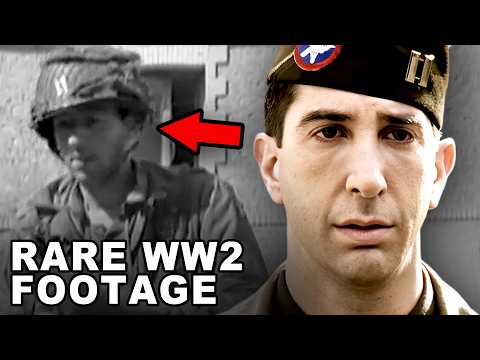
Deep within the National Archives, a single clip survives—a ghost from June 1944, showing Captain Herbert Sobel in the liberated town of Carentan, France. He’s not leading a charge or shouting orders. Instead, he’s standing calmly, map in hand, deep in conversation with General Maxwell Taylor, the commander of the 101st Airborne Division.
This is the Sobel you never knew: the commander of the 506th Parachute Infantry Regiment’s Service Company, the man responsible for keeping the front lines supplied with food, ammunition, and medical aid. “He had an important job,” the narrator explains, “and General Taylor wanted to make sure the regiment was being resupplied.”
The footage is grainy, the uniforms dusty, but the significance is undeniable. Sobel had jumped into Normandy on D-Day, not with Easy Company, but with the Service Company. After landing, he gathered four lost paratroopers and used grenades to take out a German machine gun nest—an action that earned him a Combat Infantry Badge.
“This video provides proof that not only was he in Normandy, he was in direct communication with General Taylor,” the narrator notes. And yet, in the series, Sobel is portrayed as a failure, a man whose rigidity nearly cost his men their lives.
But the real Sobel was more complex. Many of the same soldiers who resented his discipline later credited his toughness for their survival. “What this series did to Sobel was not right,” one veteran remarked after the premiere.
As the camera pans across the shattered buildings of Carentan, you can’t help but wonder: what was he thinking in that moment? The Germans were planning a counterattack; the Battle of Bloody Gulch loomed. Sobel stood at the crossroads of history, a man history would later misremember.
This is just the beginning of his story—and the truth is far more haunting than fiction.
What the footage doesn’t show is what came next. The date on the clip—if it is indeed June 12th—places Sobel in Carentan on the eve of one of the most vicious fights the 101st Airborne would face in Normandy.
The following morning, the 17th SS Panzer Grenadier Division launched its counterattack, hoping to split the Allied beachheads. They were met a mile southwest of town in the fields near Bloody Gulch, where Easy Company and the rest of the 506th dug in behind hedgerows.
The Germans came on with armor and infantry, and for a time it looked like Carentan might fall. But tanks from the US 2nd Armored Division rumbled in, shattering the assault. The link between Utah and Omaha was secured for good.
And where was Herbert Sobel during all of this? Not in the thick of the fighting—that wasn’t his job anymore. He was doing what he’d been reassigned to do: making sure the men at the front had bullets, bandages, and fuel. It was unglamorous work, the kind that never makes it into the miniseries.
There’s also a photograph from that same period, less famous than the film clip but just as telling. Sobel sits under a canopy at a camp near Carentan, surrounded by the mundane machinery of war—crates, vehicles, the quiet chaos of a supply depot.
No dramatic music. No villain’s sneer. Just a captain doing his duty.
It’s a strange thing to look at these images now, knowing what came later. The war would end. The men would go home. And Herbert Sobel would fade into a story that wasn’t quite his own.
But the footage remains—a flicker of truth against the fiction. And once you’ve seen it, the series will never look quite the same.
The veterans who knew him best didn’t need archives to remember. In the years after the war, when Band of Brothers premiered and the world met David Schwimmer’s sneering caricature, some of Sobel’s former soldiers spoke up with a quiet fury. “He was tough, but he trained us to survive,” one of them said. Another put it more bluntly: “Sobel got us ready. Winters got us home. Both matter.”
That distinction is precisely what the miniseries blurred. Sobel’s rigidity, his obsession with inspections and discipline, became the butt of a joke rather than the foundation of a fighting unit. The men who mocked him in 1944 later understood what he’d given them—a hardness they didn’t know they’d need until the bullets started flying.
And the footage from Carentan captures something the show never allowed him: competence. There he stands, map spread, conferring with the division commander, a man trusted with the logistical lifeline of an entire regiment. Not a punchline. A professional.
But history has a way of exacting its own kind of cruelty. The same man who kept the 506th supplied through Normandy would later struggle to keep his own life together. The war ended, the uniforms came off, and Herbert Sobel discovered that the battlefield had been the easy part.
His story after 1945 is one the miniseries never touched—the failed businesses, the fractured family, the slow unraveling. When he died in 1987, it was by his own hand, a final act that casts a long shadow back over every frame of that old footage.
Watching him now, young and sharp in the ruins of Carentan, you feel the weight of what he couldn’t know. The German counterattack would come and go. The war would end. The series would make him a villain. And the truth would wait decades to surface.
There’s one more detail in the clip worth noticing. As General Taylor speaks, Sobel listens—really listens—his posture attentive, his expression unreadable. It’s the face of a man who understands that the next twenty-four hours will decide whether the men at the front eat or starve, advance or stall.
No one is watching him for heroism in that moment. They’re watching him for answers.
And he gives them. The supplies move. The line holds. The war grinds on.
That is the part the legend leaves out. Not the shouting on the parade ground, not the mutiny, not the punchline of a miniseries joke—but a captain with a map, standing in a shattered town, doing the unglamorous arithmetic that keeps an army alive. “Sobel got us ready,” a veteran said, and in Carentan you can finally see what that meant.
The footage is only seconds long. A jump cut betrays the longer conversation Taylor and Sobel shared, two men bent over a map while the future of the beachhead hung in the balance. The next morning the German armor would come, and the men of Easy would hold the line at Bloody Gulch. Sobel wouldn’t be beside them in the hedgerows—he’d be behind them, moving crates and fuel and bandages, keeping the machine fed.
History remembers the men who charged. It forgets the men who made the charge possible.
And that is the quiet tragedy of Herbert Sobel. He trained them, hardened them, and then watched them march into legend without him. The war ended, and the man who had once commanded Easy Company struggled to command anything at all—his businesses, his family, his own mind. When he died in 1987, the world had already rewritten him as a villain.
But the film survives. Grainy, silent, undeniable. A young captain in the ruins of Carentan, listening to his general, holding the line in the only way left to him.
So the next time you watch Band of Brothers and see David Schwimmer’s sneer, remember the flicker of truth from the National Archives. The real Sobel was never a cartoon. He was a soldier.
Now the question is yours: if history misremembered a man this badly, how many other stories are still waiting in the archives for someone to press play?
Report this article
Select a reason for reporting:






