The sky over Europe was a deadly chessboard, and two American fighters were about to make their move. The P-51 Mustang and the P-47 Thunderbolt—both legends, both lethal, but only one could claim the crown. As the roar of their engines echoed across the clouds, pilots faced a choice that could mean life or death. The Mustang, sleek and swift, promised agility and deadly precision. The Thunderbolt, a flying fortress, offered unmatched toughness and firepower. Which one would you trust with your life?
In the brutal aerial battles of World War II, these two titans clashed not just with the enemy, but with each other for supremacy. Their designs were as different as their missions, yet they shared a common goal: to dominate the skies. But as the war raged on, one question lingered—which fighter truly ruled the European theater?
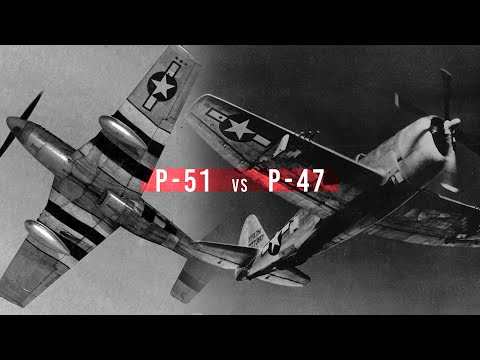
The Mustang, with its Rolls-Royce Merlin engine, was a marvel of speed and maneuverability. It could dance through the air, outturn its foes, and strike with deadly accuracy. The Thunderbolt, powered by the rugged Pratt & Whitney R-2800, was a beast of a different kind. It could take a beating and keep flying, shrugging off damage that would send other planes spiraling to the ground.
“The Mustang was a pilot’s dream,” many aces would say. “But the Thunderbolt brought you home.” That dichotomy defined their legacy. The Mustang racked up an impressive kill ratio, claiming between 4,200 and 4,950 victories—a record unmatched by any other American fighter in Europe. The Thunderbolt, with 2,600 to 3,700 kills, was no slouch either, but it lagged behind in the scorecard.
Yet numbers never tell the whole story. The Mustang’s edge in maneuverability made it a natural predator in dogfights, especially against nimble German fighters like the Bf 109. Its speed at low altitudes gave it a critical advantage when battles descended into the weeds. But the Thunderbolt’s ruggedness was legendary. Its air-cooled radial engine could survive hits that would doom the Mustang’s liquid-cooled Merlin, which was prone to coolant leaks and overheating.
When it came to range, the Mustang was the undisputed king. It could escort bombers deep into enemy territory, a role that turned the tide of the air war. The Thunderbolt, while capable, couldn’t match the Mustang’s endurance without external tanks. But with those tanks, it could reach out and touch the enemy too, albeit with less grace.
Armament was another story. The Thunderbolt packed eight .50-caliber machine guns and double the ammunition of the Mustang’s six. That meant more lead in the air, more chances to bring down a foe. For ground attack, the Thunderbolt was a beast, carrying up to 2,500 pounds of bombs. The Mustang, lighter and faster, was less suited for that role but excelled as a pure fighter.
As the war progressed, the Mustang became the primary long-range escort, while the Thunderbolt took on other missions. Pilots who flew both often favored the Mustang for its agility and speed. But those who valued survival above all else swore by the Thunderbolt’s toughness.
The debate raged on, even after the war. In Korea, the Mustang struggled in close air support, vulnerable to ground fire. Many argued the Thunderbolt would have been better suited, but it never saw combat there. The Skyraider took that role instead, leaving the Thunderbolt’s legacy frozen in WWII.
So which was better? The Mustang’s kill ratio and versatility make a strong case. But the Thunderbolt’s durability and firepower are not to be dismissed. In the end, it might come down to the mission—and the pilot. But one thing is certain: both were extraordinary machines that helped win the war.
But the story doesn’t end with statistics and specifications. To truly understand which fighter was superior, we must look at the men who flew them and the missions they flew. The Mustang’s rise to dominance was not immediate. When it first entered service with the RAF in 1942, its performance was mediocre at best. The Allison engine limited its high-altitude capabilities, making it unsuitable for the demanding air war over Europe. It wasn’t until the marriage with the Merlin engine that the Mustang became the legend we know today.
The Thunderbolt, on the other hand, was a brute from the start. Its massive R-2800 engine gave it power at altitude, and its rugged construction made it a survivor. But it was heavy, and heavy meant sluggish in a turning fight. “You didn’t dogfight in a Jug,” veteran pilots would recall. “You hit and ran, using your speed and firepower to overwhelm the enemy.” That was the Thunderbolt’s doctrine—energy fighting, boom and zoom, never staying in one place too long.
The Mustang, by contrast, could mix it up. Its laminar flow wing and lighter frame gave it a turning radius that could compete with the best German fighters. “In a Mustang, you could dance with a Bf 109 and come out on top,” one ace remembered. “In a Thunderbolt, you had to be smart, use your advantages, and never let them get behind you.”
This difference in philosophy extended to their roles. The Mustang became the bomber escort par excellence, its range allowing it to follow B-17s and B-24s all the way to Berlin and back. The Thunderbolt, with its shorter legs, was often relegated to shorter escort missions or ground attack. But when the Mustang took over the long-range escort role, the Thunderbolt found its niche in close air support—a role it excelled at thanks to its heavy armament and ability to absorb punishment.
Yet the Thunderbolt’s contribution to the air war cannot be overstated. It was the backbone of the USAAF’s fighter force in the early years, holding the line while the Mustang matured. Its ruggedness saved countless pilots who would have perished in a more fragile aircraft. And its firepower was devastating—eight .50-caliber guns could shred an enemy fighter in seconds.
The Mustang, for its part, was the war winner. Its introduction in large numbers in 1944 turned the tide of the air war over Germany. Its kill ratio—often cited as 10:1 or better—speaks to its effectiveness. But that ratio was also a product of the changing nature of the war. By the time the Mustang dominated the skies, many of Germany’s best pilots were gone, and the Luftwaffe was a shadow of its former self.
So which was better? The answer depends on what you value. If you value speed, agility, and the ability to rack up kills, the Mustang wins. If you value survivability, firepower, and the ability to bring your pilot home, the Thunderbolt is the clear choice.
But there’s another dimension to this comparison that often gets overlooked: the men who maintained these machines. The Mustang’s Merlin engine was a精密 piece of engineering, requiring careful tuning and constant attention. Its liquid-cooling system was vulnerable, and the Packard-built V-1650 demanded skilled hands to keep it running at peak performance. The Thunderbolt’s R-2800, by contrast, was a workhorse—rugged, reliable, and forgiving of rough handling in the field.
“You could patch up a Jug with a hammer and some wire and send it back up,” one crew chief recalled. “The Mustang needed a surgeon. The Thunderbolt just needed a mechanic.” That difference mattered enormously when squadrons operated from forward airfields in France after D-Day, where conditions were primitive and spare parts scarce.
Then there was the matter of training. The Mustang was unforgiving of novice mistakes. Its narrow landing gear and sensitive controls led to a high accident rate among inexperienced pilots. The Thunderbolt, with its wide-tracked gear and stable handling, was far more forgiving. “You could teach a farm boy to fly a Jug in a few weeks,” a flight instructor noted. “The Mustang took longer—and it killed more trainees who weren’t ready.”
This brings us to a critical point about the kill ratios themselves. The Mustang’s impressive 10:1 ratio was achieved largely by experienced pilots flying in 1944 and 1945, when German pilot quality had collapsed. The Thunderbolt’s 4.6:1 ratio was earned in the brutal years of 1943 and early 1944, when the Luftwaffe still fielded its best. In other words, the Thunderbolt fought the German air force at its strongest—and still held its own.
Consider the missions. In 1943, Thunderbolt pilots were escorting bombers deep into Germany with no drop tanks, fighting against Fw 190s and Bf 109s flown by veterans of Spain, France, and the Eastern Front. They took heavy losses, but they also inflicted them. By the time the Mustang arrived in force, the Luftwaffe was a broken force, its best pilots dead or exhausted, its fuel supplies dwindling.
This isn’t to diminish the Mustang’s achievements. It was a superb fighter, and its contribution to victory was immense. But context matters. The Thunderbolt was the right plane at the right time—a sturdy, heavily armed escort that could take punishment and dish it out when the odds were against it.
There’s also the question of versatility. The Thunderbolt proved itself as a fighter, a bomber escort, and a ground-attack platform. In the Mediterranean theater, it was the primary close air support aircraft for the Allied armies, destroying tanks, bridges, and supply columns with devastating effect. Its ability to carry bombs and rockets made it a precursor to the modern multirole fighter.
The Mustang, while capable of ground attack, was never as effective in that role. Its liquid-cooled engine was too vulnerable to ground fire, and its lighter construction meant it couldn’t absorb the punishment. “We used Mustangs for ground attack when we had to,” one pilot admitted. “But we didn’t like it. One hit in the radiator and you were done.”
So the debate continues. The Mustang was the better pure fighter—faster, more agile, and more deadly in the hands of an expert. The Thunderbolt was the better war machine—tougher, more versatile, and more forgiving of both pilots and mechanics. Which one was ‘better’ depends entirely on what you asked it to do.
But perhaps the final word belongs to the pilots who flew both. When asked which fighter they’d choose for a mission over Berlin in 1944, many veterans paused. “If I wanted to come home,” one said, “I’d take the Jug. If I wanted to kill Germans, I’d take the Mustang.” That simple truth captures the essence of both aircraft.
The Mustang was the scalpel—precise, fast, and deadly in the right hands. The Thunderbolt was the sledgehammer—blunt, powerful, and nearly impossible to break. Both won the war, just in different ways.
In the end, the P-51 Mustang edges out as the better overall fighter of WWII Europe. Its kill ratio, range, and agility made it the weapon that broke the Luftwaffe’s back. But the P-47 Thunderbolt remains the unsung hero—the plane that held the line when the odds were longest, and brought its pilots home against all reason.
So, which would you fly into the jaws of the Reich—the graceful Mustang or the indestructible Thunderbolt? Let us know in the comments below.
Report this article
Select a reason for reporting:






