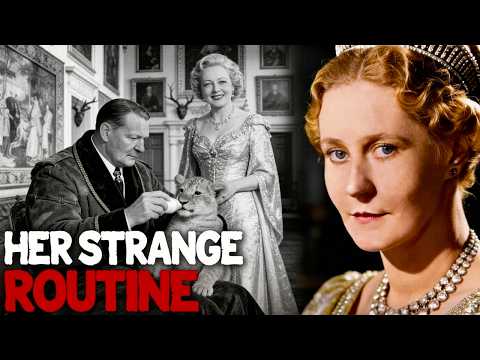
She woke each morning in a palace built on stolen lives. Servants called her “Ho Dame”—High Lady—as she walked past paintings looted from Jewish collections, their rightful owners already deported or dead. Lion cubs padded across marble floors. A model railway the size of a tennis court waited in the next room. And outside, in the real world, the trains running east carried people to places from which they would never return.
This was the daily reality of Emmy Göring, the woman who served as the public face of the Nazi regime while Eva Braun stayed hidden in the shadows. But how did a middling provincial actress with no major roles to her name end up presiding over state dinners, hosting Mussolini, and presenting a criminal government as cultured and civilized?
The answer lies in the greatest performance of her life—one she never stopped giving, even after the curtain fell on everything she had helped make glitter.
Emmy Sonnemann was born in Hamburg in 1893, the daughter of a wealthy chocolate manufacturer. Her upbringing was comfortable, predictable—the kind that makes everything that followed feel like a casting error. She trained as an actress and spent two decades in provincial theaters across Germany, never landing a breakthrough role. By her late thirties, she had settled into a life of competent but unremarkable performances, polite applause from small audiences, and no trajectory toward anything larger.
Then, in 1932, she met Hermann Göring at a social gathering in Weimar. She wasn’t a naive young woman swept off her feet. She was a 39-year-old professional performer who had spent her entire adult life reading rooms and studying audiences. She recognized the audition of a lifetime—and she took the part without hesitation.
On April 10, 1935, Emmy and Hermann married in the Berlin Cathedral. Adolf Hitler stood as witness. Tens of thousands of uniformed Nazi formations lined the streets while military aircraft roared overhead. The ceremony was broadcast nationwide, carried into living rooms across Germany as though it were a state occasion—because that’s exactly what it was. This wasn’t a wedding. It was a propaganda deployment designed to present the Nazi leadership as cultured, legitimate, and worthy of admiration.
Emmy’s farewell performance at the Prussian State Theater came that same year. Göring had already named her a Prussian State Actress in 1934, a title that carried both prestige and a generous pension. She told the press she was retiring from the stage, but that wasn’t quite true. She hadn’t stopped acting—she’d simply moved to a much bigger stage with a far larger audience and stakes that went well beyond a curtain call.
Every day from that point forward, her role was the same: to make the Third Reich look civilized.
The setting for this performance was Carinhall, Hermann’s sprawling hunting estate in the Schorfheide Forest north of Berlin, named after his first wife, Carin, who had died in 1931. The estate was enormous and deliberately theatrical—massive halls filled with antlers and hunting trophies, rooms decorated with old masters stolen from Jewish collections across occupied Europe. Paintings that had once hung in private homes now served as background decor for dinner parties.
Hermann had installed a gigantic model railway that he and guests played with for hours, crouching over miniature landscapes like children while the real world outside burned. He dressed in velvet and fur outfits that shifted between medieval fantasy and operatic costume—robes, embroidered jackets, jeweled daggers tucked into silk sashes.
And then there was the private zoo. Lion cubs padded through the terraces and salons like household pets, sprawling across furniture and nudging guests for attention. When Benito Mussolini visited Carinhall, Emmy and Hermann presented a lion cub as casually as another couple might offer a cocktail. One contemporary observer noted the zoo required enough meat to feed an entire village—all while wartime rationing squeezed ordinary German families into ever-tighter portions.
But Carinhall was only one piece of the fantasy. The couple rotated between Göring’s Berlin residences, a luxury yacht called Carin the Second, and a thatched holiday house on the fashionable island of Sylt. Emmy moved between these settings like an actress between stage sets, always dressed for the part, always ready for the next audience.
None of this was personal eccentricity. It was regime-funded spectacle built on systematic theft, and Emmy was its lead performer every single day. She woke each morning inside a world assembled from the possessions of people who had been robbed, deported, or worse. And her job was to make it all look elegant.
Emmy didn’t just live in this world—she curated it into a quasi-royal persona. Staff were required to address her as Ho Dame. She was chauffeured between residences in motorcades. She dressed for every reception as though it were a coronation. And she treated the role with the discipline of a performer who had finally landed the part she’d always wanted.
But her daily routine had a dimension most people won’t expect. Starting in 1936, Emmy chaired the Emmy Göring Künstlerstiftung, a foundation that oversaw a retirement home for aging theater artists in Weimar. This meant daily correspondence, administrative decisions, and filtering petitions from artists across Germany hoping for financial support or professional patronage. She reviewed these requests and submitted them to her husband in his capacity as the regime’s overlord of theater and opera. Hermann controlled Prussia’s state theaters, and Emmy served as his gatekeeper.
This wasn’t a vanity title on fancy letterhead. It was a lever of real cultural influence, and she pulled it every single day. She decided who received help and who was ignored—a quiet but meaningful kind of power.
And there was a deeper structural reason why her daily routine mattered so much to the regime. Eva Braun was Hitler’s companion, but the German public had no idea she existed. Hitler kept Eva hidden because he believed his bachelor image was politically useful—the idea that he was married to Germany itself, devoted entirely to the nation. But someone had to fill the void at public events, and Emmy stepped into it naturally.
She appeared at receptions, theater premieres, charity galas, and state ceremonies as the regime’s public feminine face. Foreign dignitaries visiting Berlin encountered Emmy, not Eva. Press photographs featured Emmy, not Eva. She was, in every functional sense, the first lady of the Third Reich. And she embraced the role completely.
This is what made her routine so valuable to the regime. Every gracious handshake with a foreign ambassador, every glamorous photograph in the newspapers, every warm smile at a state reception helped present Nazi leadership as sophisticated, cultured, and normal. She turned mass theft into background decor and made a criminal government look civilized.
That wasn’t an accident. That was the performance she delivered every single day.
But behind the glamour, there were teeth—and they were sharp.
Shortly after the 1935 wedding, an opera singer named Helene von Weinmann made an offhand remark to acquaintances. She’d known Emmy back in the provincial theater days, back when Emmy was available for a cup of coffee and two shilling 50. It was a casual, almost affectionate jab. But in Nazi Germany, casual remarks about the powerful had consequences.
That single sentence cost Weinmann everything. She was denounced, arrested, and beaten during interrogation. A court sentenced her to three years in a penitentiary. She wasn’t released until 1943, gravely ill from years of imprisonment. Whether Emmy personally pushed for the prosecution remains unclear—but the woman who chaired a foundation dedicated to helping theater artists did nothing to protect a fellow artist destroyed for telling the truth about her past. That silence reveals the iron underneath the velvet.
Emmy’s claim to the first lady title also put her on a collision course with Magda Goebbels and Eva Braun. She treated Eva with naked condescension, refusing to acknowledge her status as Hitler’s companion. But Emmy had miscalculated badly. Hitler personally intervened, ordering Hermann to make his wife treat Eva with respect. When Emmy’s behavior didn’t change, she was frozen out of invitations to the Berghof—the inner social court where real influence was brokered. The woman who had built her entire public identity as the regime’s leading lady was quietly expelled from the only stage that actually mattered.
As the war turned against Germany, the fantasy kingdom disintegrated. Carinhall was evacuated in early 1945, the looted art packed onto trains and scattered across hiding places. The estate itself was blown up to keep it from the advancing Soviets. Emmy fled south with her daughter Edda. American forces arrested them in May 1945.
Even in custody, she couldn’t let go of the role. Camp staff reported quarrels because Emmy kept putting up a photograph of Hermann in her quarters and demanding it stay. She was mostly bedridden with sciatica, insisting on medical treatment befitting her former status, telling anyone who would listen that she was being persecuted simply for being married to a prominent man.
Her husband was convicted of war crimes at Nuremberg and swallowed a cyanide capsule hours before his scheduled execution. And yet, the performance continued without interruption.
In 1948, a denazification court classified Emmy as an active National Socialist. The tribunal confiscated 30% of her remaining assets and banned her from the stage for five years—effectively ending any hope of returning to acting. She retreated to a small fifth-floor apartment in Munich, nursing chronic pain, surviving on a modest pension supplemented by old acquaintances who remembered the family’s former glory. The woman who had once been addressed as High Lady now shared a hallway with strangers and climbed five flights of stairs to reach a home that could have fit inside one of Carinhall’s guest rooms.
In 1967, she published a memoir called An der Seite meines Mannes—My Life with Göring. The book portrays both Emmy and Hermann as essentially apolitical aesthetes who loved art, culture, and each other. It makes no mention of Göring’s role in founding the Gestapo. It omits his central involvement in the persecution of Jews and the plunder of an entire continent. Her own words captured the delusion with painful clarity. She wrote that high politics had not occupied her much, as with most women, and that she was merely an actress who served an apolitical stage art. A German court had already ruled otherwise—classifying her not as a passive follower, but as an active participant in the regime she now claimed had nothing to do with her.
Emmy Göring died in Munich on June 8, 1973, at the age of 80. Her daughter Edda would spend the rest of her own life defending her father’s memory, petitioning courts for confiscated property, attending gatherings of former Nazi officials, and refusing until her death in 2018 to acknowledge what her parents had been part of. The performance, it seemed, was inherited.
So what did Emmy Göring actually do all day? She woke in a palace decorated with stolen art. She was addressed as High Lady by servants. She played with lion cubs in rooms where looted masterpieces hung on the walls. She hosted foreign dignitaries who left thinking the Nazi regime was sophisticated and refined. She ran a cultural foundation while a fellow artist who mocked her rotted in prison. She feuded with Eva Braun until Hitler himself had to intervene. And when it all collapsed, she spent nearly three decades insisting none of it was political.
Emmy Göring’s daily routine wasn’t harmless. It was the regime’s most convincing argument that everything was normal—delivered by a trained actress who never once broke character, not even after the curtain came down.
But here’s the question that lingers: when a performer spends decades perfecting a role that makes evil look elegant, at what point does the performance stop being a performance—and become the truth of who they are? Was Emmy Göring a woman trapped in a part she couldn’t escape, or did she simply refuse to ever read the final script? Let us know your thoughts in the comments below.
Report this article
Select a reason for reporting:






