November 15th, 1943. Aberdeen Proving Ground, Maryland. A cold, gray morning filled with the smell of diesel and wet metal. American mechanics pulled off a dusty tarp, expecting a powerful German machine. But what they found made them laugh.
Underneath sat a tiny, box-shaped car with an engine smaller than a lawn mower. The Kübelwagen—Germany’s Jeep. They checked the numbers twice. 25 horsepower, barely half of what the American Jeep had. “How could this thing survive a war?” one soldier joked. But by the end of the day, no one was laughing.
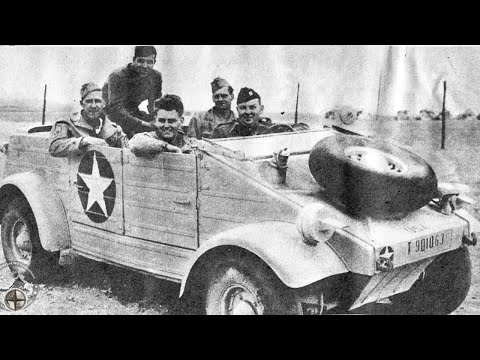
The tests that followed would reveal something shocking—that the German ‘toy car’ hid secrets no one expected, and lessons the US Army never forgot. So stay with us, because what began as a joke turned into one of World War II’s strangest truths.
If you love real history told with raw detail, don’t forget to like this video, subscribe, and watch till the end. This story will change how you see the war machines of WWII.
The captured German Kübelwagen arrived at Aberdeen Proving Ground on a cold November morning in 1943. Frost covered the grass, and soldiers’ boots crunched over the frozen ground. A small group of American mechanics stood waiting beside a wide concrete ramp, their breath forming white clouds in the air. They had been told that this strange little car was one of the most reliable machines used by the German army—a symbol of their famous engineering skill.
When the tarp was pulled off, silence followed. The vehicle looked simple, almost toylike. Its thin metal panels rattled when the wind blew. The front hood lifted easily, revealing a small, flat engine no bigger than a kitchen stove.
“You got to be kidding me,” muttered Sergeant Mike Kowalski, a Detroit mechanic who used to build engines that made three times this power. He read the tag again. “25 horsepower.”
The men laughed—a low, tired laugh that came from disbelief, not joy. Next to their sturdy Willys Jeep, this thing looked weak. It weighed about 1,700 pounds, almost 700 less than the Jeep, yet still seemed fragile. Major Sterling, the officer in charge, simply said, “We’ll see what the numbers say.” In the army, feelings didn’t matter. Data did.
The Kübelwagen’s engine was air-cooled, meaning it had no water radiator or coolant system. That seemed strange to the men who were used to liquid-cooled American engines. Air-cooled motors were lighter and simpler, but also risked overheating. The soldiers made notes. Four cylinders, 985 cubic centimeters, top speed maybe 50 mph if lucky. Not impressive.
Kowalski leaned closer, listening to the faint ticking sound as the metal warmed in the sun. He could smell the sharp scent of old fuel and oil trapped from the battlefield. “Looks like something you’d use to deliver mail, not fight a war,” he joked. And the others nodded.
But Major Sterling didn’t laugh. “It’s lasted three years on every front Germany fights,” he said quietly. “There’s something here we don’t see yet.”
They rolled the Kübelwagen into the test shed, the dyno room. Inside, the air was thick with oil fumes and the hum of machines. The team attached wires, gauges, and belts to measure power, speed, and torque. Corporal Chen, the youngest of the group, wrote down every number carefully in a small notebook. This was how truth was measured—not by pride, but by data.
When the engine finally started, the sound was unexpected—soft, even gentle. No roar, no deep growl, just a smooth humming like a sewing machine. The men exchanged looks. For something so small, it ran clean and steady. No leaks, no smoke, no shaking.
“Huh,” said Kowalski, half smiling. “She may be ugly, but she’s polite.”
As the test began, the dyno spun up, measuring every ounce of the engine’s strength. The numbers on the gauge confirmed it. 25.3 horsepower at 3,300 RPM. The Jeep made more than double that. But the little German car didn’t strain or cough. It just kept going. The paradox grew stronger. Weaker on paper, but calm and steady in action.
Outside, the sun began to melt the frost, turning puddles into mirrors. The smell of hot oil filled the air. Kowalski wiped his hands on a rag and stared at the tiny car sitting quietly on the rollers. For the first time, he wasn’t laughing.
“Numbers don’t lie,” he said softly. “But sometimes they don’t tell the whole story either.”
They didn’t know it yet, but this little test would lead to something much bigger—a discovery about how wars are won, not just by strength, but by smart design, good training, and the people who keep machines running when they shouldn’t. And this was only the beginning.
Inside the dyno room, the air buzzed with noise and the smell of burning oil. Gauges flickered, belts turned, and the little German Kübelwagen engine hummed steadily on the test stand. Sergeant Mike Kowalski stood with his arms crossed, watching the pointer on the dial move. The reading was clear: 25.3 horsepower at 3,300 RPM.
“25,” he repeated slowly, shaking his head. “That’s less than some lawnmowers back home.” The other mechanics laughed, but Major Sterling didn’t smile. “Let’s finish the test,” he said. “Numbers matter more than jokes.”
Next to the Kübelwagen, a Willys Jeep engine was already waiting for comparison. The Jeep’s motor produced around 60 horsepower—more than double the German vehicle. When the Jeep’s turn came, it roared loudly, shaking the floor. The difference in sound alone felt like a fight between a whisper and a shout.
Still, as the tests continued, something interesting began to show. The German engine stayed cool and smooth even after running for half an hour. Its temperature held steady around 180°F, while the Jeep’s water-cooled motor often climbed higher. The Kübelwagen didn’t use any coolant at all—just air. Simple, fewer parts, fewer leaks.
Private Patterson, a quiet man who loved precision, leaned close to the clipboard. “Fuel burn is lower,” he said. “Half a gallon less per hour than the Jeep.” The men exchanged looks. Half a gallon per hour meant a lot when fighting across long battlefields.
They recorded more numbers. 0 to 30 mph: 26 seconds. Top speed: 50 mph on flat ground. Jeep 0 to 30: 11 seconds. The gap was huge. The Jeep was fast, powerful, and built for climbing and pulling. The Kübelwagen was light and slow—almost lazy.
When the dyno test ended, they rolled the car outside again. Steam rose gently from the exhaust pipe. The sound faded into the cold air, soft as a sigh. Kowalski touched the warm metal with his bare hand. “It’s weird,” he said. “It shouldn’t work this well, not with so little.”
Major Sterling looked down at his notes. “Maybe that’s the point,” he said. “It’s built for enough, not for more.”
They began the next part of testing: the acceleration run. A long, straight track stretched across the proving ground, flat and empty. The Kübelwagen rolled to the start line, its small tires crunching over gravel. The wind was sharp and cold, carrying the smell of gasoline.
“All right, Mike,” Sterling said. “Take her up to 30.” Kowalski nodded and climbed in. The seat felt stiff, the steering wheel thin and rough. He pressed the starter. The engine hummed instantly. He pushed the pedal down. The little car began to crawl forward, slowly, gaining speed. The seconds ticked. 10… 15… 20… 26. The needle finally touched 30 mph.
When he stepped out, he was half amused, half impressed. “Feels like it’s giving all it has,” he said. “But she doesn’t quit.” The Jeep did the same run later. It hit 30 in 11 seconds flat, throwing up dust behind it. The difference was obvious, but the Kübelwagen had one quiet advantage. It never stalled, never overheated, and ran smooth every single time.
Back in the workshop, Corporal Chen summarized the results in his report. “The Kübelwagen lacks power compared to the Jeep, but shows remarkable fuel efficiency, cool operation, and mechanical steadiness.” Major Sterling underlined one sentence: “Reliability over raw power.” That would become the phrase they used again and again in their notes.
As the sun set over Aberdeen, the men packed up their tools. The orange light made the little German car glow faintly. It still looked weak, but the numbers suggested something different. Kowalski wiped his hands and said quietly, “Maybe ugly things can still do their job right.” But the real challenge was still waiting: hills, mud, and time. That’s where true strength would show itself.
Report this article
Select a reason for reporting:






