The summer of 1936 was supposed to be a celebration of global unity, but behind the grandeur of the Berlin Olympics lurked a sinister truth. Adolf Hitler’s Nazi regime had meticulously choreographed a façade of tolerance, temporarily shelving its brutal racist policies to deceive the world. Foreign spectators and journalists marveled at the spectacle, unaware that they were being played. This was not just a sporting event—it was a propaganda masterstroke that would have devastating consequences.
As the world watched, the opportunity to stand against tyranny slipped away. The athletic organizations of the United States and other Western democracies had a chance to boycott the games, a move that some believed could have weakened Hitler and bolstered international resistance. But they hesitated, and the moment passed. What followed was a tragedy of epic proportions.
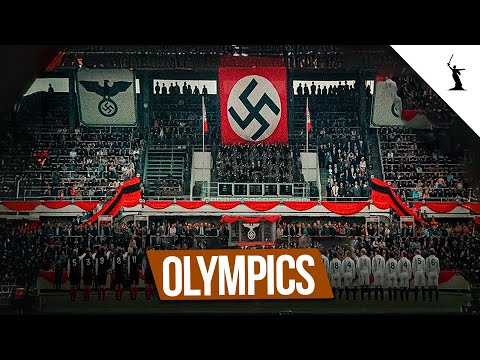
In 1931, the International Olympic Committee awarded Berlin the 1936 Summer Olympics, signaling Germany’s return to the global stage after its post-World War I isolation. But just two years later, everything changed. Adolf Hitler rose to power, transforming a fragile democracy into a ruthless one-party dictatorship. The Nazi regime quickly began persecuting Jews, Roma, and political opponents, while also seizing control of sports to promote the myth of Aryan racial superiority.
“The Nazis idealized the physical strength of athletes, emphasizing so-called Aryan features as part of their twisted vision of fitness for military service,” one historian noted. The regime’s manipulation of sports was not just about winning medals—it was about embedding their ideology into every aspect of life.
Despite the growing threat, preparations for the Olympics continued. In April 1933, an Aryan-only policy was enforced across all German sports organizations, systematically excluding Jews and Roma. World-class athletes like high jumper Gretel Bergmann were expelled from their clubs and barred from the German Olympic team. Jewish athletes who were removed from German sports clubs formed separate associations, such as Makabi and Shield, using improvised facilities that paled in comparison to the well-funded Nazi sports machine.
“Even symbolic gestures, like allowing fencer Helene Mayer—whose father was Jewish—to compete, were calculated moves to appease international opinion,” the transcript reveals. Mayer won a silver medal and performed the Nazi salute on the podium, a chilling image that underscored the regime’s control.
As the games approached, the Nazi regime intensified its efforts to deceive the world. Anti-Semitic posters were removed, and newspapers softened their rhetoric under the direction of Joseph Goebbels’ propaganda ministry. “The regime exploited the Olympics to present a false image of a peaceful and tolerant Germany,” the transcript states. Berlin was adorned with Olympic flags and swastikas, creating a festive atmosphere that masked the darkness beneath.
But the truth was far from idyllic. Just weeks before the games, on July 16, 1936, about 800 Roma were arrested and held in a special camp in Marzahn on the outskirts of Berlin. The Nazi authorities also ensured that foreign visitors were not subject to the laws criminalizing homosexual relations, further hiding the regime’s brutal reality.
The opening ceremony on August 1, 1936, was a grand spectacle. Adolf Hitler presided over the event, announced by a musical fanfare led by composer Richard Strauss. Hundreds of athletes marched into the stadium, and a lone runner brought the Olympic torch from Olympia, Greece, introducing a new ritual. A total of 49 nations competed, the largest number in any Olympics up to that point. Germany fielded the largest team with 348 athletes, followed by the United States with 312 members, including 18 African Americans.
“The American delegation was led by Avery Brundage, president of the American Olympic Committee, whose controversial stance would later come under scrutiny,” the transcript notes. The Soviet Union chose not to participate, a decision that echoed until the Helsinki Games in 1952.
Nazi Germany promoted the Olympics with skillful propaganda, using colorful posters and magazine covers that linked Germany to ancient Greece. “The emphasis on athletic images reinforced the Nazi racial myth that superior German civilization was the rightful heir of a classical Aryan culture,” the transcript explains. The regime’s propaganda continued even after the games with the release of Leni Riefenstahl’s controversial documentary Olympia in 1938.
But the glory of the games was overshadowed by the fierce debate over a boycott. As the transcript details, politicians, civil rights groups, and newspapers in the United States cited the persecution of Jews as a reason to skip the Berlin Olympics. “The central argument was that the Olympics could not be separated from political reality and that the international community had a moral duty to denounce and condemn the atrocities committed in Nazi Germany,” the transcript states.
However, opponents of the boycott argued that sports should remain neutral and that denying athletes the opportunity to compete would be unfair. The debate reached its peak in December 1935 with a decisive vote by the Amateur Athletic Union (AAU) of the United States. “The vote nearly led to a boycott, but in the end, the majority voted in favor of participating,” the transcript reveals. This decision sealed the fate of the American Olympic team and, some argue, emboldened Hitler.
The role of Avery Brundage, who made anti-Semitic comments and labeled the anti-Olympic campaign as a Jewish-communist conspiracy, was critical. “Brundage’s stance led to accusations that he was acting as a Nazi puppet,” the transcript notes. His visit to Germany in 1934, where he received VIP treatment, convinced him that Jewish athletes were being treated fairly—a conclusion that couldn’t have been further from the truth.
As the boycott battle unfolded, international public opinion was also affected. Short-lived boycott appeals emerged in countries such as Britain, Canada, France, Sweden, Czechoslovakia, and the Netherlands. But ultimately, these countries followed the AAU’s decision and participated in the Berlin Games. “The 1936 Olympics took place with the participation of 49 nations, and no nation ended up boycotting the event,” the transcript states.
The games themselves were a propaganda victory for Hitler. German athletes won the most medals, and visitors praised the organization and hospitality. “Most newspaper reports suggested that the games had reintegrated Germany into the international scene and even humanized the Germans again,” the transcript says. But few realized, as American journalist William Shirer did, that the shine of Berlin concealed a racist and oppressive regime.
Soon after the games, the persecution resumed. Two days after the Olympics ended, Captain Wolfgang Fürstner, head of the Olympic Village, committed suicide after being dismissed from military service due to his Jewish ancestry. On September 1, 1939, Germany invaded Poland, triggering World War II—just three years after the Olympics.
The story of the 1936 Olympics is a stark reminder of how the world can be deceived by spectacle and how the failure to act can have catastrophic consequences. As the transcript concludes, the debate over boycotting the Olympics is not just about sports—it’s about human rights, international politics, and the moral duty to stand against tyranny.
Yet the question of whether a boycott could truly have altered the course of history remains fiercely debated. Some historians argue that the AAU’s decision in December 1935 was the last real opportunity for the international community to send an unmistakable message to Hitler before his ambitions spiraled into catastrophe.
“Had the United States withdrawn, other nations might have followed. The regime, still fragile in its early years, could have faced a diplomatic humiliation it could not afford,” one analyst contends. Others are far more skeptical, pointing out that the Nazi machine was already too entrenched, too determined to pursue its goals regardless of international opinion.
The stories of individual athletes caught in the middle of this geopolitical storm reveal the human cost of these decisions. Jesse Owens, the African American sprinter who won four gold medals in Berlin, became a global symbol of defiance against Nazi racial ideology. Yet even his triumph carried a bitter irony.
“When Owens returned home, he was still subjected to the indignities of Jim Crow segregation in his own country,” the transcript reminds us. His Olympic glory did not shield him from the racism that pervaded American society. It would take decades before his achievements were fully recognized as a blow against white supremacy—both in Berlin and at home.
The American athletes who chose to compete did so for a complex mix of reasons. Some were pressured by Jewish organizations to stay away, yet went anyway, often without fully grasping the scale of Nazi persecution. Others saw participation as a personal opportunity—a chance to prove themselves on the world stage, politics be damned.
Meanwhile, the Nazi regime’s propaganda apparatus worked overtime to ensure the games served its purposes. Leni Riefenstahl’s Olympia, released in 1938, was a cinematic masterpiece that glorified the Aryan body and cemented the link between Nazi Germany and the classical ideal of ancient Greece. “The film was not just a documentary—it was a weapon of ideology, carefully crafted to shape how the world would remember the Berlin Games,” the transcript explains.
Riefenstahl’s camera angles, her use of slow motion, and her focus on the aesthetics of athletic prowess created a visual language that blurred the line between sport and propaganda. The film won international acclaim, further burnishing the regime’s image even as its true nature grew darker by the day.
Back in the United States, the boycott debate had exposed deep fractures within American society. The hypocrisy of condemning German racism while tolerating Jim Crow at home was not lost on critics. “Some African Americans pointed out the double standard—how could the US claim moral authority when its own Black athletes faced segregation and discrimination?” the transcript notes.
This tension would simmer for decades, resurfacing during the civil rights movement and later in debates over Olympic protests. The 1936 Games, in this sense, were not just a Nazi propaganda victory—they were also a mirror held up to the contradictions of the Western democracies that chose to participate.
As the games drew to a close, the world seemed eager to move on. Newspaper headlines praised Berlin’s hospitality, the efficiency of the German organizers, and the athletic achievements of the competitors. The darker realities—the arrests, the persecution, the militarization—were largely ignored or dismissed as exaggerations.
“The shine of Berlin concealed a racist and oppressive regime,” William Shirer warned at the time. But his voice, like those of other skeptical journalists, was drowned out by the chorus of approval. The world wanted to believe in the fairy tale, and the Nazis were only too happy to oblige.
Within days of the closing ceremony, the façade began to crumble. Captain Wolfgang Fürstner, the head of the Olympic Village, took his own life after being dismissed from military service because of his Jewish ancestry. The persecution of Jews, Roma, and other minorities resumed with renewed intensity.
The lessons of 1936 would echo through the decades, shaping future debates over Olympic boycotts from Moscow in 1980 to Beijing in 2022. Each time, the same questions resurfaced: Can sport truly be separated from politics? Does participation legitimize a repressive regime, or does it offer a platform for resistance?
The debate over the 1936 Olympics never truly ended—it simply evolved. “The Berlin Games taught the world that sport could be weaponized, and that silence in the face of tyranny is complicity,” one historian reflected. Yet the athletes who competed carried their own truths, their triumphs and compromises woven into the fabric of history.
Jesse Owens returned to a country that celebrated his medals but denied him basic rights. “I wasn’t invited to the White House,” he later said. “Hitler didn’t snub me—it was our president who snubbed me.” His story became a symbol not just of Nazi racism, but of America’s own unresolved sins.
As the world moved toward war, the 1936 Olympics stood as a haunting prelude—a moment when the international community chose spectacle over substance. The question remains: did the games legitimize Hitler, or did they expose the failure of democratic nations to act?
What do you think—should the 1936 Olympics have been boycotted, and would it have made a difference? Share your thoughts below.
Report this article
Select a reason for reporting:






