The workshop table in New Haven held a single shotgun barrel, its steel marred by a row of fresh file marks. Each groove was a wound—not on the metal, but on a partnership that had defined American gunmaking for nineteen years. The men who cut those grooves knew exactly what they were doing. They were trying to reverse-engineer a genius they had just thrown away.
This is the story of the Winchester Widowmaker—a shotgun so dangerous it earned its name one finger at a time. But to understand how a company as respected as Winchester could sell a weapon that maimed its own customers for fourteen years, you have to go back to a winter afternoon in 1902, when two men sat across from each other and one of them walked out forever.
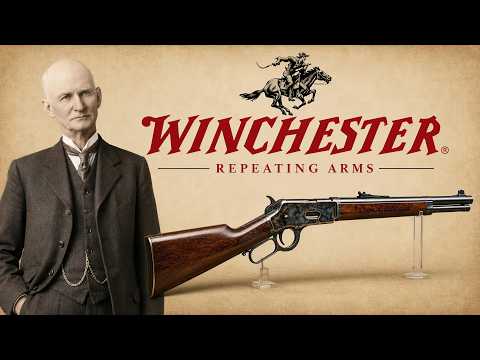
On one side of the table was John Moses Browning, the self-taught Utah gunsmith who had invented the modern firearm. Lever-action, pump-action, semi-automatic pistol, machine gun—his fingerprints were on all of them. He was fiercely independent, and he knew exactly what his ideas were worth.
On the other side was Thomas Crosley Johnson, a company man who would eventually hold 124 patents, all owned by Winchester. Brilliant, yes. But free? Never. One man owned his work. The other’s work was owned by his company. That difference is the seed from which the Widowmaker grew.
For nineteen years, the arrangement had been simple: Browning designed, Winchester paid, and everyone got rich. The Model 1886, the Model 1892, the Model 1894—every classic Winchester you picture came from Browning’s drawing board. He sold them his guns, took the money, and went home to invent the next one.
Then Browning invented something that broke the rhythm. It was the first automatic shotgun that actually worked—a gun that used each shot’s recoil to chamber the next shell. In an age of pump-actions and side-by-sides, it was future technology in a wooden stock.
He brought it to Winchester as always. But this time, he wanted something new. By 1902, he had started working with another company on a royalty basis—a few dollars for every gun sold, instead of a one-time payment. He knew what he had built. He wanted an inventor’s share, not a supplier’s fee.
Thomas Bennett, Winchester’s president, refused. “It is against company policy,” he said. Winchester bought designs outright. That was how it had always been done, and Bennett would not change it for anyone—not even Browning.
The argument was brief. Then Browning did something that ended nineteen years in about a minute. He walked into the room where his prototypes were kept, picked up his guns—the ones Winchester had helped him patent in his own name—and carried them out the door. He never came back.
Bennett let him go. He believed Winchester would do fine without Browning. For a moment, it seemed like a reasonable belief. It was not. It was the most expensive mistake the company ever made.
Browning took the shotgun to Remington first—and the story of that day is almost impossible to believe. He arrived to meet Remington’s president, Marcellus Hartley, and while Browning waited, Hartley died of a heart attack somewhere in the building. The meeting never happened.
So Browning, forty-five years old and never having crossed an ocean, packed up his shotgun and sailed for Belgium. At Fabrique Nationale in Herstal, he found exactly what Bennett had refused him: a royalty on every gun sold. He was so confident in his design that he personally ordered ten thousand guns for the American market. In less than a year, they were all sold.
The gun was called the Browning Auto-5. It stayed in production for nearly fifty years and dominated the market for most of them. The man Winchester let walk out the door had built the most successful shotgun of its era—for someone else.
In New Haven, the news was not received well. In the summer of 1903, Bennett did something a confident man usually doesn’t have to do: he wrote letters to Winchester’s distributors and dealers explaining the split and assuring them the company would thrive without the Browning family. That letter survives today in a firearms museum. In plain terms, it was a company telling its customers not to worry about the very thing it was secretly worried about.
Because Winchester had a problem it couldn’t talk its way out of. It had no automatic shotgun. Browning’s gun was outselling everything else on the market, and demand was growing every season. There was a hole on their shelf, and it looked exactly like the gun Bennett had turned down.
So Winchester turned to its own engineer—Thomas Johnson. He was given a task that bordered on cruelty. “Build us an automatic shotgun, but the patents on how an automatic shotgun works belong to Browning. So build something that achieves the same result without touching any of his protected parts. Find a way around the master’s design. Beat him without using anything he invented.”
And there was a personal twist that must have stung. Years earlier, Johnson had helped Browning draft some of those very patents. The walls he now had to climb over, he had helped build.
The company’s loyal engineer was told to defeat the independent inventor in a contest the independent inventor had already locked down from every angle. Johnson would spend nearly a decade on it. He later joked dryly that it took him almost ten years to design an automatic shotgun without infringing on Browning’s patents. It sounds like a quip. It was actually a confession of how tight the trap was.
This is the part that changes everything. The Widowmaker’s flaws were not the mistakes of an incompetent engineer. They were the shape of a cage.
Start with the handle Browning owned. On an automatic shotgun, the most natural part is the small knob on the bolt—the thing you pull to load. Browning held the patent. Johnson could not use it. So he had to invent another way to cock the gun.
And when every good way is closed off, the only path left is to make the shooter pull the barrel itself. That is why there was no handle. That is why there were grooves cut into the steel.
The strange, dangerous, chest-pointed loading method behind the gun’s infamous name was not ordinary carelessness. It was the direct physical result of a business decision made in a boardroom nine years earlier. Bennett protected a policy. A duck hunter a decade and a thousand miles away paid that policy’s price with his hand.
And there was a second cage most people never notice. Browning had also patented the small metal rings inside the gun that absorbed recoil—the parts that made the shotgun comfortable to shoot all day. Johnson could not use those either. He substituted compressed fiber rings that wore out quickly. When they wore out, the gun stopped absorbing anything. Every shell’s kick went straight into the shooter’s shoulder.
Men came home with bruised, blackened shoulders. Some stocks split down the middle from the force. That was the gun’s other nickname: the Skull Cracker. And it came from the same source as the first.
But the worst consequence was never the shoulder. It was the loading gate. Go back to the man in the marsh. The swollen shell. The barrel buried in the mud, its muzzle under his chin. When it went wrong, it didn’t just bruise. It changed a life or ended one.
The stories of men killed by this gun have circulated through gun shops for a century. The records are as murky as you’d expect. Some documented, some the kind of tale a man swears he saw his uncle do. What isn’t folklore is much more recent and much harder to wave away. As late as 2005, an Oklahoma newspaper reported that one of these old Winchesters had exploded during loading or cleaning, injuring four people. Nearly a hundred years after it was designed, the gun was still doing the work its name promised.
After roughly 83,000 were made, Winchester finally stopped production in 1925. By the numbers, it was a failure. The Browning shotgun outsold it many times over.
But end the story there and you miss the strangest turn. Because the same man at the same company, the one who fought Browning’s war, also built one of the finest shotguns in American history.
While Johnson was wrestling with the Widowmaker, he designed the Winchester Model 12. It arrived in 1912. They called it the ‘Perfect Repeater,’ and for once the marketing was almost honest. Winchester made nearly two million of them over half a century. Soldiers carried it through two world wars. It is widely acknowledged as one of the best pump shotguns ever built.
So look at what the fight actually produced. The same rivalry, the same pressure, the same engineer made a gun people whispered about and a gun people trusted blindly. Johnson was never a failure. He was a brilliant designer handed one impossible task and one sensible one, and from the same drawing table he produced a masterpiece and a cautionary tale.
And Browning? Browning was right the whole time. Right to bet on himself, right that his gun would win. But his patents—the proof of his genius—were the very thing that forced a rival engineer to build something that hurt people.
Both men won. Both men lost. Neither was simply the hero.
Today those 83,000 Widowmakers are collector’s items. They turn up at auctions, estate sales, and the back of gun shops. That grooved barrel still speaks silently to anyone who knows the history, telling them what it really is.
And if you stand at a gun counter long enough, you’ll hear the argument start again. One man will pick it up, hunt for a handle that isn’t there, and call it the worst shotgun in history—a death trap, a joke. Another will shake his head and say it was never a bad design. It was a good design strangled by a patent war it never chose. A gun caged, not a gun botched.
Neither will realize they are standing exactly where Bennett and Browning stood in the winter of 1902. One is taking the company’s side, the other the man’s. The men are gone. The factory has changed hands. But the argument never ended. It just moved to another counter and found two new people to carry it on.
The clerk behind the counter will shrug, and the argument will fade into small talk about collectibles and condition grades. But the grooved barrel will still be there, cold under the glass, waiting.
Because the Widowmaker was never really about bad engineering. It was about what happens when a company decides that a policy matters more than a person—and then spends a decade building a cage to protect that decision. The grooves weren’t a flaw. They were a receipt.
And somewhere in that same shop, a young designer will be sketching a new idea, wondering whether to sell it outright or demand a share. He won’t know he’s standing at the same fork in the road Browning faced in 1902. He won’t know the cost of getting it wrong.
But the gun on the shelf knows. It has been telling the story for over a century, one bruised shoulder and one broken stock at a time.
So here’s the question: if you were Browning, would you have walked out that door—or taken Bennett’s check and kept the peace?
Report this article
Select a reason for reporting:






