The guitar hit the stage with a sickening crack. James Carter, Elvis Presley’s lead guitarist, crumpled to the floor mid-chord, his hand still curled around a pick that had already fallen. Twenty thousand people screamed. Elvis dropped his microphone and rushed to his side. The concert was live. Millions were watching. And the most important song of the night hadn’t even started.
Backstage, James had whispered the truth to a stranger in a yellow jacket: the song was for his daughter Lily, nine years old, waiting for heart surgery. The melody hidden inside Elvis’s arrangement was her lullaby. “She thinks Elvis is singing it for her,” James had said. Then he collapsed. The ambulance doors closed. Elvis returned to the stage, looked at the abandoned guitar, and asked the silent arena: “Can anyone here play?”
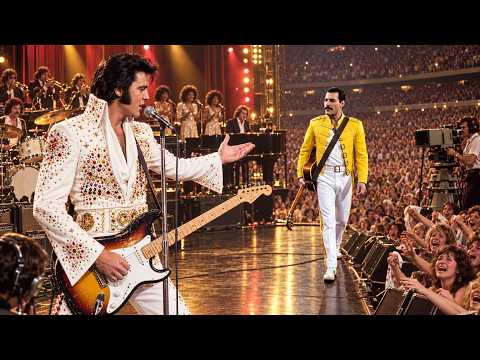
No one moved. Then a thin, dark-haired man in a bright yellow jacket stepped forward. “I can.” Security blocked him. The audience laughed. He was unknown, foreign, unassuming. But when Elvis asked if he knew the song, the stranger’s answer erased every trace of amusement: “I know what your guitarist was trying to say with it.”
Elvis ordered the guards aside. The man climbed onto the stage. “What is your name?” Elvis asked. “Freddy. Just Freddy.” A ripple of laughter moved through the arena. Elvis didn’t smile. “If you turn this into a joke, you won’t finish the first chord.” Freddy met his eyes. “And if we walk away now, a frightened girl may believe her father forgot his promise.”
Freddy lifted James’s damaged guitar. A tuning peg had broken. Blood streaked the strings. A technician offered a replacement. Freddy refused. “Lily needs to see her father’s instrument.” He stepped beneath the spotlight and played the opening of the lullaby. The first chord was quiet, imperfect, painfully uneven. Someone shouted for Elvis to continue alone. Freddy ignored it. He looked directly into the camera carrying the broadcast to Lily’s hospital room and played the phrase again. This time, the hidden melody became clear.
Elvis’s eyes widened. He had rehearsed the song countless times but never understood those particular notes. Now he heard a father’s private message woven beneath the arrangement. He lifted the microphone and sang softly, leaving spaces where James had designed the guitar to answer. “Is all of that for her?” Elvis whispered between lines. Freddy nodded. “Every note.”
The damaged peg slipped. Freddy tightened it without missing a beat. Then he added something no one expected: harmony. His voice entered beneath Elvis’s melody as a restrained whisper, warm and precise. It expanded into an operatic wave that swept across the arena. Elvis missed his next entrance, captivated. Freddy smiled. “Your turn, darling.” The audience erupted. What began as an emergency substitution became a conversation between two extraordinary voices.
Backstage, a British cameraman recognized the stranger and whispered to a producer. But Elvis still knew him only as Freddy. The arrangement reached the section James had struggled to complete. Freddy remembered the instruction: “Leave space here. Lily always takes a breath before the melody returns.” He stopped for precisely one beat. Elvis waited. Then the lullaby returned.
Inside the hospital, Lily lay beneath a thin blanket, her father’s photograph beside the television. She recognized the melody but not the man holding her father’s guitar. “Where is daddy?” she asked. A producer connected the call to Elvis’s monitor. “Daddy,” her voice came through the speakers. Elvis’s voice faltered. Freddy stopped playing. Thousands fell silent.
Elvis explained that James had become ill. Lily began to cry. “He promised he would play my song.” Freddy stepped toward the microphone. “He is playing it.” Lily didn’t understand. “That isn’t Daddy.” “No,” Freddy said. “My name is Freddy. Your father taught me what every note meant before the concert. He trusted me with it.” Lily’s breathing trembled through the speakers. “Did he forget?” Freddy’s expression changed. “No, sweetheart. He held on to the promise so tightly that he collapsed before he could release it.”
The arena remained completely still. Freddy lifted the guitar toward the camera. “These are his strings. This is his arrangement. I am only helping his notes reach you.” A quiet sob came through the line. “Can he hear me?” Elvis looked toward his manager, who shook his head. James was still unconscious. Freddy answered carefully. “Perhaps not yet.” Lily’s voice grew smaller. “What if he doesn’t wake up?” No one knew what to say.
Freddy returned to the guitar. “Then we make this song loud enough to follow him wherever he has gone.” He began the lullaby again, playing directly toward the camera. Elvis stood beside him, one hand pressed against his chest. The entire arena listened as though any careless noise might frighten the child on the other end of the line.
Freddy reached the delicate bridge. The damaged peg slipped. He corrected it. Then the guitar produced a violent metallic snap. A string broke across his hand. Blood appeared instantly along his fingers. The instrument fell silent. The audience gasped. Elvis seized Freddy’s wrist. “That is enough.” Freddy shook his head. “Not until she hears the ending.” “The guitar is broken.” Freddy looked toward the microphone carrying Lily’s frightened breathing. “Then we finish without it.”
He placed the guitar carefully on its stand and wrapped a cloth around his bleeding hand. Elvis stared. “No one else knows the arrangement.” Freddy stepped toward the microphone. “I do.” “You cannot play it without the guitar.” Freddy looked directly at him. “Who said I was going to play it?” He closed his eyes. Then, using only his voice, he produced the exact sound of James’s missing guitar line. One vocal note became a string. Another became the bass beneath it. A soft rhythm formed in his throat, building an invisible band around Elvis. The crowd stared in disbelief.
Just as Elvis raised his microphone to join, Lily’s voice returned through the speakers. “Wait!” Freddy stopped. The entire arena held its breath. Lily whispered that the broken string had silenced the most important part—the final passage her father had written only for her. Then she revealed that nobody else knew the words.
Freddy stood motionless before the microphone. Elvis looked toward the broken guitar. “Did your father write them down?” he asked. “No.” “Then how do you know them?” Lily’s breathing grew unsteady. “Daddy whispered them whenever the doctors made me afraid.”
Freddy moved closer to the speaker. “Can you teach us?” The girl became silent. Inside her hospital room, nurses and her mother waited beside the telephone. Lily had never sung for strangers. Her weakened heart made long phrases difficult, and she was ashamed of how breathless her voice sounded. “I can’t sing like you.”
Freddy looked toward the camera. “Neither can Elvis.” The audience laughed through its tears. Elvis raised an eyebrow. “I was about to say something kind about you.” “Save it for the encore, darling.” The brief humor softened the fear inside Lily’s room.
Freddy continued. “You do not have to sound like anyone else. The words belong to you before they belong to the song.” “What if I forget them?” “Then we wait.” “What if my voice breaks?” “Then it will match the guitar.” Lily gave a small laugh.
Freddy signaled for every light in the arena to be lowered except the beam surrounding James’s instrument. The damaged guitar rested alone on its stand. “This is still your father’s performance,” Freddy said. “Elvis and I are merely standing inside it.”
Lily took one careful breath. Then she spoke the first line. Her father had written that even when the road became dark, she should follow the rhythm already living inside her chest. Freddy repeated the words softly, shaping a melody around them. Lily gave him the second line. Elvis sang it back.
The process continued slowly. A nine-year-old girl inside a hospital room taught two of the world’s most powerful voices how to complete her father’s promise. Every time Lily stopped to breathe, the arena waited. No one shouted. No one demanded the show continue faster. Twenty thousand people allowed one frightened child to decide the rhythm.
The final line described a father’s love remaining beside his daughter even when his hands could no longer hold the guitar. Elvis lowered his head. Freddy closed his eyes. “That is the ending,” Lily whispered. “No,” Freddy said. She sounded confused. “What is missing?” “Your voice.” “I told you I can’t sing.” “And I told you we would wait.”
Lily’s mother spoke from the hospital. “She has surgery in the morning. She is exhausted.” Freddy’s expression softened. “Then she should not carry the entire verse alone. Neither should her father.” He turned toward the audience.
Freddy sang a simple wordless harmony and asked the arena to repeat it. The first attempt was uneven. Some voices entered too early, others missed the pitch. Freddy smiled again. The second attempt became stronger. Elvis added a lower note beneath it. The sound deepened, moving through the arena like a distant choir.
Freddy divided the audience into sections. One side carried the rhythm James had played beside Lily’s crib. The other held a sustained note beneath the final verse. Within minutes, twenty thousand strangers had become the instrument the broken guitar could no longer be. Freddy turned toward Lily’s camera. “When you are ready, begin.”
The giant screen above the stage flickered. Lily appeared from her hospital bed. She looked impossibly small beneath the white blankets. Wires crossed her chest and a monitor pulsed beside her. In her hands, she held a photograph of James playing the guitar, now standing beneath the arena spotlight. The crowd saw her. A wave of emotion passed through the building.
Lily opened her mouth. No sound emerged. Her eyes filled with panic. Freddy raised his injured hand. The audience remained silent. He did not rescue her by beginning the song. He waited long enough for Lily to understand that the moment still belonged to her.
She tried again. Her first note trembled through the speakers. It was thin, breathless, perfectly hers. Freddy joined beneath it. Elvis followed. The audience entered when Freddy lowered his hand. The arena became a choir built around Lily’s fragile voice.
She gave them the words her father had never written, while Freddy recreated his guitar line through changes in tone and distance from the microphone. One voice became the missing strings. Another created the bass. A soft pulse formed in Freddy’s throat, matching the rhythm James had hidden inside the arrangement.
Elvis sang directly toward Lily’s image. His voice carried warmth without overwhelming her. Whenever emotion weakened him, Freddy protected the melody. Whenever Freddy’s wounded hand began shaking, Elvis gripped his shoulder. They moved as if they had rehearsed together for years.
The final passage approached. Lily whispered through the speakers. “That is the part Daddy wrote for me.” Freddy stopped conducting. “Then lead us.” Lily looked frightened. Elvis stepped toward the camera. “Your father trusted you with the ending.”
She pressed the photograph against her heart. Then she began. Freddy answered with the missing guitar line. Elvis carried her words. The audience lifted the harmony until it seemed to rise beyond the arena roof.
On the giant screen, Lily placed one hand against the television speaker. She could hear Elvis. She could hear Freddy. Beneath them, an entire arena carried the promise her father had been unable to finish.
The lights dimmed further. Only Elvis, Freddy, and James’s guitar remained visible on stage. Lily’s face glowed above them. Elvis delivered the final line. Freddy answered with one breathtaking note that hung above the crowd. It did not display power for its own sake. It carried Lily’s voice farther than her body could.
Then silence. Nobody applauded. For several seconds, the arena remained completely still. Lily spoke one final time. “Tell Daddy I heard him.”
Elvis closed his eyes. Freddy lowered his head. The audience rose. Applause crashed through the building like thunder. People cried openly. The studio musicians embraced one another. Elvis kept one hand on Freddy’s shoulder while the stranger in the yellow jacket conducted the crowd with his bloodstained fingers.
Then a telephone rang beside the sound engineer. He answered. His face immediately changed. A second call had arrived from the hospital receiving James’s ambulance. The engineer pulled Elvis’s manager close and whispered into his ear. The manager went pale. Elvis saw them. “What happened?” Neither man answered.
Freddy stepped away from the microphone. “Tell us.” The engineer looked toward Lily’s image, still shining above the stage. He lowered his voice, but the nearest microphone captured every word. “James’s heart stopped before the ambulance reached the hospital.”
The applause collapsed into silence. Lily had heard the announcement through the open connection, her face filled with terror. “Is my daddy dead?” Elvis could not answer. Freddy stared at James’s guitar while the arena waited.
Then another voice entered the telephone line, a doctor shouting that the emergency team had not stopped working. A monitor began sounding through the speakers. Every person in the arena could hear the rhythm of James’s failing heart. Freddy lifted his injured hand and silenced the crowd. “Keep the connection open,” he said. “If James is fighting to come back, he will not fight in silence.”
He tapped the wooden body of the guitar. A soft pulse answered. Elvis understood and added a second beat. Twenty thousand people began tapping the rhythm against their seats, hands, and chests. The sound moved through the arena like one enormous heartbeat. Freddy approached Lily’s microphone. “Your father taught me this rhythm. Now we sing it for him.”
Lily drew a careful breath and began the lullaby again. Her voice was weaker than before, but the arena protected it. Elvis entered beneath her words. Freddy rebuilt James’s missing guitar line using only his voice. The audience maintained the heartbeat.
For several seconds, nothing could be heard except static. Then came one electronic tone. Another followed. The monitor found a rhythm, slow, uneven, alive. A doctor’s voice entered the line. “We have a heartbeat.”
The arena exploded. Elvis lowered his head against Freddy’s shoulder. Lily’s mother collapsed beside the hospital bed while her daughter sobbed into the telephone. Freddy did not celebrate immediately. He looked toward the speaker. “Is he safe?” The doctor answered honestly, “No, but he is with us.” Freddy closed his eyes. “For tonight, that is enough.”
Elvis lifted James’s guitar from the stand. The broken string hung from its bridge, and Freddy’s blood remained across the wood. He held it toward the camera. “James, your song reached her.” Lily pressed her hand against the television screen. “I heard you, Daddy.”
The concert ended without another scheduled song. No fireworks appeared. No encore began. The audience remained standing while James’s lullaby played once more through their voices alone. When the hospital connection finally closed, Elvis turned toward the stranger who had saved the promise. “Freddy, who are you?”
Freddy glanced toward the crowd. “My full name is Freddy Mercury.” The reaction began near the front where several British fans recognized him. Someone shouted Queen’s name. Within seconds, the identity traveled through the arena. Elvis stared at Freddy. “You are the singer from Queen.” “On agreeable days.” Elvis laughed through his tears. “You stepped onto my stage without telling me.” “You asked whether anyone could play. That was playing.” Freddy placed one hand over his chest. “My dear, I was being restrained.”
Elvis extended his hand. Freddy accepted it, but Elvis pulled him into an embrace. “You did not save my concert,” Elvis whispered. “You saved his promise.” Freddy shook his head. “We carried it. Lily finished it.”
Backstage, Elvis’s manager approached with an envelope. Payment for the emergency appearance. Freddy did not touch it. “Give it to Lily’s family.” The manager hesitated. The amount was intended for one song. “Then add the profits from tonight’s broadcast,” Elvis spoke before anyone could object. “Every dollar.” His manager stared at him. “That is a considerable amount.” “So is heart surgery.”
Elvis announced that the concert’s proceeds would cover Lily’s operation and support James during his recovery. Any remaining funds would help other families whose children required cardiac care. The arena erupted again.
Freddy asked for one more thing. When James recovered, the damaged guitar must be repaired without removing its scars. Then it would belong to Lily. “Not a museum?” Elvis asked. “No glass case?” Freddy replied. “Promises are meant to be held.”
James remained in the hospital for several weeks. When he finally opened his eyes, Lily sat beside him with headphones connected to a small cassette player. A recording of the concert rested in her lap. “Did I finish?” he whispered. Lily took his hand. “We all did.”
Her surgery followed soon afterward. The night before the operation, a nurse brought the repaired guitar into her room. The damaged tuning peg had been replaced, but the scratch from its fall remained. So did the faint marks left by James’s blood and Freddy’s wounded hand. Inside the case was a note signed by Elvis and Freddy. A broken string cannot end a promise carried by many hearts.
Lily survived the operation. Months later, James returned to the stage during another Elvis concert. He walked slowly and played only one song. Lily watched from the front row. Before he began, Freddy Mercury appeared unexpectedly from behind the curtain. The crowd recognized him immediately this time. Elvis joined them beneath one spotlight. James played the lullaby. Lily sang the final verse.
No one asked which voice was greatest. No one cared which legend owned the stage. They understood that the song belonged to a father who had collapsed before completing it, a daughter who taught an arena its ending, and a stranger brave enough to step forward when everyone else remained still.
People later remembered the night as the first unexpected meeting between Elvis Presley and Freddy Mercury. But fame was never what made it unforgettable. Elvis was the king. Freddy would become a legend. Yet the most powerful voice that evening belonged to a nine-year-old girl whispering through a hospital telephone.
Her father’s guitar broke. His heart stopped. The music disappeared. Still, the promise continued. Because sometimes one person cannot finish a song alone. Sometimes it takes a king, a future legend, and twenty thousand strangers to carry the final note.
What would you have done if you were in that arena that night—would you have joined the heartbeat?
Report this article
Select a reason for reporting:






