What happens when you discover that your family name is etched into the darkest chapters of history? For the descendants of the Third Reich’s most notorious figures, this is not a hypothetical question—it is a chilling reality that shatters identities and forces impossible choices.
Seventy years after the collapse of Nazi Germany, the children and grandchildren of Hitler’s inner circle have been forced to confront a legacy of unimaginable horror. Some grew up in opulent silence, surrounded by wealth built on slave labor and stolen goods, unaware that their grandparents orchestrated mass murder. Others were raised on distorted narratives that glorified war criminals and denied the Holocaust. But sooner or later, the truth always surfaced.
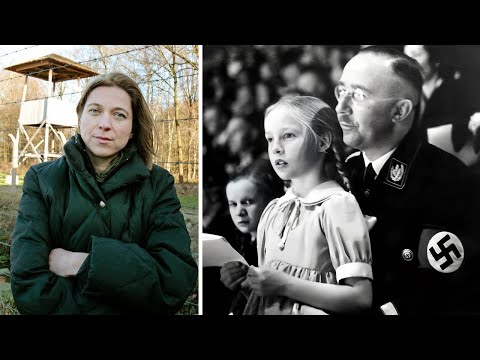
For Rainer Höß, the breaking point came at just 15 years old. During a school trip to the Dachau concentration camp, he stood frozen before a sign bearing a name that matched his own—Rudolf Höß, the commandant of Auschwitz, where over one million people were murdered. The realization hit him like a physical blow. His grandfather was not a distant historical figure; he was the architect of industrial-scale extermination.
What followed was a radical rupture. Rainer left home, severed all ties with his family, and never looked back. But the name Höß followed him everywhere. At boarding school, a gardener—a Holocaust survivor—beat him upon learning his identity. “Once a Höß, always a Höß,” they told him. The phrase became a haunting refrain.
While some descendants chose silence, others embraced confrontation. Jennifer Teege, an Afro-German woman, made a life-shattering discovery at 38 when she stumbled upon a book in a Hamburg library. Flipping through its pages, she recognized a photograph of her biological mother. Then she saw another name: Amon Göth, commandant of the Płaszów concentration camp, the man who shot prisoners from his balcony for sport. Her grandfather.
“To him, I would have been a disgrace,” she would later say. “He probably would have executed me.” The revelation plunged her into acute depression, but it also set her on a path of acceptance and truth-telling.
Yet not all families chose to break the silence. The descendants of Magda Goebbels, Hitler’s propaganda minister’s wife who poisoned her six children before taking her own life, inherited a vast industrial fortune built on forced labor and plundered Jewish businesses. For decades, they managed their wealth from a holding company in Bad Homburg, their surname absent from public records but its shadow ever-present.
When Colleen-Bettina Quant was 16, she learned the truth about her grandmother. The shock was profound. She converted to Judaism and married a descendant of Holocaust survivors—a definitive break from the ideological heritage she had inherited.
Others in the family chose different paths. Her sister Gabriele briefly turned to Marxist activism, while Katharina dedicated herself to equestrian pursuits. None of them use the Goebbels surname, nor do they give interviews. They have opted for a discreet profile, far from scrutiny.
After their parents’ deaths, the five sisters consolidated the management of their capital through the Harald Quandt holding company. From its headquarters in Bad Homburg, they meet several times a year to coordinate the administration of their assets. The family history, long written by men, thus passed into the hands of a new female generation. They not only preserved the fortune but multiplied it.
Access to private archives remains restricted. There are no authorized biographies or accessible personal documents. The Goebbels surname does not appear in the business structure, but its shadow is ever present. The public distance contrasts with the private weight of memory.
In rare interviews, some family members admitted that living with that surname is an inevitable burden. Magda is not just any name. Her role as a symbolic mother of the Reich and her final decision in the bunker are not forgotten. In every family meeting, in every succession document, that past remains latent.
The fortune remains intact, protected by robust legal and financial structures. But among those who manage it, there are also those who chose to face the origin of that capital head on. Colleen, with her conversion and life distanced from the surname, represents one of the few visible breaks in a family that otherwise has preferred to manage the past with absolute silence.
While some families inherit fortunes tainted by silence, others live with surnames that marked history with blood. After the fall of the Third Reich, the Himmler name did not dissolve with defeat. It became synonymous with extermination. Katrin Himmler, great-niece of the Reichsführer, did not grow up in opulence, but under the weight of a lineage no one could ignore.
Heinrich Himmler was far more than a high-ranking Nazi official. As head of the SS, he built the regime’s most effective repressive apparatus. In just a decade, he transformed a unit of fewer than 300 men into a paramilitary structure of nearly one million. His influence extended beyond police power. From 1943, he also led the Reich’s Ministry of the Interior, orchestrating an administration based on terror.
Under his command, the mobile killing squads, the Einsatzgruppen, were formed, tasked with shooting entire communities following the German advance in the east. He also centralized the network of concentration camps under a specialized SS unit. Dachau was the first in 1933. By the end of 1934, all camps were under his control.
Himmler was not just operationally responsible. He was the architect of the genocide. He directly oversaw the expansion of Auschwitz, ordered the installation of gas chambers, and promoted the use of Zyklon B as an extermination method. Under his direction, millions were murdered—Jews, Roma, Soviets, Poles, and other victims of the regime. The industrial scale of the killing would not have been possible without his systematic intervention.
At the war’s end, he tried to escape. He disguised himself, hid his identity, and sought a deal with the Allies. He was captured by British troops. During a medical examination, he hid a cyanide capsule between his teeth. He bit into it before speaking. He died in seconds.
Himmler’s figure became one of the pillars of Nazi horror. His legacy haunted not only the victims, but also his family. Katrin did not choose that surname, but she decided not to hide behind it.
Katrin Himmler discovered her connection to the Reichsführer of the SS during a history class. She was 15 when a classmate asked in front of the entire room if she was related to Heinrich Himmler. Upon confirming the link, an uncomfortable silence followed. No one reacted, not even the teacher. The incident marked her adolescence, not only because of the shame, but also due to the omission. The topic was never brought up again.
Years later, after graduating in political science, her father asked her to investigate the past of her grandfather Ernst. In the archives of Koblenz, Katrin confirmed that not only Heinrich had been involved in Nazism. Ernst and his other brother, Gebhard, had also joined the SS. They were not coerced. They saw the family connection as a path to power and prestige within the regime.
Her research uncovered concrete facts. Her grandfather denounced an acquaintance for having Jewish ancestry, thus contributing to their persecution. Her grandmother, after the war, sent packages to Nazis convicted of crimes against humanity. None of this was part of the family narrative. In her home, Heinrich was seen as a respected figure, not as the primary orchestrator of the genocide.
The contrast between the official history and the family narrative became unsustainable. Katrin realized that this type of denial was not an isolated case. In many German families, the gap between what is acknowledged publicly and what is passed down privately remains vast. Collective memory is still shaped by inherited myths—stories of grandparents supposedly uninvolved with the regime, of supportive neighbors, of silences that evade the truth.
Married to an Israeli citizen and mother to a son who carries both legacies, Katrin took on a difficult commitment. With her son, she chose gradual honesty, explaining not only what happened, but also the role her family played. She knows there is no simple way to convey that burden, but she understands that hiding it only perpetuates the problem.
After confirming that her grandfather and great-uncle actively participated in the SS, Katrin Himmler understood that the family’s silence was not a gesture of caution, but a form of structural denial. The image instilled in her childhood—of a cultured family detached from the regime’s crimes—could not stand against the archival documents. Heinrich Himmler had designed the extermination apparatus. Ernst, her grandfather, was not a passive bystander. He collaborated within the system. Gebhard, the other brother, followed the same path.
This contrast between public memory and private narrative drove her to investigate systematically. Her training in political science provided analytical tools, but it was personal necessity that set the pace of her search. Her goal was not to vindicate or point fingers at the dead, but to dismantle the inherited narratives that still blocked a true understanding of the past.
The result was The Himmler Brothers, a work based on primary sources, family correspondence, and official records. Through the book, Katrin not only reconstructed the political biography of her family, but also exposed the gray areas of postwar Germany—families that publicly acknowledged the Holocaust while privately downplaying it, generations raised on myths of fictitious resistance, and a society where the ritual of memory did not always involve a real confrontation with the legacy.
The publication sparked immediate reactions. Some family members accused her of betraying the surname. Neo-Nazi groups threatened her for dishonoring the greatness of National Socialism. However, she also received support from readers who, like her, sought tools to interpret a silenced past.
Today, Katrin participates in conferences, collaborates with historical memory initiatives, and educates her son from a clear perspective. There is no inherited guilt, but there is responsibility toward the legacy. Her work marks a substantial difference between acknowledging the crime as a historical fact and understanding how that crime was rooted in family structures that even today resist the truth.
While some heirs of the Nazi elite lived under silence, Bettina Göring grew up with a surname that offered no escape. Her great-uncle Hermann Göring’s name filled entire pages in history books. For many, he was the very face of the Third Reich’s unrestrained power. A fighter ace in the Great War, decorated with the Pour le Mérite, he was also one of the most influential architects of Hitler’s regime.
Göring was not only one of the first to join the Nazi Party, but also the founder of the Gestapo in 1933 before handing it over to Himmler. His ambition led him to amass power quickly. As head of the Four-Year Plan, he controlled vast sectors of the economy, reorganized ministerial structures, and became one of the country’s richest men. Hitler granted him a unique rank—Reichsmarschall of the Greater German Reich—above all other military commanders.
Beyond his military and political roles, he was one of the 20th century’s greatest cultural looters. During the occupation of France, he personally oversaw the theft of artworks. The selected pieces ended up in his Carinhall residence, an opulent estate turned into a personal shrine of plunder. His name appears more than 130 times in Allied archives on art theft. His collection is estimated to have been worth over $200 million.
As commander of the Luftwaffe, he led the air offensive against the United Kingdom. But the failure in the Battle of Britain undermined his influence. In the regime’s final months, he attempted to position himself as Hitler’s successor, sending a telegram that was interpreted as treason. He was stripped of his posts, captured by the Allies, and tried at Nuremberg. The tribunal declared him guilty of all major charges: war crimes, crimes against humanity, conspiracy, and waging aggressive war. Sentenced to death, he avoided the gallows by ingesting a cyanide capsule the night before his execution.
Despite his theatrical demeanor and penchant for excess, Göring was not a distant bureaucrat. His signature appears on the order that initiated the Final Solution.
Bettina grew up knowing her surname was tied to the extermination. From an early age, her life began to revolve around that inescapable legacy.
Having grown up under the weight of the Göring surname, Bettina soon realized that her family history was not merely a matter of the past. It was a constant conflict between two identities—her father’s Nazi heritage and her mother’s pacifist environment. At 10 years old, when her gravely ill paternal grandmother moved into their home, tensions escalated.
That woman, close to Hermann Göring during the regime, denied any crimes of National Socialism. When a documentary about Auschwitz appeared on television, her grandmother’s reaction was neither guilt nor grief. It was denial. For Bettina, this was unbearable. Soon after, she decided to leave home. She was 13.
She fled without a plan, driven only by the desire to escape the burden of a name she never chose. For years, she sought alternative paths to shed that weight. She took refuge in communes, lived in countercultural communities, and explored radical ways to break free from anything that reminded her of her history.
One experience profoundly marked her. It was with an older Jewish man with whom she shared a brief but revealing relationship. When she told him her surname, he froze and showed her his forearm. It bore the tattooed number of a concentration camp. He was a survivor.
Bettina felt an indescribable guilt, but he did not reject her. From that moment, she understood that not everything had to be repeated.
After years of internal flight, Bettina Göring decided to sever her heritage in a literal way. At 30, she chose to undergo sterilization. It was not just a personal decision but a symbolic gesture—she feared, in her own words, carrying the wrong seed in her blood. Her brother also sterilized and expressed it with a phrase Bettina never forgot: “I have cut the line.”
She rebuilt her life in Santa Fe, New Mexico, far from Germany and her family’s silence. There, among Jewish neighbors and open conversations, she found a space for reconciliation she had never had in her homeland. “I, a descendant of Nazi exterminators, mediating between two Jewish families,” she said with irony.
She didn’t see it as redemption, but as part of a deeply personal process that included sharing her story publicly without filters, without pride, but also without shame. In her encounters with children of Holocaust survivors, she didn’t seek absolution, but understanding. She maintained that it wasn’t about erasing the past, but looking at it with awareness so it would cease to hold dominion.
Sometimes she still wonders if that burden is inscribed in her DNA—if historical memory can be transmitted through the body. But over the years she has learned not to fear that possibility, to view her family with less anger and more complexity, and to take control of her story from a radically different place: that of someone who chooses not to repeat it.
What would you do if you discovered your family name was written on the darkest pages of history—would you hide, or would you confront it?
Report this article
Select a reason for reporting:






