In the suffocating heat of the Vietnamese jungle, silence was never neutral. For most soldiers, it signaled imminent danger. A jungle too quiet meant ambush. But for a rare breed of men, silence was not a warning. It was a mission objective. It was the very definition of survival.
While the conventional American war machine stormed across Vietnam with thundering helicopters and earth-shaking artillery, another war unfolded in complete quiet. It was a parallel conflict, invisible to most, and deadly in its own right. There were no battalions here, no platoons marching in formation. Instead, four or six men would vanish into dense, enemy-infested jungle. Alone, unsupported, and largely forgotten.
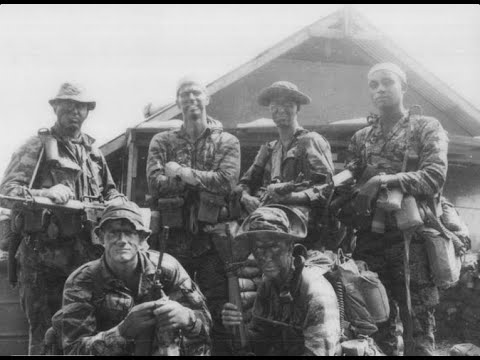
These men were part of a secretive force known as the long-range reconnaissance patrols, or LRRPs, pronounced “lurps”. They didn’t go out to fight the enemy. They went out to find him, and to do so without ever being seen. Their success was measured not in enemy bodies, but in how completely invisible they remained. A successful mission ended without a single shot fired, without a broken twig, without so much as a trace left behind.
But these were no ordinary patrols. Where a regular infantry platoon consisted of 40 to 60 men, the standard LRRP team was just four to six individuals, each carrying their own body weight and equipment, each trained to survive in total isolation. There was no cavalry coming if things went wrong, no tanks, no reinforcements, sometimes not even air support. They operated dozens of kilometers behind enemy lines in some of the most dangerous terrain of the war.
Their very existence required a new kind of soldier. Not the clean-cut parade ground trooper, but men who could disappear mentally and physically into the jungle. Men who were more comfortable moving in silence than shouting orders. Who could lie motionless for hours in leech-infested mud, surrounded by enemy patrols, and not move a muscle. They were ghosts, and they knew it.
You couldn’t draft a man into the long-range reconnaissance patrols. You couldn’t force someone to become a ghost. The job was too dangerous, too demanding, and far too lonely. Every LRRP soldier was a volunteer, and not just in name. They chose this life knowing exactly what it meant. No backup, no safety net, and no guarantees.
When General William Westmoreland issued the directive in early 1966 for divisions to form dedicated long-range patrol units, the call went out across Vietnam. It was simple and stark: “We need men who can read a map, handle a radio, move silently, and stay alive.” The soldiers who stepped forward weren’t always the polished poster boys of military discipline. Many were misfits, the kind of men who didn’t quite fit in with traditional units. Some had been disciplinary problems. Others were simply tired of filling sandbags and shining boots in the rear.
In the LRRPs, nobody cared if your hair was regulation length or your boots were polished. What mattered was whether you could navigate dense jungle in total darkness, stay perfectly still for hours, and pull the trigger only when it absolutely counted. Precision, patience, and silence became the true markers of excellence.
But volunteering was only the beginning. To become a Lurp, you had to be rebuilt from the ground up. That process began at one of the most rigorous training programs in theater, the MACV Recondo School in Nha Trang. This wasn’t a classroom filled with theory and chalkboards. It was a crucible, an unforgiving gauntlet of exhaustion, fear, and pain designed to burn away bad habits and replace them with instincts.
Instructors were often Special Forces veterans who had already survived the worst the jungle could offer. Their teaching philosophy was blunt: “In the bush, a mistake doesn’t get you a bad grade. It gets you killed.” Recruits ran long distances in the blazing tropical heat, rappelled from hovering helicopters, and learned to call in artillery strikes with mathematical precision.
They were taught the anatomy of ambushes, how to read signs of enemy movement, how to move in absolute silence, and how to function with no sleep, no comfort, and no promise of extraction. But the most critical part of the training wasn’t physical. It was psychological.
In conventional infantry school, you’re taught to close with and destroy the enemy, to assault, to overwhelm, to engage. But at Recondo School, that instinct had to be unlearned. Pulling the trigger meant failure. If you were shooting, it usually meant the mission had gone sideways.
The entire ethos of the LRRPs revolved around not being seen. They weren’t killers first. They were hunters and observers, trained to study the jungle as if it were a living thing. To sense its rhythm, to know when something was out of place. If combat came, it had to be brief, brutal, and surgical, because the enemy was rarely far and reinforcements were never close.
The final test of Recondo training wasn’t theoretical. It wasn’t simulated. It was a live patrol in enemy territory. Students were inserted by helicopter into hostile jungle with real ammunition and real enemies nearby. It wasn’t a drill. If they came back alive, they passed.
That experience bonded them in ways even they struggled to articulate. A six-man team wasn’t just a group of soldiers. It was a single organism, each man a critical nerve or muscle. Trust wasn’t optional. It was existential.
The point man was the team’s eyes, scanning the ground for tripwires, traps, and enemy signs. The radio operator, the RTO, was the team’s voice to the outside world, the lifeline to artillery, extraction, or air support. The rear security man guarded the trail behind, always walking backward, always watching for signs they were being followed. Every member was essential. Every mistake was fatal.
They learned a new language, the language of silence. Hand signals replaced voices. A single gesture could mean halt, danger, or change direction. Speaking was reserved for whispers and only when absolutely necessary. Even breathing was something to control.
And when the team was finally formed and fully trained, their war began with the sound of rotor blades beating over the treetops. The familiar thump of a Huey was the start of every mission, a ride that carried them over the firebases, over the rivers, into the vast green unknown.
They taped down every piece of gear before takeoff. No rattling allowed. Dog tags were taped or stuffed in boots. Canteens were secured, ammo magazines checked for creaks. Even the springs were silenced. Every detail mattered, because once the helicopter flared and they dropped into the elephant grass, they were on their own.
And then the jungle swallowed them whole. The noise of the war faded. The silence returned. The mission had begun.
The jungle wasn’t just the battlefield; it was the enemy. Every leaf, every vine, every half-submerged root was a trap waiting to break a man’s silence. Once inserted, the team’s first moments on the ground were always the most dangerous. The landing zone could be booby-trapped, watched, or ambushed.
To counter this, teams frequently conducted false insertions, briefly touching down in multiple locations before the real drop. But even so, they never assumed they were safe. For 30 to 60 minutes, they would sit in absolute silence, just listening to the jungle breathe, distinguishing its normal rhythm from a disturbed one.
Movement was never casual. It was a performance of precision. The patrol advanced in single file, each man responsible for a specific direction of observation. Speed was never the objective. In fact, slowness was survival. A good team might cover only 200 meters per hour in dense terrain.
At night, they formed a tight circular perimeter, the radio centrally placed. Touch contact was essential, so each man could reach out in the dark and tap the next. They barely slept. Half the team remained awake at all times, rotating silently. The silence was more than a tactic. It was their shield, their weapon, their prayer.
For the LRRPs, breaking silence was a crisis. Six men against sixty was the average. If a team opened fire, it was with the full knowledge that they had minutes, perhaps seconds, before the enemy responded in force. And yet, some missions demanded it. Ambushes planned at known enemy choke points. The team leader would wait until the optimal moment, then detonate the Claymores. The entire ambush lasted less than thirty seconds.
But not every encounter was planned. When compromised, the break-contact drill kicked in. Shoot, move, cover. The RTO screamed into the handset, begging for gunships, artillery, anything. Sometimes help came. Other times, the only help was the men beside you and the next ridge over.
When silence returned, it was over. The Huey disappeared into the sky. A torn trail of footprints, blood, and burnt leaves marked where men had vanished again. They didn’t want a firefight, but when it came, they fought with the desperate urgency of men who knew they were already outnumbered.
For them, war wasn’t a matter of if the silence would break. It was a matter of how fast they could disappear again once it did. They were ghosts walking beside ghosts. Their names weren’t in the papers. Their victories left no captured hills. But entire battles shifted because of what they saw.
This isn’t the story of glory. This is the story of ghosts. And like all ghost stories, it begins quietly. Some never fully came home. They heard birds and thought about trail watchers. They saw wooded parks and checked for movement in the trees. They grew old in years, but part of them stayed young. Forever nineteen or twenty, forever crawling through the mud with five others depending on them.
They weren’t looking for medals. They weren’t chasing recognition. They just wanted to remember, and to not forget. But in a war fought in whispers, who ensures the silence itself is never forgotten?
Report this article
Select a reason for reporting:






