The shot came without warning. An American sergeant raised his weapon and fired at the departing Australian convoy, the crack of his rifle splitting the humid afternoon air of Phuoc Tuy Province. The bullets went wide—luckily, as the convoy commander later noted—but the message was clear: someone had just tried to kill them over a missing piece of paper.
It was 1966, and the Australians of the 5th Battalion, Royal Australian Regiment, had just loaded their Land Rovers and trailers with supplies from a US depot in Vung Tau. They left without the proper authorization. The sergeant at the gate did his job. But that single shot, recorded in a few terse lines by the officer who led the convoy, opens a window onto a far stranger story—one of bureaucratic chaos, desperate improvisation, and a barter economy that armed a battalion with machine guns in exchange for a pair of slouch hats and some butter.
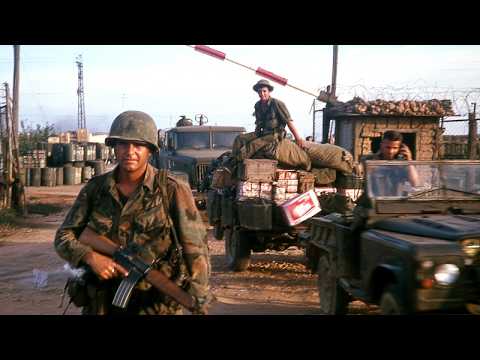
The officer who wrote it down was Major Stan Maizey, second-in-command of the battalion. He described the incident twice: once for the battalion association, and again in a chapter of the official history, Duty First: The Royal Australian Regiment in Vietnam, published in 2020. The American sergeant’s name is lost. The number of shots fired is unrecorded. The only witness was the man driving away.
Why was an Australian battalion even at that depot? The answer begins not with the enemy, but with the supply system—and a war fought on paper before a shot was fired in anger.
The 5th Battalion was raised in Holsworthy, on the outskirts of Sydney, on 1 March 1965. It was part of the expansion that came with national service, the birthday ballot introduced by the Menzies government at the end of 1964. Twenty-year-olds were called up for two years, and from 1965 they could be sent overseas.
From the start, according to Maizey, clothing and equipment were in short supply. The army’s procurement system proved woefully inadequate. The battalion’s first battle was against forms. Requests sent to ordnance depots with multiple items on each sheet were rejected—depots accepted only one item per form. Every clerk in the battalion was seconded to the supply officer for ten days to rewrite the paperwork.
Requests for infantry area equipment, classified as restricted war stores, came back stamped “not approved.” When the battalion asked to hold six months of consumables instead of three, as its equipment tables specified, the request was refused or deferred until a greater commitment to Vietnam was announced.
Maizey arrived as second-in-command in December 1965, while the commanding officer, Lieutenant Colonel John Warr, was away visiting the 1st Battalion in Vietnam. What he found in the stores was bleak. Some soldiers had only one set of jungle greens. Most had a single pair of general-purpose boots with steel toe caps. So each soldier was issued a pair of tropical ankle boots—a 1944 pattern with canvas gaiters worn over them.
For the national servicemen in the ranks, the arithmetic was simple. They had registered in the year they turned twenty, which meant they were born in the mid-1940s. The boots they laced up were older than some of them.
Maizey’s verdict on the replacement system meant to keep them equipped: “It left a lot to be desired.”
Weapons were short too. When the battalion’s M16 rifles arrived, they came without cleaning kits, so the armorer had to make cleaning rods from thick fencing wire. Belts for the M60 machine guns were carried in pouches made from inflatable field mattress pads. In the final training exercise before departure, with the help of the regimental medical officer, they even secured a ration of rum for all ranks through the supply system.
The advice they carried to Vietnam, as Maizey remembered it, was to get used to American rations.
The advance party landed at Vung Tau on 20 April 1966. By 13 May, the entire battalion was on the ground. On 24 May, it came under the command of the US 173rd Airborne Brigade, the paratroopers based at Bien Hoa, northeast of Saigon.
That, in the words of the battalion’s operations officer, Max Carroll, was when the 5th Battalion’s real war began.
The battalion was airlifted to Nui Dat that same day, about 30 kilometers north of Vung Tau, in the rubber plantation country of Phuoc Tuy Province. Heavy loads were moved forward by helicopters of the US 68th Assault Helicopter Company, based at Vung Tau airfield. Maizey wrote that the company provided magnificent support whenever called upon. When ammunition had to be moved forward, a pilot was asked how much weight each aircraft could carry. The pilot told him to fill it right up, and that is what they did.
On 5 June, the headquarters of the new 1st Australian Task Force took over the area from the Americans, and the 6th Battalion joined to make the force two battalions strong. Carroll’s verdict on the army’s logistic support for all of this was curt. From the start there were acute problems, and he laid the blame squarely on what he called union sabotage on the wharves in Australia.
At Nui Dat, the machine guns would not stay put. When the whole battalion was inside the wire, the M60s were enough. When infantry companies went out on operations, most of the guns went with them, and the base, in Carroll’s phrase, was stripped of machine guns. His term for the men who stayed behind is simply the people who remained in the base during operations. The base is protected from static positions, and static positions are built around machine guns.
The battalion requested an increase in its theatre allocation—an additional batch of weapons for base defense—and Carroll says it pressed for months without success. Phuoc Tuy was the territory of a Viet Cong provincial battalion, the one the Australians knew as D445, and the base was a target.
On the night of 16 August 1966, Carroll records that Nui Dat came under heavy fire from mortars, recoilless rifles, and light artillery from the east. The 5th Battalion was returning to base on the afternoon of the 18th, at the time D Company of the 6th Battalion was fighting hard at Long Tan. It too had weapons it had tried to leave behind.
The battalion had tried to get rid of its Carl Gustav anti-tank launchers and its six 106mm recoilless rifles, but the attempt failed. So the recoilless rifles came to Vietnam on their own Land Rovers. The Carl Gustav is a shoulder-fired launcher. The recoilless rifle is a heavy anti-tank gun that needs a vehicle to carry it. In Vietnam, the big guns mostly sat unused. Two were kept in the base area beside the flagpole in front of battalion headquarters, and the rest, according to Maizey, fought the war inside the supply depot.
That left six Land Rovers without a job, and the battalion’s armorer, Sergeant Mick Hennessy, found them one. He proposed mounting a machine gun on each, essentially to protect convoys on the roads. Maizey wrote that the six vehicles became known as the “sports cars” and were invaluable in their converted role. In the same sentence, he described that role as illegal, and did not explain the word.
Then there was the platoon the battalion invented after it arrived. Maizey called it the “collection platoon.” He wrote that it was formed in-country for obvious reasons. Its members were the company second-in-command, the supply sergeants, and most of the battalion’s administration company personnel, and it was under his command. In any infantry company, these are the men responsible for the stores, the rations, and the transport. So the battalion simply took men whose job was supply and pointed them at finding whatever could be found.
Max Carroll calls it the “beggars’ platoon” and puts the word “found” in quotation marks when he lists what they brought back. One early discovery, according to Maizey, was an abandoned switchboard, some telephones, and radios, which appeared beside a road. Maizey does not mention which road or whose they were. Carroll classifies the telephones, switchboards, and radios among the things the battalion needed to secure the base.
The best deal the platoon made was with the allies. For a pair of military hats and some butter, Maizey wrote, “the battalion obtained several .30 and .50 caliber machine guns.” Carroll is more precise. He lists light Browning .30 caliber machine guns, heavy Browning .50 caliber machine guns, and about 50,000 rounds of ammunition from a source he calls American. Both were old American designs in service since before the Second World War. Neither officer names the American unit, and neither says who on the other side wanted a military hat badly enough.
The .30 caliber guns were mounted directly on the sports cars. The .50 calibers went into the fortifications in the company areas, the main strongpoints, as Carroll says, on the base perimeter. If we count the trade in the same units, it looks like this. In one direction, a pair of hats and some butter. In return, several Browning machine guns in two calibers, light and heavy, and about 50,000 rounds to feed them. The heavy machine gun fires a half-inch bullet, weighs about 38 kilograms without its tripod, and was designed to stop vehicles and aircraft as well as men. By comparison, an M60 weighs about 10.5 kilograms and fires a rifle-caliber round.
Against that, there was what the army’s own system had provided by then. It had sent M60s that left the base whenever the companies left, and it had not responded to the request for more weapons in months. The price appears in the records too, though no one paid it in cash. None of the weapons came with paperwork. Six Land Rovers carried them in an operation their second-in-command called illegal. And the platoon that made the trade was the same one that drove out of the Vung Tau depot past a sergeant who wanted a form.
Carroll put the battalion’s position plainly. “Survival required them to rely on themselves,” he wrote. He was equally frank about the Americans. The battalion’s hosts in the 173rd Airborne Brigade were extremely generous, he said, and helped the Australians in every way they could. He believed they respected the professionalism of the Australian Army, and traced that to the 1st Battalion, which had served with the brigade since 1965, and to the reputation of the Australian Army Training Team, the advisers who had been in Vietnam since 1962.
He wrote both things, and he did not say the guns came from the brigade. No one in either account does. The source of the Brownings remains exactly where Carroll left it: American, and unnamed.
Then the monsoon began. Carroll wrote that everyone was permanently wet from rain or sweat, and soon the clothing and boots began to rot. The 1944 pattern tropical boots had a fate of their own. According to Maizey, they provided food for rubber ants. The association history for those months says the clothing surrendered to wear and tear and could not be replaced. There were no spare boots and no personal equipment to distribute either, and the shortage stretched into the battalion’s operations. Maizey wrote that the battalion could commit only about two-thirds of its fighting strength to any operation. He gave that figure in the same passage where he discussed the boots and the shirts.
Food went differently. There was a delay in installing refrigeration, and the fresh ration system collapsed entirely, in the association’s phrase. Fresh food that did arrive often came while the battalion was out on operations, so much of it spoiled and was written off. Australian combat rations were not available, and the American rations that filled the gap were huge and unwanted. Then, from late July 1966, the battalion ate sausages and sweet corn, three meals a day, seven days a week, for about five weeks.
Maizey’s response was to work around the system. He sent the battalion’s supply officer to Da Lat, an old French hill town in the central highlands about 200 kilometers to the northeast, to buy fresh vegetables with regimental fund money—the battalion’s own funds. In August, the commanding officer received a bill for 25,000 dollars for the fresh rations that had been written off.
Moisture crept into the ammunition too. The belts for the M60 machine guns rusted, and the battalion decided to spend regimental funds on 144 cans of WD-40, the water-displacing anti-rust spray that mechanics still use. The cans never reached Nui Dat. The battalion later found them in a rubbish tip at Vung Tau, alongside crates of general-purpose boots and soft green hats. These were the boots his men had lacked since Holsworthy.
Maizey recorded his question and left it there. How did these supplies get there? Nothing in his account answers that. The cans had been paid for from regimental funds, the same funds that bought the vegetables in Da Lat.
The torn shirt belonged to Warr. When Lieutenant General Ken Mackay, commander of Australian forces in Vietnam, came to visit, the commanding officer of the 5th Battalion, the man to whom the ration bill had been addressed, was wearing a shirt worn and badly torn. Mackay commanded every Australian soldier in the country from his headquarters in Saigon. He knew the battalion’s condition and ordered a search of the supply depot at headquarters in Saigon for anything it held. What came back to Nui Dat was about 100 sets of green uniform and a box of belts, pouches, and webbing.
Maizey does not record the date of the visit, nor whether the colonel received one of those shirts.
The lens is the odd item on Maizey’s list. In mid-September 1966, with the monsoon still falling and the Frankfurt-sausage period over, the battalion wanted a wide-angle lens for a film projector, the CinemaScope type, so the men could watch movies outdoors at Nui Dat in a theater the battalion called the Mayfair. The battalion was lucky to find one, Maizey wrote, at a US services unit in Saigon. He used the same verb for the lens that the battalion used for the switchboard beside the road, the one Carroll put in quotation marks, which brings the story back to Vung Tau and to the trip Maizey never dated.
The collection platoon took the battalion’s Land Rovers and trailers to the US depot and spent most of the day inside what Maizey called the supermarket. In one account, he described the load as necessary supplies and borrowed supplies, with a slash between the words. When it was time to leave, the guards had changed. The new guard, a sergeant, demanded a form of some kind, which of course they did not have, Maizey wrote. Maizey explained, as politely as possible according to his account, that it was late and the paperwork could be settled later. He had reason to hurry. The road to Nui Dat was classified black, meaning it was unsafe at night, and he had to get a convoy of loaded trailers across it.
The sergeant went into the guardroom to ask for advice. Maizey drove off. The sergeant fired, and Maizey’s last word on it is that luckily he was inaccurate.
Set Maizey’s two accounts side by side and the details shift. The changing of the guard and the missing pass appear in both, and so does the shot. The battalion history names the place the “US supply depot at Vung Tau,” while his association article calls it the “US ordnance depot.” The book says the sergeant’s aim was inaccurate. The article says simply that he was inaccurate.
Carroll, in the next chapter, calls the group the “looting platoon.” Among the things it found, he lists a US six-wheel-drive truck with a two-and-a-half-ton capacity, without mentioning where or when. Maizey’s list from the depot contains a supply truck and a water truck. Whether Carroll’s truck was one of these two or a third, neither man says. As for the shot itself, there is one witness who tells it twice, and both times he says the sergeant missed.
The road the convoy took ran north from Vung Tau, along Route 15 to Baria, then along Route 2 to the task force at Nui Dat. That was the road that caused Maizey’s hurry at the gate, dark after nightfall. The history of the Royal Australian Army Service Corps describes the same journey in the language of the official system. The ordnance point of the task force at Nui Dat was an intermediate storage area between the US depot at Vung Tau and the task force. It says the Australian logistic support group at Vung Tau was able to rely on American infrastructure for much of its support, while its base area there was improving little by little with hard standings, huts, and central messes.
Maizey’s convoy made that trip without any paperwork at all.
Go back to 5 May 1965, a year before all this. On that day, the US study records, an agreement on military working arrangements was signed between Brigadier Jackson, who commanded the Australian Army Force in Vietnam, and General William Westmoreland, the American commander there. The 1st Battalion arrived in early June, was attached to the 173rd Airborne Brigade, and operated from Bien Hoa, drawing its support from the Americans. On 7 September, the financial side was settled. The Americans would provide full administrative and logistic support. And in the study’s phrase, the Australian government agreed to reimburse the United States for the cost of that support.
When the study reaches the Canberra bomber squadron the RAAF sent in 1967, it spells the arrangement out in detail. Petroleum products, rations, accommodation, engineer stores, and what it calls common-user items would be provided by the United States on a reimbursable basis. Rations are on the list.
Elsewhere in that chapter, the two generals traced one reason for Australian success in Vietnam to their experience stretching back more than a generation in fighting guerrilla wars.
On 8 March 1966, the government of Harold Holt announced that a full task force would go. Nine days later, the arrangement was struck again. A new agreement signed on 17 March replaced the 1965 one. Under it, as the study records, Australia agreed to reimburse the US government for the cost of support provided to Australian forces in South Vietnam.
In October 1967, the government announced it would increase the Australian force from about 6,300 soldiers to more than 8,000. On 30 November, a third arrangement set the reimbursement value on a per-capita basis, a price per head. The list of what this arrangement covered was long and utterly ordinary. It ran from housing and food, medical and dental care, and mail to post exchanges, rest and recreation travel, spare parts, and fuel.
New Zealand appears in that chapter too, reimbursing the Americans for the cost of its support in the same way.
Compare those arrangements with another set of arrangements in the same war. The Americans had a name for every ally that sent forces: Free World Military Assistance Forces, and the study that records Australia’s payments is a history of those forces. Australia, by the same study’s own record, signed three times to pay the cost of what its soldiers used to the United States. And from November 1967, it was paying on a per-capita basis.
The other three allies that sent forces—Thailand, South Korea, and the Philippines—had money paid to them. The United States paid their soldiers special allowances, and by 1970, according to newspaper reports of Senate debates, some of those allowances were larger than the extra pay an American soldier of the same rank received.
Both kinds of arrangement ran in the same war, in the same years. On 20 August 1970, in the US Senate chamber, Senator J. William Fulbright of Arkansas, chairman of the Foreign Relations Committee, offered an amendment to the 19.3 billion dollar defense procurement bill. The amendment barred the United States from paying Thailand, South Korea, or any other allied force in Vietnam wages or special allowances above what American soldiers received. The Washington Post put numbers to what was happening. It reported that a Thai first team would receive 5,400 dollars a year in US-funded special combat pay, while an American officer of the same rank received only 780 dollars extra. The New York Times offered a smaller example. A Philippine captain, paid 125 dollars a month by his army, received 150 dollars extra from the United States.
There was a figure from the General Accounting Office too. From fiscal year 1966 to mid-1970, the office found, the United States gave the Philippines 40.8 million dollars, while the Pentagon said it had provided only 17.3 million. Senator John Stennis accepted the amendment, and Senator Barry Goldwater agreed. It passed on a voice vote, with Senator Strom Thurmond alone opposed. Fulbright said it was time to stop turning allies into mercenaries. Neither newspaper report mentioned Australia.
The Australian side of that ledger was kept in Saigon. The monthly reports of the Australian Forces Vietnam headquarters list amounts reimbursed to the United States for fuel, rations, accommodation, aircraft, small-arms ammunition, artillery shells, M16 rifles, radios, batteries, and rest and recreation travel. The researcher Lex Macaulay reviewed them and compiled the payments in a study he called “Paying Our Way.” The total he reached, as reported by the historian Ernie Chamberlain, comes to a little more than 54 million US dollars, not counting 1971. It is one researcher’s tally carried by another, and best treated as such.
The headquarters that kept those reports was the same one whose supply depot Mackay searched for a hundred green uniforms.
The 5th Battalion’s habits appear everywhere in the Australian War Memorial’s catalogue in Canberra. Photograph captions from the war describe Australian soldiers who preferred American and South Vietnamese bags. The men of the 2nd Squadron of the Special Air Service carried M16 magazines in US Special Forces pouches, and the men of the 1st Squadron wore American-approved green uniforms. If there is an American bag or jungle hat in a cupboard in your house, brought home by your father or grandfather, the War Memorial holds its equivalent.
Two of the memorial’s hats make this exchange easy to imagine. One is a slouch hat that belonged to a sergeant in the 1st Battalion, T. G. Langford, from about 1965. It is the kind of hat the 5th Battalion’s platoon handed over with the brim folded up on the left. The other is an American-made “boonie” jungle hat, a soft cloth hat with a round brim, worn by a 1st Battalion man on combat operations. The memorial’s page for the first hat displays the other beside it. On one side of the exchange sits the hat that marked the Australian at a glance, and on the other the hat the Americans gave and the Australians wore in the jungle.
One 5th Battalion man recorded his own deal, and described its price only as “cheap.” Brian London was the battalion’s radio sergeant, and his testimony sits in the association’s collection of veterans’ stories, named for the battalion’s motto: “Tales of the Tiger.” In 1966, London had gone ahead with the advance party and attended a briefing at the 173rd Airborne Brigade base. There he met his counterpart, the radio sergeant of the 1st Battalion’s signals platoon, who had long since bought himself an M16 Armalite. And before London left to meet his battalion’s main body, the 1st Battalion man offered him the rifle at a cheap price, and London accepted.
The weapon issued to him was an Owen gun, an Australian design from the Second World War. For a time, the rules prevailed. London carried the Owen on operations “reluctantly,” as he put it, to comply with the rules, and kept the M16 until he was allowed to carry it. During the battalion’s settling-in period at Vung Tau, he also managed to get a brand-new Colt automatic pistol, which he kept in a bag that was not army issue. At the end of his tour, he sold the rifle to the man who replaced him for the same price he had paid. His explanation for all of it was the bureaucrats who sent the battalion to Vietnam with obsolete weapons. In his memory, the Owen guns were later withdrawn and replaced with M16s, and he described the whole controversy as a storm in a teacup.
Back at Nui Dat, the request that had gone unanswered for months was finally approved. Carroll wrote that the increase in theatre allocation was approved, and the battalion received more M60 machine guns it had asked for. He does not mention the date, nor specify how many arrived. The request was for base defense, the role the .50 calibers had filled in the perimeter bunkers since the barter. The battalion kept the Brownings anyway. The .50 calibers stayed in the company bunkers: weapons that entered the battalion without an official request, a signature, or any document, alongside the machine guns that arrived through the proper channels.
Maizey’s testimony stops at December 1966. By then his year as second-in-command was over, and the title of his association article says so: “The Logistic Problems Experienced by the Battalion up to December 1966.” The association keeps the article on its website among the battalion’s active service records. He wrote about that depot trip, then rewrote it for the battalion history in a chapter called “Facing New Realities from Holsworthy to Nui Dat,” published in 2020, 54 years after that shot. The sentence about the sergeant survived in both versions, almost word for word. So did the slouch hats and the butter.
The 5th Battalion’s year ended in May 1967, when the 7th Battalion of the Royal Australian Regiment arrived on its first tour to replace it. The 7th Battalion had also been raised during the 1965 national service expansion. Carroll’s account of the handover reads like an inventory. The telephones, switchboards, and radios the platoon had found were left for the 7th Battalion. So was the American two-and-a-half-ton truck. Perhaps the switchboard found beside the road was among them, though Carroll’s list does not distinguish one find from another. He does not say what the new battalion did with what it inherited, nor does his list mention the fate of the .30 caliber guns on the sports cars.
That leaves the guns. The field reinforcements had arrived. The new M60s were in the battalion’s hands, while the 5th Battalion kept the two .50 caliber Brownings it had acquired for a few slouch hats and some butter. It kept them through the monsoon and the dry season for the rest of its year in Phuoc Tuy. And when it went home, it did not take them with it. Carroll records that the 5th Battalion handed the .50 caliber machine guns to the 7th Battalion, which took over its tasks in May 1967.
So the guns stayed in Vietnam, passed from one Australian battalion to the next, bought with hats and butter from an unnamed American, and carried out of a depot past a sergeant who only wanted a form. The paperwork never caught up. It never does.
What do you think—was this looting, or was it survival?
Report this article
Select a reason for reporting:






