June 1941. The German war machine thunders across the Soviet border, and nothing—not Stalin, not the Allies—sees it coming. As Operation Barbarossa tears through the countryside, the Wehrmacht expects a swift, mechanical victory. Instead, they collide with an enemy they never anticipated: hundreds of thousands of Soviet women in uniform, standing shoulder to shoulder with men, rifles in hand, eyes burning with defiance.
For some German officers, the sight of a female soldier is an abomination. For others, it is an invitation. In the chaos of the Eastern Front, a woman in a Red Army uniform becomes both a target and a prize.
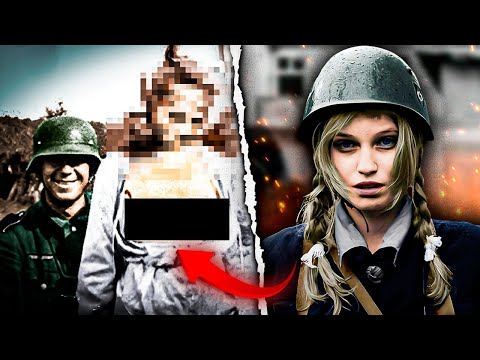
The numbers are staggering. Over 800,000 Soviet women served in the Red Army during the war. They were snipers, pilots, medics, machine gunners, partisans. The Night Witches—the all-female 588th Night Bomber Regiment—flew over 23,000 sorties, gliding silently over German lines with engines cut, dropping bombs like whispers of death. Their very existence shattered the Nazi illusion of a quick and easy conquest.
But as the tide of war turned, so too did the fate of those who fell into enemy hands. The Nazis had a name for the women they captured: untermenschen—subhuman. And they treated them accordingly.
Among the first to volunteer was a young Siberian woman named Tatiana Nikolayevna Baramzina. Born in 1919, she had dreamed of becoming a military pilot. When the war broke out, she immediately enrolled in a nursing course, then graduated with honors from a sharpshooting program. By 1944, she was a sniper with the 252nd Rifle Regiment, already credited with sixteen kills.
On July 4, 1944, her unit set an ambush near the village of Pekka. The Germans, retreating in disarray, fought back with feral desperation. Baramzina, though assigned to telephone duties, insisted on joining the fight. When the tide turned and wounded soldiers were left in a dugout, she chose to stay with them—refusing to abandon her comrades.
“She opened fire with a machine gun, killing three German soldiers as they charged the dugout.” She fought until her ammunition ran dry, then threw grenades until those too were gone. When two Germans finally entered from behind, they hurled grenades into the dugout, injuring her before dragging her out by her hair.
What followed was pure savagery. They stabbed her with bayonets, beat her with rifle butts, and finally shot her point-blank with an anti-tank rifle. Her head and body were left unrecognizable.
Her story is but one of thousands. For the women who survived capture, a different hell awaited—the concentration camps.
At Auschwitz, Soviet women were among the first to be tattooed with numbers. They were considered especially dangerous, prone to resistance, and above all, beautiful. In a block known as “Canada,” the SS selected the most attractive women for forced labor—and something far worse.
They were given food, showers, and the chance to grow their hair—in exchange for their bodies. The commandant ordered running water installed so the women could bathe, making them more “presentable” for the officers. Night after night, drunk SS men arrived to handpick girls from the barracks, and those taken rarely returned.
For those who refused to submit, the gas chambers awaited. For those who survived, silence became a prison of its own.
Yet even in this darkness, Soviet women found ways to resist—sharing food, hiding the sick, sabotaging work. Their courage did not end at the gates of the camps. It followed them back to a homeland that often greeted them with suspicion, not gratitude.
But before we reach that bitter homecoming, we must first understand what happened in the forests and villages behind German lines—where young women like Zoya Kosmodemyanskaya and Zinaida Portnova turned sabotage into an art form, and where the line between hero and martyr was measured in days.
Zoya Kosmodemyanskaya was eighteen years old when she crossed the front line in October 1941, slipping into occupied territory with a partisan unit. Her assignment was simple and brutal: burn the village of Petrishchevo, where a German cavalry regiment was stationed. She set fire to three houses before she was caught alone, trying to torch a fourth.
The Germans stripped her, beat her, and tortured her with two hundred lashes. They burned her skin with cigarettes and demanded she name her comrades. She gave them nothing. The next morning, they marched her to the village square with a board around her neck reading “house burner.”
She was hanged in front of the villagers and left hanging for weeks as a warning. In February 1942, she became the first woman named Hero of the Soviet Union during the war. She was not yet nineteen.
Even younger was Zinaida Portnova, who joined the Belarusian underground at sixteen. She poisoned the food of a Nazi garrison, killing dozens. When a Gestapo officer interrogated her, convinced she was just a harmless girl, she shot him dead with his own pistol, then killed two soldiers who rushed in at the sound.
She fled into the woods but was caught at the riverbank. She was tortured for days, then driven into the forest and executed—still not eighteen. In 1958, she too was made a Hero of the Soviet Union, her face cast in bronze in Minsk.
These were not exceptional women. They were ordinary girls who chose to fight, and the forest became their battlefield. But the forest was also where the Nazis hunted them with particular cruelty, knowing that a woman with a rifle was a symbol they could not tolerate.
And beyond the forest, in the air, another kind of woman was rewriting the rules of war.
The 588th Night Bomber Regiment flew in planes made of wood and cloth—slow, fragile, and flammable. They cut their engines near the target and glided through the darkness, the wind whistling through their struts sounding to German soldiers like broomsticks. They called them the Night Witches.
Marina Raskova, a legendary aviator, had used her personal connection to Stalin to form three female air regiments. The women who flew were in their late teens and early twenties. They carried no parachutes until 1944—the bombs were too heavy, the altitudes too low.
Together they flew over twenty-three thousand sorties and dropped three thousand tons of bombs. When a pilot was shot down, the Germans had a habit of executing the survivors on the spot. And if a Soviet pilot was captured and later liberated, her own country often branded her a traitor for having been taken alive.
That paradox—fearless in the sky, suspect on the ground—would follow many of these women long after the guns fell silent. But before the reckoning at home, there was the matter of the camps, where the war stripped away every pretense of civilization and left only the raw contest between tormentor and survivor.
It is there, behind the barbed wire of Ravensbrück and Auschwitz, that the story of Soviet women in the Second World War reaches its darkest and most defiant chapter.
Ravensbrück was built on a swamp, and the women who arrived there learned quickly that the mud was the least of their enemies. About a thousand Soviet women were eventually imprisoned within its walls, and the guards reserved a special contempt for them. They were marked with red triangles and treated as the lowest tier of the camp hierarchy—below the political prisoners, below the Jehovah’s Witnesses, below everyone.
Every morning the roll call began before dawn. The women stood in rows on the frozen ground, sometimes for hours, while the SS counted and recounted them. Those too weak to stand were beaten where they fell. Then came the selection: a flick of a gloved finger to the left meant the gas chamber, to the right meant another day of labor.
“You will not leave this place alive,” an SS guard reportedly told a group of newly arrived Soviet women. “But you will work first.”
They chopped wood in the forests, hauled water from the river, and carried stones until their hands split and bled. The clothing they were given was thin and never warm enough. Food was a cup of watery soup and a crust of bread, and the women who survived learned to ration it down to the crumb.
But something else happened in Ravensbrück that the SS had not planned for. The Soviet women organized.
They had been raised on collective principles, on the idea that the group outlasts the individual. In the barracks, they formed small circles—women from the same city, the same factory, the same school. They shared everything: bread, clothing, information, and hope. When one of them fell sick, the others covered her work quota. When a guard singled out a girl for punishment, another woman would step forward and claim the fault was hers.
Polish and Jewish prisoners later testified that these Soviet circles saved their lives. A scrap of bread passed in the dark. A warning whispered about a coming selection. A pair of shoes slipped under a bunk.
It was not heroism in the way the medals described it. It was something quieter and more stubborn—the refusal to let each other disappear.
And then there was the matter of the children. Pregnant women arrived at Ravensbrück regularly, and the camp authorities had a policy for them. Infants were taken from their mothers within days of birth. Some were drowned. Others were sent to makeshift nurseries where they were left to die of exposure and starvation. The mothers were given no explanation, no grave, no name to mourn.
Olga Benário Prestes had already lost her daughter this way—taken from her in a Berlin prison, raised by her husband’s family in Brazil, a child she would never see again. When Olga was transferred to Bernburg in 1942 and gassed, the women who had known her in Ravensbrück understood that the same fate awaited them all.
But the war was turning. By late 1944, the Red Army was advancing from the east, and the Germans began to dismantle the camps, marching prisoners westward in columns that became known as death marches. Women who had survived years of starvation and beatings now faced the final cruelty: a forced march through snow, with no food, no shelter, and guards who shot anyone who fell behind.
Thousands died on those roads. But thousands more kept walking—through the winter, through the chaos, until the Allied armies finally reached them.
And when the survivors returned east, they discovered that the war had not finished with them yet.
The Soviet authorities had a phrase for returning prisoners of war: vrag naroda—enemy of the people. Stalin’s Order No. 270 declared that any soldier who surrendered was a traitor, and women were not exempt. Anna Yegorova, who had flown 270 combat missions, was stripped of her Hero of the Soviet Union medal simply because she had been taken alive.
She was interrogated for eleven days straight. “Kill me if you like, but I won’t let you torment me anymore,” she finally screamed at her accuser. Only the testimony of the doctors who had treated her in the POW camp saved her from the gulag.
Others were not so fortunate. Thousands of women who survived the camps were sent to filtration camps, then to Siberia. Their medals were revoked. Their Party cards were confiscated. Their neighbors whispered that they must have collaborated, because real heroes died rather than be captured.
Yet they had fought. They had flown. They had bled and buried their friends and refused to break. The Night Witches, the snipers, the partisans, the nurses who crawled through artillery fire—they had done everything their country asked, and more.
Today, their stories are finally being told. The names of Zoya and Zinaida, Tatiana and Anna, Olga and Marina are carved into monuments and printed in books. But for every named heroine, there are hundreds whose stories died with them—anonymous women who vanished into the camps or the snow or the silence of a suspicious homeland.
They gave everything for a world free of fascism, and asked for nothing but to be remembered. So remember them: the women who fought when the world said they could not, who endured what no one should, and who returned to a country that did not always want them back.
What would you have done, in their place—fought, survived, and then faced a homeland that called you a traitor? Share your thoughts below.
Report this article
Select a reason for reporting:






