On the 18th of June 1815, two of history’s greatest commanders finally met on the battlefield. Napoleon Bonaparte, the Emperor of France, and the Duke of Wellington, Britain’s most formidable general, had never faced each other in combat. Both born in 1769, they had fought their first battles within a year of each other. Napoleon had fought over 80 battles, losing about 10. Wellington had fought 30 and had never been defeated. Now, on a rain-soaked ridge near the village of Waterloo, their armies would collide in a struggle that would decide the fate of Europe.
The odds seemed stacked against Wellington. His army was a patchwork of British, Dutch, Belgian, and German troops—only about a third were British. Napoleon’s forces were more experienced and outnumbered Wellington in artillery nearly two to one. As the French guns roared to life, Wellington knew he had to hold on until the Prussians arrived. The battle would rage for eight hours, leaving nearly 50,000 dead and wounded. It was, as Wellington later said, “the nearest run thing you ever saw in your life.”
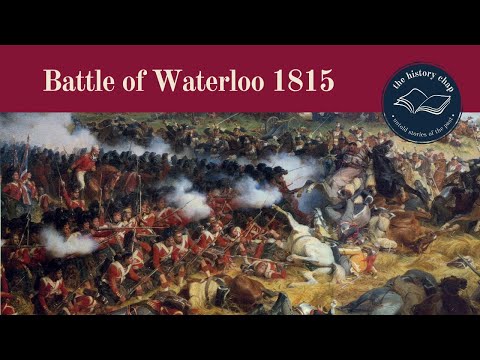
Napoleon’s plan was to smash through Wellington’s center and drive the Allied army from the field. But Wellington had chosen his ground well. He positioned troops in the fortified farms of Hougoumont and La Haye Sainte, which became killing grounds for the French. At Hougoumont, a desperate struggle unfolded as the French tried to break through the farm’s gates. Sergeant Graham managed to bring down the bar on the door, securing the gate for the British. The farm held out all day, draining thousands of French troops.
Meanwhile, the French infantry under Marshal Ney advanced against Wellington’s center. They were met by a devastating volley from the British Guards, who then charged with bayonets. “Now Maitland, now’s your time!” Wellington reportedly shouted as the Guards rose from the tall grass. The French reeled back, and the tide of battle began to turn.
But the crisis was not over. Napoleon sent his elite Imperial Guard forward, the finest soldiers in his army. As they advanced up the ridge, they were met by the British 52nd Foot, who poured a deadly fire into their flank. The Guard faltered, then retreated. “The guard dies but does not surrender!” they cried, but the battle was lost. Wellington waved his hat, ordering a general advance. The French army broke, and the Prussians arrived to seal the victory.
Napoleon fled the field, leaving behind 25,000 killed or wounded and 8,000 captured. Four days later, he abdicated for the second time. He surrendered to the British and was exiled to Saint Helena, where he died in 1821. Wellington’s victory was complete, but it came at a terrible cost. His own army had lost 15,000 men. As he surveyed the carnage, Wellington wrote, “Nothing except a battle lost can be half as melancholy as a battle won.”
Yet the story of Waterloo is not merely one of British triumph. It is the story of an alliance—fragile, improvised, and held together by a commander who understood that victory belonged to no single nation. Wellington’s army was a coalition in miniature: Dutchmen under the young Prince of Orange, Belgians who had fought for Napoleon only months before, Hanoverians and Brunswickers whose homelands lay under French occupation, and the men of the King’s German Legion, exiles in red coats who had never set foot in Britain.
It was the King’s German Legion that held La Haye Sainte to the bitter end. The farm’s defenders had torn down its main gate the night before to use as firewood, never imagining they would need it. When two battalions of French infantry came storming up the slope, there was no gate to slam shut. Of the 360 men inside, only 39 survived. Their sacrifice bought Wellington precious time—time for the Prussians to arrive, time for the line to hold.
And arrive the Prussians did. Marshal Blücher, the old warrior who had been unhorsed and ridden over at Ligny two days earlier, kept his promise. His troops streamed onto the eastern flank, forcing Napoleon to divert the Imperial Guard before it could finish Wellington. That delay—perhaps an hour, perhaps less—was the margin between victory and annihilation.
So Waterloo was never a purely British victory, though British troops bore the heaviest burden on the ridge. It was Dutch and Belgian battalions who threw back the Middle Guard at the crisis. It was German artillerymen who served the guns. It was Prussian bayonets that turned a retreat into a rout. Wellington commanded them all, and in doing so, held together an army that had never fought together before.
In the years that followed, Waterloo became a legend—a story of redcoats and squares, of cavalry charges and dying guardsmen. But the legend obscures the reality: a desperate, bloody, improvised stand by soldiers from half a dozen nations, who held a muddy ridge against the greatest commander of the age. Wellington himself never forgot it. “Believe me,” he later said, “nothing except a battle lost can be half so melancholy as a battle won.”
And yet, even as the guns fell silent and the wounded cried out across the waterlogged fields, the consequences of that June day were only beginning to unfold. Napoleon would soon surrender, and the map of Europe would be redrawn. But for the men who fought at Waterloo, the battle would never truly end—it would follow them for the rest of their lives.
Napoleon’s final act was not on the battlefield but on a rocky island in the South Atlantic. He spent his last years dictating his memoirs, crafting the legend that would inspire future generations. He died in 1821, still insisting he had been defeated not by Wellington, but by fate and treacherous subordinates.
Wellington lived on for another thirty-seven years. He became Prime Minister, commanded armies, and watched his victory at Waterloo become a national myth. Yet he never gloried in it. When asked late in life if he had ever been afraid at Waterloo, he replied that he had been afraid every minute. “I don’t think I ever saw anything more terrible than that battlefield,” he confessed to a friend.
The two men never met again. Napoleon never learned that Wellington had admired his military genius—even as he worked to destroy it. Wellington never forgot the cost of his victory: the mud, the blood, the screams of the wounded echoing through the night.
Today, the battlefield is a quiet place. Tourists wander the ridge, photograph the Lion’s Mound, and buy postcards. But stand there at dusk, when the mist rises from the fields, and you can almost hear the cannon. Waterloo was the closest-run thing, and the men who fought there knew it.
Wellington’s own words remain the truest epitaph: “Nothing except a battle lost can be half so melancholy as a battle won.” The battle ended Napoleon’s empire, but it also broke the men who won it. And that, perhaps, is the real story of Waterloo—not the glory, but the cost.
What do you think? Was Waterloo Wellington’s greatest victory, or was it simply the luckiest day of his life? Let me know in the comments below.
Report this article
Select a reason for reporting:






