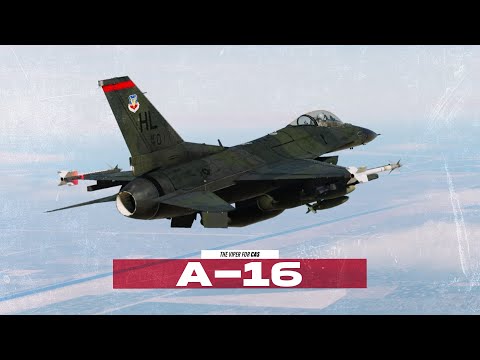
In the mid-1980s, the United States Air Force faced a dilemma. The A-10 Warthog, designed specifically for close air support, was proving its worth in exercises but had powerful detractors who questioned its slow speed and vulnerability in contested airspace. Meanwhile, the F-16 Fighting Falcon, a nimble dogfighter, was being considered for a radical transformation. Could a lightweight fighter be turned into a heavy-hitting close air support platform to rival the Warthog? The answer would lead to one of the most controversial and short-lived experiments in modern military aviation.
The story begins with a simple question: what if the F-16 could carry a massive 30mm cannon and enough ordnance to loiter over the battlefield? The Air Force greenlit the A-16 program in December 1986, aiming to overhaul the F-16 airframe with a stronger structure, a 30mm cannon, and even 7.62mm minigun pods. Proponents argued that the Viper’s speed and agility would make it a superior close air support asset. Critics, however, were not convinced. They pointed to the Warthog’s unique ability to fly low and slow, absorb punishment, and carry an enormous payload. The debate raged, with some even suggesting the Army should take over the A-10 if the Air Force didn’t want it.
As the 1980s drew to a close, the A-16 project gained a new designation: A-16 Block 60. F-16A Block 15s and F-16C Block 25s were painted in European 1 camouflage, ready for testing. But resistance grew. Many inside and outside the Air Force favored the Warthog or a dedicated “mud fighter” design. General Larry D. Welch, Air Force Chief of Staff, famously declared, “I don’t give a damn how you slice that data… The data does not say mud fighter, the data says A-16.” Yet, budget cuts and congressional mandates forced the Air Force to retain a number of A-10s, effectively ending the A-16 concept in November 1990.
But the desire for a close air support F-16 didn’t die. The Air Force then pursued the F/A-16, upgrading Block 30 F-16s with GPS, digital terrain mapping, and a modular mission computer. The 174th Tactical Fighter Wing even equipped 24 F-16A Block 10s with a 30mm gun pod—the GPU-5A Pave Claw—mounted on the centerline pylon. The plan seemed promising: a miniaturized version of the A-10’s cannon, with 350 rounds, would give the Viper a punch. Test flights with the cannon installed went smoothly during takeoff, landing, and cruising. But then came live-fire testing.
The results were disastrous. When the 30mm cannon fired, the entire aircraft shook violently. Pilots reported that the vibrations made aiming nearly impossible and even affected the aircraft’s ability to fly. “The vibrations were so intense that it not only made aiming extremely difficult, it even affected the aircraft’s ability to fly properly,” one pilot recalled. Unlike the A-10’s robust internal mountings, the pod transferred the recoil through a single pylon, amplifying the force. The F-16’s speed made aiming even harder, and without the CCIP system, pilots had to rely on outdated run-in methods. After just a few days, pilots complained they could barely control the aircraft when firing, resorting to spraying the cannon as an area-effect weapon. To make matters worse, the heat and gases from the gun were singing the right side of the fuselage.
By the end of 1991, the setup was deemed unacceptable. The pods were unbolted and removed. The F/A-16 was dropped in January 1992 in favor of equipping Block 40 F-16s with the LANTIRN system. The experiment had failed, but it left behind a valuable lesson: the Warthog’s design was uniquely suited for close air support, and turning a Viper into a Warthog was a bridge too far.
As Pierre Sprey, a Pentagon engineer who worked on both the F-16 and A-10 programs, noted, the A-10 had accounted for two-thirds of tank kills and nine-tenths of artillery kills during Desert Storm while making up only one-twelfth of the aerial force. The A-16’s primary argument—that the Warthog was vulnerable due to its low operating altitude—was contradictory, for the A-16 was designed to negate the F-16’s high-altitude strike capabilities in favor of the very same low-level tactics, albeit without the Warthog’s strength and triple redundancy. In the end, the A-16 remains a fascinating footnote in aviation history, a testament to the challenges of adapting a design for a role it was never meant to fill.
Yet the story of the cannon-armed Viper did not end with the removal of the pods. In the corridors of the Pentagon, a quieter debate continued to simmer. The A-16 had failed, but the underlying question—how to provide effective close air support in a high-intensity conflict—remained unanswered. The Air Force’s leadership had made their preference clear: precision strikes from medium altitude, using guided munitions and advanced targeting pods. The Warthog, with its low-and-slow approach, was seen by many as a relic of a bygone era.
But the troops on the ground saw things differently. For them, the A-10 was a guardian angel. Its distinctive gun run—the brrrt of the GAU-8—was more than just firepower; it was a psychological weapon. The mere presence of a Warthog overhead could break an enemy assault. “When you hear that gun, you know someone up there cares,” one Army sergeant later remarked. The F-16, for all its speed and agility, could never replicate that feeling.
The failed F/A-16 experiment did, however, leave a legacy. The lessons learned from the vibration issues and the pylon-mounted cannon informed later efforts to integrate heavier weapons onto fighter aircraft. The Falcon Eye flare system, developed during the program, proved its worth in tests and was quietly adopted for other platforms. And the concept of a specialized close air support variant of an existing fighter didn’t disappear entirely—it simply morphed into upgrades rather than radical conversions.
By the mid-1990s, the Air Force had shifted its focus. The Block 40 F-16s equipped with LANTIRN pods became the primary night-attack platform, capable of delivering precision-guided munitions with deadly accuracy. The A-10 fleet, meanwhile, was kept alive through incremental upgrades—new wings, improved avionics, and eventually the A-10C conversion. The Warthog soldiered on, proving its critics wrong time and again, from the Balkans to Iraq and Afghanistan.
Yet the ghost of the A-16 lingered. In the early 2000s, as the Air Force once again debated retiring the A-10, the old arguments resurfaced. Proponents of the Warthog pointed to its unique capabilities, while critics argued that modern fighters could do the job more efficiently. The F-35, with its advanced sensors and stealth, was touted as the future of close air support. But veterans of the A-16 program knew better. “You can put a cannon on anything,” one retired engineer said, “but that doesn’t make it a Warthog.”
The A-16 had been an ambitious attempt to merge two very different philosophies of air power. It failed not because the F-16 was a bad aircraft, but because the role of close air support demanded specific traits—loiter time, survivability, and a certain stubbornness—that the Viper simply didn’t possess. The experiment was a reminder that in military aviation, as in nature, form follows function. The Warthog was built for one job, and it did that job better than anything else.
As the sun set on the A-16 program, the F-16 continued to evolve into a multirole powerhouse, serving in air forces around the world. The A-10, meanwhile, became a beloved icon, its future perpetually uncertain but its place in history secure. The two aircraft, born from different eras and different needs, had crossed paths briefly in the late 1980s. It was a meeting that produced more questions than answers—and a lasting lesson about the limits of adaptation.
In the years that followed, the A-16’s failure became a case study at military war colleges. Instructors would present the program to young officers as a cautionary tale about the dangers of forcing a platform into a role it was never designed for. But the lessons were not always heeded. The temptation to find a single, cost-effective solution to every mission persisted, and the F-16’s versatility made it an easy target for such ambitions.
By the late 1990s, another idea emerged from the same lineage. With the A-10 fleet aging and modernization costs climbing, some planners proposed a dedicated “strike fighter” variant of the F-16 that would carry standoff weapons and advanced sensors to suppress enemy air defenses. This time, the emphasis was on precision and survivability rather than low-level gun runs. The proposal gained little traction—budget realities and the overwhelming success of the A-10 in the Balkans kept the Warthog alive.
Still, the ghost of the cannon-armed Viper haunted conversations at airshows and in squadron ready rooms. Pilots who had flown the test aircraft spoke of the sheer violence of firing that 30mm pod. “It felt like the jet was trying to shake itself apart,” one test pilot recalled decades later. “You’d squeeze the trigger and the whole world turned into a blur of vibration and noise. Aiming? Forget it. You were just hoping the rounds went somewhere near the target.”
What few outside the program knew was that the vibration problem had a deeper cause. The GPU-5A pod was originally designed for the F-5 Freedom Fighter, a much smaller and lighter aircraft. Mounting it on the F-16’s centerline pylon created a harmonic resonance that engineers had not fully anticipated. The pod’s recoil mechanism, optimized for a different airframe, transferred energy directly into the Viper’s slender fuselage. The result was not just discomfort for the pilot but genuine structural fatigue. Inspections after the live-fire tests revealed hairline cracks in the pylon mounting points—a finding that sealed the program’s fate.
The Air Force quietly buried the results. There was no formal cancellation ceremony, no public explanation. The modified F-16s were returned to their original configurations, the gun pods shipped back to storage, and the test reports classified for years. Only later, through Freedom of Information Act requests, did aviation historians piece together the full story.
Meanwhile, the A-10 continued to prove its worth. In 1999, during Operation Allied Force, Warthogs flew thousands of sorties over Kosovo, destroying tanks, artillery, and armored vehicles with impunity. The aircraft that the Air Force brass had once dismissed as obsolete was now the most requested asset by ground commanders. “The A-10 is the only aircraft that can do what it does,” a NATO commander remarked at the time. “You can’t replace that with a fighter that drops a bomb from 20,000 feet and flies away.”
Back at Nellis Air Force Base, the lessons of the A-16 were being applied in a different way. The Fighter Weapons School began incorporating close air support scenarios into its F-16 training syllabus, emphasizing low-angle strafing runs with the Viper’s internal 20mm cannon. Pilots learned to use the aircraft’s speed and agility to make quick, precise passes rather than lingering over the battlefield. It wasn’t the same as a Warthog’s sustained presence, but it was a recognition that the F-16 could still contribute to the mission—just not in the way the A-16’s designers had envisioned.
The A-16’s legacy also lived on in the technology it spawned. The digital terrain mapping and modular mission computer developed for the F/A-16 found their way into later Block 50 and Block 52 Vipers. The automatic target handoff system, tested in the program, became a standard feature on modern fighters, allowing pilots to share targeting data with ground units in real time. Even the Falcon Eye flare system, a minor success in an otherwise failed program, influenced later night-attack sensors.
But perhaps the most enduring lesson was philosophical. The A-16 had tried to make the F-16 into something it was not—a low-and-slow gun platform. In doing so, it ignored the fundamental truth that the Warthog’s designers had understood from the start: close air support is not just about firepower. It is about presence, persistence, and the willingness to put the aircraft in harm’s way to protect the troops below. The F-16 could never match the A-10 in those qualities, no matter how many cannons were bolted to its belly.
Decades later, the question resurfaced in a different form. As the Air Force once again debated retiring the A-10, a new generation of planners proposed arming F-16s with precision rockets and small-diameter bombs to fill the close air support gap. The old arguments echoed through briefing rooms: speed, survivability, cost. But veterans of the A-16 program shook their heads. “We tried that already,” one retired colonel said. “The Viper is a fantastic aircraft, but it’s no Warthog. Some lessons you only learn once.”
The A-16 remains a footnote, but a telling one. It proved that adaptability has limits, and that the bond between a ground soldier and the aircraft overhead is built on more than specifications. The Warthog endures because it was designed with that bond in mind. The Viper, for all its brilliance, was built for a different sky.
So what do you think—could a modern F-16 ever truly replace the A-10, or is the Warthog irreplaceable? Share your thoughts in the comments below.
Report this article
Select a reason for reporting:






