Before the first shot was fired, the war had already begun—not on the battlefield, but in the minds of millions. Adolf Hitler understood a truth that would reshape history: to conquer the world, he first had to conquer perception. And he had the perfect architect for that dark ambition—Joseph Goebbels.
While the German people celebrated the bloodless annexations of Austria and the Sudetenland, basking in the glow of diplomatic triumph, a far more sinister machinery was quietly whirring to life. Hitler wanted more. He wanted war. But the public, still scarred by the humiliation of Versailles, had no appetite for it. They would need to be convinced—or manipulated.
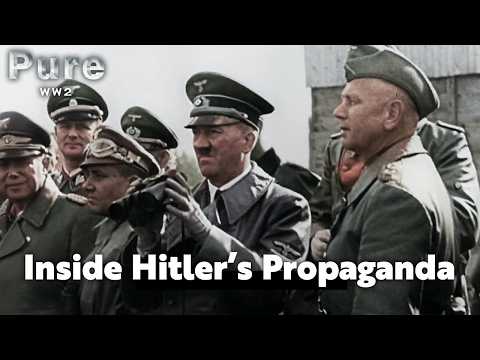
By 1939, the Nazi propaganda apparatus was a well-oiled beast. Every newspaper, every radio broadcast, every film reel fed the same narrative: Germany was the victim. Poland, the aggressor. “The need to go and free these Germans who were trapped in Polish territory,” the propaganda screamed, framing invasion as liberation.
The lie was so effective that even the German public believed it. When SS officers, dressed in Polish uniforms, staged a fake attack on a radio station on August 31, 1939, the stage was set. The next day, Germany invaded Poland—and the world was told it was self-defense.
But Goebbels knew that propaganda alone wasn’t enough. He needed the people to feel it—to see it, to live it. And nothing captured the hearts and minds like film.
In 1940, over one billion cinema tickets were sold in Germany. Newsreels became the pulse of the nation, delivering curated victories and sanitized horrors. Goebbels famously claimed that private photos taken by soldiers were “a thousand times more valuable” than official propaganda—because they felt real.
Yet the most insidious films were yet to come. The Eternal Jew, released in 1940, was a masterclass in dehumanization. It painted Jews as a global threat, a plague to be eradicated. “The film shows the Jews as responsible for what’s happening,” one historian notes—a chilling foreshadowing of the Holocaust.
As Germany’s military swept across Europe, the propaganda machine promised a swift victory. “One more thing,” the regime insisted, “and the war will be over.” The public, initially skeptical, became drunk on success. Each conquest was framed as defense against foreign aggression, each victory a step toward a new German empire.
But when Britain refused to fall, the narrative shifted. Churchill became the villain, the Jews his puppet masters. “Behind the enemy powers, the Jew,” posters declared, linking the Soviet Union, Britain, and America to a supposed Jewish conspiracy.
By the time the United States entered the war, Nazi propaganda had a new target: America, the greedy empire builder. “They had no culture,” Goebbels instructed, “only consumerism and greed.” Yet even as the lies grew bolder, cracks began to show.
After Stalingrad, the propaganda machine faced its greatest challenge. The Sixth Army had been annihilated, but the regime lied. “They died fighting for the nation,” Goebbels declared, turning defeat into martyrdom. His “Total War” speech on February 18, 1943, was a masterpiece of manipulation—a crowd whipped into frenzy, screaming “Ja!” as he asked if they wanted total war.
But the tide had turned. The lies could no longer hide the truth. As Allied bombs rained down on Berlin, the propaganda machine kept churning, even as the Reich crumbled. “Hitler is victorious,” the newspapers still claimed, days before the Führer took his own life.
In the end, reality brought the illusions crashing down. Hitler’s propaganda was more than a tool—it was the medium of government, a manufactured reality that consumed its own creators. And as the world would learn, the cost of those lies was measured in millions of lives.
The story of Nazi propaganda, however, did not end in the rubble of Berlin. Its echoes would reverberate through the decades that followed, shaping the way we understand truth, power, and the terrifying fragility of the human mind.
In the immediate aftermath of the war, the Allied powers faced a daunting question: what to do with the millions of Germans who had been immersed in this manufactured reality for over a decade? The denazification process attempted to strip away the layers of indoctrination, but the task was monumental. How do you unmake a reality that has been woven into the fabric of everyday life?
The Nuremberg Trials exposed the horrors that propaganda had concealed. The world watched as the architects of the Reich—those who had survived—were forced to confront the consequences of their lies. Yet many Germans claimed ignorance. They had not known. They had not looked. The regime had told them not to.
But the propaganda had left its mark. The images, the slogans, the carefully constructed narratives—they had seeped into the collective consciousness. The generation that grew up under Hitler’s spell would carry that shadow for the rest of their lives.
In the decades that followed, the tools of propaganda evolved. The radio gave way to television, and television to the internet. But the fundamental mechanics remained the same. Simple messages. Repetition. An external enemy to blame. A threat to justify action.
Edward Bernays, the father of public relations and a nephew of Sigmund Freud, had written in his 1928 book Propaganda that the conscious and intelligent manipulation of the organized habits and opinions of the masses was an important element in democratic society. The Nazis had taken this principle and weaponized it to an unprecedented degree.
Their techniques—the big lie, the scapegoat, the manufactured crisis—became a template for authoritarian movements around the world. The machinery of mass persuasion that Goebbels had perfected was studied, adapted, and replicated.
Yet the story of Nazi propaganda is not merely a historical cautionary tale. It is a mirror held up to our own age. The same vulnerabilities that allowed Hitler to manipulate an entire nation—the desire for simple answers, the comfort of belonging, the fear of the other—remain deeply embedded in human nature.
What made the Nazi propaganda machine so effective was not just its reach, but its sophistication. Goebbels understood that people do not respond to dry facts; they respond to stories. They respond to emotion. They respond to the feeling of being part of something larger than themselves.
He gave the German people a narrative of victimhood and redemption, of struggle and triumph. He made them feel righteous. And in doing so, he made them complicit in the most terrible crimes of the twentieth century.
In the end, the Nazi propaganda machine could not save the regime from destruction. But it had achieved something perhaps even more disturbing: it had shown how easily truth can be buried, how quickly a nation can be led to believe the unbelievable, and how profoundly the human mind can be reshaped by the relentless repetition of lies.
The lessons of Hitler’s propaganda are not confined to the history books. They are written in the headlines we read today, in the algorithms that curate our news feeds, in the echo chambers that reinforce our beliefs. The tools have changed, but the game remains the same.
And the question that haunted the postwar world still haunts us now: if it could happen there, in the heart of civilized Europe, could it happen again? The answer, historians warn, is that it always can. The machinery of manipulation is always waiting, ready to be switched on. All it requires is a willing leader, a receptive audience, and a truth that is just pliable enough to be bent.
But perhaps the most unsettling legacy of Goebbels’ machine is not that it worked so well on its own people, but that its methods proved so portable. After 1945, the Nazi propaganda apparatus was dismantled, its architects dead, imprisoned, or in hiding. Yet the playbook survived.
In the Cold War that followed, both East and West built their own propaganda empires, borrowing liberally from the techniques the Nazis had refined. The Soviet Union had its own Ministry of Truth in all but name, controlling every newspaper, every broadcast, every film that reached its citizens. The United States, meanwhile, poured money into the CIA’s cultural programs, funding magazines, orchestrating book publications, and shaping the narrative of the free world versus the communist menace.
The language was different. The symbols were different. The underlying architecture was eerily familiar.
What made the Nazi model so durable was its understanding of human psychology—a dark insight that later propagandists would study with clinical precision. Goebbels had grasped that people do not merely accept lies if they are repeated often enough; they come to need them. The lie becomes a kind of shelter, a way of making sense of a frightening world.
When the war ended, the German people were forced to confront the wreckage of that shelter. But the psychological mechanisms that had made them vulnerable did not disappear with the regime. They simply lay dormant, waiting for new circumstances to activate them.
In the 1950s and 1960s, as West Germany rebuilt itself, a strange amnesia settled over the nation. The Wirtschaftswunder—the economic miracle—became a kind of national sedative, allowing people to focus on prosperity and forget the past. The propaganda of the Nazi era was condemned, but the deeper question—how ordinary people had been persuaded to accept the unacceptable—was quietly shelved.
It was easier to treat Goebbels as a monster, an aberration, than to confront the uncomfortable truth that his methods had worked because they tapped into something universal in human nature.
Historians and psychologists would spend decades trying to understand the mechanics of that persuasion. Stanley Milgram’s obedience experiments in the 1960s revealed how readily ordinary people would follow orders that violated their conscience. Philip Zimbardo’s Stanford prison experiment showed how quickly individuals could be transformed by the roles they were assigned. Each study seemed to echo the same unsettling conclusion: the line between civilization and barbarism is thinner than we like to believe.
The Nazi propaganda machine had exploited this fragility with ruthless efficiency. It had created a world where the unthinkable became normal, where cruelty was dressed as duty, where lies were accepted as truth because the alternative—admitting the deception—was too painful to bear.
And in the decades that followed, as new technologies transformed the way information was consumed and shared, the lessons of that machine took on a new urgency. The radio and the cinema had been powerful, but they were nothing compared to what was coming.
The internet arrived like a tidal wave, sweeping away the old gatekeepers of information. Suddenly, anyone could publish, anyone could broadcast, anyone could shape the narrative. It was a revolution in human communication—and it carried within it the seeds of a new kind of propaganda, one that Goebbels could scarcely have imagined.
Social media algorithms learned to feed people what they wanted to see, what they wanted to believe. Echo chambers formed, reinforcing existing biases and insulating people from opposing views. The machinery of manipulation had found a new home—and it was everywhere.
In the second decade of the twenty-first century, as populist movements surged across Europe and the United States, the vocabulary of the 1930s began to resurface. Immigrants were cast as threats. Elites were blamed for national decline. The concept of a pure, unified people—a Volk—was resurrected in new forms, wrapped in the language of patriotism and sovereignty.
The parallels were not lost on those who remembered. Scholars of authoritarianism warned that the conditions that had allowed Hitler to rise were re-emerging: economic anxiety, cultural dislocation, a distrust of institutions, and a longing for strong leaders who promised simple solutions.
Yet the most chilling similarity was not in the specific messages, but in the mechanism itself. The same techniques that Goebbels had perfected—the big lie, the scapegoat, the relentless repetition—were being deployed again, this time through smartphones and social networks.
The propaganda of the twenty-first century was not delivered by a single ministry from a central office. It was distributed, decentralized, viral.
And that made it, in some ways, even more dangerous. Because when everyone is a broadcaster, when every individual can become an unwitting amplifier of falsehood, the truth becomes harder to pin down. Reality itself becomes contested, a battlefield where competing narratives clash and no one can agree on what is real.
Goebbels had understood that the most effective propaganda does not feel like propaganda at all. It feels like common sense. It feels like the voice of the people. It feels like truth.
As the world entered an era of deepfakes, algorithmic manipulation, and state-sponsored disinformation campaigns, the ghost of the Nazi propaganda machine loomed larger than ever. The tools had changed, but the fundamental vulnerability—the human capacity to be deceived, to be led, to be manipulated—remained unchanged.
The machinery Goebbels built was destroyed, but its blueprint was not. “The most effective propaganda does not feel like propaganda at all,” one historian observed—and that insight became the dark inheritance of the digital age.
Where Hitler needed ministries and film chambers, today’s manipulators need only an algorithm. A lie repeated across a thousand feeds becomes indistinguishable from truth. The scapegoat returns, the manufactured crisis returns, the comforting narrative of victimhood returns—only now it arrives in your pocket, personalized and relentless.
The lesson of Nazi propaganda is not that evil can triumph through lies. It is that ordinary people, when frightened and offered simple answers, will look away from what they do not wish to see. The regime said, “Don’t look.” And the world learned what happens when enough people obey.
So the question is no longer whether it could happen again. The machinery is already humming. The only question left is this: when the next big lie arrives at your screen, dressed as common sense—will you look closely enough to see it?
Report this article
Select a reason for reporting:






