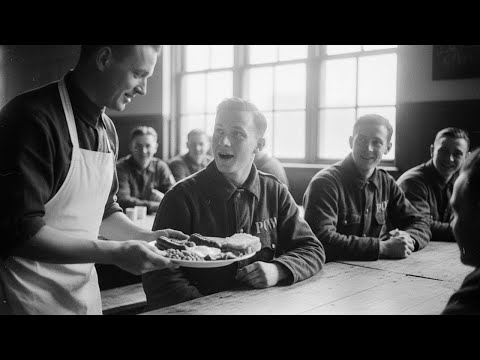
March 1943. The war had been grinding on for nearly four years, and for Oberleutnant Klaus Zimmermann, the world had just been turned upside down. He sat in the back of a British military truck, his hands loosely bound, watching the English countryside roll past through a canvas flap. He was a 26-year-old Luftwaffe pilot, shot down over Tunisia just three weeks ago. Now he was a prisoner, being transported to a camp in Yorkshire. Klaus had grown up believing Germany would win this war easily. He had been a member of the Hitler Youth since he was ten. They taught him that Germans were superior, that the British were weak and starving on their little island. The propaganda minister, Joseph Goebbels, broadcast on the radio every week about how Britain was about to collapse. Klaus had seen the posters showing skinny British children with empty bowls, desperate mothers standing in front of bare shop shelves. He believed it all.
Back home in Hamburg, things had gotten very hard. Food rationing started in 1939, right when the war began. At first it wasn’t too bad, but by 1943 each German person only got about 1,700 calories worth of food per day. Before the war, people ate about 3,000 calories daily. Klaus’s mother stood in line for hours just to get 300 grams of meat per week. That was barely 10 ounces for seven whole days. The bread they ate now had sawdust mixed into it to make it stretch further. Real coffee disappeared from the stores in 1941. Chocolate was just a memory. His little sister was eight years old and had never tasted a banana. The government kept telling them to sacrifice for the war effort, that victory was just around the corner. Meanwhile, everyone was always hungry.
Klaus figured that if Germans were suffering like this, the British must be dying. After all, Germany controlled most of Europe. The German U-boats were supposed to be sinking every British supply ship in the Atlantic Ocean. How could that tiny island nation possibly feed itself? Even before the war, everyone knew British food was terrible. Boiled vegetables with no seasoning, gray meat with no flavor, everything overcooked and bland. His father used to joke that the British had conquered half the world searching for spices, then refused to use any of them. Now, with war rationing, Klaus imagined it must be even worse. Watery soup, boiled cabbage, stale bread, all tasteless and gray. He expected to arrive at a prison camp where even the guards looked thin and tired, eating flavorless slop from tin plates. He had prepared himself mentally for months of hunger and boredom. It would be hard, but he was a soldier. He would endure it.
The truck turned through a gate. Klaus saw a sign that read “Camp 186”. There were about 847 German prisoners here, he would learn later. The camp sat in the Yorkshire countryside surrounded by green fields that seemed impossibly lush compared to the bombed cities he remembered. Tall fences topped with wire surrounded the wooden barracks. British soldiers in clean uniforms walked the perimeter. Klaus was processed through an intake station where they took his information and gave him prison clothes. A camp commandant named Colonel Davies spoke to the new arrivals briefly. He was an older man with gray at his temples, firm but not cruel in his manner. He told them they would be treated according to the Geneva Convention rules. Klaus barely listened. He was too busy trying to understand what he was seeing.
The British guards looked healthy, not starving, not desperate. Actually, they looked well-fed. Their uniforms fit properly. Their boots were in good condition. One stood near the gate eating an apple, casually tossing it up and catching it like he had apples to spare. Klaus felt confused. Where was the starvation? Where were the desperate faces? A mess sergeant named Harold Thompson walked past, a thick man with rosy cheeks and strong arms. He had fought in the trenches during the First World War, Klaus would later discover. Harold was laughing at something another guard had said. How could a nation about to lose a war have soldiers who laughed?
Then Klaus smelled something that made him stop walking. It drifted from the camp kitchen on the evening breeze: bacon. The unmistakable smell of frying bacon. He thought he must be imagining it. Bacon had disappeared from German stores two years ago. It was rationed so severely that most families never saw it. But the smell was real, rich and fatty and impossible to mistake. Klaus felt his mouth water against his will. A British sergeant noticed him sniffing the air and grinned. The sergeant had a crooked front tooth and kind eyes. He said something in English that Klaus didn’t fully understand, but he caught two words clearly enough: “Sunday” and “treat”. The sergeant made a gesture like eating, then patted his stomach and smiled wider. Klaus turned away, angry at himself for caring about food, angry at the British for this confusing kindness.
That night in the barracks, Klaus lay on his bunk and stared at the ceiling. The mattress was thin but clean. The blanket was wool, not the scratchy synthetic material they made in Germany now. Through the window, he could see lights in the guard station, actual electric lights burning bright and steady. Back in Hamburg, the city had rolling blackouts to save power for the war factories. Here, the British seemed to have electricity to waste. Klaus thought about his mother standing in line for her tiny meat ration. He thought about his sister who had never eaten chocolate. He thought about the guard eating that apple like it was nothing special. He thought about the smell of bacon. Something felt wrong. All of it felt wrong. The propaganda had told him one story, but his eyes were showing him something completely different.
In the darkness, Klaus heard another prisoner whisper a question to his bunkmate. The words were in German. He asked if the other man had noticed how healthy the British looked. The bunkmate whispered back that he had noticed. They both went quiet after that, left alone with thoughts neither wanted to speak out loud. Sunday was in two days. Klaus didn’t know why, but he felt like something important was going to happen. Something that would make him see things differently. The sergeant’s words echoed in his mind. “Wait till Sunday. You’re in for a treat.” Klaus closed his eyes and tried to sleep, but the smell of bacon lingered in his memory, refusing to fade.
Sunday morning came with pale March sunlight filtering through the barracks windows. Klaus woke to the sound of a bell ringing across the camp. It was 7:00 on March 21st, 1943. Other prisoners were already climbing out of their bunks, talking quietly in German about breakfast. Klaus pulled on his prison uniform and joined the line of men shuffling toward the mess hall. His stomach felt tight and empty. He expected thin porridge, maybe a slice of that terrible ersatz bread with sawdust mixed in. That was what people ate during wartime. That was what sacrifice looked like.
The mess hall was a long wooden building with rows of tables and benches. The room smelled like cooking fat and something else Klaus couldn’t quite identify. British guards stood along the walls watching but not threatening. The prisoners formed a line, each man taking a metal tray from a stack near the serving counter. Klaus picked up his tray. The metal felt cold in his hands. He moved forward in line expecting the worst. Then he reached the counter and everything he thought he knew about this war fell apart.
A British cook placed items on his tray one by one. First, two fried eggs. Not the powdered eggs that Germany had been using since 1941. Real eggs with bright yellow yolks that wobbled when the tray moved. Then three strips of bacon, properly fried, still sizzling slightly, the fat glistening under the mess hall lights. Two pork sausages, thick and brown and real. A scoop of baked beans in tomato sauce, the beans plump and whole. A grilled tomato, cut in half, the flesh soft and warm. Mushrooms, actually cooked with butter from the smell of them. Two slices of bread that had been fried in the bacon fat, golden and crispy. Something dark that the cook called black pudding, made from blood and oats. And finally, a tin cup of hot tea with real milk—not the blue watery substitute—and the cook dropped in two full teaspoons of actual white sugar.
Klaus stood there holding the tray, unable to move. His hands started shaking. The prisoner behind him said something impatient in German, pushing him forward. Klaus walked to a table in a daze and sat down. He stared at the food. This single plate contained more meat than his mother received in an entire week. Her ration back in Hamburg was 300 grams, barely 10 ounces, and she had to stand in line for hours to get it. This breakfast had to be at least a pound of meat, maybe more. The eggs alone were impossible. His family hadn’t seen real eggs in months. They used egg powder mixed with water, and even that was running out.
Klaus picked up his fork. He cut into one of the sausages and put a piece in his mouth. The flavor exploded across his tongue, rich and fatty and seasoned with herbs. This wasn’t bland. This wasn’t boiled and gray and flavorless. This was delicious. He had to close his eyes. The sausage had pepper, sage, maybe thyme—actual spices that made his taste buds wake up after years of eating SS food with no flavor. When was the last time he tasted something this good? Before the war started, maybe. Four years ago.
He ate slowly, trying to make it last, but his body was so hungry that he couldn’t stop. The eggs were perfect, the yolks running into the beans, creating a rich sauce. The bacon was crispy and salty, not limp and greasy. Even the fried bread was delicious, soaking up all the other flavors, crunchy on the outside and soft inside. The grilled tomato was sweet and tangy. The mushrooms tasted buttery and earthy. Every single item had flavor—real flavor—not the bland, boring British food he’d been promised.
He drank the tea, and the sugar made him feel almost dizzy. He had forgotten what real sugar tasted like. Around him, other German prisoners were eating with the same stunned silence. Nobody spoke. A few men had tears running down their faces. Klaus understood. This wasn’t just food. This was proof that everything they had been told was a lie. The British were supposed to have bland, tasteless food, even in peacetime. Now, during wartime rationing, their enemy prisoners were eating a breakfast more flavorful and delicious than anything served in German officers’ mess halls. If Britain was starving, if Britain was about to collapse, how could they afford to feed prisoners like this? And how could they make it taste this good?
The British guards were eating the same breakfast at a table near the wall. The same eggs, the same bacon, the same everything. There was no special officer food and terrible prisoner food. Everyone ate the same. Klaus thought about the camp population, 847 German prisoners. If each man got this much food, that was an enormous amount of supplies. Where was it all coming from?
Monday morning, Klaus was assigned to work duty in the camp kitchen. He reported after breakfast and was given an apron and told to help with food preparation. The kitchen was huge, with industrial ovens and massive pots and long steel counters. He watched British cooks pull fresh bread from the ovens. 847 loaves baked that morning. The bread was white and fluffy, made from real wheat flour with no sawdust, no chestnuts, no substitute ingredients at all. Klaus was put to work washing vegetables. There were potatoes, carrots, onions—all fresh and firm. No rot, no mold, just clean, healthy vegetables in quantities he couldn’t believe.
Tuesday brought an even bigger shock. A delivery truck arrived at the camp, and Klaus helped unload it as part of his kitchen duty. The workers rolled in wheels of cheese, massive rounds that weighed 200 pounds each. Real cheddar cheese, not the synthetic cheese product that Germany made from coal and chemicals. Klaus touched one of the cheese wheels. It felt waxy and cool. The smell was sharp and tangy. Back home, cheese was so rare that his mother saved tiny portions for special occasions. Here, the British had enough to feed hundreds of prisoners without worry.
Wednesday was the day the Red Cross parcels came. Each prisoner received a cardboard box with his name written on it. Klaus carried his back to the barracks and opened it with shaking hands. Inside was a chocolate bar—an actual Cadbury chocolate bar with purple wrapping—a pack of cigarettes, a bar of soap that smelled like lavender, a tin of corned beef, some crackers, a small jar of jam. These were things that had vanished from German shops in 1941. His sister had never tasted chocolate in her entire life. She was eight years old and had never even seen a candy bar except in old photographs. Klaus held the chocolate and felt something break inside his chest. He carefully wrapped it back up and hid it in his bunk. He would save it to bring home. His family wouldn’t believe him otherwise.
Thursday, Klaus was sent to help repair a fence on the camp perimeter. While he worked, he watched British civilian workers eating their lunch nearby. They had sandwiches with real meat, apples, thermoses of tea. They were laughing and talking, sitting on the grass in the spring sunshine. They looked healthy and normal, like people who weren’t losing a war. Their clothes were patched but clean. Their faces weren’t hollow with hunger. Klaus kept comparing everything he saw to what he knew from home. The comparison made him feel sick. These British workers ate better than German soldiers ate. They certainly ate better than German civilians.
That night, Klaus took out a small notebook he had managed to hide from the guards. He wasn’t supposed to have it, but the British hadn’t searched too carefully. Using a pencil stub, he wrote in tiny letters: “How can a nation about to lose afford to feed its enemies better than we feed our own? We were told British food was bland and tasteless. That breakfast had more flavor than anything I’ve eaten in Germany.” He stared at the words for a long time. Then he wrote more. “The propaganda minister Goebbels says Britain is starving. He says they are desperate and weak. He says they eat boiled gray slop with no spices. But I have eaten better in five days as a British prisoner than in two years as a German officer. The sausages had herbs—real herbs. The bacon was perfectly cooked. Even their tea had real sugar. Someone is lying.”
Klaus closed the notebook and hid it under his mattress. He lay in the dark thinking about his mother standing in food lines eating bread made with sawdust. He thought about his sister who had never tasted chocolate. He thought about the full English breakfast on Sunday morning, every item bursting with flavor. He thought about the cheese wheels, about the Red Cross parcels. He thought about everything he had believed about German superiority and British weakness, about bland British food and superior German cuisine. For the first time in his life, Klaus Zimmermann wondered if he was fighting for the wrong side.
The months passed slowly in Camp 186. Summer came and went, then autumn with its golden leaves falling across the Yorkshire countryside. Klaus settled into the routine of prison life, working in the camp workshop where prisoners repaired broken equipment and built simple furniture for the barracks. Every day brought new realizations that chipped away at what he used to believe.
The workshop had proper tools, precision instruments marked with stamps that said “Made in Birmingham.” Klaus had used German tools his whole life and always thought they were the best in the world. But these British tools were better—sharper, more reliable. The measuring equipment was more accurate. The metalwork was finer. He tried not to think about what that meant. The camp had electricity that never shut off. Back in Hamburg, the power went out for hours every day to save energy for the war factories. Here in a simple prison camp, the lights burned all night long. The workshop had electric drills and saws that ran smoothly without breaking down.
Klaus worked alongside other prisoners, and sometimes they talked quietly in German about what they were seeing. One man named Heinrich had worked in a munitions factory before the war. He kept examining the British machinery with a worried expression. One day he whispered to Klaus that the British manufacturing was better than German manufacturing. Not just a little better, but significantly better. More efficient, more reliable, built to higher standards. Heinrich said, “If this was true in a prison camp workshop, imagine what it was like in their real factories.” Klaus didn’t want to imagine it. The thought was too frightening.
December came with cold winds and gray skies. The prisoners were issued winter coats, proper thick wool coats that kept them warm. Klaus thought about German soldiers on the Eastern Front fighting in Russia. He had heard stories about them freezing to death because they didn’t have proper winter equipment. The German High Command hadn’t expected the war in Russia to last through winter. They hadn’t prepared. But here, British prison guards made sure German prisoners had warm coats. The contradiction made Klaus feel dizzy sometimes, like the world had turned upside down and he couldn’t find his balance.
Christmas Day 1943 started with snow falling softly on the camp. Klaus woke early and lay in his bunk watching the white flakes drift past the window. He was thinking about home, about his mother and sister. They would have almost nothing for Christmas this year. Maybe some thin soup. Maybe a small piece of bread. Certainly no presents, no decorations, no celebration. The war had taken all of that away. Klaus felt guilty for being warm and fed while his family suffered. But he also felt angry, though he wasn’t sure who he was angry at anymore.
At noon, the bell rang for Christmas dinner. The prisoners filed into the mess hall, and Klaus couldn’t believe what he saw. The British had decorated the room with pine branches and red ribbons. There was a small Christmas tree in the corner with candles on it. The tables were set with real plates instead of metal trays. British guards stood along the walls, but they were smiling. Some of them wore paper hats that looked silly and cheerful. Klaus sat down at his assigned table and waited.
The cooks brought out the food on large platters. Roast turkey, golden brown and steaming. So much meat that Klaus’s eyes went wide. Roast potatoes, crispy on the outside and fluffy inside. Brussels sprouts cooked with butter, carrots glazed with something sweet, gravy in boats that the prisoners could pour themselves, stuffing rich with herbs. And then, after the main course was finished, the cooks brought out Christmas pudding, dark and dense and soaked in brandy sauce. The smell of the brandy filled the room, warm and spicy. Finally, they served real coffee—not the substitute coffee made from acorns and chicory that Germans drank now. Actual coffee made from coffee beans, black and bitter and perfect.
Klaus ate until his stomach hurt. Around him, grown men were crying openly. Some prisoners were laughing with disbelief. Others just sat in a stunned silence, staring at their empty plates like they couldn’t quite process what had happened. This meal contained more food than most German families would see in a month. Klaus had calculated the numbers in his head over the past months. Back home, his mother received about 15 kilograms of meat for the entire year. That was her annual ration, about 34 pounds for 365 days. Here at Camp 186, Klaus had eaten at least 38 kilograms of meat in the nine months he had been imprisoned. He had eaten better as a prisoner than as a free man in Germany.
After dinner, something happened that Klaus would remember for the rest of his life. Commandant Davies walked to the center of the mess hall and raised his hands for quiet. The room fell silent. Davies spoke in English, but one of the German prisoners who spoke the language translated in a whisper. Davies said it was Christmas, a time for peace and goodwill. He said he hoped all the German prisoners would be home with their families next year. He said that even though they were on opposite sides of a war, they were all human beings deserving of dignity and respect. Then Davies walked around the room shaking hands with prisoners, looking each man in the eye, wishing them Merry Christmas in careful German.
Klaus shook the commandant’s hand. Davies’s grip was firm and his eyes were kind. Klaus felt something crack inside his chest, like ice breaking up in spring. After Davies moved on, Klaus watched British guards sharing cigarettes with German prisoners. Someone started singing “Silent Night” in German. A British guard joined in, singing the English words. Other voices joined them, both German and English, the two languages mixing together in harmony. Klaus sat listening to the carol and felt tears running down his face. He didn’t try to stop them.
That night Klaus lay in his bunk and couldn’t sleep. His mind was racing with thoughts he couldn’t control. He kept thinking about the Christmas dinner, about Davies shaking his hand, about the guards singing carols with the prisoners. He thought about everything he had been taught in the Hitler Youth. They told him Germans were the master race, superior to all others. They told him other peoples were inferior, that they deserved to be conquered and controlled. They told him the British were weak enemies who would collapse at the first sign of pressure. But the British had treated him with more kindness and dignity than his own government had ever shown to the Polish workers in German factories. The British fed him better than Germany fed its own people. The British gave him a Christmas dinner with turkey and pudding, while German children went to bed hungry.
Klaus pulled out his hidden notebook. By the dim light from the window, he wrote carefully: “Yesterday I had the best meal of my life. I am a prisoner of war. This should be the lowest moment. Instead, I feel ashamed—not of capture, but of what I believed. We were told we fought for civilization against barbarism, but barbarians don’t serve turkey dinners to enemies. We do not win this war. We cannot. Not against a nation that can afford kindness.” He stopped writing and read the words over several times. Seeing them written down made them feel more real, more true. He wrote one more sentence: “I thought I knew what power looked like. I thought it was tanks and guns and conquered territory, but real power is feeding your enemies better than they can feed themselves. That is strength we cannot match.”
Klaus closed the notebook and put it away. He thought about German bread now, made with 50% sawdust and wood pulp to stretch the flour supplies. He thought about the bread he ate every day here, made with 100% wheat flour, soft and white and perfect. He thought about his mother eating bread filled with sawdust while he ate bread made from pure wheat. The guilt felt like a stone in his stomach, but underneath the guilt was something else, something that scared him more. It was the understanding that he had fought for the wrong side, that everything the Nazi party had promised was built on lies. That Germany was not superior. That German strength was an illusion hiding a weak and failing system.
The British didn’t need to break him with torture or cruelty. They broke him with bacon and eggs and basic human decency. They broke him by proving that everything he believed was backwards. Klaus stared at the ceiling in the dark and understood that even if Germany somehow won this war—which seemed impossible now—he could never go back to being the person he was before. That Klaus Zimmermann died somewhere between a full English breakfast in March and a Christmas dinner in December. The man who remained didn’t know what he believed anymore, except that kindness was stronger than cruelty and truth was more powerful than propaganda. Those lessons came from his enemies, and they would stay with him forever.
The war ended in May 1945, but Klaus didn’t return home until July 1946. The British kept many German prisoners for more than a year after the fighting stopped, using them as workers to help rebuild damaged areas. Klaus didn’t mind. He knew there was nothing good waiting for him back in Germany. The letters from his mother had stopped coming in early 1945. He didn’t know if she was alive or dead. He didn’t know what had happened to his sister. He didn’t know if his home was still standing. All he knew was that Germany had lost everything, just as he had predicted in his notebook on that Christmas night.
When the day finally came for his release, a British guard gave Klaus a surplus army coat. It was thick and warm, olive green, with the British military stamp still visible inside the collar. The guard said Klaus would need it because things were very bad in Germany now. Klaus also had his carefully saved Cadbury chocolate bar, wrapped and re-wrapped so many times the purple paper was soft as cloth. He had several empty food tins with British labels that he’d kept as proof of what he’d been fed, and he had a photograph taken at a camp football match where German prisoners had played against British guards. In the photo, both teams stood together, arms around each other’s shoulders, smiling. Klaus looked at that photograph often. It reminded him that enemies could become something else, something better.
The train journey across Europe took three days. Klaus stared out the window at the devastation. Cities were flattened, bridges were destroyed, factories were bombed-out shells. Everywhere he looked, he saw ruins. The few people he saw looked like ghosts, thin and hollow-eyed, moving through the rubble in a daze. Germany had been broken completely, smashed into pieces, and nobody knew how to put it back together. Klaus felt numb watching it all roll past. This was what happened when you believed lies. This was what happened when you thought you were superior to everyone else. This was the price of following a madman who promised glory and delivered only ashes.
The train pulled into Hamburg station in the evening. Klaus stepped onto the platform carrying his small bag of possessions. The station roof was partially collapsed, open to the sky. Pigeons nested in the broken girders. The city beyond was unrecognizable. Klaus had grown up in Hamburg, knew every street, but now he couldn’t tell where he was. 90% of the city had been destroyed by bombing. Block after block was just rubble and burned timbers. A few buildings stood like broken teeth among the ruins. People lived in the basements of destroyed houses, in makeshift shelters built from scrap wood and sheet metal. Children with stick-thin arms and distended bellies begged on street corners. Old women dug through garbage piles looking for anything edible.
Klaus walked through the ruins carrying his bag. The British army coat marked him as someone who had been a prisoner. People stared, but didn’t approach. Everyone was too tired, too hungry, too broken to care much about anything. It took Klaus two hours to find his mother’s apartment building. The building was still standing, surprisingly, though several walls were cracked and most of the windows were boarded up with wood. Klaus climbed the stairs, his heart pounding. He knocked on the door of what used to be his family’s home.
His mother opened the door. Klaus barely recognized her. She had been a sturdy woman before the war, round-faced and cheerful. Now she looked seventy years old, though she was only fifty-two. Her hair was completely gray. Her face was a skull covered with papery skin. Her hands shook constantly. She stared at Klaus for a long moment, then made a sound like a wounded animal and pulled him into her arms. She weighed almost nothing. Klaus could feel every bone in her body through her thin dress.
Inside the apartment, his sister sat at the table. She was twelve years old now, though she looked about eight. Her legs were stick-thin and her eyes were too large in her gaunt face. She smiled when she saw Klaus, but didn’t get up. She didn’t have the energy. The apartment was freezing cold even though it was July. There was no fuel for heating, no fuel for anything. One room had been sealed off because the wall was damaged. They lived in two rooms now, mother and daughter, surviving on almost nothing.
That night, Klaus’s mother made dinner. She heated water on a tiny makeshift stove that burned scraps of wood. Into the water she put potato peels, some wilted cabbage leaves, and a small piece of turnip. That was dinner. Watery soup with scraps floating in it. No meat, no fat, no protein of any kind. Klaus watched her pour the soup into three chipped bowls. His sister took her bowl with shaking hands and drank it slowly, trying to make it last. His mother sat down and looked at Klaus across the table. She asked him the question he’d been dreading. “Was captivity terrible? Did they hurt you?”
Klaus looked at his mother’s hollow face. He looked at his sister’s stick-thin arms. He thought about the full English breakfast on that Sunday morning in March 1943. He thought about the Christmas dinner with roast turkey and pudding. He thought about fresh bread every single day, about cheese wheels weighing 200 pounds, about Red Cross parcels with chocolate and soap. He opened his bag and pulled out the Cadbury chocolate bar. He placed it on the table between them.
His mother stared at the chocolate like it was a bar of gold. Her hand reached out slowly, trembling, and touched the purple wrapper. Then she started crying, deep broken sobs that shook her whole body. She hadn’t seen chocolate since 1941, five years ago. His sister was crying, too, though Klaus wasn’t sure she even remembered what chocolate tasted like. Klaus broke the bar into three pieces. They each ate their portion in tiny bites, making it last as long as possible. The chocolate was old and slightly stale, but his mother and sister ate it like it was the most precious thing in the world.
After they finished, Klaus’s mother asked again about captivity. Klaus looked at her tired, aged face. He said, “I ate better as a British prisoner than you did as a loyal German citizen. That’s what I learned about our glorious Reich.” His mother nodded slowly. She said she had learned the same lesson from the other side. She said the government had lied about everything—the victories, the strength, the future. She said she was glad he survived, glad he was home, and that nothing else mattered now.
The years after the war were hard. Klaus found work as a teacher in 1948, when the schools began opening again. He taught history and civics to children who had grown up knowing only propaganda and lies. He used his prisoner of war experience as a teaching tool. He told his students about the full English breakfast, about the Christmas dinner, about British guards shaking hands with German prisoners. He taught them how to recognize propaganda, how to think critically, how to question what their government told them. He taught them that strength wasn’t about conquering others, but about having enough resources to be kind even to enemies.
Klaus married in 1950. He and his wife had three children. Every year on March 21st, the anniversary of his first full English breakfast, Klaus cooked that same meal for his family. He fried eggs and bacon, made sausages and baked beans, toasted bread, and brewed strong tea. His children grew up hearing the story of how a breakfast changed their father’s life. They understood that food could be more than just fuel for the body. It could be a message, a lesson, a weapon against lies.
Klaus wasn’t alone in his experience. 400,000 German prisoners of war had passed through British camps during the war. Surveys done after the war showed that 73% of them reported treatment that exceeded the Geneva Convention minimum standards. Many of these men returned to Germany as changed people. They had seen British democracy in action. They had experienced British fairness and rule of law. They had learned that strength didn’t require cruelty. These men became unofficial ambassadors for democratic values in post-war West Germany. They helped rebuild their country not as a military power, but as a democracy that respected human rights.
Among German veterans, the full English breakfast became legendary. Men would gather years later and talk about their first breakfast in British captivity, about the shock of seeing real eggs and bacon when they expected starvation rations. They talked about the moment they understood they had fought for the wrong side. That breakfast became a symbol, a turning point, the instant when Nazi ideology broke against the simple reality of British decency.
Klaus lived to be 84 years old. He died in 2001, having seen Germany transform from ruins into one of the strongest democracies in Europe. On his deathbed, he told his grandson about that Sunday morning in March 1943. He said the full English breakfast taught him more about winning and losing than any battle he had ever fought. He said the British didn’t defeat him with bombs or bullets. They defeated him with kindness, with bacon and eggs and basic human dignity. He said that was the most powerful weapon any nation could possess.
Klaus Zimmermann went to Britain as an enemy and left as a changed man. The British military didn’t break German prisoners with torture or starvation. They broke Nazi ideology with full plates and fair treatment. They proved that everything the Third Reich had promised was a lie. Sometimes the most powerful weapon isn’t a bomb or a gun. Sometimes it’s a breakfast plate that shows an enemy soldier his own government has been lying to him. That full English breakfast in March 1943 did more to defeat fascism in one man’s heart than a thousand propaganda speeches could ever undo. Because it’s hard to believe in a master race when your inferior captors feed you better than your own superior government ever did. Klaus learned that lesson over eggs and bacon on a cold March morning, and he spent the rest of his life teaching it to others. That was his legacy. That was what survived when everything else turned to ash.
What do you think was the most powerful moment in Klaus’s story—the breakfast, the Christmas dinner, or the chocolate bar reunion? Share your thoughts in the comments below.
Report this article
Select a reason for reporting:






