Captain William Harrison stepped off the Huey into the blistering Vietnam sun, his uniform starched, his boots polished, his jaw set with the confidence of a man who believed in the gospel of American military doctrine. He had been sent to evaluate the Australian SAS—an elite unit that, to his eyes, looked like a gang of feral vagrants. Their uniforms were faded and torn, their beards thick and matted, their bodies caked in grime. They lounged on ammo crates, smoking and laughing, utterly indifferent to his arrival. Harrison’s lip curled. This was the vaunted SAS? A ragtag collection of scarecrows who had never stood at attention in their lives. He was ready to lecture them on discipline, hygiene, and the American way of war.
He marched toward the man who seemed to be in charge—Captain McGregor—who sat whittling a piece of wood with a darkened knife, not even bothering to look up. Harrison cleared his throat and launched into a speech about regulation grooming and the importance of soap and a razor. “A clean soldier is a disciplined soldier,” he declared. McGregor listened in silence, then stood, his eyes holding a strange, pitying amusement. He leaned in close, and Harrison caught the stench of stale sweat and dried blood. “I could smell your soap from the moment your chopper doors opened,” McGregor whispered. “Out here, that scent is a target. The Vietcong don’t need radar—they use their noses. You’re a walking corpse, Captain.”
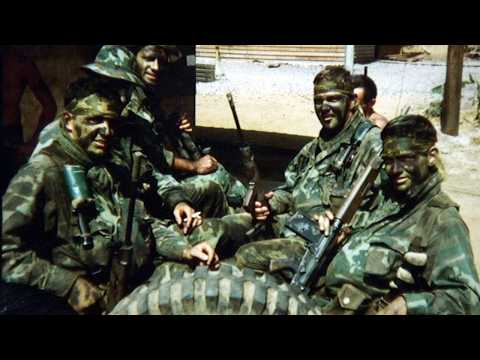
Harrison froze, the blood draining from his face. The logic was terrifying. His immaculate appearance, his pride—it was all a death sentence. Before he could respond, Sergeant Williams grabbed his rucksack and dumped its contents into the mud. “Cans clink,” Williams growled, banging two metal tins together. “That sound travels 300 meters. You might as well send the enemy an invitation.” Harrison watched in disbelief as the Australian pulled out his own kit: rations in silent cloth bags, no spare uniform, no underwear, and a toothbrush with the handle sawed off. “Five grams,” Williams said. “Over a ten-day patrol, that’s wasted energy. Every gram counts.” Harrison’s shock deepened as he realized these men carried 40 kilograms of ammunition and mines—yet cut their toothbrushes to save weight. They weren’t soldiers; they were fanatics.
The medic then explained the science of scent. Americans, with their meat-and-dairy diet, sweated ammonia and fatty acids—a chemical factory to the locals. The Australians ate cold rice and fish sauce to alter their body chemistry. They deliberately cultivated fungal infections, letting their skin rot to mask the smell of a healthy human. They stopped using insect repellent, choosing to be eaten alive rather than emit a foreign odor. “To hunt a tiger, you can’t smell like a man,” the medic said. “You have to smell like the swamp floor.” Harrison listened in horror as they described how they became part of the jungle, shedding every vestige of civilization to become more efficient killers.
Finally, Sergeant Williams knelt and pointed his knife at Harrison’s brand-new jungle boots. “Every tracker knows the Panama sole,” he said. “It screams American.” Without warning, he hacked at the rubber, gouging deep, irregular channels. Then he scooped up a handful of mud and urine and rubbed it into the fresh cuts. “Now you’ll leave tracks like a wild pig,” he said. Harrison stood in stunned silence, his boots ruined—and his military identity dismantled. The ritual was complete. He was no longer a soldier of the United States Army. He was a ghost in training, about to learn the true silence of the jungle.
The first hours in the bush stripped away whatever illusions Harrison still clung to. The Australians moved without sound—not the clumsy, deliberate stealth he had practiced at Fort Bragg, but something deeper, almost organic. They flowed through the vegetation, each footstep a rolling caress of the earth, testing for twigs before committing their weight. Harrison tried to mimic them and failed, his boots snapping a branch within the first hour that echoed like a gunshot. Williams didn’t even turn around. He simply raised one finger—freeze—and the entire patrol melted into the foliage, invisible within seconds.
They waited twenty minutes for a response that never came. When they moved again, Harrison’s heart hammered so loudly he was certain the enemy could hear it. They walked for three hours without a single spoken word, communicating through finger snaps, hand signals, and the deliberate breaking of twigs that mimicked natural forest sounds. It was a language of the dead, and Harrison was learning it one silent syllable at a time.
Then the point man raised a fist, and the world stopped.
Harrison crouched behind a teak tree, his pulse pounding in his ears. Ten minutes passed. Twenty. His legs cramped, then burned. A fly crawled toward his eye and he dared not swat it. The Australians around him were statues—they did not blink, did not shift, did not seem to breathe. And then a lone Vietcong scout emerged from the bamboo, no more than twenty meters away, a cigarette dangling from his lips.
Harrison’s finger tightened on the trigger. This was the enemy. Engage and neutralize. His body coiled to spring—
A hand clamped onto his shoulder with the strength of a vice. Williams. The grip was iron, a silent command: Do not shoot.
The scout walked closer. Twelve meters. He stopped to adjust his sandal, looking directly into the brush where Harrison hid. The American stopped breathing entirely, certain discovery was imminent. But the scout saw nothing—only shadows and leaves—and continued on, passing within eight meters before vanishing into the green.
Harrison turned to Williams, bewildered. Why? It was a guaranteed kill. But the sergeant remained frozen, and they waited another thirty minutes in absolute stillness before he finally signaled them forward. Only later did Harrison learn the truth: where there was one scout, there were trackers behind him. Shooting the bait would have sprung the trap—on them.
Deeper into enemy territory, Harrison instinctively reached for his radio handset. In the American Army, communication was dogma—the umbilical cord to artillery and medevac. Williams’ hand shot out and clamped his wrist with bruising force, fury blazing in his eyes. The North Vietnamese had Soviet direction-finding gear. Every radio check was an electronic flare screaming “Here I am, come kill me.” Instead, the SAS used the jungle itself as a telegraph wire—a snapped twig to regroup, a soft scratching on a rifle stock to signal danger close. To the enemy, an Australian patrol didn’t sound like soldiers. It sounded like wind and rain.
As darkness fell, Harrison expected foxholes and a defensive perimeter. The SAS simply stopped moving and lay down in the mud where they stood, heads together, feet outward like the spokes of a wheel. No sleeping bags. No mosquito nets. Just five men facing the darkness with their eyes, their ears, and their knives. Harrison lay rigid as fire ants marched across his neck and a leech dropped from the canopy onto his eyelid. When his hand twitched to tear it away, Williams’ grip stopped him. He lay there for four hours, the leech drinking blood from his eye, tears mixing with the trickle down his cheek. Survival, he learned, was not about fighting the pain. It was about accepting it.
Dawn brought no relief—only the realization that they were being hunted. The Aboriginal tracker found a fresh sandalprint in the mud. Harrison braced to pursue, but Williams signaled retreat. They backtracked two hundred meters, stepping in their own footprints, then veered ninety degrees into a bamboo thicket and lay facing their own trail. The fish hook. They were using themselves as bait.
Forty minutes later, three Vietcong trackers emerged, eyes fixed on the ground, hunting the hunters. The lead tracker smiled at Harrison’s footprint—then five rifles tore him apart. It lasted five seconds. The retreat had been the attack. The prey had become the predator.
They stripped the bodies with the efficiency of men who had done it a hundred times before. Harrison watched as Williams pulled a small notebook from the lead tracker’s chest pocket, flipped through the water-stained pages, and grunted. “Battalion movement order,” he said, his voice barely above a whisper. “Something big is coming down this trail. Today.” The patrol melted back into the brush without a word, but Harrison noticed the change in their bearing—shoulders lower, eyes harder, every sense cranked to a pitch he had never witnessed in American soldiers.
They hadn’t gone a kilometer when the point man froze again, his body going rigid as a corpse. He signaled absolute stillness. Harrison crept forward, peering through the ferns, and his blood turned to ice.
A column of North Vietnamese regulars was moving along a major trail—not a patrol, but an army. Hundreds of them, heavily armed with AK-47s, RPGs, and heavy machine guns, marching south with the confidence of men who owned the territory. Harrison counted fifty in the first minute, then a hundred, then stopped counting. A reinforced battalion. A force capable of wiping out an entire American firebase, let alone five men lying in the mud.
They passed within twenty meters. Harrison could see their faces, smell their sweat and the oil of their weapons. He understood now, with sickening clarity, that the fish hook had saved them from walking blindly into the flank of this tidal wave. The Australians’ paranoia about tracks, their refusal to engage unless the terms were perfect—it wasn’t caution. It was the only reason they were still breathing.
They lay frozen for two hours as the river of green uniforms flowed endlessly past. When the last soldier vanished, Harrison felt small, insignificant, and terrifyingly vulnerable. He realized that the American strategy of search and destroy was a suicide pact. You couldn’t destroy this. You could only survive it, harass it, and disappear before it swatted you like a fly.
When they finally moved, Harrison placed his feet with the care of a thief. He scanned the shadows not for targets, but for survival. He understood now why Williams had cut his boots, why they ate rice and smelled like rot. They weren’t playing soldier. They were playing a game where the rules were written by the jungle, and the penalty for breaking them was absolute annihilation.
The extraction helicopter appeared on the horizon days later, and as Harrison climbed aboard, he knew the civilized, arrogant American officer had died back there on the trail. But the jungle wasn’t finished with him. The final lesson would not be taught in the mud, but behind locked steel doors—where the true horror of what these men had become was written in cold, classified ink.
The CIA debriefing took place behind a steel door that locked with a sound like a coffin lid. A trembling analyst slid a tactical map across the metal table and tapped a sector with a nicotine-stained finger. “The North Vietnamese have a name for them,” he said, his voice barely a whisper. “Ma Rang. The phantoms of the jungle.” He read from translated intercepts—battalion commanders ordering their men to march three extra days through leech-infested swamps just to avoid the Australian sector entirely. Seasoned NVA units, terrified of forest spirits who made no sound and struck without being seen.
Then the analyst opened a ledger and pointed to the kill ratios. For every American soldier lost in the sector, the US forces eliminated roughly three enemy combatants. Respectable, built on firepower. But the Australian column read differently. Two hundred to one. Harrison stared at the number, unable to process it. A handful of dirty, bearded men with sawed-off toothbrushes had achieved what millions of dollars in bombs could not.
He walked out into the blinding sunlight and watched a fresh-faced platoon of American boys file past, their uniforms crisp, their voices loud, the scent of soap drifting behind them like a beacon. He felt a wave of profound sadness. They were walking into a meat grinder armed with the wrong mindset. They believed technology would save them. They didn’t know that in the deep green dark, the only thing that mattered was how still you could sit and how bad you were willing to smell.
That night, Harrison sat alone and wrote his final report—a confession that the greatest military power on earth was losing because it refused to embrace the dirt. He signed his name, turned off the lamp, and sat in the darkness, finally comfortable in the silence that terrified everyone else.
But the jungle had one last lesson to teach, and it came years later, in a quiet room far from the war. Harrison opened a letter from Captain McGregor, postmarked from a small farm in Queensland. Inside was a single sentence: “You never really left the green hell, did you, Captain?” Harrison read it twice, then smiled—because the old Australian was right.
So here is the question that keeps him awake at night, the one he now poses to you: If civilization is a liability in the jungle, what happens to the men who learn to live without it—and can they ever truly come home again?
Report this article
Select a reason for reporting:






