Just after 4 a.m. on 10 April 1917, the first waves of the 4th Australian Division lay in the snow before the Hindenburg Line. They stretched in long rows on white tapes laid across no man’s land during the night, the German wire looming ahead in the darkness. Nothing fell on that wire. No shells cut through it, no creeping barrage waited to lead the infantry in. That was deliberate.
For two years, almost every attack on the Western Front had begun with artillery. This one would not. Twelve British tanks were supposed to arrive, flatten the wire, and breach the trenches for the Australians to follow. The men waited on the tapes. The tanks never came.
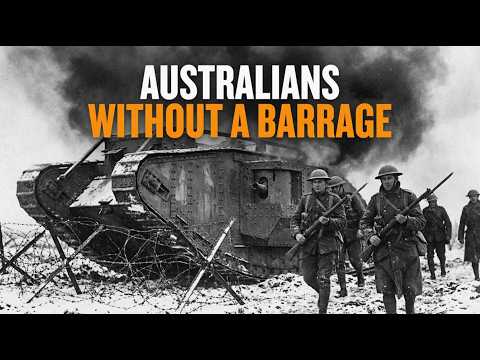
The wire they were waiting to cross was part of a line the German army had spent the entire winter building. Belt after belt of wire. Then a trench, then more wire, then a second trench. The tanks had been caught in a blizzard on the way. Around 5 a.m., as dawn approached, the divisional commander, Major-General William Holmes, decided it was time to pull his men back before the Germans spotted them lying in the open.
A snowstorm swept across the ground at just the right moment and hid them from view. Entire battalions stood up, turned their backs on the Hindenburg Line, and walked away. The official historian, Charles Bean, wrote that they returned like a crowd leaving a football match. Holmes had less than three months to live. In July, a German shell exploded beside him near Messines while he was escorting the Premier of New South Wales on a tour of the battlefield, making him the most senior Australian official to die on the Western Front.
The next morning, they went back to the same ground with the same plan, and still the guns would not fire in front of them. Around 5,000 Australians from two brigades lay down in the dark for a second time. Twelve tanks were assigned to the attack. One broke down before it began. Eleven set off. At zero hour, only four of the eleven were where they were supposed to be.
Keep that number in mind. Four tanks on a front whose plan depended entirely on tanks, and 5,000 men asked to wait for them. The place was a farming village called Bullecourt, southeast of Arras in northern France. At a quarter to five, the infantry rose and went forward anyway.
What happened in the next seven or eight hours—what the tanks did, what the men did when the tanks were not there, why the guns behind them stayed silent while Australians inside the German trenches fired distress rocket after distress rocket—is all on paper. Bean’s official history, battalion reports, German regimental records, and a book by the British officer who devised the plan in the first place. And they got in.
By about ten minutes to seven, Australians from both brigades were standing in the German front trench and the second trench behind it, on ground they were supposed to reach behind a screen of tanks. They had no tanks, and nothing was firing in front of them. They held on through the morning in trenches the Germans knew better than they did, with the bombs and ammunition they had carried in.
The next seven hours were shaped elsewhere by a flood of messages reaching headquarters behind them, and by what those who read them chose to believe.
The Hindenburg Line existed because the German army had chosen to give up ground on purpose. Through the winter, it built a new defensive line away from the old Somme battlefields. From 9 February, it began quietly evacuating the land in front of it. The new line cut off a large part of the old front and shortened it by about 40 kilometres. Between 16 and 20 March 1917, the last German troops withdrew to it, leaving behind a strip of ruined villages and cratered roads.
The Germans called the operation “Alberich,” after a dwarf from old legend. The Australians followed them across that strip. They reached the outskirts of Bapaume on 17 March, then had to fight for the outpost villages the Germans left in front of the new line at Lagnicourt, Noreuil, and Hermies. Some of those fights were savage. By 9 April, the last outposts had been taken and the Australian Imperial Force faced the wire directly.
Bean described what they were looking at: wide belts of wire three layers deep. The last was about 50 yards from the first trench, with another strong belt in front of the second. In many places the wire was set in triangles, and the two trenches were 150 or 200 yards apart. On British maps they carried the names “OG1” and “OG2.”
At Bullecourt, the line made all of it worse. It curved to form a salient between two villages, Bullecourt on the left and Quéant on the right, so that an attack in the middle of that pocket could be hit by fire from both sides at once. Patrols reported the wire there was about 30 yards deep. Bean noted the line was also reputed to have concrete fortifications and tunnels behind it.
On 9 April, the British army began its offensive at Arras to the northwest, and on the first day the Canadians took Vimy Ridge. The Australians of I Anzac Corps were following that spring behind General Sir Hubert Gough’s Fifth Army, and Gough’s task was to assist from the south. He wanted to break the Hindenburg Line at Bullecourt and push on to two villages behind it: Riencourt, about half a mile past the wire, and Hendecourt, about a mile beyond. After that, the 4th Cavalry Division, including Indian squadrons, was to pass through into open country. Theoretically, the day was supposed to end with horsemen riding out the far side of the Hindenburg Line.
The idea of doing it without artillery came from a British officer, Major William Watson, who commanded the heavy tank company that would carry out the attack. Watson later wrote in a book called Tank Company that the plan was for the tanks to creep up to the Hindenburg Line without a preliminary bombardment, so the Germans would not be alerted. His immediate commander, Lieutenant-Colonel John Hardress Lloyd, put it to Gough and told him they wanted to break the line with tanks. Gough decided to attack at dawn the next day.
The attraction was time. The guns that usually spent days cutting wire were not ready, and Gough did not want to wait for them. Instead, twelve tanks would do the cutting. The Australian corps staff did not like it.
Brudenell White, chief of staff of I Anzac Corps and the man who had planned the evacuation from Gallipoli, described the meeting years later in a letter to Bean. He and General Birdwood, the corps commander, opposed the operation, and by White’s recollection they were making progress. Then Gough was called to the telephone and left the room. After that, White wrote, he felt they had no room left to argue.
Bean, who assembled the details of the meeting from other accounts, wrote that Gough was clearly trying to make up his mind when the telephone called him outside. According to the British official history, Birdwood repeated his doubts about the attack from the start, yet the attack went ahead. The two most senior officers in the Australian corps looked at a plan to send infantry against the Hindenburg Line without artillery, told the army commander so, and lost the argument in the time it took to answer a phone call.
Someone had to find out what the wire really looked like. The intelligence officer of the 14th Battalion was Albert Jacka, who had won the Victoria Cross at Gallipoli. On the night of 8 April, he went out into no man’s land with Lieutenants Swadling and Bradley of the 16th Battalion to scout the wire. Afterwards, he and Bradley fixed the long white tapes the infantry would lie on. On one of those nights, two Germans surprised him in the dark, an officer and his orderly. Jacka’s pistol jammed. Despite that, he captured them both and brought them in as prisoners. The German officer later complained to a senior Australian staff officer about how roughly he had been handled. Jacka received a second Military Cross for those nights. Bean later wrote that everyone who knew the facts realised Jacka deserved the Victoria Cross three times over.
So on the morning of the 10th, the tapes were laid, the men lay down on them, and then the whole order was cancelled as the snow came down. The decision was made to try again the same day, with the same tanks and the same plan. Not one man failed to reach the second attempt.
Major Benjamin Lean of the 48th Battalion was on the railway embankment behind the line on the 10th when a shell killed him. His brother, Lieutenant-Colonel Raymond Lean, commanded the 48th. The battalion would enter the Hindenburg Line the next morning, and its commander would lead it one day after losing his brother. Ray Leane survived the war and returned home to become police commissioner of South Australia.
The news did not reach everyone on the 10th. To the left of the Australians was the British 62nd Division, the West Riding men from Yorkshire, and they had orders for that morning too. If the tanks broke through, a battalion was to rush Bullecourt itself, and a brigade was to send strong patrols forward. No one told the 62nd Division the attack had been cancelled.
At 4:30, groups from two West Yorkshire battalions advanced toward the village on their own against wire no one had cut. They lost 162 men and two Lewis gun teams. The Australians had been ordered back under a snowstorm, while the Yorkshiremen beside them were left to find out the hard way.
At 4:30 on the 11th, the tanks began to move. Five minutes later, a green flare rose over Bullecourt. At a quarter to five, exactly as Bean described it, the 4th Australian Brigade rose from behind the tapes, the 16th and 14th Battalions leading, followed by the 13th and 15th.
These were men from New South Wales, Victoria, Queensland, Tasmania, Western Australia, and South Australia. The brigade had fought at Quinn’s Post and Courtney’s at Gallipoli, and at Pozières and Mouquet Farm the summer before. Bean judged they had never faced a harder task, nor been less equipped to meet it.
Percy Black was a major in the 16th. A carpenter and then a gold miner in Western Australia before the war, he had worked a machine-gun at Gallipoli with a mate named Harry Murray. Before the attack, he said goodbye to his commander, Lieutenant-Colonel Edmund Drake-Brockman, and told him he might not come back, but they would take the Hindenburg Line. Then he led his men toward the wire.
Bean wrote that the wire seemed to swarm with fireflies. No tank was anywhere near the 16th. Black called out to his men to forget the tanks and keep going. They broke through the first belts and reached OG1. Black’s last message said the first objective was taken and he was moving on to the second.
In front of OG2 was another narrow, uncut belt, and Black pushed toward it looking for a gap. He was hit in the head and fell there. He has no known grave, and his name is carved on the memorial at Villers-Bretonneux. The 16th Battalion lost 640 men that day.
On the left, the 12th Brigade had orders to start 15 minutes after its tanks moved off. The tanks did not arrive, and the brigade did not move until a quarter past five. The 46th Battalion walked straight into the pocket between the two villages, where machine-guns on both sides could sweep them. On its right, Bean found only two men who appeared to have survived: Lieutenant Pentland and one soldier.
The 48th followed. Leane’s battalion, which had lost his brother on the embankment the day before, passed through the wire into the German trenches behind what was left of the 46th. By about ten minutes to seven, both brigades held parts of OG1 and OG2.
Inside the Hindenburg Line, the Australians were in a trench system the Germans knew inch by inch, while the Germans still held the trenches on either side of them. From about seven, the enemy began shelling along the trenches from both flanks. At a quarter past seven, Harry Murray of the 13th, Black’s former number two at Gallipoli, now a temporary major, sent a message to the rear. He said that with artillery support they could hold their position as long as possible. He asked for guns and more ammunition. His sector fired seventeen SOS rockets that morning. Each one meant the same thing: shell in front of us now.
Murray received the Distinguished Service Order for Bullecourt, and the historian of the 16th Battalion later wrote that he collected more gallantry awards than any other infantry soldier in the British army in that war. No shelling came.
Behind the line, the men directing the guns had a different picture of the morning. At ten minutes to seven, a report reached headquarters that Australian troops had been seen beyond Riencourt, the village half a mile past the wire. At a quarter past eight, another reported two British tanks moving south of Hendecourt, a mile away. Neither was true. If it had been, the barrage in front of the Hindenburg Line would have fallen on Australians and British tanks, so the guns held their fire. Back at the railway embankment, a detachment of cavalry, some of them Indian, was moved up to wait for a gap. The British official history says Birdwood refused to order the barrage.
Above OG1, Murray’s rockets kept going up, fired by men with no idea what headquarters believed it was seeing. From where Major Watson stood, the morning looked like this. He was in his mid-twenties and had devised the plan himself. He wrote that when the guns began at first it was more like a bombardment than a covering barrage, and his tanks crawled forward in the dark with small groups of Australians close behind. Then the reports began coming back.
Lieutenant Davies in tank 799 crossed the German line and ended up behind it. Tank 586 did the same and its commander, Lieutenant Clarkson, lost his life. Lieutenant Mooney fell in tank 590. Lieutenant Sewers fell too, and in Lieutenant Bernstein’s tank the driver was hit and killed. Then someone came to Watson and told him almost all the tanks had been destroyed. His own count was nine of eleven hit directly, two missing. Of the 103 men in his crews, he could find only 52.
The trenches belonged to the 27th Division, three Württemberg regiments of southwest Germany under a reserve corps commanded by General Otto von Moser. They knew the ground well and had plenty of bombs. They came down the trenches from both ends, and the Australians replied with bombs until they had almost none left to throw. The 47th Battalion had carried 600 bombs for the 12th Brigade. On the 4th Brigade side, the Germans advanced down a communication trench the maps called “Ostrich Avenue.” No one at OG1 or OG2 needed to be told what would happen when the bombs ran out.
The Germans paid heavily too. Their losses that day were about 670 to 750, depending on the count, and the divisional commander, Heinrich von Maur, received Prussia’s highest courage award, the Pour le Mérite, for holding at Bullecourt.
Shortly after midday, it was over. With few bombs left, no artillery, and no tanks, the brigades came back the way they had entered, through the same wire, now in daylight, under fire from both sides. Many never reached the wire. According to the British official history, the last battalion out was the 48th at 12:25, and it came out steadily. That was Ray Leane’s battalion. He had led it into the Hindenburg Line the morning after his brother fell on the embankment, and now he brought out what was left.
Of the 3,000 men the 4th Brigade took in, fewer than 700 returned to their own lines unhurt. The 4th Brigade entered the attack 3,000 strong and lost 2,339. The 12th Brigade entered 2,000 strong and lost about 950. The Australian War Memorial estimates the day’s total casualties at more than 3,300.
About 1,170 Australians were taken prisoner, the number the Memorial records as the largest captured in a single battle in the entire war. Other estimates range from 1,166, the German figure, to 1,182. The total number of Australians captured by the Germans in the whole war, according to the Memorial, is a little over 3,800. So nearly a third of them were taken on this one morning.
If there is a family story about a grandfather who spent the last part of the war in a German camp, there is a strong chance it began that morning at this wire fence. For the prisoners, things did not end at the wire. In April 1917, more than 1,500 Australians captured at Noreuil, Bullecourt, and Lagnicourt were selected for reprisal work, because the British and French were forcing German prisoners to labour behind Allied lines within range of German guns. The Australians were held for 10 days in the citadel of Lille, then sent back to the front to bury the dead, pave roads, and dig trenches. At least seven of them died under Allied shellfire.
Private Horace Janson of the 16th Battalion remembered the citadel at Lille as a place where they were given almost no food, a single slice of bread a day, and spent their days building shelters and carrying shells. One of the men captured that morning was Douglas Grant of the 13th Battalion, an Aboriginal soldier from Queensland who ended up in a prison camp at Wünsdorf outside Berlin.
Lieutenant Davies’s tank never came back. Tank 799 was a British Mark II, a rhomboid steel hull with a crew of eight, moving at about walking pace, and it was a training machine. According to the Tank Museum, it carried no armour at all. The Germans captured it, measured it, examined it, and photographed it. The Australian War Memorial holds one of those photographs, German soldiers standing around tank 799. Another, printed as a German postcard, shows German officers beside tank 586. What they met the tank with was a K-round armour-piercing machine-gun round, and one German crew fired more than a thousand of them at a single tank. The Germans concluded that ordinary infantry with K ammunition could stop a British tank, and an order went out that all infantry should carry it. They never discovered that tank 799 had not been armoured in the first place.
Bean wrote that Bullecourt, more than any other battle, shook the Australian soldiers’ confidence in British command, because the mistakes were plain to almost anyone. John Monash, in his book Australian Victories in France in 1918, listed Bullecourt among the bloody battlefields he meant alongside Pozières and Stormy Trench. In the same book, he wrote that tanks became hated by the Australian forces because they failed so utterly at Bullecourt and let the infantry down. That distrust lasted about 15 months, until the battle of Hamel in July 1918, when Australians and tanks advanced together and the task succeeded. Memorial historians have since noted that hatred of tanks was strongest in the 4th Division, the men who were at the wire that morning, and that many others did not feel it as sharply.
Three weeks after the first attack, the Australians returned to the same part of the Hindenburg Line. At a quarter to four on the morning of 3 May, the 2nd Australian Division, made up of the 5th Brigade from New South Wales and the 6th from Victoria, waited in the dark again facing OG1 and OG2 beside the British 62nd Division at Bullecourt. The 6th Brigade was commanded by John Gellibrand, and one of his officers that morning was Stanley Savige. After the war, Gellibrand founded a club for returned officers in Hobart, and Savige helped found Legacy in Melbourne, the organisation that has cared for the widows and children of Australian service personnel ever since.
This time there was a barrage, and it crept forward ahead of them. They got in and they stayed. The fighting went on for two weeks, with the 1st Division then the 5th Division taking part. On 6 May, Corporal George Howell of the 1st Battalion won the Victoria Cross, and on the 12th, Lieutenant Robert Moon of the 58th won another. On the 7th, Australians and British met inside the line, and the British 7th Division entered the village, while the rest of Bullecourt fell to London and West Riding territorials on the 17th. Those two weeks cost the Australian Imperial Force 7,482 men, and the British more than 8,000.
The Germans tried once more to retake the position. On 15 May, they counter-attacked the Australians holding OG1 and OG2 and were driven off. Five weeks had passed since the first waves of the 4th Division lay on white tapes in the snow before that wire, waiting for tanks that never came, then walked back through a snowstorm. About 1,170 of the men who went in with them the next morning were still in German hands. Across both battles, the Australian Imperial Force lost about 10,000 men, counting the wounded and the captured. After 15 May, the German command decided to leave that part of the Hindenburg Line to the Australians.
So the question remains: was Bullecourt a failure of tanks, of artillery, or of the men who ordered the attack without either—and would you have risen from the tapes that morning?
Report this article
Select a reason for reporting:






