June 1944. Five years into World War II, the future of Europe hung by a thread. In the West, the Allies were preparing a massive invasion to open a new front and liberate France. While the Wehrmacht awaited the imminent Allied landing, Adolf Hitler remained at the Berghof, his residence in the Bavarian Alps above Berchtesgaden. On June 3rd, as the Allied forces finalized preparations for the invasion, a wedding took place in that mountain retreat in an atmosphere marked by tension. Gretl Braun, younger sister of Eva Braun, married Hermann Fegelein, a high-ranking SS officer and liaison for Heinrich Himmler at the Führer’s headquarters. The ceremony brought together key figures of the regime, who wore their finest attire for the occasion, except for Hitler, who opted for his characteristic gray uniform.
Assuming the role of host and father figure to the bride, Hitler allowed the event to unfold with some relaxation. Champagne was served without restraint, and an SS band provided music for the guests, who soon indulged in dancing and drinking. Despite the festive atmosphere, Hitler did not stay long and retired early, leaving the celebration to continue without him. The party stretched into the early hours of the morning with the guests enjoying the plentiful drinks and the spirit of camaraderie. Among them, Martin Bormann let himself go the most, drinking excessively until he lost all composure. His condition became so severe that his companions had to drag him back to his residence, unable to stand on his own.
Hitler was convinced that his position was secure and awaited the Allies with anticipation, confident that the invasion would be contained and destroyed at the Atlantic Wall. His Minister of Propaganda, Joseph Goebbels, even doubted that enemy forces would dare cross the English Channel. In his speeches, he insisted on a provocative slogan that he repeated constantly, “They say they will come. Why don’t they?” For Hitler, the failure of the Allied offensive would mean much more than just a defensive victory. He believed that if the invasion was repelled, both the British and Americans would be forced to abandon the war, allowing all military efforts to be concentrated on the Eastern Front against the Soviet Union.
To protect the Western Front, Hitler ordered the construction of an extensive defensive line along the Atlantic coast, known as the Atlantic Wall. This barrier, presented as an impenetrable defensive line stretching from Norway to the border with Spain, was largely a product of National Socialist propaganda, rather than a truly effective structure. Once again, Hitler gave into the illusion of his own regime and rejected any comparison to the Maginot Line, the French fortification that had failed in 1940. He also ignored warnings from commanders in charge of coastal defense, who insisted they lacked sufficient concrete to complete the necessary bunkers and batteries. The shortage of resources was largely due to Hitler having prioritized the construction of enormous submarine shelters, convinced that a new generation of U-boats would change the course of the war and neutralize the Allies’ naval superiority, despite the Kriegsmarine having already lost control of the Atlantic.
The Commander-in-Chief of the Western Front, Field Marshal Gerd von Rundstedt, considered the Atlantic Wall nothing more than an exaggerated and worthless construct. Like other high-ranking officers, he kept in mind the lesson of Frederick the Great: “He who defends everything defends nothing.” In his view, the Wehrmacht should withdraw from Italy, whose geography only complicated any defensive operation, and fall back beyond the Alps to establish a more sustainable line. He also questioned the stationing of so many troops in Norway, as he believed its military significance was limited to the naval sphere and did not represent a priority in land warfare.
German High Command officers questioned Hitler’s decision to turn several ports into fortified positions. He ordered that Dunkirk, Calais, Boulogne, Le Havre, and Cherbourg on the English Channel, along with Brest, La Rochelle, and Bordeaux on the Atlantic be designated as Festungen, fortified garrisons that were to resist to the last man. These strongholds, conceived to delay the enemy advance, were to be held even if completely isolated. The strategy generated criticism within the army. Many commanders warned that spreading units across fixed points weakened the ability to maneuver and respond to an invasion. Despite these objections, Hitler insisted on his plan and forbade the mobilization of the divisions stationed in the Channel Islands. He believed the British would attempt to retake that territory before any other on the continent. Convinced of his analysis, he rejected the possibility of relocating those forces to France, where they could have reinforced the German defense. Hitler believed that the construction of fortresses in both the east and the west was essential to contain the enemy and prevent unauthorized withdrawals by his generals. His strategy immobilized thousands of soldiers in static positions, weakening the defense of the German interior. In northern France, 120,000 men were trapped in fortified garrisons, unable to reinforce other key areas. The order to defend these enclaves contradicted the traditional principles of the German General Staff, which favored tactical flexibility.
Hitler entrusted the improvement of the Channel defenses to Field Marshal Erwin Rommel, commander of Army Group B. Rommel, who had been a loyal follower of the regime, experienced a shift in perspective after facing Allied air superiority in North Africa. Despite his prestige as a strategist and war hero, he became critical of how the war was being conducted. He ironically referred to Hitler’s speeches to demoralize generals as “sunbeam treatments.” Nevertheless, Rommel never gave up on his efforts to improve the coastal defenses. Rommel spent little time at the castle. He would rise at 5:00 in the morning, have breakfast with Lieutenant General Hans Speidel, his chief of staff, and immediately depart in his official Horch car to carry out inspections along the coast. He was accompanied only by a couple of officers. His staff meetings took place in the afternoon after his return. After a frugal dinner, he usually met with a small trusted circle, mainly consisting of Speidel and Rear Admiral Friedrich Ruge, his naval adviser. During their nightly walks under the cedars of the castle, they privately discussed matters that could not be addressed in formal meetings.
One of the issues that most frustrated Rommel was the lack of unified command for the defense of France. Hitler, influenced by Göring and Admiral Dönitz, refused to merge the Luftwaffe and Kriegsmarine under a single authority, preferring to keep them as separate entities that only he could supervise. The Luftwaffe had around 350,000 personnel in the West, most assigned to logistics and communications within Göring’s vast power structure. Moreover, the Reichsmarschall refused to place his anti-aircraft artillery under army control, which prevented coordination between ground defense and air protection, leaving it vulnerable to Allied attacks. Whenever Rommel expressed his frustration over the Luftwaffe’s inefficiency, Hitler’s headquarters tried to appease him with promises of imminent jet fighter production and secret weapons that supposedly would force Britain to surrender. Rommel not only distrusted these announcements, but also understood that operationally, his room to maneuver was nonexistent.
Increasingly convinced that the Allies would choose Normandy as the landing site, Rommel frequently inspected the coastal defenses of the region. He observed that the bay that would later become known as Omaha Beach had similarities with Salerno, where the Allies had landed in Italy. He believed the outcome of the battle would be decided in the first 2 days, and tirelessly dedicated himself to strengthening the defense. To reinforce the fortifications, turrets from French tanks captured in 1940 were reused, installed in concrete bunkers, and nicknamed Tobruks in reference to the battle in North Africa. Rommel also promoted the construction of obstacles to hinder the landing of airborne troops. Using French labor and Italian prisoners of war, large wooden stakes were erected in areas identified by German paratroopers as possible drop zones. These obstacles, scattered across fields and meadows, were nicknamed Rommel’s asparagus because of their shape and layout.
Rommel’s constant inspections on the Western Front affected troop training. The focus on fortification reduced opportunities for practice, and ammunition shortages limited live-fire exercises, which impacted the accuracy of German units. Despite the apparent strength of German forces in the West, the reality was different. Rundstedt, in theory, commanded 1.5 million soldiers, but had no authority over the Luftwaffe or Kriegsmarine. Of the 850,000 men assigned to the army, the quality of the units varied. More than half of the 36 infantry divisions lacked mobile artillery and were relegated to coastal defense. Some of these formations included the so-called ear and stomach battalions, composed of soldiers with abdominal wounds or hearing problems. The divisions deployed in France had a significant number of recruits who were either too young or too old, which affected their performance. Moreover, the infantry units in the West were weakened by the priority given to the SS, Luftwaffe paratroopers, and armored divisions, which received the best recruits. As a result, the lack of adequate reinforcements forced armored units to remain in combat for prolonged periods, reducing their operational capacity.
The German army in France included soldiers from annexed territories such as Alsace, Lorraine, and Luxembourg, as well as Volksdeutsche, men of German descent born outside Germany. Many struggled with the language and had limited integration into their units. Additionally, forced conscription brought young Poles to the front with no choice in the matter. German officers and NCOs in charge of foreign troops recruited by the Wehrmacht feared that in the midst of combat their own men might turn against them. The mistrust was justified as several of these soldiers deserted and joined the French Resistance. The 352nd Infantry Division was the most prominent German unit during the D-Day landings, serving as the main defender at Omaha Beach and part of Gold Beach. Created in November 1943 in Saint-Lô under the command of Lieutenant General Dietrich Kraiss, it was composed of Eastern Front veterans, young recruits, and soldiers of German ancestry. Initially destined for the Eastern Front, it was sent to Normandy due to the impending Allied invasion and deployed in the Bayeux sector as part of Rommel’s strategy.
The armor divisions and panzer grenadier units, both of the SS and regular army, represented the most effective force among German troops in France. In contrast to the weakness of many infantry units, these formations were better equipped and comprised experienced soldiers. Among them stood out the Panzer Lehr Division, commanded by Lieutenant General Fritz Bayerlein, a veteran of the North African campaign and one of Rommel’s trusted officers. This division was made up of personnel from armored training centers, making it an elite unit within the German army. Another of the most powerful divisions in Normandy was the 2nd Armored Division, commanded by Lieutenant General Heinrich von Lüttwitz. Rommel trusted his leadership capabilities and even considered him a viable option to negotiate with the Allies if the situation required it. Closer to the coast, the 21st Armored Division was tasked with halting the British advance in the Caen sector. However, its units were equipped with Mark IV tanks instead of the more advanced Panther or Tiger models. Additionally, a significant portion of its personnel consisted of Volksdeutsche, soldiers of German origin who, according to their commander, Lieutenant General Edgar Feuchtinger, had difficulty understanding and executing orders. In the British sector, especially on the eastern flank around Caen, one of the largest concentrations of Waffen SS armored divisions since the Battle of Kursk was deployed. Among them was the 1st SS Panzer Division along with the 12th SS Panzer Division Hitlerjugend formed by highly indoctrinated young fighters.
In the early light of June 6th, 1944, Lieutenant Colonel Werner Pluskat, commander of the 1st Battalion of Fusiliers of the 352nd Infantry Division, was observing the sea from a fortified position high above Omaha Beach. From inside the bunker, he watched the horizon through his binoculars without noticing any movement. At his feet, his dog rested silently until it suddenly sprang up, startled, and began barking toward the English Channel as if it had sensed something invisible in the dense fog. Moved by the animal’s unease, Pluskat raised his binoculars once more. This time, among the fog banks that were beginning to dissipate, he could make out dark silhouettes emerging on the horizon. Before his eyes, thousands of warships, transports, and Allied landing craft were advancing toward the French coast. In front of him, unfolded the largest invasion fleet in history with more than 6,000 vessels heading directly for Normandy. At that moment, Pluskat became one of the first German officers to witness the beginning of D-Day.
At approximately 5:50 in the morning, the Allied fleet opened fire on the coastal defenses of Normandy. From battleships, cruisers, and destroyers, hundreds of guns turned toward the mainland and unleashed a heavy barrage on the five landing beaches. The bombardment included shells of various calibers and more than 38,000 rockets, which ravaged the terrain and covered it in craters and smoke, leaving the coast transformed into a devastated landscape resembling a lunar field. While the coastline was being pounded by naval fire, hundreds of landing craft headed toward shore with thousands of American, British, and Canadian soldiers on board. Many of them were exhausted after long hours of waiting and visibly affected by the rough seas, which reached 2 m in height. Soaked by the waves, the British and American soldiers soon regretted having eaten the large breakfast served before the landing. The canned meat rations quickly reappeared, and the general discomfort intensified with the rocking of the landing craft. The seasickness bags, already wet from the seawater, tore easily, leading many to use their own helmets as makeshift containers, quickly rinsing them by dipping them into the water when a wave allowed it. In contrast, the German troops, protected in bunkers and trenches, withstood the bombardment without major losses. Rested and alert, they awaited the landing with their weapons ready.
At 6:30 a.m. on June 6th, 1944, the US 4th Infantry Division was the first to set foot on land in the sector designated as Utah Beach. The landing occurred on a sandy strip connected to marshy areas, where dunes offered some cover from the weak enemy fire. The German defenders, small in number, responded with mortars from nearby positions and rifle fire from improvised trenches. Due to a navigation error, the first wave landed approximately 1 km south of the planned point. Coincidentally, that sector had been mistakenly bombed beforehand, further weakening the German resistance. This allowed American troops to advance rapidly, dislodging the enemy forces. Within minutes, engineers opened a breach in the concrete seawall, facilitating the inland advance. Leading the landing troops was General Theodore Roosevelt Jr., son of President Franklin D. Roosevelt, who motivated his men with a phrase that went down in the history of the landing, “We’ll start the war from right here.” The 4th Infantry Division managed to secure Utah Beach with relative ease, neutralizing several German defenses thanks to a landing that bypassed the most fortified points. One of the German batteries that managed to remain active during the bombardment was the one at Crisbec. From there, one of its guns succeeded in hitting and sinking the destroyer USS Corry, causing the death of four American sailors. Despite this isolated incident, the capture of Utah Beach was swift and involved relatively low casualties. In total, the Americans suffered 429 casualties, of which 129 were killed and 300 wounded.
The beach that became a true hell on earth was Omaha Beach. There, the failed preliminary bombardment left German defenses intact, and when the first American waves reached the shore, they faced devastating crossfire from fortified positions. The German troops were made up of elements of the 352nd Infantry Division, with veterans from the Eastern Front and the 716th Coastal Division, totaling around 7,000 men deployed along the 8 km of beach, protected by cliffs up to 50 m high. Aboard the landing craft, the soldiers of the first wave watched in awe as the naval artillery roared. The shells fired from the battleships flew over them with such force that many compared them to freight trains thundering through the sky. The soldiers were packed so tightly into the landing craft that most couldn’t see beyond their comrades’ helmets or above the front ramp. Some, with a bit of visibility, noticed dead fish floating nearby, carried by the waves, likely killed by rockets that failed to reach the shore. When the front ramps opened, German machine guns directed their fire straight at the openings. Several of the craft had become stuck on sandbanks, still some distance from shore, leaving the soldiers exposed under intense fire before they could set foot on land.
Many of the craft that managed to reach the beach immediately deployed their front hatches, forming ramps for the American soldiers to descend. But, as they exited, they faced two equally deadly fates. Some sank in the water due to the weight of their equipment and drowned before reaching the beach. Others were cut down by enemy fire without even leaving the boats, which soon earned the nickname “sardine cans” due to how easily they were hit. In the western sector of Omaha Beach, one of the assault boats from the 116th Infantry Regiment was immediately struck by enemy fire as its front ramp opened. The three platoon leaders leading the landing were killed instantly along with several other soldiers. Some tried to escape by jumping over the sides, but they too were hit. Two members of the crew died on the spot. One of the soldiers, upon disembarking, found the water barely ankle deep, but after a few steps, it quickly rose to his waist, forcing him to swim. He managed to reach a steel anti-landing obstacle and took cover behind it. Bullets struck the metal, and one of them pierced his backpack without injuring him.
In various areas along the coast, when the landing craft ramps opened, the soldiers jumped into the water without knowing that in many places it would cover them completely. Numerous fighters did not know how to swim. In desperation, they discarded their weapons and backpacks in an attempt to stay afloat. Behind them, others watched as the first men disappeared under the weight of their gear, causing scenes of panic. Some were hit by enemy fire while struggling not to drown, regardless of their swimming ability. Lifeless bodies floated beside wounded men calling for help, and some, in a final attempt to survive, pretended to be dead, hoping the current would carry them to solid ground. Once out of the water, moving forward on the beach became an extreme ordeal. The weight of the equipment, along with soaked clothing, made every step exhausting. Many felt their legs immobilized from the effort, as if they were dragging lead. Those carrying extra ammunition or equipment had little chance of survival. Later, it was concluded that many lives could have been saved if the first wave of troops had not been so overloaded.
Cries of pain and pleas for help echoed across Omaha Beach. Amid explosions and crossfire, many soldiers were wounded the moment they hit the shore. Some moved slowly, submerged up to their necks, burdened with gear that hindered every movement. Exhaustion was widespread. Amid the chaos, several collapsed without taking a single step, while others sought cover in shallower areas to regain strength. From some units, like entire platoons, only a few managed to reach the shore alive. The loss of commanding officers early in the landing left many sections without leadership. However, the soldiers understood that standing still meant certain death. Under constant fire and without immediate support, advancing was the only way to survive. Crossing that stretch of sand was not a mission. It was a desperate race to stay alive. During the most critical moments of the Omaha Beach landing, the soldiers advanced slowly, taking cover in short bursts between explosions and gunfire. The terrain was littered with lifeless bodies, immobile wounded, and burning landing craft that failed to reach the shore. The scene was chaotic and devastating. Several fighters attempted to go back and help those left behind, but were gunned down before they could succeed. Those who did make it across the beach were unable to offer support as most of their weapons had been rendered useless by seawater and sand. It is estimated that nearly 80% of the weaponry malfunctioned. Many soldiers had removed the protective covers from their rifles too soon, leaving the mechanisms exposed to the salt water. Furthermore, nearly all radios failed for the same reason, causing a total breakdown in communication and coordination. Amid enemy fire, the advance became disorganized with isolated units unable to regroup.
In the early hours of the Omaha Beach landing, psychological collapse affected many soldiers exposed to enemy fire and the chaos of battle. Some, in a state of shock, abandoned their equipment and wandered disoriented across the beach or in the water, unable to respond or recognize the immediate danger. Several remained motionless, sitting or lying down with no visible injuries, but completely incapable of reacting. The rising tide caused new casualties among the wounded who couldn’t move. Some gathered in stranded landing craft in a desperate attempt to find safety, but were overtaken by the water and drowned. Others, disoriented, walked along the beach as if unaware of the hostile environment, while machine gun bursts kicked up columns of sand around them. Medical units and officers tried to retrieve those they could, but the intensity of the fire forced them to abandon these efforts. Amid the confusion, there were cases of soldiers who completely lost control, running aimlessly until they were shot down.
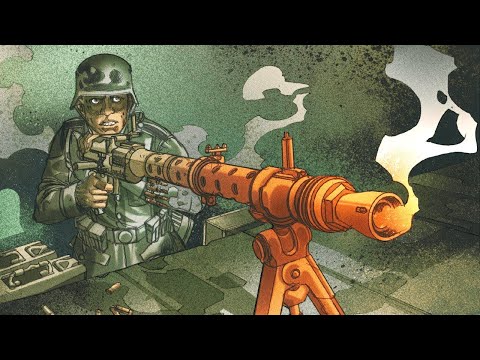
Heinrich Severloh, a machine gunner in resistance nest 62, became one of the German soldiers who inflicted the most casualties on US forces during the Omaha Beach landing. With sustained fire for hours and the support of a team supplying him with ammunition, Severloh became a key figure in the German resistance on that stretch of coastline. Heinrich Severloh later recalled how the bursts from his machine gun shattered the surface of the water, each impact marked by splashes. He watched as US soldiers threw themselves to the ground trying to find cover, while disorder and fear began to spread among the ranks attempting to move up the beach. When the machine gun was not in operation, he continued firing with his Mauser K98 rifle, with which he used approximately 400 rounds that day. After spending the entire morning firing almost without rest, Severloh noticed something unsettling. He no longer heard other machine guns active in his sector. The neighboring positions, which had also responded intensely at the beginning of the landing, had gone silent. This impression was soon confirmed by a message transmitted at 10:12 a.m., reporting that only one machine gun was still functioning in resistance nest 62, it was his. For hours, Severloh practically held the defense of that beach sector on his own.
One of the most traumatic moments for Heinrich Severloh during the Omaha Beach landing was not caused by the massive use of his machine gun, but by a single shot fired from his Mauser rifle. In front of his position, two concrete blocks, remnants of an old mill used to produce construction material for the bunkers, offered scant protection in the middle of the beach. It was there that Severloh spotted a US soldier with a flamethrower on his back trying to take cover behind those structures. Without hesitation, he aimed and fired. The bullet pierced the soldier’s helmet, killing him instantly. Though it was just one among hundreds of shots fired that day, that act became etched into his memory. Years later, Severloh would recall that moment as the most disturbing of all, even more so than watching dozens of men fall to the bursts of his MG 42. That image haunted him for years in the form of recurring nightmares. Around 2:00 in the afternoon, Heinrich Severloh spotted Sherman tanks approaching from the west. His machine gun had already exhausted its main ammunition, so he continued firing tracer rounds. Shortly after an explosion hit his position and wounded him in the face, but he remained at his post. An hour later, Lieutenant Bernhard Frerking, the officer in charge of resistance nest 62, ordered him to abandon the position. Severloh withdrew. Frerking was killed shortly afterward. With the front collapsing, the surviving German soldiers began retreating, moving through the remains of the terrain toward Colleville.
What helped put a stop to the initial massacre on Omaha Beach was the steady arrival of new landing craft, which began to fill the beach with more reinforcements. As US soldiers left the water, they began to group along the shore, gaining ground slowly on the sand under deadly fire. German machine guns, artillery, and hidden mines caused devastation. In a matter of minutes, all officers and non-commissioned officers of the 116th Regiment who landed in the Mole and Moulin sector were killed. The situation worsened with the loss of 27 out of 29 Sherman tanks sunk by heavy waves before reaching the shore. The two that made it were disabled in the surf zone. In several sectors, the units suffered over 75% casualties. Without support and unable to advance, the survivors dug improvised shelters or took cover behind obstacles such as Czech hedgehogs, embankments, and sand mounds. At that point, the assault had stalled. The beach had become a death trap.
On the morning of June 6th, 1944, while the last pockets of combat were dying down on Omaha Beach after a brutal bloodbath, the rest of the Normandy front presented a mixed picture of successes and setbacks. On the far western flank, the 2nd Ranger Battalion was completing its mission at Pointe du Hoc after a risky climb under enemy fire. Although they managed to secure the cliff, they discovered that the guns they were supposed to destroy were no longer there. They would be found hours later abandoned inland and destroyed by a small patrol. At Utah Beach, fortune had favored the Americans. The 4th Infantry Division landed in a less fortified area due to a navigation error that, paradoxically, led them to a more favorable sector. Within a few hours, they secured the area with minimal losses, neutralizing the German defenses without encountering organized resistance. Farther east, Gold Beach was the scene of the British advance. UK forces, led by the 50th Infantry Division, encountered scattered resistance but managed to push inland. Several key positions were secured, though certain points such as Hamel and La Rivière offered resistance and inflicted casualties. At Juno Beach, the Canadians faced a more consistent defense. Coastal obstacles, mines, and crossfire caused considerable losses in the first wave. Still, with determination, the 3rd Infantry Division broke through German lines in several sectors, taking important positions such as Courseulles and Bernières. The advance, though costly, allowed the area to be consolidated before noon. Finally, at Sword Beach, British troops and inter-allied commandos landed under naval cover and with armored support. Despite the sinking of a destroyer by a German torpedo boat, the attackers advanced rapidly, securing the coastal defenses and several nearby towns. The organization and initial momentum facilitated the push inland. By midday, with Omaha under US control at an extremely high cost, the rest of the Allied beaches had been secured. Although there were still areas to be cleared and scattered pockets of resistance, the landing had achieved its main objective: to establish a solid beachhead on the coast of Normandy.
That morning, Hitler got up at 8:00 a.m. At which point he was informed that Allied forces had landed on the coast of Normandy. He immediately called an urgent meeting with the Army High Command, attended by Generals Wilhelm Keitel and Alfred Jodl. After hearing the situation report, the Führer appeared confident and authorized the deployment of the 21st Panzer Division. Convinced that now that the Allies were already on solid ground, he could destroy them, he confidently expressed that the time had come to defeat them on the continent. At 9:00 a.m., the National Socialist regime officially announced the invasion over the radio. 10 minutes later, both in the United States and the United Kingdom, their respective governments made their own statements public. In London, Prime Minister Winston Churchill addressed the House of Commons, while hundreds of citizens gathered around the Whitehall Cenotaph, aware that the future of Europe was being decided at that moment.
At 9:00 a.m., German forces were fully mobilized, awaiting instructions. An hour and a half later, at 10:30, General Erich Marcks ordered the 21st Panzer Division to launch an attack against British positions on the beaches. However, his direct superior, Edgar Feuchtinger, canceled the order. Meanwhile, a bitter argument broke out between Fritz Bayerlein and Friedrich Dollmann on the same matter. Bayerlein considered it madness to expose tanks in broad daylight under enemy artillery and air fire for what he still believed was merely a minor raid. At 2:30 in the afternoon, Gerd von Rundstedt finally gave the order to Commander Fritz Witt for the 12th SS Panzer Division Hitlerjugend to advance toward the Normandy coast. He did so with great reluctance, fearing that by moving that unit so far north, it would be out of position to respond when, according to his belief, the real invasion began at the Pas de Calais.
Around 4:00 p.m. on June 6th, the 21st Panzer Division received orders to attack the gap between the British and Canadian landing zones. Erich Marcks, with an urgent tone, told the commander in charge of the offensive, “If we don’t throw the British into the sea, we will have lost the war.” But neither Hitler nor the High Command, already informed of the landing since 1100 hours, were convinced that this was the main operation. They still believed the real blow was yet to come. At approximately 4:30 p.m., the 21st Panzer launched its attack, marked on Allied maps with a red number two. The offensive was strongly repelled, and the division withdrew toward Caen. The German commander gave a contradictory justification. He claimed to have sighted 600 Allied aircraft moving east and feared being cut off. Other reports claim that his unit was heavily punished by fighter-bombers, British Firefly tanks, anti-tank artillery, and naval gunfire. Some sources state that it lost 70 of its 124 tanks. Others say it still had 70 when it retreated. At nightfall, around 10:00 p.m., the first elements of the 12th SS Panzer arrived at the Orne River, but most of their tanks were immobilized due to lack of fuel. Their commander, Fritz Witt, did not seem concerned. At that same time, the ISS Panzer Corps received orders to move toward Falaise, not Caen. Shortly afterward, the 17th SS Panzer Grenadier Division Götz von Berlichingen was ordered to march toward Normandy. They would not arrive until June 10th, too late. The High Command remained convinced that it was all a diversionary maneuver. They thought the Allies were being cunning and that the real invasion had not yet begun. Years later, some senior commanders tried to justify their confusion by blaming a supposedly sleeping and inactive Hitler. But the truth was something else. Allied intelligence had brilliantly deceived them. The first serious set of German offensive orders was not issued until 14 hours after the start of the landing, at 12:07 a.m. on June 7th. They had assumed that for logistical reasons the Allies would attack a port, and in a way they weren’t entirely wrong. They just didn’t expect the Allies to bring their own floating ports with them.
By the end of D-Day, the British commanders positioned on the Sword beachhead adopted an overly confident attitude regarding their failure to take Caen, mistakenly convinced they could capture the city the next day. The resistance encountered from the 21st Panzer Division had generated unrealistic expectations within the Allied ranks. What they didn’t yet know was that the worst was yet to come. They had not yet faced the feared Hitler Youth and Division. Moreover, they completely underestimated that the true firepower of the 21st Panzer did not lie in its armored vehicles, but in its feared 24 88-mm anti-tank guns, which were lethal on the battlefield.
On the morning of June 7th, 1944, the British began the first offensives toward Caen as part of Operation Perch, intending to encircle and capture the city. However, these advances were quickly halted by the tenacious German defense. On three occasions, Allied troops were pushed back by the 12th SS Panzer Division Hitlerjugend, a unit composed of youths just 17 and 18 years old who fought with an uncommon ferocity. Equipped with Panzer 4H tanks armed with 75 mm guns, but they were not mere recruits. This division was without a doubt one of the most ideologically cohesive formations within the Waffen-SS. Many of its senior officers came from the prestigious Leibstandarte with experience accumulated on multiple fronts, especially in the East. Their preparation was characterized by intense military and doctrinal training aimed at forging soldiers committed to the mission and to discipline. One of the most notable elements of this unit was its reconnaissance battalion led by Commander Bremer, known among his troops as the reckless for his boldness and bravery in combat. Figures like Kurt Panzermayer had already demonstrated their leadership abilities in previous campaigns, consolidating their reputation as determined and strategically effective officers. The division was commanded by Standartenführer Fritz Witt, 35 years old, decorated with the Knight’s Cross with Oak Leaves.
The training of these young men did not follow traditional methods. A specifically designed approach was chosen to prepare them for extremely demanding combat. “Flexible like leather, tough like Krupp steel, swift like greyhounds” was a slogan imposed by the Führer himself and turned into a motto in the training camps. They were to become complete soldiers capable of lunging at the enemy’s throat worthy of receiving decorations. A deep sense of duty was instilled in them along with a spirit of camaraderie, willingness to sacrifice, decisiveness, self-control, and physical and mental endurance. For this reason, exercises in the barracks were prohibited. Training was carried out exclusively under real combat conditions. By the end of the clashes, the Hitlerjugend had suffered 60% casualties, but they had proven to be the most feared force the Allies faced in France. The Norman hedgerows witnessed the fall of the first young men struck by air attacks. The Jabos, relentless and persistent, harassed them without rest. Like a swarm of furious insects aiming to demoralize what they called the child division. But instead of breaking, the soldiers responded with overflowing ferocity. In the midst of the ambush, many officers were impressed by the attitude of those youths. They held their ground as if they had years of combat experience, facing the enemy with contained rage and determination. Some still wore the Hitler Youth armband on their uniforms, a symbol of their origin. “The English will soon know who they are up against,” they said. Despite the constant bombardment from naval artillery, shells, tank guns, and RAF air strikes, those young men advanced through a hell of steel and fire. And against all odds, they managed to engage in hand-to-hand combat with the enemy.
On June 8th, 1944, Allied forces attempted to expand from the beachheads, but their advances were quickly contained thanks to the deployment in the area of the Panzer Lehr Division. This unit, considered the most powerful in the German army on French soil at the time, had 230 tanks and around 600 motorized vehicles, making it a true shock force. Its intervention easily halted the British 50th Infantry Division Northumbrian near Audrieu. And the next day, June 9th, it stopped the Second Canadian Corps in key locations such as Putot-en-Bessin, Norey-en-Bessin, and Bretteville-l’Orgueilleuse. In turn, on June 11th, the feared 12th SS Panzer Division Hitler Youth redeployed to the front in the face of a new Allied attempt. This time, it was the 51st Scottish Infantry Division Highland that tried to break through the front south of Ranville, aiming for Saint-Honorine. After 2 days of fierce fighting, the Scottish forces were forced to retreat, leaving behind a high number of casualties.
The stagnation of the British Second Army in its advance toward Caen had multiple causes, among which the complex geography of the region stood out. The area was dominated by the so-called bocage landscape, a network of narrow fields separated by thick hedgerows, vegetative walls that offered the German troops the perfect hiding place for ambushes. From those camouflaged positions, the German defenders deployed artillery, rocket launchers, machine guns, and Panzerfaust anti-tank weapons, turning every Allied advance attempt into a deadly trap. During those intense days of fighting on the outskirts of Caen, Allied pressure resulted in constant bombardments of German positions. On June 14th, a British naval attack struck directly near Venoix, where the command post of the 12th SS Panzer Division was located. Among the victims of the bombardment was the unit’s commander himself, Fritz Witt, who was hit in the face by shrapnel and died instantly along with one of his officers. The news of his death caused a deep shock among his troops, especially among the veterans who had accompanied him since his time in the Leibstandarte. Witt was buried with military honors in the Champigny-sur-Marne Cemetery. Shortly afterward, command of the division fell to Kurt Meyer, a young 33-year-old officer known for his boldness and leadership in combat.
After securing Utah and Omaha beaches, US forces began their advance into the interior of Normandy with the aim of joining both beachheads and consolidating the front. The key point to achieve this connection was the city of Carentan, a strategic junction through which several important roads and a railway line crossed. Its capture would allow the establishment of a corridor between the landing sectors and facilitate the advance toward Cherbourg. However, the terrain posed enormous difficulties. The Germans had flooded the surrounding fields, leaving as the only viable access a raised road about 2 km long that crossed the Douve River and its canals, flanked by bridges and with barely any cover. On June 8th, paratroopers from the 501st Regiment of the 101st Airborne Division forced the German troops to retreat from Saint-Côme-du-Mont toward Carentan. During their withdrawal, the Germans destroyed the first bridge on the raised road to slow the Allied advance. Despite these obstacles, the 101st Airborne continued its offensive facing fierce resistance in a battle marked by close combat and the difficult terrain conditions. The capture of Carentan became crucial to ensure the continuity of the American front and open the way toward the northern Cotentin Peninsula.
Field Marshal Bernard Montgomery, visibly frustrated by the lack of progress of the British Second Army in Caen, especially when compared to the swift advance of the US Army under General Omar Bradley, decided to act urgently. Thus, on June 21st, 1944, he devised Operation Epsom, an ambitious flanking maneuver to the west of Caen involving more than 60,000 soldiers and about 600 tanks. The plan took advantage of the recent arrival of the British VIII Corps, which had landed between Gold and Juno beaches. What Montgomery did not know was that at the same time, major German armored units from the Second SS Panzer Corps were moving in from northern France and Belgium to reinforce the defense. These units included the First SS Panzer Leibstandarte stationed in Verson, the 10th SS Panzer Frundsberg defending the strategic Hill 112, the 9th SS Panzer Hohenstaufen deployed on the southern bank of the Odon River, and the Second SS Panzer Das Reich based in Noyers. In addition, around 80 88-mm anti-aircraft guns from the 16th Luftwaffe Division were positioned to repel any enemy advance.
Before the formal start of the offensive between June 24th and 25th, the British Second Army made partial advances that hinted at potential success. The British XXX Corps on the left flank of the front captured the towns of Tilly-sur-Seulles, Audrieu, and Cristo. In the center, the VIII Corps took the villages of Le Mesnil-Patry, Putot-en-Bessin, Norrey-en-Bessin, and Bretteville-l’Orgueilleuse. Meanwhile, the Second Canadian Corps on the right sector managed to occupy Rots. Additionally, the 49th Infantry Division, West Riding, attempted an independent advance toward the strategic junction of Rauray, but was only able to consolidate positions in Fontenay-le-Pesnel due to fierce German resistance. At 7:00 a.m. on the morning of June 26th, 1944, the offensive known as Operation Epsom began with a massive artillery preparation. More than 700 guns opened fire, accompanied by half a thousand air raids, naval shelling from three British cruisers in the English Channel, and the powerful gun of the monitor HMS Roberts. Half an hour later at 7:30, the 15th Scottish Infantry Division began its advance, managing to penetrate nearly 4 km into German lines and capturing the towns of La Gaule and Saint-Manvieu, where they lost a Crocodile flamethrower tank heroically destroyed by young soldier Emil Dürr. Severely wounded, he managed to fire two Panzerfausts and place a magnetic mine on the tank, turning it into a heap of scrap metal. For his action, he was posthumously awarded the Knight’s Cross of the Iron Cross. The Scots also partially entered Cheux and Le Haut du Bosq, but the advance stalled. German soldiers emerged from concealed positions in the undergrowth or from disguised fortifications and inflicted severe casualties, destroying numerous British tanks. In Cheux alone, the 15th Division lost 200 men, facing formations of the 12th SS Hitlerjugend and Panzer IVs, while other Allied armored vehicles were destroyed by 88-mm anti-aircraft guns. By evening at 1800 hours, a new attempt to cross the Odon River was repelled, leaving more dead among the Scots.
On June 27th, the second day of the offensive at 0500 hours, units of the 11th Armoured Division, supported by the 43rd Infantry Division Wessex, attempted to cross various stretches of the Odon River, but encountered a strong defense from the Waffen SS, which effectively stopped the advance. Nevertheless, the 15th Scottish Division managed to fully capture Sher and Le Haut du Bosq, and one of its units captured the Tourmauville Bridge, allowing the establishment of a precarious bridgehead on the southern bank of the Odon. This position was soon expanded with the capture of the town of Grainville. Meanwhile, on the westernmost sector, the British 1 DCX Corps succeeded in occupying Rauray, and combined with the progress of the VIII Corps over the river, the British managed to create a salient on the front about 8 km deep and 4 km wide, located to the west of the city of Caen. On June 28th, the third day of combat, Operation Epsom continued with limited advances. The 15th Scottish Infantry Division consolidated its rear by driving German troops out of Mondrainville and Le Valtru, while extending the bridgehead over the Odon River by taking control of Gavrus. However, not all British units fared as well. The 11th Armoured Division, which had captured Baron, led the deepest advance into the German defensive system, taking them directly to the dreaded Hill 112. This elevation, heavily fortified and defended by Waffen SS units, was equipped with perfectly positioned anti-tank guns. When the British Sherman tanks attempted to ascend, they became easy targets. One after another, the tanks were destroyed by direct fire from the summit, while from the surrounding areas, hidden in the dense terrain of bocages and nearby woods, artillery batteries and heavy mortars opened indirect fire, causing total devastation among British ranks. The assault on Hill 112 turned into a catastrophe for the 11th division, which suffered very heavy losses.
On June 29th, 1944, Operation Epsom entered a critical phase. Although the 43rd Infantry Division Wessex managed to capture the town of Mouen, the Allied advance was immediately countered by a series of powerful counter-offensives from the 2nd SS Panzer Corps. At 1800 hours, the 9th SS Division Hohenstaufen launched from Cheux toward Noyers, but was held off by the 49th Infantry Division West Riding. That same day, the 2nd SS Panzer Das Reich attacked the northern bank of the Odon River, being stopped by the Scots of the 15th Division, while the 10th SS Frundsberg made small gains against the British 11th Armoured Division, destroying several Sherman tanks. However, these counter-attacks began to lose momentum on June 30th, when the Allies responded with intense aerial and artillery bombardment using Typhoon fighter-bombers to punish enemy concentrations in the rear, forcing the SS divisions to retreat after losing about 40 tanks, although they had inflicted considerable armoured losses on the enemy. At the beginning of July, the British offensive was officially halted. Operation Epsom failed to achieve its strategic objectives. The advance was limited, and Allied casualties were so high that a pause was imposed to reorganize the units. Despite the attrition, the German defensive reaction was considered a tactical victory.
Nevertheless, within the Axis High Command, critical voices began to emerge. Field Marshal Gerd von Rundstedt and Field Marshal Erwin Rommel proposed to the Führer the abandonment of Caen and the regrouping of forces farther south, an idea Hitler flatly rejected. The boldness had consequences. Von Rundstedt was dismissed and replaced by Gunther von Kluge, while General Geyr von Schweppenburg was removed as head of Panzer Group West in favor of Heinrich Eberbach. Worse still was the fate of General Friedrich Dollmann, commander of the Seventh Army, who committed suicide upon learning he would be relieved of command and subjected to a court-martial following the loss of the port of Cherbourg to the Americans. The city of Caen was fully taken by Allied forces on July 20th, 1944, 36 days behind Field Marshal Bernard Montgomery’s original plan, which had envisioned its capture on June 6th during the first hours of the Normandy landings. The prolonged stalemate in front of this key city was seen as a serious symbolic defeat for the United Kingdom, especially since while the British advance stalled just 10 or 12 km from the beaches, the US Army progressed more rapidly through the Cotentin Peninsula and toward Brittany. Finally, General George S. Patton, Montgomery’s direct rival, managed to break through the front at Arromanches during Operation Cobra, which precipitated the German retreat and culminated in the encirclement known as the Falaise Pocket, sealing the fate of the Third Reich’s forces in France.
The figures reflect the intensity of the fighting. The Allies suffered nearly 23,000 casualties and lost around 890 tanks, while German forces counted approximately 12,000 casualties and 300 tanks destroyed. Throughout the 36 days of the Battle of Caen, the German Army significantly slowed the Allied advance, managing to contain the Western Front at a critical moment. This tactical success was seen as one last great victory for Field Marshal Erwin Rommel, who in this way managed, to some extent, to avenge his 1942 defeat at El Alamein against Montgomery himself. However, the German success would be short-lived, as after the breakthrough south of Caen, the American and Anglo-Canadian troops united and advanced inland, soon facilitating the liberation of Paris and marking the beginning of the collapse of the Third Reich in Western Europe.
After being captured by US forces on June 6th, 1944, Heinrich Severloh did not know that the soldiers who had taken him prisoner belonged to the 16th Infantry Regiment, the very same unit he had fired upon all morning from his position in Resistance Nest 62 on Omaha Beach. Fortunately for him, at the time he did not reveal too much information about his role in the battle, which may have saved his life. Wounded, Severloh spent the following days in a temporary prisoner of war camp in Vierville, helping other soldiers who were more seriously injured than he was. He was later transferred to England and afterward to the United States, where he remained for nearly 2 years in various labor camps along the East Coast from Boston to Florida, performing agricultural work, mainly harvesting crops. During his time as a prisoner, one moment left a deep mark on his conscience. A comrade was flipping through a Stars magazine that included a graphic article about the landing at Omaha. Although Severloh didn’t understand English, his friend translated a passage that described how in the Easy Red sector, American soldiers couldn’t land because the mud mixed with blood made them slip constantly. It was a harsh emotional blow that made him confront, for the first time, the human dimension of what he had experienced.
In April 1947, Heinrich was released early at the request of his father, who needed help on the family farm. Back in Germany, he tried to resume a normal life, but the memories of war stayed with him. Seeking some peace, he met with the mother and widow of his friend Bernhard Frerking, whom he helped find the grave of their loved one in a military cemetery near Omaha. He also reunited with Lisa, his former girlfriend, whom he married in 1949. For years, she was his only refuge for talking about the past. Heinrich returned to Normandy on several occasions, seeking understanding and forgiveness. Over time, he met with veterans from both sides, and in the year 2000, he published his memoirs as a cathartic act, not to become famous, but to free himself from the emotional burden he had carried for decades. He died in 2006. Today, the WN62 nest is still preserved as a silent witness to the story of a young man who survived the hell of Omaha.
For the men who survived, Normandy never truly ended. Severloh’s confession, published decades later, sparked both outrage and a strange, uneasy sympathy. “I fired because I had to. But I have carried those men with me every single day.”
Across the Channel, Allied veterans returned to the same cliffs, some seeking closure, others seeking the ghosts of friends who never left the sand. In 1984, on the fortieth anniversary, a handful of former enemies met above Omaha Beach and shook hands in silence.
History would judge the Atlantic Wall as a monument to illusion, and the hedgerows of the bocage as the graveyard of overconfidence. Yet in the quiet of WN62’s concrete bunker, the question remains unanswered: was it duty, or was it something darker that kept a young man firing for nine hours?
What do you think—can a soldier ever truly be forgiven for doing what war demands of him?
Report this article
Select a reason for reporting:






