In the fall of 1944, Royal Air Force test pilots described a battle that left German pilots baffled. A Focke-Wulf 190 had every advantage—altitude, speed, and surprise. Below it, a Spitfire with the same elliptical wing that German pilots had targeted since 1940. Then the Spitfire climbed, and kept climbing, faster than the Fw 190 could follow. It was as if the sky itself had betrayed them.
Two years earlier, the head of RAF Fighter Command feared the Spitfire was nearing the end of its useful life. What changed when the aircraft looked almost identical? The answer was hidden where no pilot could see it—and it wasn’t designed to be a fighter at all.
To understand, we must go back to late summer 1941, when RAF pilots over northern France began reporting a new German fighter: radial engine, stubby nose, wide landing gear. Some early reports wondered if these were captured French Curtiss Hawks. They weren’t. This was the Focke-Wulf 190, and within months it was inflicting crushing defeats on the Spitfire V.
The Spitfire V wasn’t a bad aircraft. It was Britain’s trusted defender, descendant of the fighter that won the Battle of Britain. Yet it lost to the Fw 190 in almost every significant engagement. British tests later showed the Fw 190 was 25 to 35 mph faster at low altitudes. It climbed, dived, and turned faster—so much so that an Fw 190 pilot could reverse direction and dive away before a Spitfire pilot even completed his reaction.
The Spitfire had one advantage left: tighter turning. But one advantage is not a strategy. A Spitfire pilot could survive an attack by turning if he saw it coming, but he couldn’t catch an Fw 190 that didn’t want to be caught, nor escape one that did.
This was the real fear. Air Marshal Sholto Douglas, head of Fighter Command, looked at the situation and reached a grim conclusion. The Merlin engine in the Spitfire seemed to be at the end of its development, while the Fw 190 was just beginning. If true, Britain’s most famous fighter was about to become a liability.
The RAF needed to know the truth about what they faced—not rumors, not combat reports written by exhausted pilots, but a real aircraft they could fly, measure, and fight. People were seriously planning how to get one. A plan called “Aerial Thief” proposed landing commandos in France and sending a British pilot to fly a stolen Fw 190 home.
Then, on the evening of June 23, 1942, the Luftwaffe solved the problem for them. Lieutenant Armin Faber was a staff officer and adjutant to the group commander of Fighter Wing 2, stationed in Brittany. That day, he got permission for a combat mission over southern England. In the fight that followed, he tangled with a Czech pilot from No. 310 Squadron, Sergeant František Trejtnar. Faber survived the fight but came out the loser.
Heading toward what he thought was home, he crossed a body of water he took for the English Channel. It was the Bristol Channel. The airfield below wasn’t in France—it was RAF Pembroke in South Wales. Faber, low on fuel and apparently convinced he was safe, waggled his wings in celebration, lowered his gear, and landed.
The duty pilot, Sergeant Jeffreys, realized what he was seeing as the aircraft rolled to a stop. Pembroke was a training base. He had no pistol, so he grabbed a flare gun, jumped onto the wing of the most feared fighter on the Western Front, and captured its pilot.
Within days, the aircraft—an Fw 190 A-3—was at the Royal Aircraft Establishment at Farnborough, repainted in RAF colors with the serial MP499. Then it was sent to the Air Fighting Development Unit at Duxford, where RAF pilots finally did what they had been desperate to do for nearly a year. They flew against it.
The first lesson confirmed what squadron pilots already knew. The Spitfire V was outclassed. But the second lesson was more interesting, because by then Britain had something new. The Spitfire IX had entered service just weeks after Faber landed. From the outside, it looked almost identical to the Spitfire V. A slightly longer nose, some changes under the wings. To a German pilot closing at several hundred miles per hour, it was very hard to tell apart.
Later accounts often claim Luftwaffe pilots had nasty surprises attacking what they thought were Spitfire Vs. That’s plausible but mostly told after the fact, so treat it with caution. What test pilots wrote was more precise. Flying the Spitfire IX against Faber’s Fw 190, they found the two aircraft remarkably close. The IX was slightly faster at most altitudes. The 190 was better in lateral maneuvers and superior in the first part of a dive. In the climb, they were nearly matched up to about 22,000 feet. Above that, the Spitfire’s climb rate increased while the 190 fell away rapidly.
Remember that detail. It looks like a small line in a test report, but it actually summarizes the whole story. The question is: why did this happen? And the answer doesn’t start with a fighter aircraft at all.
The official assessment of the Spitfire IX was cautious. The report noted that if the Spitfire IX held the initiative, it would certainly have a good chance of shooting down an Fw 190. Not absolute dominance, not overwhelming superiority—a good chance. Parity. After a year of being outclassed, parity was oxygen.
So where did this strange behavior above 22,000 feet come from? To answer that, we need a man who never designed a wing in his life. Stanley Hooker was a mathematician. He won a scholarship to Imperial College London and specialized in fluid dynamics—the study of how fluids flow. Not engines, not fighters. Fluids.
He joined Rolls-Royce in 1938 and was given an interesting assignment. Look at the Merlin’s supercharger. Here’s why that mattered. A piston engine is essentially an air pump. The higher we go, the thinner the air, and the less air the engine can consume. Power drops. A supercharger is a rotating impeller, driven by the engine, that forces extra air in so the engine can keep producing power in low-density air.
Hooker looked at that impeller the way a fluid dynamicist looks at water flowing through a pipe, and he saw waste. He redesigned the airflow and raised the supercharger’s efficiency from 68 percent to 76 percent. That may sound like a theoretical number, but it wasn’t. His work contributed to the Merlin 45, the engine of the Spitfire V, and raised its power by roughly 30 percent.
Then came the broader idea. A single impeller can only compress air so far—so why not use two? Mount two impellers on the same shaft, one after the other. The first compresses the air, the second compresses the already-compressed air again. This is the two-stage supercharger, but it came with a problem. Compressing air twice makes it hot, and a hot fuel-air mixture could detonate inside the cylinders and destroy the engine.
So the design required an intercooler—essentially a radiator to cool the intake air before it reached the cylinders. More piping, more length, more weight. But up high, the payoff was enormous. And here’s the strange part: this engine was never designed for the Spitfire. The Air Ministry requested a high-altitude Merlin to power a pressurized version of the Wellington bomber, the Wellington VI, designed to fly far above normal bomber altitudes.
Hooker’s team built the two-stage Merlin for that mission. The first engine ran in March 1941. The high-altitude Wellington was not a success—only 63 were built. The bomber vanished from the market, but the engine did not. It was fitted to the Spitfire as the Merlin 61, which turned the Spitfire V into the Spitfire IX. The engine that saved the Spitfire in 1942 came from the remains of a bomber almost no one needed.
Now the puzzle of 22,000 feet was beginning to make sense—but not entirely. The other half lay on the German side, inside that big round nose. The Fw 190 was powered by the BMW 801, a 14-cylinder air-cooled radial. The 801 was, in many ways, a remarkable engine—rugged, powerful, and perfectly suited to a small, fast-turning fighter. But its design was originally intended for bombers and transports, aircraft operating at medium altitudes, roughly 15,000 to 20,000 feet.
So it was fitted with a simple single-stage supercharger. At those altitudes, the 190’s performance was outstanding, and that is precisely where the Channel battles of 1941 and 1942 were fought. The engine’s tuning matched the combat requirement almost perfectly—but that same choice limited its capabilities. Above roughly 20,000 feet, the 801 began to lose power. Its power fell, and the aircraft fell with it.
This was the latent weakness behind the 190’s strength. It wasn’t a bad design; it was a design optimized for one altitude band, and the British ended up with an engine optimized for the band above it. The Spitfire IX found a gap the Fw 190 could not easily cross.
The next question was obvious: what if a bigger engine were pushed through that gap? Rolls-Royce already had one, called the Griffon. The Griffon was a much larger V12 than the Merlin, displacing about 37 liters against the Merlin’s 27. The first one ran in November 1939, and Spitfire prototypes with the Griffon were ordered as early as 1940—before anyone in Britain had heard of the Fw 190.
The first aircraft flew in November 1941, but the first Griffon Spitfire to enter the war taught the RAF a lesson it hadn’t expected. The Spitfire XII used an early Griffon with only a single-stage supercharger. At low speed, it was like a rocket. It entered service mainly to counter Fw 190 fighter-bombers making fast, low-level raids on the south coast of England. In trials against a captured Fw 190 at low altitude, the XII proved markedly superior in speed and acceleration.
But the truth soon emerged. German fighter pilots were reluctant to fight Spitfires of any kind below 20,000 feet. They didn’t have to fight that low—they could stay higher. What an irony! The single-stage Griffon gave the Spitfire a huge advantage in the very place the enemy chose to avoid. Power alone wasn’t enough; it had to be present on the battlefield.
So the solution was to combine the two ideas: take the big Griffon and give it a two-stage supercharger. Thus was born the Griffon 61 series, and one of its versions, the Griffon 65, would power the aircraft in our title.
For the airframe, the task fell to Supermarine’s design team under Joseph Smith, the man who took over the Spitfire after R.J. Mitchell’s death in 1937. Their approach wasn’t elegant, but it was fast. They took six Spitfire VIII airframes, serials JF316 to JF321, and modified them to accept the two-stage Griffon. The first flew on January 20, 1943.
This was the Spitfire in reality. Not a fighter designed from scratch, but a wartime compromise. A Spitfire airframe reinforced with a much larger engine bolted to the front. And like any compromise, it had a price.
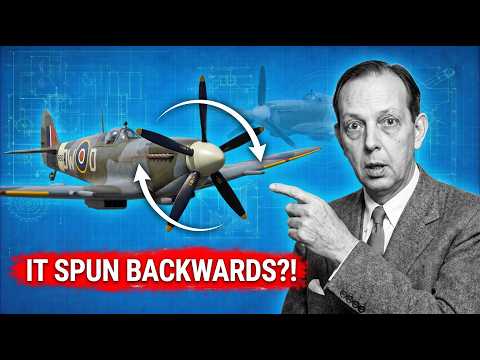
The Griffon 65 was longer, so it sat about 10 inches forward. To convert all that power into thrust, it drove a five-bladed propeller. Why five blades? Because the propeller couldn’t be longer before it hit the ground. If you can’t increase blade length, you add more blades.
Then came the change, literally. The Griffon turned its propeller in the opposite direction to the Merlin. Every Spitfire pilot in the RAF had learned to counter the aircraft’s swing to one side on takeoff. The Spitfire XIV swung the other way, to the right, and powerfully. Pilots advised in their notes to open the throttle slowly and keep boost low initially because of its strong tendency to swing right at the start of takeoff.
Imagine what that means. Hundreds of hours of muscle memory training your foot to press the rudder pedal while the aircraft fights you, now on a narrow-track Spitfire with over 2,000 horsepower. The longer nose made the aircraft heavier forward. The tail needed a larger fin and rudder to keep it straight. More power meant more fuel burned, and range was always the Spitfire’s weak point.
A pilot writing for Flight magazine in 1945 described the reaction of many experienced Spitfire pilots after their first flight in a Spitfire XIV. They said: “It’s a nice, fast, easy-to-control aircraft, but it’s no longer a Spitfire.” That was the price. The Spitfire was loved for its ease of handling and smooth controls. The Spitfire XIV traded some of that smoothness for enormous power.
So what exactly did this power bring? Here a common idea about the Spitfire emerges. Ask most people why the Spitfire outperformed German fighters, and you’ll hear the same answer: its superior maneuverability. Outturn the enemy, get on his tail, and shoot him down. It’s easy to see why this idea is widespread. The Spitfire did have excellent maneuverability. It was the one advantage the Spitfire V retained even against the Fw 190. It’s the familiar image in every film: two fighters chasing each other in a tightening circle.
But that’s not why Fw 190 pilots watched the Spitfire XIV disappear above them. In 1944, the Air Fighting Development Unit conducted tactical trials pitting the Spitfire XIV against the aircraft it would face, including the Fw 190 A. And no, it wasn’t Faber’s aircraft. That one had already disappeared. We’ll come back to that later.
Here’s what the trials found. In speed, the XIV was about 60 mph faster than the 190 A at most altitudes. Two bands narrowed the gap to about 20 mph: from sea level to 5,000 feet, and between 15,000 and 20,000 feet. Notice where those bands are—where the BMW 801 was at its best.
In climb, there were no bands at all. The XIV climbed much faster at all altitudes, not just up high where you’d expect a two-stage engine to excel, but everywhere.
In turning, yes, the XIV could outturn the 190, though the report noted this advantage was less pronounced in right turns. Very likely this was the Griffon’s torque itself, the force that tried to pull the aircraft off the runway, now working against the pilot in one direction.
The 190 still had its guns. It could roll much faster. It gained a slight advantage in the first part of a dive. The report was clear about what that meant. If an Fw 190 flipped and dived away, the Spitfire would likely not close until the German pilot had to break off.
Now look at the tactical advice. If a Spitfire XIV is on the defensive, it should use its maximum climb and turn circle to get away. But climb comes first. That’s the change. The Spitfire’s escape tool was no longer just a tight horizontal circle—it was vertical. Point the nose up and climb to where the Fw 190 couldn’t follow.
Now you can understand why a German pilot might find it hard to explain what was happening to him. From the cockpit of an Fw 190, the XIV didn’t look like a new type. It still had the elliptical wing. It still had the Spitfire shape he’d trained to recognize. The long nose and five-bladed propeller were there if you had time to study them. In combat, you rarely had that time.
What he couldn’t see was what was doing the work. Two impellers spinning on one shaft, compressing thin air twice, feeding a 37-liter V12 that was still producing enormous power while his own engine began to gasp. It wasn’t a trick by the pilot; it was a trick of the air.
Theoretically, the Mark XIV had won. Now it had to prove it where the bullets were real. The first production Mark XIVs left the factory in October 1943. On January 6, 1944, No. 610 Squadron received the first eight aircraft. The start was not smooth. The squadron spent weeks learning an aircraft that behaved completely differently from what they knew.
The first Mark XIV lost in combat was not shot down by an Fw 190 at all. On a maritime reconnaissance mission near the Channel Islands, the squadron leader, Lieutenant Percy, was hit by anti-aircraft fire. He climbed, then bailed out, but his parachute didn’t open. This was the war the Mark XIV actually fought. Not a clean duel between two famous fighters. Anti-aircraft fire, bad weather, a new aircraft, and bad luck.
Then, on March 7, 1944, No. 610 Squadron engaged Fw 190s. The squadron intelligence officer wrote a report on the combat. At one point, an Fw 190 fired at a Spitfire XIV, but its deflection was too slight. It couldn’t pull its guns far enough ahead of the turning Spitfire. The report noted that the Mark XIV’s turn circle appeared better than the Fw 190’s. Slight evidence, one engagement, low in the haze, but it matched what the trials had predicted.
Then the war changed the Mark XIV’s mission before it could settle into the fight it was designed for. On June 13, 1944, a week after D-Day, the first V-1 flying bombs fell on England. They were unmanned, fast, low, and perfectly straight. They didn’t climb or turn. They had to be shot down. Suddenly, one of Britain’s fastest low-altitude aircraft was worth its weight in gold.
On June 16, No. 91 Squadron began patrols with its Mark XIVs. That same day, Lieutenant Moffat chased a V-1 for about 20 miles before destroying it over Kenley. The commander of No. 610 Squadron, Squadron Leader Richard Newbery, personally shot down several more. So for much of 1944, the fighter designed for high altitude spent its time chasing robotic bombs at very low altitude. It wasn’t the confrontation anyone had imagined, but it proved something else. This aircraft was fast almost everywhere.
After the V-1 launch sites in France were overrun in September of that year, the Mark XIVs moved to the heart of the battle, crossing the English Channel with the Second Tactical Air Force. And here, precisely, the story becomes more complex. The Germans had learned the same lesson. In the autumn of that year, a new Focke-Wulf began to appear: the Fw 190 D-9, known as the Dora. Pilots called it Langnase, the long nose. The BMW radial was gone, replaced by the Junkers Jumo 213, an inline V-12 with an annular radiator around its nose, making it look round from the front.
Why replace the engine of one of the most successful fighters of the war? Because Focke-Wulf had been aware of the altitude problem for years. They had tried versions with two-stage superchargers and different engines, but most of those projects failed. The D-9 was the practical solution, and it was a real threat—faster than the radial-engined 190, better in climb and dive.
So here it is before us. The Spitfire XIV’s superiority rested on one idea, and the Luftwaffe was preparing an Fw 190 designed specifically to attack that idea. Did the Dora close the gap? Partly. It reduced its high-altitude weakness, but didn’t eliminate it. Even the Dora lost some performance above about 6,000 meters, though less noticeably. And it paid a heavy price. Its maneuverability was worse than the radial-engined Fw 190. Its famous trick, the snap dive-away, was also diminished. Power with weaknesses on both sides.
There’s another story often attributed to the Spitfire XIV in that period, and it deserves clarification. Many sources say the Spitfire XIV was the first Allied fighter to shoot down a Messerschmitt Me 262 jet on October 5, 1944. It’s a great story, but it’s not true. The Spitfires credited with victories that day belonged to No. 401 Squadron of the Royal Canadian Air Force and were Spitfire IXs. The Spitfire XIV doesn’t need borrowed glory; its real record is more interesting.
By the last winter of the war, Spitfire XIVs were flying from bases in Belgium and the Netherlands, then from airfields inside Germany itself. They flew patrols, armed reconnaissance, and attacks on trains and roads. And when they met German fighters, the pattern from those trials repeated. The Spitfire XIV preferred to fight from above, while the German pilot often preferred to maneuver and dive away.
Consider one of these aircraft, Spitfire XIV SM826, coded EB B, of No. 41 Squadron. In early 1945, the squadron flew daily armed reconnaissance missions over western Germany, clashing with Luftwaffe units at the front lines. On March 18, Squadron Leader John Sheppard took command. He had already scored victories in a Spitfire XIV with No. 610 Squadron. While flying SM826, he shot down two enemy aircraft. Then the Australian Tony Gaze scored two more victories in the same aircraft. Pat Coleman added another. One airframe, three pilots, five victories—a hero that was an aircraft, not a man.
You might now wonder about the big number. How many Fw 190s did the Spitfire XIV destroy? What was its kill ratio? Here’s the blunt answer. The most surprising number about the Spitfire XIV is how few were built. Only 957 of all marks combined. Compare that to the Spitfire IX, a stopgap from 1942, of which more than 5,600 were built. The Spitfire XIV was itself meant to be a temporary aircraft, bridging the gap until something better arrived. It never reached the level where one aircraft changes the course of a war by itself.
The Luftwaffe it faced in late 1944 was not the Luftwaffe of 1942. Experienced German fighter pilots were dying faster than the Allies could replace them. New pilots arrived with far less training. Fuel was desperately short. Allied fighters outnumbered them heavily. A skilled, experienced pilot in a Dora could match a Spitfire XIV. But many of the young men flying those aircraft in 1945 were not given the time to become such pilots.
So when Fw 190 pilots watched Spitfires pulling away from them, part of what they saw was an aircraft. Another part was a system on the other side that had fuel, training hours, and overwhelming numbers. The Spitfire XIV did not win the air war. What it did was ensure that when it met an Fw 190, the Fw 190 was usually the one deciding where the fight would happen. In air combat, that is almost everything. He who can climb chooses. He who chooses attacks.
And that brings us back to the people behind this advantage. Because the men who created that hidden edge went their separate ways when the war ended, and their aircraft quickly became history. Stanley Hooker, the mathematician who looked at superchargers as if they were water in a pipe, moved straight into new horizons. At Rolls-Royce, he contributed to Britain’s first jet engines, Welland and Derwent, then Nene. Later, at Bristol, he led work on the Pegasus engine, the engine that made the Harrier jump jet possible. The man who taught piston engines to work in thin air spent the rest of his career developing engines that needed no propellers at all.
The two-stage Merlin didn’t stop at the Spitfire either. It was built in America by Packard, and the high-altitude Merlin was fitted to the P-51 Mustang, helping transform it into an escort fighter capable of staying with bombers deep into Germany. And what of the Spitfire? The Griffon marks kept growing—heavier, longer, more powerful—until the last of them barely resembled the aircraft Mitchell drew in the 1930s. The Spitfire XIV was the point where that change could no longer be ignored. The moment when experienced pilots climbed out and said it was no longer a Spitfire.
Now, let’s return to that evening in South Wales. Armin Faber’s Fw 190 was the aircraft that showed Britain how much it was losing. It was measured, tested, fought, and studied. Twenty-nine flights between July 1942 and January 1943. Then it was partially disassembled to test its engine. In September 1943, it was scrapped. The first production Spitfire XIV left the factory the following month. The aircraft that revealed the problem disappeared before the solution was ready. It never saw what it had started.
And that solution wasn’t a better wing or a new shape. German pilots were looking at the same silhouette they had known since 1940. What had changed was hidden behind the propeller. Air compressed twice through an idea originally designed for a high-flying bomber that never existed. That’s why the Spitfire XIV kept climbing away—because the pilots in the Fw 190s were less skilled, and because their engines were designed for a part of the sky the battle was leaving behind.
So what do you think? Was the Spitfire XIV’s advantage a triumph of engineering, or a reflection of the Luftwaffe’s decline? Share your thoughts in the comments below.
Report this article
Select a reason for reporting:






