The wind screamed across the frozen wasteland like a wounded animal, and Sergeant James McNite couldn’t feel his fingers anymore. The thermometer read -5°C—cold enough to freeze skin solid in minutes. He and his four-man Canadian reconnaissance crew had been stuck in this position for 36 hours, ordered to watch the road, report enemy movement, and not get involved with civilians. The war was almost over, but the cold didn’t care.
Then McNite heard it—a sound that didn’t belong in this frozen hell. Crying. Faint and far away, but definitely crying. The kind of sound that grabbed your heart and squeezed. He asked his corporal, Davies, if he heard it too, but Davies shook his head. McNite heard it clearly now: children, multiple voices, weak and desperate, coming from the direction of a bombed-out town they’d passed the day before. Nothing but rubble and broken walls. No one should be alive there.
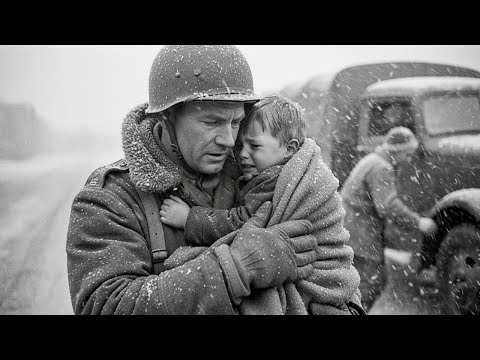
This was exactly the kind of situation their commanders had warned them about. The roads were packed with German refugees—thousands of them, old people, women, children—all running from the advancing Soviet forces, dying in ditches, freezing in abandoned buildings. And the Canadian Army’s position was clear: This is not our problem. We are soldiers, not babysitters. Stick to the mission.
But McNite was 28 years old, a farm boy from Manitoba who knew cold. He’d found frozen cattle in the fields after bad storms. He knew exactly what those children were going through. “I’m going to check it out,” he said. Davies looked at him like he’d lost his mind. “Sarge, we can’t leave our position. Orders are orders.” McNite interrupted: “I know what the orders are. But I also know what I’m hearing. Those are kids, Davies. Little kids.”
The other three men gathered around—Wilson, Patterson, and Kowalsski. They all looked at McNite with the same expression: part of them wanted to help, part of them knew better. “What if it’s a trap?” Wilson asked quietly. “Germans could be using kids as bait.” McNite had thought of that, but this didn’t feel like a trap. Traps didn’t cry like that. “Then we’ll find out together,” he said. “But I’m going. Anyone who wants to stay here, stay here. No judgment.” Nobody stayed.
The crying grew louder as they moved through the snow. McNite could make out individual voices now—young voices, some crying, some calling out in German. “Help us. Please help us.” The bombed-out schoolhouse appeared through the snow like a broken tooth. Three walls still standing, the roof collapsed on one side, windows blown out. McNite had walked past this building yesterday and assumed it was completely dead. The crying was coming from inside, from below—a basement, maybe.
McNite pushed through the broken doorway. The inside was somehow even colder than outside—dead, frozen air. He found the basement stairs, half collapsed, but enough remained to climb down. What he found would stay with him for the rest of his life. 18 children huddled together in the corner like a pile of puppies trying to stay warm. The oldest looked maybe 12. The youngest couldn’t have been more than three. Their lips were blue, their skin gray. Some weren’t even crying anymore, just staring with empty eyes that had given up hope.
They’d been down here for at least 36 hours, McNite figured. No heat, no food, no water except snow. Two of the older children had wrapped the younger ones in their own coats, trying to share body heat. When the children saw the Canadian soldiers, several screamed. These were enemy soldiers—soldiers who bombed their cities and killed their fathers. For a moment, nobody moved. Then the smallest child, a little girl with blonde hair, started crying again. Not the hopeless crying from before—something different. The crying of a child who sees adults and thinks maybe, just maybe, someone will help.
McNite made a decision in that frozen basement that would change everything. He didn’t think about military protocol. He thought about his kid sister back home in Manitoba. He thought about what his mother would want him to do. “We’re taking them,” he said quietly. “All of them.” Davies stared at him. “Sarge, our truck fits eight people. Maybe 10 if we’re packed tight. There’s 18 kids here, plus the five of us. That’s 23 people total.” McNite was already moving, checking each child. The two in the corner weren’t responding when he touched them. Their skin felt like ice. Hypothermia. Severe hypothermia. If they didn’t get warm in the next hour, they’d be dead. “Then we make it fit,” he said.
The crew moved fast. Kowalsski, the strongest, carried three of the smallest children at once. Patterson took two older boys who could barely stand. Wilson helped a girl who looked about ten, but weighed almost nothing—starvation on top of freezing. McNite carried the two hypothermia cases himself, one under each arm, trying to be gentle, but knowing speed mattered more right now.
Getting them to the truck was only the first problem. When McNite opened the back, he did quick math in his head. The truck bed was exactly six feet wide and eight feet long. Forty-eight square feet to fit twenty-three human beings. It was impossible. But impossible didn’t matter anymore.
“Out with the equipment,” McNite ordered. “Everything except the radio, medical kit, and weapons. Everything else goes in the snow.” They worked like machines—spare ammunition boxes, tool kits, extra fuel cans, rations they’d been saving. All of it went into the snow beside the road. When they were done, they had maybe doubled their space. Still not enough.
“We’ll sit on the benches,” Wilson said, pointing to the metal benches that ran along both sides of the truck bed. “Put the kids on the floor between us. Pack them tight.” It was the only way.
They started loading children. The smallest went in first, right near the cab where the engine heat would reach them. The older children filled in around them. McNite made sure the two hypothermia cases were positioned directly against the metal wall that separated the truck bed from the engine. That wall would be warm. Not warm enough, but better than nothing.
The children were too scared and cold to resist. Most didn’t even seem to understand what was happening. A few of the older ones tried to say something in German—thank you, maybe, or please don’t hurt us. McNite couldn’t tell. He just kept moving, kept organizing, kept trying to fit impossible pieces into an impossible puzzle.
When all eighteen children were loaded, the crew climbed in. They sat on the benches with children pressed against their legs, wedged between their boots. Kowalsski had a small boy sitting on his lap. Davies had two girls leaning against his sides. There was no room to move, barely room to breathe, but everyone was in.
McNite grabbed the radio handset before they started driving. He had to report this. The radio crackled and hissed, then a voice came through. “Command post, Lieutenant Davidson. Recon 4, this is base. Report.” McNite chose his words carefully. “Base, we’ve encountered eighteen German civilians—children, critical condition, severe hypothermia. We’re transporting them to the nearest Allied medical station.”
Silence, long enough that McNite thought the radio had died. Then Davidson’s voice came back, sharp and cold. “Recon 4, negative. You are not authorized to transport civilians. Contact German authorities in the nearest town.” “And there are no German authorities,” McNite interrupted. “Sir, these children will be dead in two hours if we don’t move them now. Two of them might already be past saving.”
Another pause. McNite could picture Davidson at the command post, probably with a dozen officers standing around him, all of them thinking about regulations and proper procedure and what headquarters would say. All of them knowing that saving children wasn’t part of the mission.
“Recon 4, you are ordered to maintain your observation position. You cannot abandon your post for—” “Sir.” McNite’s voice was steady but firm. “I’m not abandoning anything. I’m requesting permission to complete a humanitarian evacuation. If you deny that permission, I’m doing it anyway and accepting whatever consequences come after.”
The radio went silent again. McNite waited. The children waited. His crew waited. Everyone barely breathing in the freezing truck. When Davidson came back on, his voice had changed—softer, more human. “The nearest medical station is forty-two kilometers west. Route is through potentially hostile territory. You’ll be passing through three towns we haven’t fully cleared yet. If you get into trouble, I can’t send help. Do you understand?”
“Yes, sir.” “Then get those kids to safety, Sergeant. I’ll deal with headquarters. Davidson out.” McNite felt something release in his chest. They had permission. Sort of. Maybe enough to move.
The drive was four hours of pure hell. The truck’s heater was designed for the cab, not the open bed. McNite had them rotate the children every fifteen minutes—the ones near the warm engine wall moved to the outer edges, the ones from the edges moved to the center. Keep the warmth moving. Keep the blood flowing. They shared their water, one canteen between twenty-three people. Each child got two small sips. Not enough to matter, but enough to wet their mouths, to remind their bodies that water existed.
Patterson had chocolate in his pack. He broke it into tiny pieces, one per child. Some were too cold to chew. He’d let the chocolate melt in his palm and then let them lick it from his hand like puppies. McNite kept checking the two hypothermia cases. The girl was responding a little—her eyes would focus sometimes, she’d try to curl up tighter when he touched her. That was good. That meant her body was still fighting. The boy worried him more. Too still, too quiet. McNite pressed his own warm hands against the boy’s chest every few minutes, trying to push heat into him through sheer willpower.
They passed through the first town without incident—abandoned, everyone gone. The second town had some German civilians on the streets, old men mostly. They stared at the truck full of children, but didn’t move. Didn’t try to stop them or help. Just stared.
The third town was different.
McNite saw German soldiers—maybe a dozen, boys of fifteen or sixteen, the last scraps of Hitler’s army. They had rifles and the desperate, angry look that got people killed. Davies reached for his weapon, but McNite shook his head. “Don’t point at them. We’re just passing through.”
An officer stepped into the road and raised his hand. “Stop.” McNite’s heart hammered—if shooting started in this packed truck, children would die. Then an older girl stood up, wobbling, and called out in German. McNite caught one word repeated: Kinder. Children.
The officer looked at the truck bed. Really looked. He saw the frozen children, saw Canadian soldiers sitting among them—not guarding, protecting. His face changed. The anger drained away. He lowered his hand and waved them through. Nobody breathed until they were a mile past that town.
The medical station appeared through the snow like a miracle. Doctors and nurses ran to the truck, their faces changing as they saw the children. “Get them inside now!” a British doctor shouted. The two hypothermia cases went straight to surgery. The rest were wrapped in blankets and carried to heated tents.
The final count came two hours later: all eighteen children alive. The girl’s core temperature had been 28°C—nine degrees from death. The boy had nearly died twice on the table and would lose parts of three fingers and two toes. Fifteen escaped with only mild frostbite. In that frozen wasteland, it counted as a miracle.
Then the military police arrived. Three senior officers sat behind a folding table, asking why McNite had abandoned his post and disobeyed orders. “I did what I did,” McNite said quietly. “I’d do it again.” The inquiry dragged on for weeks, but the story had already escaped—nurses wrote letters, doctors filed reports, and soon newspapers across Canada and Britain carried the headline: Sergeant saves 18 German children.
The brass did what bureaucracies always do when faced with impossible choices. They did nothing. No charges, no punishment—but no commendation either. The war ended three months later. McNite went home to Manitoba and tried to forget.
Then, in the spring of 1960, a letter arrived from Germany. Inside was a photograph of five smiling adults and a note: We were children you saved. We have been searching for you for many years. Six months later, they flew to Canada. They met at McNite’s farm on a bright October afternoon, and one of them—the girl who’d been nine degrees from death—showed him her hands, all ten fingers intact. “You got me warm fast enough,” she said. “You saved my life and my hands.”
Before they left, they gave him a wooden plaque with all eighteen names carved into it. It still hangs in his family’s home today. His grandchildren ask about it sometimes—who were these people, why are their names on our wall? And the family tells them the story of a sergeant who heard crying in the snow and chose to see children before he saw nationality.
In that frozen moment, those soldiers proved something essential: even in history’s darkest chapters, we still have the capacity to choose kindness when kindness is the hardest possible choice. Small lights still matter. They still push back against the night.
What would you have done if you were Sergeant McNite—follow orders and let eighteen children freeze, or risk everything to save them?
Report this article
Select a reason for reporting:






