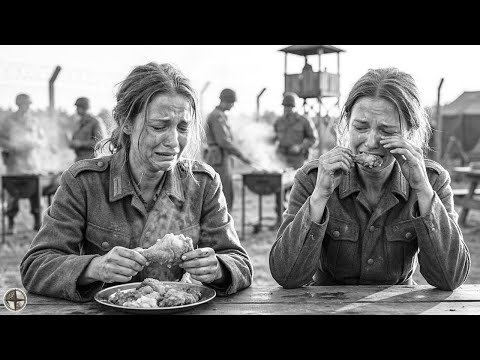
June 12, 1945. Camp Hearn, Texas. Twenty-three German women sat before a table loaded with golden fried chicken, mashed potatoes swimming in butter, and warm biscuits piled high. Their hands trembled. Their eyes filled with tears. And then they broke down completely, sobbing so hard they could barely breathe.
Not because they were being tortured. Not because they were being starved. But because they couldn’t stop eating.
These women were prisoners of war—enemy soldiers. They had been warned that Americans would beat them, starve them, work them to death in the brutal heat. Instead, three days after arriving at this prison camp, they sat before the most beautiful meal they had seen in five years, prepared by the very people they had been taught to fear most.
What happened next would challenge everything they believed about enemies, about kindness, and about what it means to be human.
Among them stood Elsa Brandt, twenty-four years old, a former radio operator from Cologne. She clutched a small canvas bag containing all she had left: a change of clothes, a photograph of her family, and a book of poetry. Around her, the other women stood in rigid formation, their gray auxiliary uniforms stained with dust from the long journey. Their faces showed nothing—trained to reveal no emotion, no weakness.
They had also been warned. Whispered stories had spread through German military units like wildfire—stories about what Americans did to their prisoners. Beatings. Starvation. Prisoners worked until they dropped dead in the brutal heat. Nazi propaganda had painted Americans as ruthless, as savage, as people who saw Germans as less than human.
Looking at the armed guards and the barbed wire, Elsa wondered how much of it was true.
Camp Hearn had held over 4,800 German prisoners during the height of the war. It was one of more than 500 prisoner-of-war camps scattered across the United States—a fact that would have shocked most Americans at the time. Now, with the war over, the camp was processing the slow bureaucratic work of sending prisoners home. But for these twenty-three women from the German Women’s Auxiliary Corps, that process meant waiting. Waiting in a strange land, waiting among enemies, waiting to discover if the horror stories were real.
Captain Eleanor Whitmore emerged from the administration building. She was younger than Elsa expected—perhaps early thirties—with sharp eyes that seemed to notice everything at once. Her uniform was crisp, a stark contrast to the dusty, wrinkled appearance of the new arrivals. Behind her stood two guards. Corporal Emmett Caldwell was a tall, lanky man with a slow, Southern way of speaking. Private Virgil Thatcher looked barely old enough to shave. His nervous fidgeting suggested this was his first time dealing with enemy prisoners.
“Welcome to Camp Hearn,” Captain Whitmore said. Her English was clear and measured. Her tone was neither friendly nor hostile, just professional. “You will be housed in Barracks 7. You will follow camp regulations. Roll call happens twice each day. Work assignments will be given tomorrow. Medical inspection in one hour.” She paused. “Any questions?”
The German women stayed silent. They had been instructed during transport: Do not speak unless directly addressed. Do not show emotion. Do not give your captives any reason to single you out.
Elsa’s hands tightened around her canvas bag. Her heart pounded against her ribs. She watched Private Thatcher shift his weight from foot to foot, looking almost as uncomfortable as she felt. That was strange. Everything about this arrival was strange—the captain’s professional tone, the guards who seemed uncertain rather than threatening, the complete absence of shouting, of violence, of the cruelty they had been promised.
Dorothea Fischer—everyone called her Dora—stood next to Elsa. She was twenty-two, one of the youngest in the group, a former clerk from Dresden who still tried to carry herself like someone older. Her eyes darted around the compound, taking in details, searching for danger. Later, she would write in a journal entry that survived the decades: We stood there waiting for the punishment to begin. We stood there for a very long time. It never came.
Hedwig Roth was the eldest among them at twenty-six. She had served as a medical assistant in Stuttgart before her capture. Now she watched the American guards with careful suspicion. These men had weapons. These men had power. And yet they seemed almost awkward, like they were following a script nobody had fully written.
The women were led to their barracks—simple wooden buildings, rows of bunks, thin mattresses, but clean, organized, functional. Not the dungeons they had imagined. As Elsa set her canvas bag on a bunk, she noticed something that didn’t fit the propaganda she had believed for years. The blankets were adequate. The building had windows that actually opened. A schedule posted on the wall showed meal times—three per day. Three meals per day for enemy prisoners.
She didn’t know what to make of it. None of them did.
They had arrived expecting monsters. Instead, they found soldiers doing an uncomfortable job—following regulations, treating them with something that looked almost like professionalism. It was confusing. And confusion, in its own way, was more unsettling than cruelty would have been. Cruelty they could have understood. Cruelty fit the story they had been given. This careful neutrality, this awkward politeness—it fit nothing at all.
But the first forty-eight hours were only the beginning. What came next would crack open something deeper. Small gestures that accumulated into evidence impossible to ignore.
The first forty-eight hours passed in tense silence. The German women moved through their routines like ghosts. They lined up for meals. They stood for roll call. They followed every order with mechanical precision. They spoke only in whispered German during the brief moments they were left alone in the barracks. And they watched constantly—waiting for the mask to slip, waiting for the cruelty to begin.
It never did.
Instead, something else happened. Something small, something that shouldn’t have mattered, but somehow mattered more than anything.
Private Virgil Thatcher brought extra water. It was the second afternoon. The Texas sun had pushed the temperature past 105 degrees. Several women looked pale and exhausted from the heat. Without a word, the young private set down additional canteens near their work area. He didn’t announce it. He didn’t wait for thanks. He just did it and moved on.
Such a small thing. A few canteens of water. But Elsa noticed—and noticing troubled her more than cruelty would have.
That same day, one of the German women stumbled on the barrack steps. Private Thatcher reached out instinctively to steady her, then caught himself, stepped back awkwardly, and looked at the ground as if embarrassed by his own kindness.
Hedwig had been watching from nearby. Later that night, she gathered the younger women around her bunk after lights out. “Don’t mistake exhaustion for kindness,” she whispered in German. “Their soldiers were enemies. That hasn’t changed just because the shooting stopped.”
But even Hedwig couldn’t explain what happened next.
Corporal Emmett Caldwell started learning German phrases. His pronunciation was terrible—the words came out mangled and awkward—but the effort was unmistakably sincere. “Guten Morgen,” he would say during morning roll call, his Southern accent stretching the syllables into something almost unrecognizable. Some of the women would respond automatically before catching themselves—before remembering they were supposed to be enemies.
Camp Hearn had processed thousands of German prisoners during the war. According to official records, the camp followed Geneva Convention protocols strictly—providing adequate food, shelter, medical care, and protection from abuse. The United States held over 425,000 German POWs across the country by 1945. Most were treated better than they ever expected. But these women didn’t know those statistics. They only knew what they had been told.
And what they had been told was lies.
Dora whispered to Elsa on their second night. “They haven’t hit anyone yet.”
“It’s only been two days,” Elsa replied.
“Still,” Dora continued, her voice barely audible. “The stories we heard—they said Americans were brutal, that they would mock us, abuse us. But that young one, the private—he helped Hedwig carry her mattress when she struggled with it.”
Elsa had noticed other things, too. Small things that didn’t match the propaganda. The way Corporal Caldwell made sure each woman received the same portion of food during meals—not favoring anyone, not withholding from anyone. Just simple, consistent fairness. The way Captain Whitmore personally checked that the barracks had adequate blankets, even though summer heat made them unnecessary at night. Someone had thought about their comfort. The way the guards talked among themselves—not about punishing prisoners or taking revenge, but about baseball scores, letters from home, when they might finally get discharged and return to civilian life.
These Americans didn’t act like conquerors. They acted like people doing an uncomfortable job. People who hadn’t been trained for this exact situation and were figuring it out as they went.
During the second evening meal, Elsa noticed someone new in the camp kitchen. He was a Black man in an army uniform—older than most of the guards, perhaps in his forties, with graying hair and steady hands. He worked over enormous pots with the focused attention of someone who took his craft seriously.
Elsa had never seen a Black person before coming to America. Nazi propaganda had taught her to expect savagery, to fear such encounters. The ideology she had absorbed painted non-white people as inferior, as dangerous, as less than human. But watching this man carefully season food—food that would feed prisoners, enemy prisoners—she felt something shift inside her chest. A small crack forming in the wall of certainty she had built around herself.
She would later learn his name: Sergeant Booker Washington, a career army cook from Georgia—a man whose grandfather had been born into slavery. But for now, he was simply a quiet figure working in the kitchen. Another piece of evidence that didn’t fit the story she had been given.
That night, Elsa lay in her bunk and stared at the ceiling. Her mind kept returning to the same impossible question: What if they had been wrong? Not just wrong about small details—wrong about everything. Wrong about Americans. Wrong about who was civilized and who was savage. Wrong about the entire framework through which they had understood the world.
The thought was terrifying. Because if they were wrong about this, what else might they have been wrong about?
Hedwig’s voice cut through the darkness. “We need to be careful. This kindness could be a trap. They might be trying to make us comfortable before they strike.”
But young Dora asked the question none of them could answer. “What information do we have that matters? The war is over. Germany surrendered. What could we possibly tell them?”
Hedwig had no response. None of them did. Because deep down, beneath layers of training and propaganda and fear, they were beginning to suspect an uncomfortable truth: Maybe the Americans weren’t trying to trick them at all. Maybe this was simply how they treated people.
Sunday morning arrived with something different in the air. The guards seemed more relaxed. Private Thatcher was whistling as he walked his patrol route. Even Captain Whitmore had a slight softness around her eyes. Something was coming—something none of them could have predicted—and it would break them open completely.
Corporal Caldwell let it slip during morning roll call. “Big meal coming this afternoon,” he told Private Thatcher, loud enough for the prisoners to hear. “Sergeant Washington’s been in that kitchen since 0500—says he’s cooking like he’s back home in Georgia, feeding the Sunday congregation after church.”
By noon, incredible aromas drifted across the compound. Elsa’s stomach clenched. She hadn’t smelled anything like this in years.
At 1400 hours, the women stepped into the dining hall—and stopped cold. Long tables were set with real plates. Platters of golden fried chicken glistened under the light, surrounded by mashed potatoes, green beans, corn, and biscuits piled high.
Sergeant Washington stood near the kitchen door, calm and patient. “Go ahead,” Corporal Caldwell urged. “There’s plenty more where that came from.”
Dora reached out first. The moment she bit into the chicken, a sob escaped her—then another. Within moments, all twenty-three women were weeping and eating, unable to stop.
Elsa’s tears burned as she tasted the best food of her life. “Why?” she finally asked the sergeant. “Why would you do this for us?”
He considered it carefully. “Sunday dinner ain’t about who deserves what. It’s about remembering we’re all human beings—even when the world tries to convince us otherwise.”
What would you have done, sitting at that table?
Report this article
Select a reason for reporting:






