June 21, 1940. In a railway carriage in the Compiègne Forest, Adolf Hitler sat down to rewrite history. This was the same carriage where, twenty-two years earlier, Germany had signed the armistice that ended World War I. Now, Hitler was here to accept France’s surrender, erasing what he saw as decades of humiliation. The Nazis reveled in symbolism, and this moment was the ultimate act of revenge.
But Hitler’s ambitions didn’t stop at France. Just days later, he stood on the cliffs of Calais, peering through field glasses at the white cliffs of Dover. Britain was now the last nation in Europe standing against him. Its army had been battered, its equipment left on the beaches of Dunkirk, and its air force outnumbered. Hitler was certain that Britain, led by the newly appointed Winston Churchill, would sue for peace. He was wrong.
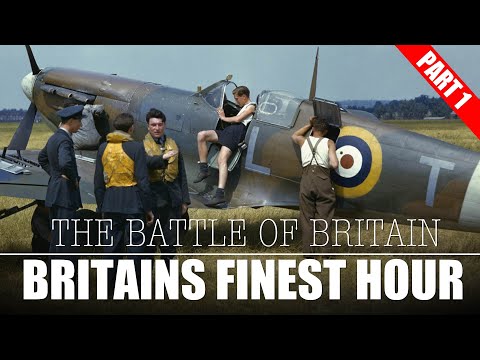
Churchill’s response was defiant: “We shall fight on the beaches, we shall fight on the landing grounds, we shall fight in the fields and in the streets, we shall fight in the hills; we shall never surrender.” The British people, though weary, rallied to his call. But spirit alone couldn’t stop the German war machine. Britain was ill-prepared for invasion. The British Expeditionary Force had left most of its tanks, trucks, and guns in France. The Royal Navy, once the world’s most powerful, now faced the daunting task of protecting the English Channel from German U-boats and bombers. And the Royal Air Force, though resilient, was struggling to rebuild after the disastrous campaign in France.
Air Chief Marshal Sir Hugh Dowding, commander of RAF Fighter Command, saw the looming threat clearly. He had warned against sending more fighters to France, knowing they would be needed for Britain’s defense. His foresight would prove crucial. But even he couldn’t predict the scale of the battle to come.
On July 10, 1940, the first major clash occurred over the English Channel. A convoy codenamed “Bread” was attacked by German bombers, and RAF Spitfires scrambled to intercept. The skies erupted in a fierce dogfight. Pilot Officer Bob Doe, his Spitfire riddled with bullets from both front and rear, bailed out and watched as his two attackers nearly collided. The RAF claimed 13 German planes downed for the loss of six of their own—a ratio that seemed promising but was not enough. Dowding knew that to win, they would need to do even better.
The battle had begun. And for the next three months, the fate of the free world would hang in the balance.
Dowding’s cold arithmetic haunted him through the long July evenings at Bentley Priory. Every engagement over the Channel told the same story: the RAF could win the skirmishes, but the Luftwaffe could afford to lose them. Fighter Command had roughly 750 operational fighters against a German force of more than 2,700 aircraft. To break even, his pilots would need a kill ratio of at least two to one—ideally three.
Meanwhile, Göring’s frustration grew with each passing week. His fighter pilots complained that the British refused to fight, that they slashed in, fired, and fled before the Bf 109s could bring their superior numbers to bear. The rotund Reichsmarschall, still stinging from Dunkirk, demanded answers. And the answer, when it came, was radar.
German intelligence had long dismissed the tall lattice towers along the British coast as primitive direction-finding equipment. But on August 12, Göring ordered them destroyed. Bf 110s carrying bombs struck at Pevensey, Rye, Dover, and Ventnor, severing power lines and toppling antennae. For the first time, holes appeared in Fighter Command’s electronic shield.
Dowding’s controllers at Uxbridge stared at silent plotting tables and turned in desperation to the Royal Observer Corps—the binocular-wielding volunteers who scanned the skies from cliff tops and rooftops. It was a fragile, human backup to the technology that had given Britain its edge.
Then came August 13. Göring named it Adlertag—Eagle Day—and threw nearly 1,400 aircraft against the RAF’s bases in southeast England. The Luftwaffe’s intelligence assured him that Fighter Command had fewer than 400 serviceable fighters left. In truth, the RAF had almost twice that number, and Lord Beaverbrook’s factories were pushing replacements out the door faster than the Germans believed possible.
The day was a shambles. Poor weather scattered formations. Bf 110s flew without their bombers, wandered over the Channel, and were pounced upon by waiting Spitfires. Some bombers attacked Eastchurch and Sheerness without fighter escort. Civilian airfields were bombed by mistake. When the smoke cleared, the RAF had lost 13 fighters—but the Luftwaffe had lost 47 aircraft.
Yet Göring, reading his pilots’ inflated claims, believed the opposite. His men reported 70 RAF planes shot down. The Reichsmarschall congratulated himself. Fighter Command, he concluded, was on its last legs.
He was catastrophically wrong—and the battle was only escalating.
On August 14, the Luftwaffe returned. Hurricanes of No. 151 Squadron tore into a lone Dornier on reconnaissance, losing one of their own to the bomber’s rear gunner before the German aircraft went down in flames. It was a small, bitter exchange—the kind of attrition Dowding dreaded.
At RAF Manston, the strain of repeated attacks had finally cracked the surface. A group of raw recruits, traumatized by the bombing two days earlier, barricaded themselves in underground shelters and refused to come out. The episode became known as the Manston Mutiny—a quiet, shameful reminder of what sustained bombardment could do to men’s nerves.
By midday, radar stations detected a large formation building over Calais. Eighty Ju 87 Stukas, screened by Bf 109s and joined by Bf 110s, headed for the Strait of Dover. The RAF scrambled two Hurricane and two Spitfire squadrons to meet them.
The Bf 110s slipped past the main engagement and went in low over Manston, bombing with greater accuracy than the level bombers ever managed. Anti-aircraft gunners scored a hit on one, its tail shearing off as it plunged to earth. But the damage was done.
Later that afternoon, RAF Middle Wallop came under attack. A lone Ju 88 made a shallow dive and released a single large glide bomb from its bay. The weapon struck a hangar directly, obliterating it and the ground crew inside. A Spitfire of No. 609 Squadron, scrambling during the raid, turned in pursuit and caught the fleeing bomber as it climbed, sending it crashing down with all four crew aboard.
Again the RAF seemed to have bested the Luftwaffe. Again Dowding was suspicious. The attacks felt scattered, almost random—as if Göring were probing rather than striking. He couldn’t yet see the pattern.
But Göring’s plan was no longer about the Channel convoys. Eagle Day had failed to crush Fighter Command, and he knew it. The new objective was simpler and more brutal: destroy the airfields themselves. Wipe out the sector stations. Force the RAF to fight on the ground, where it could not maneuver or climb or dive away.
On August 15, the Luftwaffe launched its largest operation yet—some 2,000 sorties in a single day. Bombers struck at RAF stations across the southeast while fighters swept ahead to draw the defenders into battle. This time, the Germans came in coordinated waves, and for the first time the British controllers struggled to keep pace.
At RAF Kenley, bombs cratered the runways and destroyed hangars. At Biggin Hill, the operations room took a direct hit. At Croydon, the airfield was left burning. The sector stations—the nerve centers of Dowding’s network—were being methodically dismantled.
And still the British fighters rose to meet them, scrambling from damaged fields, landing to refuel and rearm while bombs fell around them, taking off again into skies thick with smoke and German aircraft.
By nightfall, the RAF had lost 34 fighters. The Luftwaffe had lost 75 aircraft—a ratio that still favored the defenders. But the airfields were crumbling, and Dowding knew that infrastructure could not be replaced as quickly as a Spitfire.
That evening, he studied the reports by lamplight at Bentley Priory. The radar stations were patched but fragile. The sector stations were battered but operational. His pilots were exhausted, many flying three or four sorties a day.
The battle was entering its most dangerous phase—and the worst was yet to come.
The following days brought no relief. August 16 saw the Luftwaffe strike again at Kenley, Tangmere, and West Malling, while Bf 109s roamed freely over Kent, hunting anything that moved. The RAF lost 21 fighters; the Germans lost 45. The ratio held—but the airfields kept burning.
At Bentley Priory, Dowding’s staff watched the toll mount with grim precision. Pilots were arriving from training units with barely ten hours on Spitfires and Hurricanes, thrown into combat against veterans of Spain and France. Some lasted a single sortie. The squadron commanders pleaded for rest, for replacements, for anything. Park at No. 11 Group told them plainly: “We have to keep going. There is no alternative.”
Then, on August 18—a day the RAF would come to call “The Hardest Day”—the Germans launched three massive raids in rapid succession. Bombers struck at Kenley, Biggin Hill, Croydon, and West Malling while fighters swept ahead in force. By dusk, both sides had suffered their heaviest losses of the battle so far: the RAF lost 68 aircraft, the Luftwaffe 69.
For Göring, it was proof that Fighter Command was bleeding out. For Dowding, it was proof that his pilots could still make the Germans pay dearly for every mile of English sky.
But the arithmetic was turning. Replacements of aircraft were arriving—Beaverbrook’s factories saw to that. Replacements of experienced pilots were not. The men who survived were flying until exhaustion, and the new arrivals were dying before they could learn.
On August 20, Churchill rose in the House of Commons and spoke the words that would echo through history: “Never in the field of human conflict was so much owed by so many to so few.” The Few—the pilots of Fighter Command—heard it from radios in dispersal huts and mess halls. Some smiled. Some wept. Most simply climbed back into their cockpits.
The battle was far from over. The Luftwaffe would shift its targeting to London within weeks, and the Blitz would follow. But the crucial question had already been answered in the summer skies over England: Britain would not break.
Hitler’s invasion barges would rot in French and Dutch harbors, Sea Lion would be postponed, then abandoned. The Nazi tide had reached its high-water mark—and it had been turned back by radar operators, ground crews, factory workers, and a handful of exhausted young men in Spitfires and Hurricanes.
What do you think—was the Battle of Britain won by technology, by leadership, or by the sheer stubbornness of Churchill’s refusal to surrender?
Report this article
Select a reason for reporting:






