April 20, 1949. The Yangtze River, China. HMS Amethyst, a British frigate, steams upstream toward Nanking on a routine mission to protect British interests. On board, 17-year-old Ordinary Seaman Sydney Horton and his crewmates are unaware that they are sailing straight into a deadly crossfire. Within hours, the ship will be shattered by Communist artillery, its captain mortally wounded, and its crew fighting for survival on a sandbank in the middle of a hostile river.
But this is not just a story of war. It is also the story of Simon, a stray cat smuggled aboard in Hong Kong, who will become an unlikely hero. As the shells rain down, Simon will be injured, yet his spirit will lift the crew in their darkest hours.
The first shots came from the north bank—light machine-gun fire that pinged off the hull. Then came the artillery. A shell slammed into the bridge, killing the captain and wounding the first lieutenant. “We are not neutral! They are firing at us!” someone shouted. The ship ran aground on Rose Island, a sitting duck. For an hour and a half, the Communists pounded the Amethyst. Nineteen men died. Thirty more were wounded. Simon the cat was among the injured, shrapnel tearing into his body.
The crew fought back with rifles and a single working gun. They evacuated the wounded to the island, swimming and rowing under fire. Miraculously, 59 men made it. But the ship was a wreck, and the nightmare was only beginning.
That evening, as the sun set on the bloodied river, the survivors tended to their wounds and counted their dead. The captain was gone. The doctor was dead. The telegraphist worked alone. And Simon, wrapped in a blanket, purred weakly as the surgeon removed shrapnel from his body.
Help was on the way—but not enough. HMS Consort raced to the scene, only to be driven off after taking 56 hits. HMS London, a mighty cruiser, fared no better. The Royal Navy was humiliated. The Amethyst was on its own.
For ten weeks, the ship sat trapped, surrounded by hostile forces. Negotiations dragged on. Food ran low. And the rats came. But Simon, now recovered, was on a mission. He hunted the rats relentlessly, even killing a huge rodent the crew nicknamed “Mao Tse-tung.” His exploits became legendary, boosting morale when it was needed most.
Then, on July 30, under cover of darkness, the order came: escape. The crew blackened the ship, greased the anchor chain, and slipped silently downriver. But the Yangtze had one more test in store.
They almost made it. Following a brightly lit passenger ferry through the darkness, the Amethyst was spotted by sharp-eyed shore watchers. “They’ve seen us! Open fire!” Within seconds, both banks erupted in a storm of artillery and small-arms fire. Kerans ordered full speed ahead. With black smoke billowing, the frigate surged past the ferry, missing it by mere feet.
The passenger boat, illuminated and caught in the crossfire, took the brunt of the barrage. Reports later claimed it sank with heavy casualties. But the Amethyst—battered, leaking, yet still fighting—slipped through the gauntlet.
By 5:30 a.m. on July 31, HMS Concord was waiting at the river mouth near Shanghai, guns trained on Fort Wusong in case the Chinese opened fire. The fort stayed silent. Concord escorted the Amethyst into the East China Sea, and Kerans sent his signal: “Rejoined fleet south of Wusong. No damage. No casualties. God save the King.”
The ship sailed first to Hong Kong, then home to Devonport, where a hero’s welcome awaited. The entire crew was invited to Buckingham Palace to meet King George VI. Kerans received the Distinguished Service Order. Lieutenant Weston was awarded a bar to his DSC. Lieutenant Berger, the officer who had lost most of his clothes when the bridge was hit, also received the DSC. Telegraphist Jack French, the one-man communications team, was awarded the Distinguished Service Medal. So were Leonard Williams from the engine room and Acting Petty Officer Leslie Frank.
More gallantry medals followed—for the Sunderland flying boat pilot, four men from HMS London, and three from HMS Consort, including the DSO for Commander Robertson.
But there was one more medal to mention. The Dickin Medal, often called the Victoria Cross for animals. Since its creation in 1943, it had been awarded to 37 dogs, 32 pigeons, and five horses. Only one cat. Simon, of HMS Amethyst.
On the voyage home, Simon received so much fan mail that a crew member was assigned to open and answer all his letters. Upon arrival in Plymouth, he was placed in quarantine, as any animal entering Britain was at the time. Tragically, he contracted a virus that worsened the injury he had suffered on the Yangtze, and little Simon passed away on November 28.
Hundreds attended his funeral at the PDSA cemetery in Ilford, East London—including the entire crew of HMS Amethyst. His gravestone reads: “Simon, the cat who served his country.”
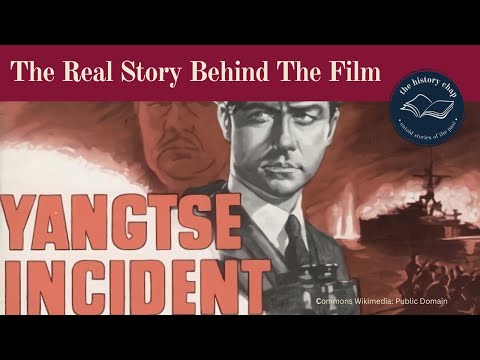
The story of HMS Amethyst was told in the 1957 film The Yangtze Incident, starring real-life war hero Richard Todd as Lieutenant Commander Kerans. William Hartnell—who would later become the first Doctor Who—played Able Seaman Leslie Frank. The film featured several other notable British actors, including Bernard Cribbins, and was released in the United States under various titles: Battle Hell, Escape of the Amethyst, and Their Greatest Glory.
The Amethyst itself played a starring role, though by then she had been sold for scrap and her engines removed, so another ship was used for the moving shots. But cinematic fame could not prevent the inevitable. She was broken up later that year. By then, HMS London and HMS Black Swan had met the same fate, and HMS Consort followed in 1961.
Their passing was almost symbolic. The days of British supremacy on the seas, of gunboat diplomacy, of Royal Navy ships sailing deep into Chinese waters, were gone. After the Opium Wars, the Taiping Rebellion with “Chinese Gordon,” and the Boxer Uprising, the Yangtze Incident—in which Britain lost 50 of her soldiers—was the last of her wars in China.
But the story of the Amethyst does not end with scrap metal and faded glory. It ends with a cat. A small, shrapnel-scarred stray who lifted the spirits of a trapped crew, who hunted rats in the darkness, and who received a hero’s farewell. In the long history of the Royal Navy, no other cat has ever been awarded the Dickin Medal. Simon remains unique—a reminder that courage comes in all sizes, and that sometimes, the smallest among us make the greatest difference.
So ends the tale of HMS Amethyst—a ship that survived fifty shell hits, a ten-week siege, and a daring midnight escape, only to be broken up for scrap within a year. Her crew returned home to medals and royal handshakes, but the most remarkable hero among them had four paws and a purr.
Simon’s Dickin Medal remains the only one ever awarded to a cat. His gravestone in Ilford still draws visitors, a quiet reminder that even in the chaos of war, a small act of courage can echo through history.
The Yangtze Incident marked the end of an era—the last gasp of gunboat diplomacy on Chinese waters. But from that final, bitter chapter came a story of loyalty, resilience, and a stray cat who refused to give up.
What would you have done if you were trapped aboard the Amethyst—would you have fought, fled, or found your own Simon to keep hope alive? Share your thoughts in the comments below.
Report this article
Select a reason for reporting:






