June 1942. A ring of coral in the middle of the Pacific, no bigger than a fingernail on a map. The Americans called it Midway. Within 72 hours, the most powerful navy on Earth would burn there—not from battleships or the biggest guns ever built, but from paper, from radio static, from the obsession of one man working in a windowless basement wearing carpet slippers instead of boots.
Four Japanese aircraft carriers steamed toward that island carrying the same pilots who had set Pearl Harbor on fire six months earlier. They believed they could not lose. They were almost right. Then, in a single window of time so narrow that historians still argue over exactly how long it lasted, everything turned. Three of those carriers became floating infernos before their crews even understood what was happening.
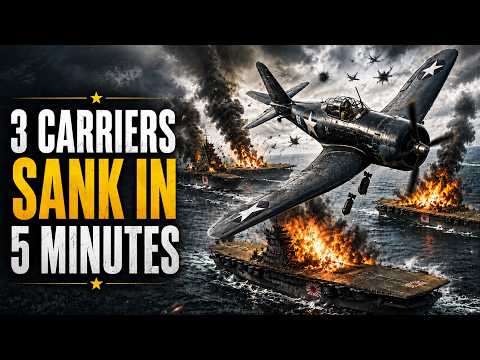
Men who had built an empire across a third of the globe watched it start to end in the space it takes to boil an egg. This is the story of how the war in the Pacific pivoted on a handful of minutes nobody could have planned. It began with a raid so small the enemy called it a nuisance, and it ended with a secret so well kept that the man who won the battle was never allowed to tell anyone he had won it.
Six months before that coral ring caught fire, the water at Pearl Harbor was already burning. December 7th, 1941. Eighteen American warships sank or shattered against their moorings in a single morning. Nearly 200 aircraft burned where they sat, wingtip to wingtip, lined up so neatly for inspection that they made perfect targets. Well over 3,500 sailors were killed or wounded before most of them had finished their morning coffee. The Japanese lost 29 planes.
In Tokyo, men called it a miracle. In Washington, they called it infamy. In a hospital bed in Honolulu, a young seaman woke up missing his leg and asked the nurse standing over him whether the war was already over. It had only just begun.
The empire moved like fire across dry grass. Guam fell. Wake Island fell. Hong Kong fell. The Philippines fell. Singapore, a fortress the British had considered unbreakable, fell in barely ten weeks. By March of 1942, the flag of the rising sun flew over nearly a third of the surface of the earth. Newspapers in Tokyo wrote of a new order, a thousand-year empire rising in the east. For a few months, it did not sound like propaganda. It sounded like arithmetic.
Then came the morning of April 18th, 1942. Sixteen American medium bombers lifted off the wooden flight deck of the carrier Hornet, roughly 700 miles east of Japan. They were not supposed to be able to do this. Twin-engine bombers were too large, too heavy, too slow to land back aboard a carrier deck. The plan had never even required them to try. The pilots had spent weeks practicing on a strip of runway in Florida marked off to the exact length of a flight deck, learning to drag their aircraft into the air in a few hundred feet of space with the ocean waiting just beyond the bow.
They flew low over rooftops in Tokyo, past temples, past schoolyards, past startled policemen who did not have time to raise an alarm. They dropped their bombs and kept flying west toward China, toward fuel tanks that were nearly empty, and airfields that were not where they were supposed to be. The physical damage they caused was small. The psychological damage was total. For the first time in living memory, a foreign enemy had reached the home islands. The emperor himself had been within range of enemy bombs. The myth of an invincible, untouchable Japan cracked open like an egg dropped on stone.
Aboard the battleship Yamato, a 58-year-old admiral set down his cup of sake very slowly. He had studied at Harvard as a young man. He had walked the streets of Detroit and Chicago as a naval attaché, touring American steel mills and counting smokestacks the way another man might count stars. His name was Isoroku Yamamoto, and he understood something most of his countrymen refused to look at directly.
He believed Japan had perhaps six more months in which its early advantage would still mean something. After that, he had told his superiors flatly, the United States would build 100 ships for every one Japan could put in the water. It was not a guess. It was long division. He needed one battle, a single, decisive engagement that would break the American Pacific Fleet before American shipyards buried him in steel he could never match. He needed it soon.
In early May, the first carrier battle in human history was fought in the Coral Sea, north of Australia. Two fleets that never once saw one another with the naked eye, fighting entirely through aircraft flying hundreds of miles to find ships that were also hunting them. It lasted four days. The Americans lost the carrier Lexington, torn apart from within by a fuel vapor explosion. The Japanese lost the light carrier Shoho in barely ten minutes, so fast that American pilots joked bitterly about how little resistance she had offered.
On paper, it read as a rough draw. Underneath the paper, something else had happened. The Japanese fleet carrier Shokaku had taken three bomb hits and would spend months in drydock, unavailable for anything. Her sister ship, Zuikaku, had come through without a scratch on her hull, but her veteran air group had been gutted—pilots killed or lost at sea, planes destroyed—and there was no time left to train replacements before the next great operation. When Yamamoto looked at his order of battle for the coming attack on Midway, two of his six finest carriers were simply missing. Not sunk, just absent, and absence can be just as costly as a torpedo.
He did not postpone the operation. He could not afford to. The plan was called Operation MI, and it was a masterpiece of complexity, the kind of plan only a supremely confident navy designs. Four fleet carriers, 11 battleships, dozens of cruisers and destroyers, more than 200 warships scattered across thousands of miles of ocean, coordinated entirely by radio signals and a rigid schedule that assumed nothing would go wrong.
The bait was Midway Atoll itself, a speck of coral and sand northwest of Hawaii. Seize its airfield, threaten Pearl Harbor directly, and when the American carriers came rushing out to defend it, ambush them with overwhelming force and annihilate them for good. Yamamoto wrote in a letter around that time that he felt like a man at a poker table with everything he owned already in the pot. He believed completely in the strength of his hand. He had no idea that the other side of the table was already reading his cards.
Three thousand miles to the east, beneath an administration building at Pearl Harbor, there was a windowless basement that smelled of stale coffee and cigarette smoke and the sour breath of men who had not seen daylight in days. The air conditioning failed constantly. Some of the men slept on cots between shifts rather than go home to wives they had not seen in weeks.
The man in charge was 42 years old. He wore a maroon smoking jacket over his uniform and shuffled across the concrete floor in a pair of carpet slippers. His superiors in Washington considered him eccentric. His friends considered him a genius. His name was Joseph Rochefort.
Rochefort and his small team were trying to break the Japanese naval code known as JN-25—a code that was not one cipher, but layers of them. A five-digit number system scrambled further by an additive key the Japanese rotated on a regular basis. Most intercepted messages arrived as pure gibberish. His team picked at that gibberish for hours at a stretch, day after day, hunting for fragments that repeated, patterns that meant something.
By early May, they had assembled enough scraps to be certain that something enormous was coming. Multiple fleets, a massive coordinated operation, a target identified only by a two-letter code: AF.
Rochefort was certain AF meant Midway. Officers in Washington were equally certain it did not, arguing the real target was Hawaii itself, or perhaps the American West Coast. If Washington was right and Rochefort was wrong, the entire Pacific Fleet would sail in the wrong direction and Midway would simply be lost before the first shot was fired.
Rochefort needed proof that could not be argued with. So he built a trap of his own.
He had the small Marine garrison on Midway send a message in plain, unencrypted English—openly, for anyone listening to intercept. The message claimed the island’s freshwater distillation plant had broken down and that the garrison was running dangerously low on drinking water. It was not true. It did not need to be true.
Two days later, a Japanese listening post in the Marshall Islands picked up an encrypted radio message and relayed it back toward Tokyo. Rochefort’s team intercepted that message, too, and decoded it, and translated it, and there on the page was the line they needed.
AF is short of fresh water.
Rochefort did not smile when he read it. He simply walked upstairs to the office of his commander-in-chief, Admiral Chester Nimitz, and told him Midway was the target, and that the attack would fall sometime within a four-day window beginning on the 4th of June.
Knowing where and roughly when was only half the problem. To spring the trap, American carriers had to be in exactly the right patch of ocean at exactly the right hour—and the man expected to lead them there was suddenly unable to leave a hospital bed.
Vice Admiral William Halsey had returned to Pearl Harbor in late May aboard the Enterprise, and the officers who greeted him were shocked at what they saw. A severe skin condition had spread raw, weeping sores across his arms, his chest, his face. He could not sleep. He could not bear the touch of his own uniform. Doctors admitted him to the naval hospital immediately and told him plainly that he would not be leaving the ward for weeks—not for this battle or any other.
Halsey argued. He demanded release. He was overruled. Before the sedatives took hold, Nimitz came to his bedside and asked him one question: who should lead the carriers in his place?
Halsey gave him a name. Raymond Spruance—his own cruiser screen commander, a quiet, methodical man of 55 who read philosophy in his off hours and disliked small talk. Spruance had never commanded an aircraft carrier. He had never directed a carrier air strike in his life. He was, in almost every visible way, the opposite of the aggressive, beloved fighter he was replacing.
“He is the man,” Halsey said from his hospital bed. “Trust him.”
Nimitz did. It would prove to be one of the most consequential personnel decisions of the entire war.
In the basement beneath the administration building, the men on Rochefort’s team barely registered the change of admirals happening above them. They lived by a different clock entirely—one measured in intercepted transmissions and burnt-out coffee pots, in the particular ache behind the eyes that came from staring at columns of numbers until the numbers stopped looking like numbers at all. Somewhere above their heads, admirals were making history. Down in that windowless room, history was being made first—quietly, in pencil, on scraps of paper that would be burned before the week was out.
There was one more piece still missing, and she was floating in Pearl Harbor with smoke still rising from her wounds.
The Yorktown limped into Pearl Harbor on May 27th, trailing oil and smoke and the dead of her own crew. She had taken a bomb at Coral Sea that punched through her flight deck and killed 50 men below. The shipyard’s estimate for repairs was 90 days. Nimitz read the report, set it down, and looked at his superintendent. “You have 72 hours,” he said.
Fifteen hundred workers descended on her in shifts that never stopped. When she sailed on May 30th, there were still welders aboard who hadn’t managed to get off in time. She was the third American carrier that should not have existed that morning—and Tokyo had already filed her away as a confirmed kill.
By June 2nd, two task forces waited at an empty stretch of ocean marked only with the words Point Luck. To the west, Nagumo’s carriers steamed directly into the trap without knowing it existed. He had no idea the other side of the table was already reading his cards.
Now the question is yours: if a single stuck catapult and one man’s carpet slippers could turn the tide of a world war, what small, unglamorous thing are you underestimating today? Tell us in the comments.
Report this article
Select a reason for reporting:






