Ray Volcker had been diving Lake Superior for eleven years, pulling sunken barges and parted tow cables off its cold, dark bottom. But on that Thursday morning in October 1984, six miles west of Eagle River, he found something that didn’t belong to any wreck he’d ever seen.
At 91 feet, past a restriction so narrow he had to slide his tank off and push it ahead of him, Volcker’s light struck a wall. Not a natural outcrop. Not a slump of collapsed ceiling. A face fourteen feet long and just over six feet high, built of dressed limestone blocks stacked in five even courses. The joints were so tight his dive knife wouldn’t seat between them.
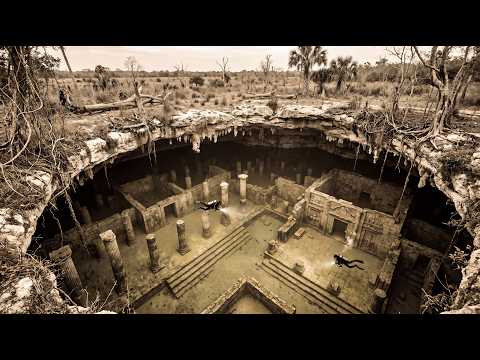
He ran a hand along the top course and felt a shallow groove cut the full length of it—a channel about a finger wide, worn smooth the way something wears when it’s been dragged along the same line for centuries. Behind a gap where one block had slipped, the chamber went on into darkness. His line didn’t reach that far that day.
Volcker surfaced. He sat on Elmer Rautio’s dock for eleven minutes without saying anything. Then he asked to use the telephone. He didn’t call the state. He didn’t call a newspaper. He called a geologist.
Marjorie Lindquist, forty-one, had spent a decade mapping the post-glacial shorelines of the Superior Basin. She drove up from Houghton that same afternoon, looked at Volcker’s photographs on his kitchen table, and made two telephone calls of her own before she got in the water the following morning.
Her field notes from that dive survive in a spiral notebook—four pages handwritten, describing the wall in the same terms Volcker used: tight coursing, a worn channel, no mortar visible anywhere in the joints. She stayed down forty minutes, took nine measurements with a tape, and sketched them into the margin. The figures are still there, written in fractions of an inch.
They add one detail Volcker hadn’t mentioned. Behind the gap in the wall, her light picked out a low bench running along the chamber’s far side. Resting on it, undisturbed and coated in fine gray silt, was an object she described only as a hammered copper plate, one corner cut cleanly away, the rest of it whole.
Lindquist’s notebook for that week is not complete. The entries run without interruption through the Monday before the dive and pick back up on the Friday after it. Four days—the day of Volcker’s first dive, the day she drove up from Houghton, and the day of her own descent—are simply not there. Not blank pages left for later. Removed. The stubs where three sheets were torn free are still visible along the spiral binding.
The geology is what makes the wall impossible to file away as a curiosity. Lake Superior arrived at its present level through a sequence of stages read off abandoned beach ridges and core samples. A chamber at 91 feet could have been dry during the Minong stage, roughly 9,500 years ago. That much is not startling on its own. But Lindquist’s measurements put the base of the wall at 118 feet—and no published Minong reconstruction for that segment of shoreline brings the water down that far.
Before Minong, there is ice. Through the whole of the Wisconsin glaciation, that spot lay under a mile of it. Not dry. Buried. Which pushes the conditions required to quarry, dress, and stack limestone by hand into an earlier interglacial entirely—more than 100,000 years back.
The accepted archaeological record for the Great Lakes does not run past 13,000 years. A finished wall at 118 feet is not a wrinkle in the record. It sits outside the record on the far side of a line nobody in the accepted timeline has drawn a bridge across.
Lindquist did not publish. A geologist with a decade of shoreline mapping credentials does not sit on a find like this by accident. What she did instead was file an internal memo describing the dive as documenting an anomalous submerged structure of unknown origin, recommending a follow-up survey with proper photogrammetry, and requesting departmental support to bring in a qualified archaeologist before the site could be disturbed further.
The support did not come through normal channels. What did come—according to the colleague who kept her folder—was a visit from two men Lindquist never named. They spent an afternoon alone with her in a closed office and left carrying the only complete set of slides she had.
Within three years, her publication record showed a hard and total turn. She wrote on heavy metal sedimentation in Portage Lake, on septic seepage in rural Houghton County—subjects with no meaningful overlap to the glacial shoreline work that had defined her entire career. She left the university in 1990 for a private consulting firm in Duluth. She gave no interview about the Kivik Sink before her departure or after it.
Rautio’s land changed hands twice in the decade that followed. The site—which Volcker and Lindquist had informally taken to calling the Kivik Sink, after a single word cut into an old boundary stone on the property—was fenced off in 1993 by the second owner, an out-of-state holding company. A heavy steel grate was bolted over the entrance fissure the following spring. The permit record lists the applicant as a land management firm and gives no reason beyond general liability.
Divers who had used the site informally for the better part of a decade were turned away without further explanation starting that same year. Some of them by a caretaker who would not give his name.
The chamber has not, as far as any public record shows, been surveyed again since Marjorie Lindquist’s dive in October of 1984.
But the Kivik Sink is not alone in the Great Lakes. Three hundred miles east, in the middle of Lake Huron, teams have mapped a drowned land bridge called the Alpena-Amberley Ridge—stone-lined caribou drive lanes, hunting blinds, branching approach corridors, roughly 9,000 years old. It went into the published record. And the reason it did is worth holding on to: the structures could be tied to a datable environmental context and to organic material in a way a stacked stone wall never can be.
One hundred sixty miles west, in Grand Traverse Bay on Lake Michigan, an underwater researcher documented a line of aligned stone blocks at forty feet in 2007. A brief period of genuine and serious interest followed. Then the discussion narrowed, site access was restricted, and to this day the alignment has never been fully mapped by an independent team.
In both cases, the pattern is the one the Kivik Sink shows in miniature—compressed into a single season instead of stretched across decades. A discovery presses against the edge of the accepted timeline. A period of legitimate scientific interest follows, brief and real. Then a narrowing begins, quiet and procedural, dressed in the language of safety and property rights, with the practical effect of keeping the deepest material out of reach of anyone without institutional sponsorship.
What survives from the Kivik Sink survives because Ray Volcker did something Lindquist’s report never mentions. On the second dive—the one whose slides were later taken—Volcker had gone in first. He lifted the copper plate off the low bench behind the wall and wrapped it in a mesh collection bag before Lindquist ever reached the chamber.
He did not report the recovery then or at any point since. The object was never logged with the Michigan State Archaeologist’s office, which under state law should have been notified of any archaeological material removed from the lake bed. Volcker kept it.
He is seventy-eight now, out of the water for close to twenty years after a hip injury ended his diving for good. The plate sits, by his own account to a small handful of people over the years, on a shelf in a house outside Chassell. Unregistered, unstudied by any qualified archaeologist. Photographed once on a drugstore pocket camera in a single print Volcker still keeps in a kitchen drawer.
Two of the few people who have seen that print have described it. A nephew who visited in the late 1990s and a retired shop customer who saw it propped against a coffee cup on Volcker’s kitchen table sometime around 2004. Both described the same object independently of each other. A hammered copper plate roughly eleven inches across, its edges folded over twice, its center thinned not by handling but by friction, one corner cut cleanly away as though a single blow had taken a piece off and nothing further had happened to it since.
Neither the nephew nor the former customer is a geologist or an archaeologist. Neither claims to be able to date the object or identify the metal it was cut from. What both of them agree on independently and years apart is that it did not look old the way a fossil looks old. It looked used the way a tool looks used by hands that came back to it again and again and then stopped.
Volcker himself, in the handful of conversations he has agreed to over the years, has never once called it valuable and has never once offered it up for testing. When asked why, the nephew recalls him saying only that he had already watched what happened to the last set of photographs somebody took of that chamber—and that the plate was staying exactly where it was.
It is the only piece of the Kivik Sink that a steel grate and a closed office in Houghton were never able to reach.
There is a case against all of this, and it is stronger than the one usually made. The serious objection is not that the wall is natural—anyone who has looked at the photographs stops making that argument quickly. The serious objection is that the depth figure does not mean what it appears to mean.
The Keweenaw shore has been rising since the ice came off it, and it is still rising. The whole basin has been tilting for ten thousand years, the northern rim lifting faster than the outlet that drains it. A floor measured at 118 feet below the lake surface in 1984 does not describe where that floor stood relative to the water nine thousand years ago. It may have stood a great deal higher. A rebound correction large enough to close the entire gap is not an exotic proposal. It is ordinary Great Lakes geology.
The second objection is smaller and harder to answer. The 118 feet comes from one tape held by one diver on one dive, with no datum control and nobody beside her to read it twice. Lindquist asked for photogrammetry precisely because she knew that. A tape measure at the end of a forty-minute bottom time in forty-degree water is not a survey, and she never called it one.
And the third is the plainest of all. A private, gated, cold, deep site with no funding attached to it is exactly the kind of site that goes forty years without being looked at again. That is not evidence of anything. That is just what happens.
None of those three objections requires anyone to have lied. All three could be true at the same time.
What the wall requires—if the geology holds and the wall is what four separate observers across two dives described it as being—is a builder working finished stone inside a dry window that predates the ice. Someone doing coursed, jointed masonry and leaving a worn utility groove behind, one that implies repeated use over a long stretch of time rather than a single ceremonial act performed once and abandoned.
That is not a claim this account can prove from where it stands. It is a claim the chamber itself makes in the only language a chamber has available to it, which is shape.
On one of the surviving pages of Lindquist’s notebook, dated two days before the dive and bearing no relation to the survey, there is a single line. She is quoting a conversation from the previous year with an Anishinaabe elder in Keweenaw Bay. When the work at a place was finished, it was closed, and the one who closed it was not always the one who opened it. Lindquist did not expand on the note. She put a question mark beside it, and that was all.
Elmer Rautio died in 1996. The sale of the land to the out-of-state holding company that installed the grate went through fourteen months before his death, arranged by a nephew who held power of attorney during Rautio’s final illness. Rautio himself, in the one recorded conversation anyone has been able to trace, told a neighbor sometime around 1991 that he regretted ever calling Volcker in the first place. Not because of what was found, but because of how quickly people he did not recognize started asking about a piece of land his family had owned since 1931. He did not elaborate on who those people were, and the neighbor did not think to press him at the time.
A small detail. Secondhand, undated beyond a general sense of the year, and it explains nothing on its own when set against the weight of a dressed stone wall ninety-one feet down. It sits alongside the pages torn from Lindquist’s notebook and the slides that left her office and never came back. One more gap in a record that keeps producing gaps in the exact places where the record would otherwise have had the most to say—as though the absence itself had learned where to stand.
The shape at the end of Ray Volcker’s dive line in October of 1984 was not a collapse. The Kivik Sink is still there. Still fenced, still gated, on land held by an entity that has never granted an interview about why that grate went up the year after Marjorie Lindquist’s career changed direction without explanation.
Lake Superior continues to sit where it has sat on that shore since the ice retreated, keeping the chamber flooded, keeping the wall exactly as it was found. Dressed stone standing in the dark, level to within two inches, waiting on the far side of a restriction most divers will never be cleared to pass—behind a gap in five courses of stone that has not had a light shine through it in close to forty years.
When that elder told her the one who closed a place was not always the one who opened it—who do you think he was remembering?
Report this article
Select a reason for reporting:






