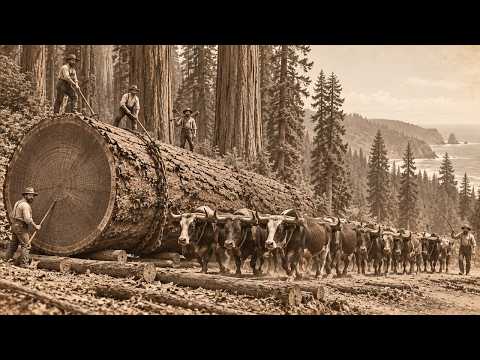
Imagine a single redwood log so massive that, lying on its side, it reaches the eaves of a one-story house. Ten oxen strain against wooden yokes, their muscles bunching as they lean into the load. Beside the log, men in wool shirts stand barely halfway up its bark. This is the Redwood Coast, where today you can drive Highway 101 through the Avenue of the Giants. But when that log was cut, there were no trucks, no tractors, and no railroad linking Eureka to San Francisco until 1914. So how did anyone drag it out?
The trees themselves were never the real problem. A man with an axe can cut anything if you give him long enough. The problem was everything that came after the tree hit the ground. Every log on that coast had to make a trip from the stump to a mill and from the mill to a ship. And every single stage of that trip was its own kind of impossible.
Two men carry this story. The first is John Dolbeer, a farm boy from Epsom, New Hampshire, who came west for gold, ended up running a sawmill on the Eureka waterfront, and one summer tied 150 feet of heavy Manila rope to a steam engine and changed the woods for good. The second is Henry Neff Anderson, a lumberman from Altoona, Pennsylvania, that everybody called Pap, who came to California in his 60s and bet more than half a million dollars on a mill built around a flywheel that weighed 116 tons.
Between the stump and the ship, the redwoods threw six problems at those crews in this order: a tree that could shatter when it fell, a log too big for anything to move, a hillside that wanted to run that log right over the oxen, canyons too deep and too far for any animal, rivers that would not flood when the loggers needed them to, and last of all, a coast with no harbor anywhere on it.
The first problem started before the tree was even down. A big coast redwood can stand more than 350 feet tall, and a mature one can be more than 20 feet across at the ground. The National Park Service puts the bark alone at up to a foot thick. Now imagine two men walking up to that with axes.
The first thing the choppers did looks backwards. They didn’t cut the tree at the ground where it was thickest. They built a platform and cut it 6, 8, sometimes 10 feet up. On the steepest trees, a chopper would cut a notch into the trunk, jam a plank about 5 feet long into the notch, and stand on that plank with nothing under him but air. That was a springboard, and on some trees the men climbed board by board until they were working 20 feet off the ground.
Here’s the strange part. The fattest, heaviest wood in the whole tree was down at the bottom, in that swollen base where the trunk flares out into the roots. And they left it behind on purpose as a stump the size of a small room. That flared base was too big for any sawmill of the day to handle anyway, and it was full of twisted grain that fought the axe. So, the first rule of moving a redwood was to leave the biggest piece of it standing in the forest.
Think about carving a turkey. You don’t start by hacking through the thickest bone. You find the joint where the knife goes through clean. The choppers were looking for the joint, the place where the trunk finally ran straight and true, and they were willing to climb to reach it.
Then came the cut that decided everything. On the side where the tree was meant to fall, two choppers swung double-bit axes, 3 or 4 pounds of Pennsylvania steel on hickory handles more than 3 feet long, and opened a deep wedge called the undercut. The axes were ground sharp every single morning before work. A pointer, a simple sighting stick the men called a gun, lined up the direction of the fall. Then the sawyers came around to the back with a felling saw 12 feet long, one man on each end, and started pulling toward that wedge.
They didn’t let the saw decide when the tree went. As the cut went deeper, they drove steel wedges in behind the blade. A history written for the National Park Service describes the moment the tree is forced bodily over by the mechanical power of the driven wedges. That’s the whole trick. A tree 300 feet tall wasn’t pushed over by men. It was levered over a fraction of an inch at a time by iron. And it could take days. One account of the work says a two-man chopping team could spend six 12-hour days bringing down a single redwood. Six days on one tree.
And all of it could be lost in the last second because a redwood is brittle for its size. Drop that much weight from that height onto uneven ground and the trunk can split open along its length or smash into pieces when it lands. So, before the last wedge went in, the crews built the tree a bed. They cut branches and brush and piled them into a long cushion on the line where the trunk would come down and they leveled the ground under it. If the tree landed on its bed, you had a log. If it missed, you could have a pile of splinters worth nothing at all.
That’s why good choppers were paid like it. Choppers could earn up to $125 a month in the 1880s. And the same history spells out what a mistake meant. One bad fall took away the lumberman’s profit in an amount equal to the chopper’s wages for a month. An unskilled chopper could shatter thousands of feet of lumber with one bad fall. It could also kill.
That danger never left the woods, not even after the steam engines came. On the 26th of July, 1918, the Humboldt Times reported a death at Camp 21 of the Hammond Lumber Company. A logger known as Jam Charlie from Big Lagoon was struck by a falling redwood about 10 feet across. A witness saw the tree start to come down and saw Charlie run. The death was ruled an accident. He left a wife and five children. That one newspaper item is all I could find about him.
So, the crews could bring a giant down in one piece. They had the springboard, the undercut, the wedges, and the bed. And the moment they did, they had a new problem lying at their feet. They now owned a log they could not move.
I’ve made something for you. It’s called the Timber Age Field Files. The real photographs and drawings of the machines that logged America with my notes on each one. Point your phone at the code on the screen or go to globaloldhistory.com for a free sample.
A redwood trunk on the ground could be well over 10 feet thick and run more than 100 feet long. No ox team on earth was going to pull that and few mills on that coast could have sawn it if they did. So, the crews did the only thing that made sense. They made the logs smaller.
First, the sawyers walked the length of the trunk with an 8-foot saw that one man could handle alone and they cut it into sections. That still left pieces bigger than a parked car. According to the park service history, a log more than 10 feet in diameter was usually split. And a log 16 to 20 feet across, a log taller than a one-story house lying on its side, was quartered by blasting.
Here’s how that worked. A man took a long auger, basically a giant drill turned by hand, and bored a hole into the end of the log until it ran past the center. Into that hole went a cartridge of blasting powder. The crew backed off, the charge went, and the log cracked apart along its grain into halves or quarters that something could finally drag.
Sound crazy? It sounds less crazy when you think about splitting firewood. You don’t cut a round of oak in half across the grain. You set a wedge in the end and let the grain do the work because wood wants to split the long way. The powder was a wedge with a lot more push behind it. A redwood log split clean along the line the tree had grown in for centuries.
I’ll be careful here because the park service history doesn’t say which powder the camps used, so I won’t pretend to know. What it does say is that the split logs were what made the rest of the trip possible. A quarter of a giant was still enormous, but now it was something a team could pull.
Then the bark had to come off. A redwood’s bark can be a foot thick and every inch of it was dead weight that someone would otherwise have to drag. So, a peeler went to work. He cut a ring through the bark around the log, then drove a steel bar in behind it and pried the whole skin away in long slabs. At certain times of the year it came off easily. At other times it didn’t. Peelers earned $50 a month plus their board.
What came off the log didn’t go anywhere. The bark, the branches, the brush from the felling bed, and everything the swampers cleared out of the way was piled up and burned. So, the woods around a working camp were often full of smoke, and every crew had one man whose job included standing by with water in case those fires got loose. That man was called the water packer, and he matters more to this story than his job title suggests. Because in a minute, he’s going to be the difference between a log that reached the mill and a log that killed the oxen pulling it.
Before we get to the oxen, I want to go back to the waterfront in Eureka, because that’s where the man who would eventually replace them was learning his trade the hard way. John Dolbeer was born on a farm in Epsom, New Hampshire in 1827. In 1850, at 23, he walked away from that farm and headed for the California gold fields, the same as thousands of other young men that year.
He didn’t stay a miner. By 1853, he had made his way up the coast to Humboldt Bay and bought a sawmill in Eureka called the Bay Mill. It didn’t go well. Fire destroyed his mill, and then fire destroyed it again. Twice before 1863, Dolbeer watched everything he’d built burn.
A lot of men would have taken the hint and gone home. Instead, by the spring of 1863, he had gone into partnership with another Eureka lumberman named William Carson. The firm of Dolbeer and Carson would become one of the first truly huge redwood operations on the coast, and it would keep working the Eureka waterfront for more than a century.
What I like about Dolbeer is that he was a measuring kind of man. Besides the machine this story is about, he patented a device for measuring how many feet of lumber a sawmill had cut. He wanted to know exactly where the wood went and exactly what it cost to get it there. And for most of his career, the answer to that second question was oxen.
So, let’s go back into the woods, where a quartered redwood log is lying in the brush, and somebody has to get it to water. The answer for the first 30 years of redwood logging was a road made of trees. The crews called it a skid road. They cut young timber, barked it smooth, and laid the poles across the path like the rungs of a ladder lying flat on the ground.
Each skid was about 12 feet long, and they were set about 6 feet apart all the way from the cutting to the landing where the logs piled up. A landing could hold 20 or 30 logs waiting their turn. On that road, the logs didn’t roll. They slid.
The crew would couple several logs nose to tail with heavy chains and steel hooks called dogs, and then the team was hitched to the front of the whole string, and the team was something to see. Eight to 12 oxen, sometimes six to 10 horses, yoked in pairs, leaning into a load no animal could have moved across bare ground.
The man who drove them was the teamster, and every camp called him the bull puncher. He walked beside his oxen with a goad stick about 4 feet long with a small brad driven into the end, and he drove them mostly with his voice. The same history quotes an old line about him that with a pair of leaders that will supplement the driver’s lungs, everything is possible.
The bull puncher was ranked the second most important man in camp, and he was paid like it, $150 to $200 a month plus his bunk. He could bring his family into the woods, and his wife could cook for the crew. He also worked the longest days of anyone because oxen don’t stop needing food and water and grooming just because the logs have stopped moving. The other men went to supper. The bull puncher went to the barn.
Now, here’s the part I didn’t expect. You’d think the hard part of moving a log with oxen was getting it to move. On a lot of these roads, it was the opposite. The hard part was keeping it from moving too fast.
Picture pulling a loaded sled down a snowy driveway. On flat ground, it drags. But, tip that driveway downhill even a little, and suddenly the sled wants to run. And if it gets going faster than you can walk, it runs you down from behind. A string of redwood logs on a skid road was that sled. Only it weighed many tons.
Where the road dropped toward the landing, the logs wanted to overtake the oxen. So, the friction on that road had to be managed foot by foot. Too much friction and the oxen couldn’t start the load. Too little and the load would come down on top of them.
That was the water packer’s real job. Earlier, I told you he stood by in case the slash fires got loose. Most of his day was spent on the skid road. He led pack animals loaded with canvas bags, 30 to 40 gallons of water on each animal, and he carried 5-gallon coal oil cans fitted with wooden handles. Ahead of each pole, he wet down the skids so the logs would slide.
Some packers didn’t use water at all. They used something called dope, which the Park Service history describes as a mixture of cheap tallow and tar. Think about what that meant. One man with a can of grease was deciding how fast a string of redwood logs came down a hill.
And the same history says it plainly, a careless water packer could spill water on a grade and let the logs overrun the team. Too much grease on the steep part of the road and the string ran down onto the oxen in front of it.
The other men on that road had their own kind of danger. Chain tenders walked beside the logs, watching the chains and signaling to the teamster. Hand skitters drove the dogs into the logs and pried them loose again. And if a dog slipped or a chain broke under that load, the whiplash came back along the string fast enough to kill the man standing next to it.
For about 30 years, that was how every redwood left the woods. Axes, powder, smooth poles, grease, and a team of animals leaning into a load they could never have moved on bare ground. It worked, but it had a limit. And the limit was the oxen themselves. They could only pull so far in a day, only on a road someone had already built, and only on ground they could stand on. The best timber kept getting farther away and steeper with every year the camps cut.
And by the early 1880s, Dolbeer and his partner had a problem down at the mill that would turn out to be the answer. It started with logs that got away. The Dolbeer and Carson crews stored their logs in a mill pond at the edge of Humboldt Bay, and some of them were floating out of the pond and into the bay. William Carson suggested that a man named H. N. Mercer hitch a small steam donkey engine to the shore and drag the strays back in with a rope. It worked. And someone at that mill looked at a steam engine pulling a log through the water and asked the obvious question, “Why not do the same thing on land?”
In the summer of 1881, Dolbeer and Carson took that idea into the woods at Salmon Creek in Humboldt County. Dolbeer had built what he called a logging engine. It was an upright boiler and a small steam engine mounted on a heavy wooden sled. On top was a vertical spool called a gypsy head. On the first model, a Manila rope 150 feet long was wrapped several times around that spool and tied to a log. The engine turned the spool, the spool pulled the rope, and the log came crawling out of the brush toward the skid road all by itself.
That’s the whole machine, and it sounds almost too simple to matter. Here’s why it mattered. A team of oxen had to walk to every log. A steam engine could sit in one place and make the log come to it. Dolbeer’s donkey reached down into the gulches and the brush where no ox could stand, and it snaked the logs up to the skid road where the oxen were waiting.
And after every pull, somebody had to take the rope back. That job went to a horse. The line horse walked the end of the rope back out into the brush to the next log. The crew hooked it on, and the engine wound it in again. Out and back. Out and back all day.
Dolbeer got his patent on the 18th of April, 1882. Some sources date the machine from that patent, and some from the summer of 1881. So, I’ll give you both. What nobody disputes is how fast it spread. Within about a year, there was a geared version that could pull a whole train of logs with cable spools on its axle for loading. And by 1888, more than 100 Dolbeer donkeys were working in Humboldt County alone. And they’d crossed into Del Norte County to the north.
The donkey brought a new crew into the woods with new names that some families still remember. The engineer who ran it was the donkey puncher. A signalman called the whistle punk passed the word from the men at the log to the engineer when to pull and when to stop. A gypsy tender paid the rope out and took it in and he also helped gather fuel because that boiler ate wood all day long and somebody had to feed it every minute it ran. Block tenders and chain men worked the rigging for 30 to 50 dollars a month plus board.
The rope sped the work up and the danger sped up with it. A steam donkey could pull in hot weather and cold when animals would have quit. The work became a closely timed chain of signals and one wrong pull, one signal missed by the whistle punk, could put a log or a snapping line straight through a man.
Still, the oxen were not finished yet. The first donkeys only did the short steep pull out of the brush. The long haul down the skid road was still animal work. That changed in 1892 when a man named David Evans built the first bull donkey. The bull donkey was a much bigger engine with a huge drum and it did the oxen’s job. It could drag a train of 10 logs down the skid road on a single cable. That cable could run as long as 5 miles wound on the big drum while a smaller line was played out to drag the end back up for the next load. The skids got a new grease too. Crude oil replaced the old tallow and water.
The teams didn’t vanish overnight. Some camps kept their oxen for years. But by the 1920s, the bull donkey had replaced the ox team across the redwood woods and the bull puncher, the second most important man in camp, was out of a job.
So now the crews could fell a giant, split it, peel it, and drag a whole train of logs out of a canyon by steam. And they had just run into the biggest problem yet. The best of the redwoods were now miles from any water and 5 miles of cable doesn’t help you when the mill is 20 miles away.
The answer was iron rails and the redwood coast started laying them earlier than you might think. In 1875, the Casper Lumber Company on the Mendocino Coast put the first steam locomotive on that coast to work hauling logs. Farther south at Albion, the mill owners built a narrow gauge line in 1881 with the rails just 40 inches apart. And for its first few years, that railroad didn’t have a locomotive at all. The cars were loaded in the woods and pulled along the rails by horses down to the riverbank where the logs were rolled into the water and floated to the mill. Steam engines didn’t replace the horses at Albion until 1885.
That tells you something about how hard this was. A railroad in the redwoods wasn’t a railroad the way you picture one, a straight line across open country. It was a line of track feeling its way up a creek bottom, around ridges, across gulches on wooden trestles, out to wherever the cutting was that year. When the timber along one stretch was gone, the crews tore up the rails and laid them somewhere else.
In Del Norte County, at the far north end of the Redwood Coast, the firm of Hobbs, Wallin Company ran two standard gauge logging railroads. The Park Service history gives a sense of how a logging train worked there. A crew of four men plus the engineer and the fireman could load 50 to 60,000 feet of logs in an hour. They rolled the logs onto the cars with jack screws, wedged them with wooden chocks so they wouldn’t roll off the other side, and ran them to the mill at about 15 miles per hour.
And here’s a detail I keep coming back to. The bridges on a lot of those early lines were made of wood, the same wood the trains were hauling. The Park Service notes that those wooden bridges were sometimes burned by the locomotives themselves. A spark from the smoke stack, a dry trestle in summer, and the railroad that was supposed to carry the forest out would set its own bridge on fire.
Some of the engines were tiny. Between 1882 and 1892, a San Francisco shop built about 20 small locomotives called Gypsies, four driving wheels and no front truck, made for exactly this kind of short, rough timber line. One of them is going to come back at the very end of this story because it’s still running.
The bigger mills built bigger railroads. On the Eel River south of Eureka, the Pacific Lumber Company was turning a settlement called Forestville into a company town. Its first bunkhouse went up in 1884. The next year, a railroad called the Humboldt Bay and Eel River connected it to the bay. In 1887, the company built a new mill there with 150 men and 100 houses. And in 1888, the town was renamed Scotia, the name it still carries along Highway 101 today.
But a railroad has one thing it can’t do. It can’t climb. A locomotive on steel rails loses its grip on anything much steeper than a gentle grade, and the Redwood Coast is not gentle. In some places, the timber sat on a high bench of land, and the shipping point sat hundreds of feet below it, right at the edge of the ocean, with a cliff in between. You could blast switchbacks into that cliff, or bore a tunnel through it, and both cost a fortune. Or you could do something cheaper and much stranger.
The best example I found is at a place called Bear Harbor, on what is now called the Lost Coast, at the very top of Mendocino County. It’s a little rocky bite out of the shore, and the story of trying to ship lumber out of it reads like a list of everything that could go wrong.
In 1882, a man named C.C. Milton started building a wharf there to ship tanbark and railroad ties. Milton drowned at nearby Rockport before he could finish it. In 1885, a Dr. W.A. McCormack finished the wharf and added a chute for loading schooners. In 1892, a steamer from San Francisco brought one of those little Gypsy locomotives into the harbor. And in 1893, a group of lumbermen formed the Bear Harbor Lumber Company to log about 12,000 acres of old-growth redwood on the ridges above.
Those ridges were the problem, so they built an incline. It was a stretch of track about 1,900 feet long that climbed 600 feet from the coastal flat up to the bench where the timber was. No locomotive went up it. The incline ran on gravity alone.
Think of an old well with two buckets on one rope over a pulley. You let the full bucket drop, and its weight hauls the empty one up from the bottom. That’s the Bear Harbor incline. A loaded log car started down from the top on a cable and its weight pulled an empty car up from the bottom on the other end. The incline had three rails instead of the usual two and halfway up where the cars had to pass each other, the rails split apart so one could slide by the other. Then they came back together.
Say it out loud and it sounds like a gamble. A car full of redwood logs rolling down a 600-foot drop toward the ocean. Held back by nothing but a cable and the weight of an empty car climbing the other way. But it worked and it saved the cost of blasting switchbacks or boring a tunnel.
By 1896, track ran from the top of the incline back into the woods to a logging camp called Moody. Named for a man named Lou Moody who ran a hotel and a saloon there. The sources put that line at 8 to 10 miles. The Little Gypsy worked the line up top and on the 2 miles of flat ground down at the shore, horses pulled the cars.
So at Bear Harbor, a log went from the woods onto a Gypsy locomotive, from the locomotive down a gravity incline, and from the incline to horses that walked it out toward the wharf. Three kinds of power to move one log 10 or 12 miles.
And then in 1899, a tidal wave came into Bear Harbor and destroyed the wharf. The local history of that coast puts it in three words: money ran out. Remember that wharf because it’s going to be hit again and the second time it happens, it will take a much bigger dream down with it.
In November of 1902, Pap Anderson, the Pennsylvania lumberman with the 116-ton flywheel, bought 10,000 acres of redwood timber in the hills behind Bear Harbor. The next year his new company bought out the Bear Harbor Lumber Company and its railroad, incline and all. He was 63 years old and he was planning the biggest mill that coast had ever seen.
We’ll get to Pap. First, the redwood still had two more problems for everybody else and the next one was water. Not every company could afford a railroad. And on the Mendocino coast, there was an older and cheaper way to move a log. You put it in a river and let the river carry it.
The first sawmill on the Mendocino County coast was built in 1852 by the California Lumber Company, right at the mouth of a river called Big River, below the town of Mendocino. And the company that grew out of that mill, the Mendocino Lumber Company, used river drives more than any other timber operation on the North Coast.
The idea was beautiful. The crews cut the timber along the banks of Big River and its forks, dragged the logs down into the dry stream bed, and left them there until the water came. Then the winter rains came. The river rose into a flood, and the flood carried every log downstream to a log boom at the mouth, a floating fence of chained timbers that kept them from going straight out to sea.
The problem was the weather. In the words of the man who wrote the history of those drives, the rains were supposed to furnish the freshet, but in most cases did not. A dry winter left thousands of logs lying in a riverbed going nowhere, and a company with logs stuck in the riverbed had a mill with nothing to cut.
So, the loggers built their own floods. Starting around 1860, they built dams across Big River and its forks. These were dams built to be emptied all at once. The local historian W. Francis Jackson counted 27 permanent dams on that one river system, 22 of which can still be verified from what’s left of them. The farthest one up sat 48 miles from the mouth.
Here’s how they worked. Behind the dam, the water built up into a lake, and sometimes the crews felled trees straight into that lake to wait. Below the dam, more logs waited in the dry channel. Then the crew tripped the gates. All of that water came out at once and ran downriver as a single moving wall, which the drive crews called the head, shaped like the front of an ocean wave. Near the dam, it stood high. 15 miles downstream, it had dropped to about 3 feet. And it picked up every log in its path and carried them along.
Think about pulling the plug on a full bathtub with a pile of toothpicks in the drain end. The water doesn’t trickle out. It rushes and it takes everything with it. Now picture that bathtub as a canyon and the toothpicks as redwood logs.
If one head wasn’t enough, the crews tripped two or more dams in sequence, timed so their floods stacked up into a bigger wave that could float more logs farther. Getting that timing right mattered because a head that arrived too early or too late just washed past the logs and left them sitting.
Clyde Mallory, who ran logging on the South Fork of Big River for years, later described what the first drive he saw on a creek called Anderson Gulch looked like. He remembered a wall of logs, trash, rocks, and other debris close to 20 feet high with the water pushing it from behind where you couldn’t even see it. The logs hit the banks so hard that dust flew as they sheared the sharp points off them.
And then sometimes it all stopped. The South Fork of Big River was crooked and its bends were known for what Jackson calls many costly and prolonged log jams. Logs would wedge across a bend, the logs behind them would pile up on top, and the river would simply stop moving wood. One jam on Big River blocked the channel for nearly 5 years. 5 years. The logging crews upstream were out of work for most of that time because there was no room left in the river to float another log. A photograph from those years is captioned part of a 22 million board foot log jam.
To break a jam like that, the crews built a special dam just above it to float the stuck logs and turn them. And when the water was high enough, they blew that dam out with powder and let the flood hit the jam all at once.
The Big River drives kept going a lot longer than you’d expect. The last dam on that river system went up in 1924 and the last raft of logs came down the North Fork in 1943. In April of 1945, the state’s Fish and Game Department burned one of the last of the old dams at a place on the South Fork called Hell’s Gate.
So by river or by rail, the logs reached the mills, and the mills turned them into lumber. And that’s where the Redwood Coast threw its last and strangest problem at everybody, because now they had to get that lumber to San Francisco, and there was almost nowhere on that whole coast to tie up a ship.
Look at the Mendocino Coast on a map, and you’ll see the problem right away. There’s no Humboldt Bay down there, no sheltered water. The shore is cliffs and reefs and little rocky coves, and the government’s own sailing directions, the Coast Pilot of 1889, describe it as lined with jagged rocks and sunken rocks. And yet mill after mill sat on those cliffs, shipping lumber south to San Francisco.
The sailors who worked that coast had a name for the places they loaded. They called them dog hole ports, and the joke was that each cove was barely big enough for a dog to turn around in. A schooner coming into a dog hole port couldn’t tie up at a dock, because there usually wasn’t one. Wharves were expensive, and the sea kept tearing them down. Instead, the ship anchored as close under the cliff as its captain dared, and tied off to whatever the shore crews had put there. Some ships were held by big anchors set on the sea floor with a log floating on the surface to mark them. Others tied to iron eye bolts drilled straight into the rock of the cliff.
Then the lumber had to get from the top of the cliff down onto the deck of a moving ship. So, the mills built chutes. The older kind was the apron chute. Picture a long wooden trough sloping down from the top of the cliff, held up on a wooden frame and steadied by cables, with a long hinged arm at the bottom end called the swing apron. Cables and pulleys raised and lowered that apron to meet the deck of the ship as it rose and fell on the swell. Then the men at the top sent the lumber down, one board or one timber at a time, by gravity.
A farm paper in 1884 described chutes on that coast anywhere from 60 to 600 feet long, and some started from bluffs 150 feet above the water. They didn’t only carry lumber, either. The same chutes sent down sacks of farm goods, and at some landings, live hogs.
And of course, the hard part was the same as on the skid road. A plank sliding down a steep wooden trough picks up speed fast, and something had to slow it down before it reached the deck of a ship full of men. So, at the bottom of the chute, there was a movable plank called a clapper, and a man called the clapper man worked it to slow each piece down before it reached the ship. It’s the water packer all over again. One man standing between a falling load and the people below it.
Then came the wire chute. Instead of a trough, the mill ran a heavy wire cable from a big drum on the cliff out over the water to an anchor set beyond where the ship was moored. The lumber was bundled into a sling, hung from a pulley on that wire, and sent sliding down through the air to the deck. Held back by a brake at the top. When the load was off, the empty pulley came back up the wire, pulled by a counterweight or by a donkey engine. Now, a whole sling of lumber could go down at once instead of one board at a time. By the 1890s, wire chutes had gone in at nearly every shipping point on the Mendocino coast.
Even so, loading a schooner could take several days. A typical three-masted lumber schooner in the 1880s carried about half a million board feet, and every one of those boards went down a chute or a wire one load at a time while the ship rocked on its anchor in open water.
And the sea fought back. At Laguna Point, near the town of Cleone, ships began loading by apron chute in 1883. Two winters later, in 1885, storms destroyed the chute and the wharf together, and the company had to put in a wire chute instead. On the headlands at Mendocino itself, the first wire chute didn’t go into service until the 28th of March, 1902, so that bigger ships could stand off in deeper water. And the National Oceanic and Atmospheric Administration estimates about 200 reported shipwrecks along that stretch of coast, most of them lumber schooners.
So, now you have the whole chain. A tree felled from a springboard onto a bed of brush. A log split open with powder and peeled. Oxen or a bull donkey dragging it down a greased road of poles. A Dolbeer donkey reaching into the gulch for it. A railroad. A gravity incline or a man-made flood carrying it to the mill. And a chute or a wire lowering the boards onto a ship anchored under a cliff. Every one of those links had to hold every day for a single board to reach San Francisco.
One man looked at that chain and decided he could build every link of it bigger and better than anyone had before in one place all at once. And on the 28th of October, 1905, a few days before his new mill was going to be dedicated, Pap Anderson walked in to watch his crew lift a roof beam into place.
There’s something I made for this. It’s called the Timber Age Field Files, the real photographs and drawings of the machines that logged America with my notes on each one. Point your phone at the code on the screen or go to globaloldhistory.com for a free sample.
Let me back up 3 years to show you what he’d built. Henry Neff Anderson was born in Altoona, Pennsylvania in 1839. He spent his life in timber, first in Pennsylvania and then in Michigan. And in 1898, he bought a mill in Aberdeen, Washington with his son-in-law. When he came to the redwoods, he came with money and with a plan. And he came just as the man who had changed those woods was leaving them.
John Dolbeer died in San Francisco on the 17th of August, 1902 at 75. By then, his donkey engines were everywhere. The oxen were on their way out and the firm of Dolbeer and Carson was still cutting on the Eureka waterfront.
Less than 3 months later, Pap Anderson made his move. On the 1st of November, 1902, he bought 10,000 acres of timber in the hills of Southern Humboldt County. Five days later, he formed the Southern Humboldt Lumber Company. And the next year, as you heard, he bought out the Bear Harbor Lumber Company with its railroad, its incline, and its battered wharf.
His mill was going to sit inland at a place called Camp 10 where Indian Creek runs into the South Fork of the Eel River. He named the town after himself, Andersonia, and he ordered machinery that nobody on that coast had seen in one building. Six boilers, two Allis-Chalmers band saws, twin steam engines of 1,100 horsepower each, driving a flywheel that weighed 116 tons. His crews built a dam across the river and a mill pond behind it big enough to hold about 20 million board feet of logs, and they laid 17 miles of track. The local history puts his investment at more than half a million dollars.
But look at how that lumber was supposed to leave. Out of the mill, onto his rails, back through the woods to the top of that gravity incline, down 600 feet to the coastal flat, and out onto the wharf at Bear Harbor. The same wharf a tidal wave had already wrecked once. All that new machinery still depended on the oldest and weakest link on the coast, a pier sticking out into open water.
Pap had an even bigger idea behind all of it. In those years, two great railroads, the Santa Fe and the Southern Pacific, were racing to build a line from San Francisco Bay up to Eureka. Anderson looked at that flat where Indian Creek met the South Fork and saw a station. If the main line came up the South Fork, his mill would be sitting right on it, and the Dog Hole problem, the incline, and the battered wharf at Bear Harbor would matter a lot less.
Then came that day in October. Anderson was making his rounds before the dedication. His crew was putting a new beam into a roof because the opening had turned out to be too narrow for a piece of machinery that had to go in. He came over to watch. The Humboldt Standard reported that he had received an injury from a piece of timber falling on him. A doctor named Rossier was called in. Anderson was operated on to relieve the pressure on his brain, and for a little while he seemed to rally. Then he didn’t. According to the Standard, he died at 7:00 on the 7th of November. Other sources give the 6th. Either way, the man who had come to master the redwoods was killed by a piece of his own mill before it ever cut a board.
That should have been the end of the bad luck. It wasn’t. His children from his first marriage and his second wife Cora went to court over the estate. An unpaid state franchise tax cost the company its right to do business for the Bear Harbor Railroad and work at Andersonia stalled while machine parts sat delayed in San Francisco. In March of 1906, a severe storm hit Bear Harbor and damaged the wharf again.
And then, at 12 minutes past 5:00 in the morning on the 18th of April 1906, the San Andreas Fault broke. The rupture ran north along the coast from San Juan Bautista, went out to sea at Point Arena, and came back on shore near Shelter Cove, just up the coast from Bear Harbor. In San Francisco, that morning became the earthquake and the fire everyone has heard of. Out on the Lost Coast, it hit nearly every link of Anderson’s chain at once.
The quake damaged the railroad, the mill, and the dam that held the mill pond. Repairing the mill would have cost hundreds of dollars. Repairing the dam would have cost thousands. And in the fire that swept San Francisco, the Santa Fe’s survey plans for a railroad up the South Fork of the Eel went up in smoke. When the main line finally came north, it took a different route, inland.
The Southern Humboldt Lumber Company never milled a single board. The wharf at Bear Harbor and the track to it were never rebuilt. A buyer named Trumbull had been ready to take the property over, and after the earthquake, he backed out. Andersonia was abandoned. The mill built around that 116-ton flywheel never ran for the man who ordered it.
It did run eventually, for other people. In the 1940s, another Anderson, Samuel Miles Anderson, came down from Aberdeen, Washington, with three of his sons and started the Indian Creek Lumber Company on the site. And from 1950 to 1972, a man named Thomas Dimmick ran the mill there. By then, the logs came out by truck. Pap had been right about the place. He was half a century early for the way to get the wood out of it.
The same earthquake did the opposite for the redwood business everywhere else. A whole city had to be rebuilt, and the Park Service notes that the earthquake and fire of 1906 accelerated the demand for redwood lumber. Every link of that chain, from the springboard to the wire chute, was about to be worked harder than ever.
So, how did America drag giant redwoods out of the forest before trucks existed? It never really dragged a giant at all. It cut the tree high and left the fattest wood standing. It blew the log apart along its grain until it was small enough to handle. It slid the pieces down roads made of other trees with one man and a can of tallow deciding how fast they went. It wound them out of the canyons on a Manila rope turned by steam. It carried them on rails, down gravity inclines, and on floods it made itself. And at the very end, it lowered the boards down a wire onto a ship tied to a cliff. Every link of that chain could break, and every one of them could kill somebody. And the whole thing ran on muscle, gravity, and steam.
People always ask how many men died doing it. I looked for a death count for the redwood camps in those years and couldn’t find one I’d trust. Only single names and single newspaper items, like Jam Charlie, who left a wife and five children and a one-paragraph notice in the Humboldt Times.
The chain held for the better part of a century, and then it started coming apart on its own. In the winter of 1925 into 1926, the dam at Andersonia, weakened by the earthquake 20 years earlier, finally gave way in the winter rains. The logs in the old mill pond went down the South Fork of the Eel, and most of them were carried out to sea. Washout stranded the old engines in their engine house back at Moody.
That same year, 1925, the first Caterpillar tractors went to work in the redwoods at Klamath Bluff, up in Del Norte County. Power saws showed up in the early 1930s and were in general use by 1936. And after the Second World War, the bulldozers, the trucks, and the trailers came, and the skid road and the bull donkey were finished.
The sea end of the chain went the same way, a little at a time. In 1914, the Northwestern Pacific Railroad was finally completed, linking Eureka to San Francisco by rail for the first time. Lumber that had always gone out by schooner could now go out by train. The wire chutes kept working for a while anyway on the coves the railroad never reached. They lasted until after the first World War and by the start of the Second World War they were gone from the northern coast. The dog hole ports went quiet one by one and the cliffs where the chutes stood went back to grass.
So what’s left of that chain today and where can you still see it? Start in Eureka at Fort Humboldt State Historic Park. Out in the open air logging display there’s a Dolbeer type steam donkey from around 1890. The same kind of upright boiler and spool that came out of that mill on the bay. Next to it is a locomotive called the Falk from the Elk River Mill and Lumber Company. And next to that is the little Gypsy, Bear Harbor Lumber Company number one. The engine a steamer carried into that rocky cove in 1892. In 1977 two men named R. Grant Anderson Jr. and Rogan Coons rescued it and after it was restored the local history calls it the only operating Gypsy in the world. On third Saturdays from May through September volunteers fire them up and every April the Timber Heritage Association holds Dolbeer Donkey Days with the donkey running and a logging skills contest.
Down on the Eureka waterfront Dolbeer and Carson worked their mill until the 1970s. William Carson’s mansion still stands in town built on redwood money. That little locomotive called the Falk is a stop of its own if you’re willing to go looking. In 1882 the Elk River Mill and Lumber Company bought 9,000 acres of redwoods south of Eureka and in 1884 it built a company town there called Falk to house 400 lumberjacks and their families. The operation shut down in 1937 in the middle of the depression and the last buildings were torn down in 1979. The engine that hauled its logs is the one sitting at Fort Humboldt.
Before you head south it’s worth going north for an hour. In 1900 a lumberman named Andrew Hammond bought the Vance Lumber Company, which had been cutting along the Mad River since 1874. And he went on to buy 36,000 acres of timber along Redwood Creek and Prairie Creek. That’s the Hammond Lumber Company, the outfit whose Camp 21 was where Jam Charlie died in 1918. Much of that country is now protected inside Redwood National and State Parks. The National Park itself was signed into law by President Lyndon Johnson on the 2nd of October, 1968.
Then drive south on Highway 101, and about half an hour out of Eureka, you’ll come to Scotia, the old Forestville, the Pacific Lumber Company town that got its railroad in 1885 and its new mill in 1887. By 1929, it was the second largest town in Humboldt County with a thousand people. And the Eel River never let it forget where it sat. In the flood of December 1964, the river washed 18 million board feet of logs and 23 million board feet of lumber out of that mill, and some of it drifted nearly 400 miles north, as far as the mouth of the Columbia River.
Just past Scotia, turn off onto the Avenue of the Giants. It’s about 31 miles of the old Highway 101, the main road until the freeway bypass opened in 1960. Stop at Founders Grove. The Founders Tree there stands about 346 feet tall. Then walk out to the Dyerville Giant. It fell in March of 1991, and the estimates of its height run from about 360 to 370 feet. Stand at the base of that trunk lying on the ground, and you’ll understand the cover of this video better than I can explain it. That’s the size of the thing those crews had to move, and they did it with axes, wedges, and oxen.
Some of these groves are standing because of an argument with the same company that built Scotia. In 1928, Pacific Lumber offered to donate several hundred acres of redwood to the Save the Redwoods League, and the fight that followed was over a grove of about a thousand acres up Bull Creek. Walking through a grove like that after reading about the springboards and the powder is a strange feeling.
A lot of people who watch these videos feel sick about how much of this forest came down, and I understand it. The Park Service says about 2 million acres of old-growth redwood once covered a strip of this coast 20 to 30 miles deep. In 1963, a Park Service study paid for by the National Geographic Society warned that without protection all of the old-growth would be gone by the year 2000.
Keep going south into Mendocino County. Out on the Lost Coast, Bear Harbor is still there. The rocky cove where C.C. Milton started his wharf and the tidal wave of 1899 took it away. Up on the ridge above it, near today’s Usal Road, is where the incline topped out and the Little Gypsy picked up the cars.
Coming down the Mendocino Coast, stop first at Cleone and walk out to Laguna Point in MacKerricher State Park where the storms of 1885 tore out the apron chute and the wharf. A little farther south is Casper where the first steam locomotive on that coast went to work in 1875. Then comes Mendocino. Walk the headlands above the cove where the wire chute started working in 1902. The cable there was the work of a man named John F. Peterson and it let bigger ships load in deep water instead of sending everything to San Francisco in small schooners first.
Look down at the mouth of Big River below the town. That’s where the first mill on that coast went up in 1852 and where the log boom caught every log that came down on those man-made floods from 48 miles up river. Just south of Mendocino is Little River where the Thomas Peterson shipyard built 13 two-masted lumber schooners between 1868 and 1879. The same small ships that tied up under those cliffs. And a few miles past that is Albion where for its first four years the logging railroad ran on horses.
Go back now to the picture we started with. A redwood log lying on a road of poles so thick that lying on its side it comes up to the eaves of a one-story house with 10 oxen leaning into their yokes in front of it and a few men beside it who barely reach halfway up the bark. That log had already been felled from a springboard onto a bed of brush, sawn into lengths, peeled by hand, and now it was being greased down a hill by a man with a can of tallow. The trucks came later. Everything that log had to survive to reach a ship came first and none of it was done by machines you’d recognize today.
If you want to see how the same problem was solved on the other side of the state where they cut the biggest trees on earth and sent them 54 miles down a wooden flume, that’s the next video.
So here’s my question for you: if you had been standing on that springboard 20 feet above the forest floor, with nothing but a plank and a 300-foot redwood between you and the ground, would you have swung the axe — or climbed back down and looked for another line of work? Tell me in the comments.
Report this article
Select a reason for reporting:






