On a summer night in July 1976, in a quiet village in rural France, an old soldier found himself trapped and surrounded inside his own home. A shotgun, rifle, and pistol close at hand. Then, gunshots shattered the silence. Flames tore through the building, followed by the roar of an engine and the screeching of tires as a car sped away into the darkness.
When investigators picked through the ruins hours later, they found a body—badly burned, lying on a bed, weapons scattered nearby. But this was no ordinary soldier. The house belonged to Joachim Peiper, a convicted war criminal and one of the most notorious German soldiers of the Second World War, sentenced to death almost 30 years earlier. To this day, the crime remains unsolved.
What really happened that night? Who came for him? And what did the investigators find amongst the ruins? For nearly 50 years, those questions have remained unanswered. The evidence gathered from the scene is believed lost, scattered, or destroyed. It wasn’t. Vast archive material had survived intact, much of it rarely, if ever, examined together.
Using this material, we set out to reconstruct, in greater detail than ever before, the final hours of Joachim Peiper. To understand what happened, we first need to go to the scene. This is Traves in Haute-Saône, eastern France. Using original police plans, cadastral records, contemporary photographs, family photos, and even aerial images, we can reconstruct the area much as investigators encountered it in July 1976.
The village sits here, while Peiper’s property—a 1.5-hectare plot of woodland known as Le Raffour—stood about 400 meters to the west, with his home largely concealed from sight. By combining all available source records into a single overlay transposed over satellite imagery, we can get a clear, accurate view of what once stood where only overgrown ruins and trees remain.
Here’s a plan view of Peiper’s home, measuring just 22 by 6 meters. It consisted, on the ground floor, of a raised veranda and doorway leading into a small library, through to a living room with stone chimney and wooden staircase, then the main entrance and hallway, off which was a bathroom and kitchen leading to a storage room, on the southern side of which was a rear door. Above the living area and built into the pitched roof were two bedrooms and Peiper’s small office. Then, finally, a flat-roofed sun terrace surrounded by wooden balustrading.
Outside, 15 meters to the southeast and reached by a footpath, was an enclosure and small kennel for the Peipers’ two German wirehaired pointers, Tim and Tam. And finally, 10 meters southwest of the main house, was a modest timber chalet with attached woodshed. The entire area was surrounded by trees, with the river Saône and a small boat jetty to the north and open pastures to the south. It was, in essence, a very secluded and seemingly secure location.
The Peipers first purchased the land in 1964 before moving to Traves permanently in 1972. Peiper built the house to his own plans with the help of a local mason and planted more than 100 fir trees around the property. By 1976, he and his wife Sibylle divided their time between tending the trees and translation work, to which Peiper devoted four hours a day. His final project was a substantial English-language work on Frederick the Great.
It’s an almost deliberately ordinary picture of retirement, but nothing about Peiper’s life at Traves can erase what happened before. He had voluntarily joined the SS in 1933, served as aide-de-camp to Heinrich Himmler—including visits to Dachau and Sachsenhausen concentration camps—and later rose to senior command in the SS Panzer Division Leibstandarte Adolf Hitler. Wounded several times and awarded the Knight’s Cross with Oak Leaves and Swords, he developed a reputation as a skillful but ruthless combat commander.
Men under his direct command murdered at least 84 American prisoners during the Ardennes Offensive, 23 Italian civilians at Boves in September 1943, and an unknown number of military and civilian victims in Eastern Europe. After the war, Peiper was convicted of war crimes and sentenced to death, though his sentence was later commuted, and he was ultimately released from prison in 1956.
Almost 20 years after his release, Peiper was 61 years old, living quietly in Traves, tending his property and doting on his dogs. None of that diminishes his past, but it does help us understand the man who was actually inside this house on the night somebody came to kill him.
Peiper appears to have wanted to disappear from public view. Whether he had any right to expect that his past would simply leave him alone is another question entirely. But by 1974, his presence in France was already known locally after he was identified by a former resistance member in Traves. Nor was he the only former SS officer here. His next-door neighbor, Erwin Ketelhut, had served with the Leibstandarte and had known Peiper for years. The two had once been close friends, but relations deteriorated with disputes over Peiper’s dogs, access to Ketelhut’s property, and fishing in his pond.
But an awkward neighbor was the least of Peiper’s problems. By the spring of 1976, the surviving paper trail allows us to watch the pressure around him begin to build. On March 31, information identifying Peiper as a war criminal living in France reached the French Communist newspaper L’Humanité, which began taking a keen interest. Around the same time, locals had become increasingly curious about the reclusive man living in the woods west of Traves, who spoke good French with a strong German accent and had a distinctly military bearing.
By May, he’d been conclusively identified as Joachim Peiper, and a targeted campaign against him began. On June 21, this leaflet was distributed throughout the village: “Inhabitants of Traves, a war criminal, SS Joachim Peiper is among you.” The very same day, graffiti appeared on the road leading to Peiper’s property. By spinning down to ground level and lining up this image with the two houses in the background, we can identify the precise location—350 meters from his home.
Less than 24 hours later, an article was released in L’Humanité under the title “Qui protège les criminels de guerre?”—who is protecting war criminals?—which set in motion a chain of events that would ultimately end in murder. This very article identified Joachim Peiper for a huge audience as an SS war criminal, detailed his wartime career, and crucially featured images of both his post box and his secluded home.
The result was predictably fierce. Immediately, Peiper began to receive death threats by letter and telephone. Journalists, political extremists, and curious locals descended on his home in droves to either get an interview with or simply hurl insults at the ex-SS officer. Despite outwardly maintaining unconcern and telling his wife that he was not worried about the threats, it appears that internally, Peiper was worried.
That night, he sat at his typewriter and wrote a letter to his wife, which he placed amongst his personal effects without showing her. “My Ziggy, since the hyenas of the past are once again snapping at my heels, and everything points to the fact that I shall set out on the great journey before you… I would like to thank you once again for everything, and to say this: you were a magnificent companion in life, and my only regret is that I was unable to provide you with a more carefree existence.”
Over the coming days, yet more threats materialized. Whilst he maintained his stoic outward appearance, he contacted the local gendarmerie to complain—who agreed to keep a close watch on the property by day—contacted the West German Embassy, and borrowed a Remington 12-gauge shotgun from a friend with whom he had reestablished contact. He also wrote a series of letters to friends detailing his situation, some of which still survive.
“The blow fell on me by surprise, directed by the Communist Party. It is believed to be a Moscow-led attack on Franco-German friendship… A campaign of intimidation is beginning. Phone calls announce my abduction and the burning of my house.”
As a matter of fact, Peiper was partly correct. Modern research has shown that the East German Stasi maintained a file on Joachim Peiper, and a letter within specifically mentioned that maximum assistance should be given to journalist Pierre Durand in his search for information on behalf of L’Humanité newspaper.
In early July, Peiper was spotted outside his house yet again, this time by a French journalist writing for Paris Match magazine. Apparently frustrated with the constant intrusions, he granted a single interview. Photographed sitting on his veranda in a checked shirt and sporting an automatic chronograph on his left wrist, the exasperated Peiper was quoted to have said: “I paid. I have nothing to say. I paid. If someone has something to reproach me for, they can contact the authorities to do so. If I’m here, then it’s because in 1940, the French lacked courage.”
That final inflammatory sentence has been often cited as the trigger for what was about to happen. It seems he knew it, too. In one of his final letters, he wrote: “From one day to the next, my peaceful paradise has been transformed into a besieged position, but I shall defend it to the death.” And Peiper was not speaking figuratively.
By July 12, he had armed himself with no less than three weapons: a .38 caliber Colt revolver, a .22 long rifle, and the borrowed shotgun. According to Ketelhut, he would spend his evenings on his terrace scanning the approaches to his home with his old wartime binoculars.
Of what occurred the following day, much has been written over the last 50 years, but often with the same errors and misconceptions, and sometimes with the wildest of claims. But by examining the crime scene photographs, witness statements, police reports, and actual items recovered from the scene, we can reconstruct the events around his death in detail.
First off, we know from her signed deposition that at 8:00 a.m. on Tuesday, July 13, 1976, Sibylle Peiper loaded up her BMW and left Traves for a pre-planned visit to friends near Freiburg. She made it clear that her husband appeared unconcerned when she departed. He even reminded her to pick up dog food and groceries on her return in two days’ time.
A short time later, but before midday, Peiper, according to Ketelhut’s deposition, received another phone call at his home, claiming that he and his dogs would be killed on July 14, adding that “the day will be a hot one.” Reportedly meeting his neighbor a short time later, he relayed that information and agreed that Ketelhut would set up a watch from his own balcony to observe the comings and goings along the road. Apparently visibly shaken but still resolute, he added, “In any case, they are not brave enough to carry out their threats,” before returning to his home.
It was the last known sighting of Joachim Peiper.
Now, it was probably a good time to look at the approaches to Peiper’s property. Unusually for any home, there was no direct vehicular access. The closest any visitor or attacker could get by vehicle was this single paved lane running east-west 95 meters to the south of Peiper’s home. In order to approach from this direction, two pastures of grazing cows with two barbed wire fences needed to be overcome. Even then, Peiper’s dog kennel might well prove problematic.
The approach from the west was no better, blocked by Erwin Ketelhut’s home and gardens, with a large impenetrable hedge running from the riverbank directly to the road. Nor did the north, where the fast-running river blocked access to anyone who wasn’t crossing by boat. Then there’s the eastern approach—350 meters of trees and thick undergrowth, which might offer concealment but was no easy path.
Witnesses reported that it was here on the terrace, with views to south, east, and north, that Peiper placed himself on a nightly basis, scanning the approaches with his binoculars. But that wasn’t where the danger lay. In fact, the investigators who turned up just a few hours later determined that right here is where the strangers approached.
Shortly before midnight, multiple assailants congregated on this bank for at least several minutes, trampling flat the long grass. They left behind a bottle top from a fuel jerrycan and a packet of Gauloises Caporal cigarettes. According to police reports, the intruders used makeshift wire cutters to break two strands of barbed wire before making their way toward Peiper’s property.
The likely route they took can be plotted thanks to the tracking dog Ado and his handler, René Bourgeois, who traced the same path three times beginning at 2:20 a.m. and marked it on this map. Ado’s route led investigators directly to this spot where two more strands of cut wire were found and later photographed. Once through, the route to Peiper’s home was open.
Let’s turn to the official police reconstruction of events. The perpetrators operated simultaneously on the east and west gables of the building. They lured the victim onto the terrace and set fire to the rear of the house from the library, which implies the presence of two groups or at least three people.
Alerted by his dogs, the victim came out onto the terrace, first standing to put his attackers to flight or negotiate, and then lying down. The report confirms the perpetrators were armed with at least one firearm—a 6.35 mm semi-automatic.
When arriving on the scene, it was immediately noted that Peiper’s two dogs were nowhere to be seen, but that a significant amount of blood was identified around the kennel, along with two spent and two unspent 6.35 mm cartridges and two bullets, suggesting they were fired at almost point-blank range. Both Tim, shot twice in the head, and Tam, incredibly, would survive the night and were later adopted by a local policeman.
It was very likely this action that caused Peiper on the terrace to react. To intimidate his attackers, Peiper fired three times with the shotgun, a weapon and ammunition entrusted to him by his neighbor Ketelhut. The first shot was probably fired from a standing position, aimed to the right toward the dirt access track—a warning. But the next two were fired almost horizontally from a prone position, suggesting that by then something had changed.
Further police ballistics evidence concluded that Peiper had also fired at least one shot from his .22 long rifle and five shots from his .38 caliber revolver, with one bullet subsequently discovered and photographed just here. It’s likely at this time, perhaps realizing that Peiper was well armed, the group abandoned their attack and rushed back across the fields to make their escape, leaving behind a quantity of evidence.
According to the police report, it was on being alerted by the start of the fire at the rear of his house that Peiper rushed to his bedroom only to find that the library, where the telephone was installed, was engulfed in flames. He then set about saving as much of his belongings as he could—his clothes and personal effects.
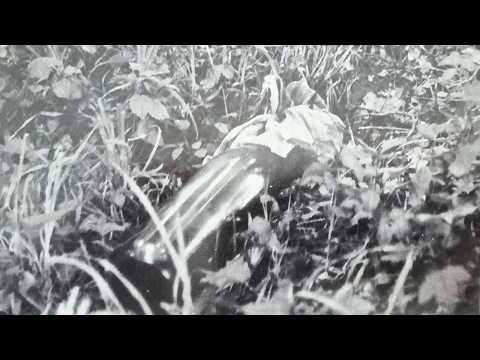
But what had actually caused the fire? Among the evidence left at the scene was a crucial clue: a crude Molotov cocktail made from a 1-liter glass bottle containing a reddish liquid, resting against the trunk of a tree. Later investigation found that not only was the singed shirt fabric used to plug the bottle practically inflammable, but testing proved the fuel inside was diesel, not petrol, and wouldn’t have ignited under any circumstances.
That said, the second incendiary device that was concluded to have been thrown into the library through this window, breaking the two right-hand panes, was not diesel and according to fire investigators had ricocheted around the room causing three distinct points of ignition. The varnished wooden floor quickly caught fire and began emitting thick toxic fumes.
The most likely sequence of events at this point is that perhaps just minutes after appearing, the attackers had fled, leaving Peiper relatively free to race first to his wife’s bedroom, scoop up an armful of her clothes and throw them off the balcony to be later found in a pile right here, then to rush to his own office where he took two drawers from a desk and loaded with documents and a few personal effects, carried them downstairs and dropped them just here where they too would later be found.
Of what happened next we can’t be absolutely certain, but it’s most likely that sometime around 12:20 a.m. on July 14, 1976—Bastille Day—Joachim Peiper re-entered his now fiercely blazing home, racing up the stairs which according to investigators acted like a funnel for the fire below. He staggered into his own bedroom before being overcome by toxic smoke, collapsing on his bed.
Several hours later, when the flames had finally subsided and investigators entered the gutted and smoldering house, in the remains of the library—having fallen through when the ceiling above collapsed—they found a twisted bed frame and a human body burned beyond recognition.
But the story was far from over. Who were those responsible for the actions here at Traves that night, and was the body even that of Peiper at all? For decades that second question has been asked, with wild conspiracies of a fake death and a plan to escape to South America doing the rounds. But could it be possible? Well, no.
Are we sure? Yes. It is true that the intensity of the fire basically consumed the body, but the totality of evidence makes it clear. Found directly underneath the body was Peiper’s wristwatch, its heat-damaged hands frozen at 1:00 a.m.
Then there’s Mrs. Peiper. Despite not initially identifying her husband on July 15, she later returned on July 22 and, having recovered from the shock of the first visit, closely compared the remains with specific details about her husband and formally identified his remains.
Then there’s the autopsies—two of them. The first on July 16 confirmed the presence of soot in the trachea and an accompanying toxicology report noting 60 ml of carbon oxide per liter of blood, confirming the cause of death as carbon monoxide asphyxiation. The second autopsy, conducted on October 26, included dental comparison of the surviving second molar of the left upper jaw, which when compared with an X-ray from Peiper’s Munich dentist who had fitted a crown to that tooth, confirmed it as a perfect match.
All told, eight medical doctors were involved in the final synthesis report published on January 19, 1977, which clearly stated: “The body recovered from the rubble is very certainly that of Joachim Peiper.”
And at the risk of going too far with this, there’s the obvious point: where would he have gone anyway? The man’s entire life was in Traves. He admitted himself that he was staying come what may, and the idea that he would have faked his own death, abandoned everything to live out his days in some South American farm, is frankly ridiculous. And remember, he wasn’t even wanted. There were no pending charges against him.
So, whilst that question we hope has finally been put to bed, one key unsolved one still remains. Who was responsible? It’s extremely intriguing and one that we have to treat very carefully as a number of the suspects are still alive.
In short, the police conducted a massive investigation, creating dozens of reports and conducting more than 300 interviews in the case, and a number of suspects did emerge. First, and perhaps surprisingly, Erwin Ketelhut. He was, of course, in close proximity to Peiper at the time of his death, had publicly fallen out with the Peipers before the attack, and made several contradictory statements to the police.
In his police deposition, he said he first met Peiper in 1965 in Germany, whereas Peiper, when interviewed for his residence permit, responded that he had known him during the war on the Russian front. More worryingly, Ketelhut had also said that he kept watch on Peiper’s home from his balcony until 11:30 p.m. on the night of his death, before going to bed and not being awoken until he heard the village fire siren go off at 1:00 a.m., and even then, seeing nothing unusual upon investigating from his balcony.
This then assumes that the veteran soldier did not hear three shotgun blasts and multiple pistol shots less than 300 meters from his home, having spent most of the night listening for exactly that. And not seeing the fire when dog handler René Bourgeois tracked the scent away from Peiper’s home at 2:20 a.m.—the trail ended right here, 40 meters from Ketelhut’s house and directly in front of his balcony.
In fact, Bourgeois’s declaration goes even further: “From that spot I could see a strong glow from the fire, though there were no longer large flames visible. I’m certain of this because, not knowing the area, I used that glow to find my way back to the Peiper house.”
For my part, I would assume that anyone standing on that balcony would have had to see the fire, especially an hour earlier when it was at its height. So, could Ketelhut, perhaps out of personal dislike, have been involved? Unlikely. Certainly, though, something doesn’t add up.
But then again, Ketelhut had personally given Peiper a shotgun for protection, passed on threats, and was reportedly on much better terms with Peiper in the days before his death. Even when asked if she thought that Ketelhut would have come to Peiper’s aid had he seen anything untoward, Mrs. Peiper, who disliked him, said, “I can’t be sure, but I think he would have.”
But whatever suspicions remained, the official report itself is unambiguous. It concludes: “It has not been possible to establish or to hold against this German national any element of guilt whatsoever, nor even any indication that he saw or recognized his neighbor’s attackers, or that he was instructed to keep silent about what he witnessed.” Unsurprisingly, within days, Erwin Ketelhut’s property went up for sale, and he returned to Germany.
The second main avenue of investigation by the police was into organized political groups, particularly communist-based organizations, which had certainly been responsible for a number of threats in the days leading up to Peiper’s death. One group, made up of ex-French resistance members, came under serious scrutiny. Though when interrogated, members were fully forthcoming, providing alibis which checked out, and whilst they expressed sincere beliefs that Peiper should have been kicked out of France, they unanimously condemned what actually took place.
After considerable investigation, the official police report ultimately concluded: “The outdated method used and the ill-sorted array of means employed do not appear serious, and in any case are poorly suited to the execution of such an action by an organized commando. The hypothesis of a raid mounted by an international organization, or of an operation plotted and directed by a properly constituted movement, party, or association, cannot therefore be sustained. Very probably, this criminal act is local in character.”
That assertion brought one more group of suspects to the fore. To be clear, these men cannot be named here. But they were the subject of considerable investigative effort and quickly became major suspects in the case. Four young local men had first come under suspicion when a friend of one, under pressure from his work colleagues, reported to the police that they had admitted participation in the attack.
The same men had allegedly been overheard in a local café saying they intended to go and beat Peiper up. And two later admitted making comments to that effect. The official police report summarizes an interview with one of the men: “Suspect two admitted having taken part on June 25, 1976, with his aforementioned friends, in a reconnaissance of the former SS colonel’s home, with a view to preparing an expedition to rough up the former war criminal.”
This same incident was recounted by Sibylle Peiper in her second deposition on October 22: “I know about the incident because it was I who noticed some young people trying to force open our letter box. I told my husband, who went out to look and was verbally confronted by these young people. When I asked my husband what they’d said, he told me, ‘Nothing important.’ I didn’t quite understand but I assumed he didn’t want to worry me.”
Six days later, the same four men reportedly returned to Traves. The official police report provides further detail: “In suspect one’s vehicle, the four young men, after dinner on June 25, 1976, around 8:30 p.m., went to the village where they asked passersby for Peiper’s address. Crossing the meadow, they then tried on foot to approach his bungalow. But, fearing a reaction from the owner, they quickly retreated.”
And it was on their way back to the car that suspect three broke open the metal letter box, stealing Gilbert Gilles’s calling card. He admitted that on two occasions—June 25 and July 1—with his aforementioned friends, he had gone to Traves, where he had thrown clods of earth and stones in the direction of Peiper, who had fired a warning shot at them with his hunting rifle.
A further memory accounts for a significant moment in the investigation. The gendarmes carried out a preliminary inquiry and discovered at the home of a friend of the suspect the delivery notice of Gilles of the Charlemagne division, a document stolen on July 1 from Peiper’s letterbox. That calling card, written by an old SS comrade of Peiper’s, provided a tangible link between those under investigation and Peiper’s home—albeit not on the date of the murder.
Unsurprisingly, that development focused the attention of Inspector Level, leading the investigation, closer onto the four youths, who were each interviewed in turn. The official report provides the following: “Suspect one, after much prevarication, was nonetheless more forthcoming. He then admitted having taken part in the operation on the night of July 13 to 14, during which he drove his friends to the area around the former SS man’s house and waited for them a short distance from Le Moulin Velle.”
But these final statements, thin and lacking in precise detail, were also undermined by those of his accused friends. Suspect one accordingly did not delay in retracting and denying the alleged outing to Traves on July 13. With nothing further to go on, the investigation records: “On the morning of August 1, 1976, on the instructions of the requesting magistrate, he and his companions were released.”
A short time later, an internal memo circulated within the gendarmerie. Suspect one’s three friends were on the run. One is said to be in the Vendée, another in the Montpellier area, and the third’s whereabouts are unknown. The witness who informed on them told his employer that it was indeed on the night of July 13 to 14 that his friends had gone to Traves. This witness is said to have been threatened since then by the suspected young men.
What had on face value looked like a promising investigative lead quickly closed when upon further inquiries, witnesses were able to confirm the presence of the four men in their hometown at midnight on July 13, and the four were ultimately cleared.
Despite extensive further investigations into all suspects in the case and a search of more than 150 known 6.35 mm semi-automatic pistol owners of 43 compatible types registered in the region, neither the gun nor the culprits were ever found, and no one was ever charged.
On July 1, 1982, almost exactly six years after the fire, the investigating magistrate formally closed the case with an ordonnance de non-lieu—a ruling that there were no grounds to proceed against anyone. The following March he wrote to Peiper’s daughter to tell her the file was closed and that the property seized from the scene at the time could now be returned to the family. It never was, not fully.
Some of it stayed in the archive, eventually finding its way into private hands, which is, in a strange way, why we’re able to tell you this story at all. This is what’s left of Le Raffour today. The trees Peiper had planted have grown up around and through the old footprint of the house. What was once a terrace, a library, a bedroom, is now a low shape in the undergrowth, marked with graffiti and largely forgotten.
But while the house has all but disappeared, the history of the man who lived here has proved far harder to leave behind. It would be easy to reduce what happened here to a simple moral reckoning. Joachim Peiper had served a criminal regime and commanded men responsible for the murder of prisoners of war and civilians. His name remains inseparable from Boves, from the Ardennes, and from the violence of the war in the East. The trees, the books, the dogs, the quiet life he built could never change that.
But neither does that past make what happened at Traves an act of justice. Whatever judgment history makes of Joachim Peiper, somebody came to his home that night. Violence followed, and nobody was ever held accountable for his death.
Reconciling the Joachim Peiper of the Second World War with the 61-year-old man living here in 1976 is not easy, and perhaps it shouldn’t be. They were, after all, the same person. So, we’ll leave you to draw your own conclusions about the man and about what happened.
But perhaps Traves does leave us with one certainty: more than 30 years after the fighting had ended, the long shadow of the Second World War was still being cast, even here in a quiet corner of rural France.
What do you think really happened at Le Raffour that night—and does an unsolved murder in the woods change how you judge the man who died there? Share your thoughts in the comments below.
Report this article
Select a reason for reporting:






