In 2006, Clemson University football player Ray Ray McElrathbey faced a choice no nineteen-year-old should ever have to make: pursue his college football dreams or become a father figure to his eleven-year-old brother, Feymar, while their mother battled crack cocaine addiction. The Disney movie Safety tells a heartwarming version of this story, but the real events were far more complicated—and far more inspiring.
Ray Ray was actually a redshirt sophomore, not a freshman, when he took custody of Feymar. In real life, he became Feymar’s legal guardian before the school year even started, not after, as the film suggests. And while the movie shows Ray Ray hiding Feymar on campus, in reality, everyone assumed Feymar was just visiting for the summer. The truth is, Ray Ray had been living on campus, taking classes, when Feymar came to visit and eventually asked to stay.
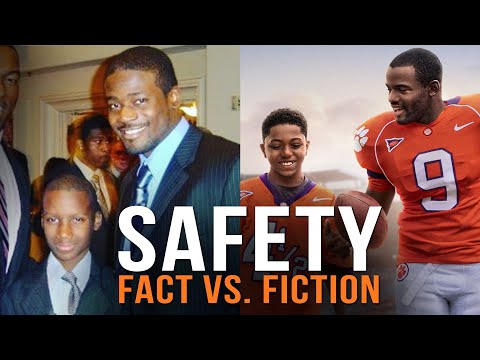
The film introduces a fictional roommate, Daniel Morelli, and a fictional love interest, Casey, who breaks the story. In reality, there was no Italian roommate or steady girlfriend. Ray Ray told Esquire that Daniel is a composite of teammates who helped him. “Eventually everyone was allowed to help, and my teammates were always there,” he said. The story was actually broken by the Post and Courier newspaper, not a student reporter.
What the movie gets right is the NCAA trouble. Ray Ray did accept help from the community—rides for Feymar, homework assistance, even a trust fund—which violated NCAA rules. But the NCAA granted an exception, allowing him to accept certain support. “It shows that humans out there care about other people and not just themselves,” Ray Ray told The New York Times.
Ray Ray’s playing career was cut short by an ACL tear in 2007, but he graduated in three years with a sociology degree. He later played one last college game for Mars Hill College in 2010, then moved to Los Angeles to work in public service and as a personal trainer. Today, he’s back in Atlanta with children, hoping to work for Clemson one day. Feymar, now 25, recently moved back to Clemson, also wanting to work for the university.
Ray Ray served as a consultant on the Disney+ film and even has a cameo as a fictional player named Rahim, after his father. But the real story is still unfolding—and the bond between these brothers remains unbroken.
What the movie doesn’t show is the sheer grind of those early months. Ray Ray wasn’t just a big brother—he was a full-time guardian juggling football practice, classes, and a terrified eleven-year-old who had been uprooted from Las Vegas. “I didn’t have time to be a college student,” Ray Ray later admitted. “I had to be a parent.”
Feymar struggled to adjust. He was quiet, withdrawn, and prone to nightmares. Ray Ray would wake him at 5 a.m. for workouts, then rush him to school before his own morning classes. Teammates noticed the kid always hanging around the facility—eating cereal in the locker room, doing homework on the bleachers.
That’s when the Clemson community quietly stepped in. Coach’s wives took turns driving Feymar to school. A local dentist offered free checkups. Someone set up a trust fund that covered groceries and winter coats. “I never asked for any of it,” Ray Ray said. “But I learned to say thank you instead of no.”
The NCAA investigation loomed over everything. Compliance officers questioned every ride, every meal, every donated pencil. Ray Ray lived in constant fear that one misstep would cost him his eligibility—or worse, force him to give up Feymar. “I told them, ‘If you take me off the field, fine. But don’t take my brother.'”
The exception the NCAA granted was narrow but crucial. It allowed community members to provide transportation, tutoring, and basic necessities—as long as no extra benefits went to Ray Ray himself. He still couldn’t accept a free meal for himself. He still couldn’t let a booster buy him a textbook.
Meanwhile, the national media descended. Oprah called. ABC named him Person of the Week. Letters poured in from strangers with five-dollar bills tucked inside. Ray Ray kept them all in a shoebox under his bed.
But the spotlight faded. By 2007, Ray Ray was rehabbing his torn ACL and watching from the sideline as his scholarship wasn’t renewed. “I was angry at the time,” he said of Coach Bowden’s decision. “But I made peace with it. Clemson gave me more than football ever could.”
He spent a year and a half at Howard University taking graduate courses, then played one final game for Mars Hill College in 2010—a small school in the mountains of North Carolina. He wasn’t chasing glory anymore. He just wanted to finish what he’d started.
After that, Ray Ray moved to Los Angeles. He worked nights as a security guard, days as a personal trainer, and weekends phone-banking for political campaigns. He helped run a homeless outreach program. “I’ve been broke, I’ve been hungry, I’ve been scared,” he said. “So I know how to talk to people who are there too.”
Feymar, meanwhile, grew into a quiet, hardworking young man. He finished school, got a job with a packaging company in L.A., and stayed out of trouble. “My brother saved my life,” Feymar said simply. “I don’t know where I’d be without him.”
Today, both brothers are back in the South. Ray Ray lives in Atlanta with his children, and Feymar recently moved to Clemson, South Carolina. Both hope to work for the university that once rallied around them. “Clemson is home,” Ray Ray said. “It’s where we became a family again.”
But the story isn’t over. Ray Ray still checks in on his mother, who has cycled in and out of rehab. He still worries about Feymar, even though his brother is grown. And he still keeps that shoebox of letters—proof that strangers once cared about two boys from Las Vegas who had nothing but each other.
The making of Safety brought its own unexpected turns. When Disney first approached Ray Ray about adapting his story, he was hesitant. “I didn’t want them to make it look easy,” he recalled. “Nothing about that year was easy.” He agreed only on the condition that he could be on set—not to micromanage, but to make sure the film honored Feymar’s struggle as much as his own.
That meant long conversations with director Reginald Hudlin and actor Jay Reeves, who spent weeks shadowing Ray Ray. The two men ran drills together, studied film of Clemson’s 2006 season, and talked late into the night about what it felt like to be nineteen and terrified. “Jay asked me once, ‘What were you most afraid of?'” Ray Ray said. “I told him the truth: that Feymar would wake up one morning and I’d be gone. That I’d fail him.”
Reeves, a former high school slot receiver and free safety himself, understood the football side instinctively. But the emotional weight took a toll. He later admitted he broke down during the scene where Ray Ray tucks Feymar into bed in a cramped dorm room. “I thought about my own little brother,” Reeves said. “I had to step outside for ten minutes.”
The cameo was Ray Ray’s idea. He plays Rahim, a fictional Clemson player named after his father—the same father who had drifted out of his life because of a gambling addiction. “It was my way of closing a circle,” he explained. “He wasn’t there for me. But I could still put his name on something good.”
Feymar visited the set only once. He watched from behind the monitors as actors recreated the moment he first asked to stay at Clemson. He didn’t say much afterward. “He just hugged me,” Ray Ray said. “That was enough.”
Not everything translated cleanly to screen. The film compresses months of NCAA bureaucracy into a few tense scenes, and it softens the harshest realities—the nights Ray Ray skipped dinner so Feymar could eat, the weeks he slept four hours because he was studying for exams after putting his brother to bed. “Hollywood needs a hero,” Ray Ray said with a shrug. “I was just a brother trying not to mess up.”
What the movie captures best, he believes, is the locker room. The real teammates who quietly covered for him—who let Feymar eat cereal in the film room, who pretended not to notice when Ray Ray dozed off during meetings. “Those guys never asked for credit,” he said. “They just showed up. That’s what family does.”
These days, Ray Ray speaks to youth groups and fatherhood programs across Georgia. He tells them the unglamorous parts: the paperwork, the court dates, the fear of failing a child who has no one else. “Everybody wants the highlight reel,” he tells them. “I want to talk about the third quarter, when you’re tired and nobody’s clapping.”
Feymar, for his part, rarely talks about the movie. He prefers the quiet life in Clemson—working, saving money, visiting his brother on weekends. But he keeps one souvenir: a photo of the two of them on set, standing beside the actor who played him. On the back, in Ray Ray’s handwriting, are four words.
“We made it out.”
That photo sits on Feymar’s nightstand now, a small square of proof that the hardest year of their lives became something worth remembering. He doesn’t need Hollywood’s version. He lived the real one.
Ray Ray still keeps the shoebox of letters, though it’s thicker now—new ones from kids in foster care, single fathers, coaches who recognized a story they’d seen in their own huddles. He reads every one. “People think I was the hero,” he says. “But I was just the one who stayed.”
Clemson hasn’t hired him yet, but the door is open. He’s applied twice. Both times, he’s been told to keep trying. “I’m not done with that place,” he says. “They gave me a family. I want to give something back.”
Feymar, now 25, works a steady job and talks to his mother when she’s clean. He doesn’t promise her anything. He’s learned that from his brother—love without conditions, but with boundaries.
Some nights, Ray Ray calls him just to hear his voice. They don’t talk about football or the movie or the NCAA. They talk about groceries and gas prices and whether Feymar is sleeping enough. Ordinary things. The things that mean you made it.
“We’re not a Disney story,” Ray Ray says. “We’re just two brothers who refused to let go.” And maybe that’s the real ending—not a trophy or a premiere, but a phone call at midnight, a shoebox of letters, and a photo that says: we made it out.
What would you have done, at nineteen, with everything on the line?
Report this article
Select a reason for reporting:






