January 1941. Two rooms, two visions, and a bet that the entire aviation industry called insane. In San Diego, aluminum sheets twisted under the sun on outdoor jigs as Consolidated built B-24 Liberators one agonizing frame at a time. In Coronado, a 60-year-old former pattern maker sat in a hotel room at 4 a.m., sketching a factory on hotel stationery. His target: one four-engine bomber every hour.
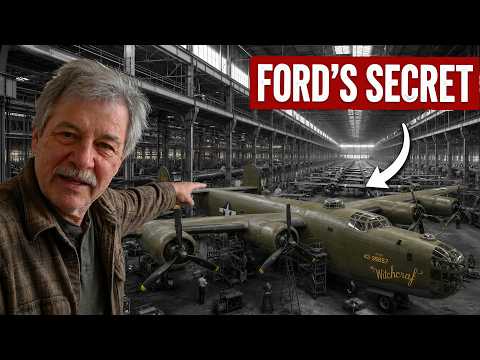
The industry laughed. Throughout 1942, the factory he designed delivered just 56 planes. Journalists started calling it “Will It Fly?”—a sneer dressed as a question. Then a senator from Missouri came to see for himself. What he found inside was beyond anything American manufacturing had ever attempted: finished bombers rotating 90 degrees on turntables in the middle of the line, because the building itself stopped at the county border.
On one side stood a company that could only build things that never changed. On the other, an aircraft whose blueprints were obsolete before they arrived. Both sides were right. Settling that argument would take two years—and more than money.
In May 1940, Franklin Roosevelt told the nation it needed 50,000 military aircraft. No one in American industry knew how to build them at that rate, because no one had ever been asked to. A single B-24 Liberator contained roughly 1.225 million parts. A car of that era held about 15,000. Consolidated built its bombers the way aviation always had: outdoors on steel jigs, one airframe at a time, each one finished by the hands and memory of the men working on it.
In January 1941, Charles Sorensen walked that yard and put his palm on a jig hot enough to bend aluminum out of true. Reuben Fleet, Consolidated’s president, offered Ford a contract for a thousand wing sections. Sorensen replied that Ford would build the entire aircraft or nothing at all. The number on his drawing was one plane per hour. Nobody in aviation believed it.
The contract came in February 1941. Ford broke ground on April 18, five weeks after a $3.4 million initial order for subassemblies. Albert Kahn designed the building. The assembly hall stretched 3,200 feet long and 1,280 feet wide, cost $47 million, and carried a production line more than a mile from end to end. Some $200 million in public money went into the complex. The line was not straight. The hall bent 90 degrees halfway through, forcing turntables to rotate complete bombers as they were built.
The story told ever since is that the bend kept the plant inside low-tax Washtenaw County instead of crossing into Wayne. Aerial photos suggest the airfield taxiways mattered too. Both may be true. Nine hundred people worked around the clock designing production tooling. The plant opened October 22, 1941, with Jimmy Doolittle on the platform. The last concrete for the airfield was poured December 4—three days before Pearl Harbor. The runways were finished. The building meant to fill them was not.
Sorensen had come to Ford in 1905, a Danish immigrant pattern maker earning $3 a day. He helped bring the moving assembly line to Highland Park. He ran the Rouge, where raw materials entered one end and finished cars rolled out the other. Now in his sixties, he had spent his career proving one idea: anything, no matter how complex, could be broken into simple pieces enough for an untrained worker to assemble.
The man who empowered him was Edsel Ford, 45, company president and the least influential man in Detroit. His father still owned the place in every sense that mattered. Harry Bennett’s Service Department watched everyone, including Edsel himself. In 1940, Edsel and Sorensen had agreed to build 9,000 aircraft engines, most for Britain. Henry Ford forced his son to cancel the deal. So the bomber plant was no ordinary contract. It was Edsel’s answer to being publicly overruled. He was already ill when he agreed to the idea over breakfast in Coronado. He had roughly 18 months of health left. He spent them here.
Everything the plant became hung on a single decision, and that decision was about steel. Aviation used soft aluminum dies, mild alloys, easy to cut, cheap to change, believed gentler on thin airframes. Ford threw them out and adopted hard steel cutting tools instead. Steel dies achieved precision the soft dies could never reach. They survived hundreds of thousands of strikes. They produced parts so identical that a wing section could be assembled and mated to a fuselage without any hand-filing to make it fit. Consolidated needed about 250 labor hours to build a center wing section. Ford eventually needed one.
That is what hard tooling buys. It is also what it costs. A die is a promise carved in steel. It insists the part will not change. Sorensen’s engineers broke the Liberator into 11 major units and 69 subassemblies, then made more than 30,000 dies to execute them. It was the equivalent of changing eight or nine full car models at once for a machine with over a million parts—and Ford had no authority over the design. Consolidated kept that. So did the Army.
Every revision reached Michigan as an order to scrap steel already cut. Those revisions were not papers. They were the aircraft learning from the men who flew it. A fuel line rerouted, a gun position rebuilt, fixes paid for in the blood of crews who never came home. Consolidated was not obstructing Ford. It was doing the only responsible thing an aircraft company could do in wartime—which happened to be the one thing Ford’s method could not absorb.
So the teams went west instead. Ford’s engineers and draftsmen traveled 2,300 miles each way to copy drawings that were incomplete when they arrived. Ten thousand of the 30,000 drawings they produced were obsolete before they reached Detroit. Six months of schedule vanished into that gap. Somewhere in that hall, a die maker cut steel for a part he already knew had been revised the week before, and cut it anyway, because the line behind him needed something to stamp.
Detroit’s newspapers had promised a bomber a minute by summer. In all of 1942, the plant delivered 56 aircraft. If this is the kind of history you want more of—the argument under the machine rather than the spec sheet—then stay with it, because what comes next is not vindication. The plant does fulfill its promise. The reversal comes after.
The first Liberator rolled out of Willow Run in the fall of 1942. Accounts differ on the exact day. Some place the rollout in September; others put the first complete aircraft off the line on October 1. Franklin and Eleanor Roosevelt had already toured the hall on September 18, walking past miles of tooling that had produced almost nothing. Then the curve began to bend.
Thirty-seven aircraft in January 1943. Seventy in February. Ninety-six in March. One hundred forty-six in April. On November 3, the plant released its thousandth completed bomber, and the men who had cut the dies came out to watch it. Picture the rollout door opening on a cold Michigan morning, four engines turning, a test pilot holding the brakes while a crowd of tool and die men stood in the noise doing arithmetic in their heads.
The numbers climbed. The nickname did not change. In April 1944, working two nine-hour shifts six days a week, Willow Run delivered 453 aircraft in 468 hours. One plane every 63 minutes. Ford was now building nearly half of every B-24 made in America. The delivered price of a Liberator fell from $238,000 in 1942 to $137,000 in 1944. In a single year, one building in Michigan produced nearly as many aircraft as the entire nation of Japan.
The final count was 8,685—6,792 complete bombers and 1,893 knocked-down kits shipped for assembly elsewhere. The promise carved in steel had come due, and it paid. That, too, became an argument of its own. Precise American production figures reached Berlin, and Hitler and Göring dismissed them as lies and impossibilities. Numbers no country could seriously intend. Somewhere, a staff officer filed a report he had no professional reason to doubt but every institutional reason to disbelieve. The Luftwaffe planned its future on the smaller number.
Inside, the building acquired a familiar face. Rose Will Monroe was driving rivets into Liberator fuselages at Willow Run when a film crew arrived to shoot a short about war bonds. Whether she was the “real” Rosie remains disputed. The lights and the rivet gun were not. Forty-two thousand people carried badges through those doors.
The plant finally kept its promise. The Army had already begun wishing it hadn’t. The turn came in four stages. The first was human. The second institutional. The third personal. The fourth strategic.
The human stage began before the aircraft did. In early 1943, Ford was hiring about 1,800 workers a month and losing 1,600. The plant sat in farmland with no housing and no streetcar line. Recruiters brought thousands north from Kentucky and Tennessee, and Ypsilanti locals coined a sneer for them: “Ypsilanties.” Henry Ford resisted federal housing until he was forced to accept it. Willow Village went up fast, peaking in 1944 at 8,820 units holding more than 18,000 workers and their families. The national production miracle was, in fact, a muddy field full of trailers.
The institutional stage arrived in the form of a committee. Harry Truman’s panel toured Willow Run in April 1942 and returned in February 1943 to stand on the factory floor and find nothing worth showing. Then the investigators issued their report, and they did not blame Ford’s methods. They found that design authority rested with Consolidated and the Army, while responsibility for construction sat in Michigan. They demanded a single plant manager with real authority. Those were the objections Ford had raised before the first die was cut. That authority went to Mead Bricker in late 1943. Subassembly work was farmed out to other plants. The ridicule had been aimed at the wrong target the whole time.
The personal stage was the most expensive. Edsel Ford died on May 26, 1943, of stomach cancer, aged 49—eleven months before the plant reached the rate he had wagered his name on. His father, 79, took back the presidency. Charles Sorensen was forced out of Ford in early 1944, weeks before 453 aircraft rolled off his line in 468 hours. Neither man was in the building when that number finally landed.
The strategic stage was the quietest and the largest. Willow Run peaked in the summer of 1944 and was told to slow down. There was no room left to park aircraft. Combat losses were not as high as the planners had assumed. The Army Air Forces had already canceled B-24 contracts with Douglas and North American. The reason was not that the Liberator had failed. By 1944 it was no longer the bomber the Army wanted most, and by 1945 it was not needed in those numbers at all. They had won the argument. The argument had stopped mattering.
On June 28, 1945, the last Liberator built at Willow Run left the line—a B-24M, serial 44-51928. It was flown to a storage yard and eventually to Kingman, Arizona, where it was cut up and smelted. Germany had surrendered seven weeks earlier, and 5,168 Liberators still on order were canceled. By then, only 7,400 people remained on a payroll that had once held 42,000.
Thousands of Liberators went to the desert, and their aluminum came back as ingots, pots, pans, coffee filters, and bread toasters. The most-produced American bomber of the war was dismantled faster than it had been built. Ford held an option to buy the plant. Ford did not exercise it. The company returned to making cars within a week of the last bomber and never built another aircraft.
Somewhere in that hall, an old toolmaker watched the presses that had held a precision no aircraft factory had ever matched get cut up for scrap. The building outlived the argument. Kaiser-Frazer moved in and built some 739,000 cars. General Motors took it over after a 1953 fire destroyed its Livonia transmission plant, and built transmissions at Willow Run for more than 50 years, until 2010, when bankruptcy closed it. Most of the building came down in 2014.
Four Ford-built Liberators survive on three continents: Duxford, Hendon, Ottawa, and Parksdale. Rose Will Monroe’s request to fly as a ferry pilot for the plant was refused because she was a widow with two children. She earned her private pilot’s license at fifty. Some 144,000 square feet of the factory still stands—the section where finished bombers rolled out the door. It belongs now to a museum, renamed the Michigan Flight Museum in 2024.
Beside it, on the concrete where the mile-long line once ran, a test track opened in 2018. Self-driving cars loop in circles while engineers argue over how much of the system to seal shut and how much to leave open for revision. Same ground. Same trade.
The promise carved in steel is still the fastest way to build anything, and still the most expensive way to be wrong. Sorensen’s rigidity is either why the plant worked or why it took two years to—and the records will back you either way.
Two rooms, January 1941. Aluminum twisting under the sun. A man at 4 a.m. with hotel stationery, deciding how much of the future to hold still.
So which was it—the stubbornness that saved the war, or the stubbornness that nearly lost it? Tell us below.
Report this article
Select a reason for reporting:






