In the spring of 1945, in the tobacco fields north of Durham, North Carolina, something extraordinary happened—something that no one ordered, no camera captured, and no historian can fully explain. Roughly one thousand German prisoners of war took off the uniforms of Hitler’s army and set them on fire. Not a single photograph of the event survives. Not one name from that thousand is known. What remains is a number, a camp name, and a story that has been passed down through history books for eighty years.
But the fire itself is only the end of a longer story. To understand it, you have to go back to what happened before—to the film the U.S. Army decided every German prisoner in America had to watch.
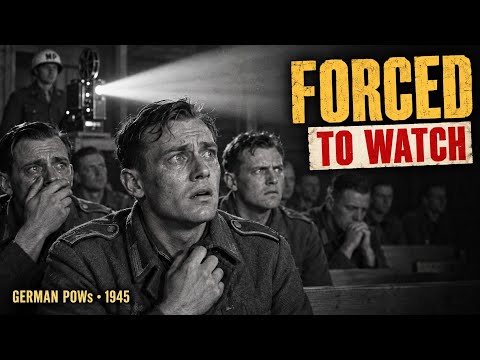
By the spring and summer of 1945, the United States held nearly 372,000 German POWs in about 700 camps scattered from Florida to Oregon. The Army ordered that every single one of them see a specific film. One of those men was a young lieutenant named Gerhard Hennes. Captured in North Africa on May 13, 1943—the day the last Axis forces in Tunisia surrendered—he spent two years as a prisoner in a small town on Tennessee’s Cumberland Plateau. When the Army screened the film in Crossville, Hennes was in the audience.
Years later, he said watching that film was the day he turned from a hero into a villain.
Across the country, men who saw the film reacted with shock, anger, and often outright disbelief. They gave the footage a nickname: “Knochenfilme”—bone films. In one Florida camp, men from a single company emptied their pockets to donate to victims of their own government. And at Camp Butner, North Carolina, that fire happened.
So what exactly was shown to them? Why did the Army wait until Germany’s surrender to screen it? And what does any of this have to do with 14 German prisoners hanged in Kansas that same summer?
To answer any of that, you have to start with who these men were—and with the strange world the Army built for them behind the wire.
The first big wave came from Tunisia in 1943: men of Rommel’s Afrika Korps, who had been winning victories just a year earlier. After them came prisoners from Sicily and Italy, and after D-Day, from France and beyond. Most crossed the Atlantic on Liberty ships that would otherwise have returned empty. At the peak, up to 30,000 prisoners arrived each month.
What waited for them on the other side surprised many. The Geneva Convention of 1929 required captors to provide the same quarters and food for prisoners as for their own soldiers, and the United States treated that as a real obligation. German POWs ate what American soldiers ate. They got cigarettes, and in some camps, beer. Enlisted men who worked earned 80 cents a day in canteen coupons. One prisoner later said he weighed 128 pounds when captured and 185 pounds after two years in American hands, joking that his face had filled out so much his eyes nearly disappeared.
Why such generosity toward men who had been shooting at Americans? Because Germany held tens of thousands of American prisoners, and both sides knew it. Every decent meal in a Mississippi camp was a message to Berlin: treat our prisoners as we treat yours.
Not everyone at home liked the arrangement. In February 1945, a weekly newspaper in Stark, Florida, near the state’s largest POW camp, ran an editorial built on a bitter comparison. Germany kills its prisoners, America feeds its prisoners cake. The editor placed real POW menus from a camp near Tampa next to reports of the Malmedy massacre of American POWs. In one camp, a literary-minded German cook gave ordinary dishes such fancy names that the menus reached the newspapers—and the Army ended up banning foreign phrases from POW menus. The food was the same. Only the words had changed.
Officers could not be forced to work. So for Hennes, the days were long and strangely comfortable. As a lieutenant, he drew twenty dollars a month. Prisoners at Crossville spent their money on beer, cigarettes, and books—some ordered straight from the Sears catalog. They gave each other courses and organized their own tennis and soccer leagues. Hennes remembered evenings full of loud talk, singing, and the slap of cards on tables.
It sounds like a summer camp. For some men, it was. For others, it was a place where a single wrong sentence could cost you your life—and the danger did not come from the Americans.
The Army did not have enough guards, and it had even fewer who spoke German. So they guarded the fence and let the Germans run the inside. German sergeants woke the men, marched them to meals, and sent them to work. It was cheap and it kept order. It also handed enormous power to the most committed Nazis in the camp.
Many of the earliest arrivals from North Africa had been captured while Germany was still winning, and they fully expected it to win again. As late as early 1945, according to one study, eight of twenty camp newspapers were still promoting Nazi ideology. Men like these held secret trials in the barracks for anyone they suspected of disloyalty. A defeatist remark, a shrug about who might win the war, or mere suspicion that you had been talking to the Americans was enough to put you before one of those courts. The beating that followed had a special name in the camps. The prisoners called it “the Holy Ghost.”
One anti-Nazi prisoner later said there was more political freedom in the German army than in an American internment camp.
On November 4, 1943, at Camp Tonkawa in Oklahoma, it happened to a thirty-nine-year-old corporal from the Afrika Korps named Johannes Kunze. He had made defeatist comments and—far worse in the eyes of the hardliners—was passing notes to the Americans. He was brought before a so-called court in the mess hall with about two hundred prisoners present. By the end of it, Kunze had been beaten to death by his own countrymen.
Four months later, it happened again in Arizona. Werner Drechsler was a twenty-one-year-old U-boat sailor who had cooperated with American intelligence after capture. He was supposed to be kept away from hardline prisoners to protect him—fear of German retaliation against Americans was behind almost every decision the Army made about its German prisoners. What they ate, what they read, whether they were punished, all of it was weighed against what might happen to Americans in German hands. Most of what happened inside those 700 camps never surfaced. There were 72 recorded suicides of prisoners in American camps during the war. No one can say for certain how many of those were actually suicides.
War is full of stories like this—stories that happened where there were no cameras rolling.
The men who killed Kunze and Drechsler were still awaiting execution by hanging when American soldiers entered a place called Ohrdruf in early April 1945. Ohrdruf was a subcamp of Buchenwald in central Germany. Units of the 4th Armored Division and the 89th Infantry Division reached it on April 4. They found bodies stacked in sheds—some covered in lime, some half-burned on improvised crematorium grates.
Eight days later, Dwight Eisenhower came to see it for himself, accompanied by George Patton and Omar Bradley. Patton, not known for a weak stomach, refused to enter one of the rooms. He said it would make him vomit. Eisenhower then did something that showed how clearly he saw what was coming. He sent a cable to General Marshall in Washington and made clear he had made the visit deliberately. He wrote that he wanted to be in a position to give firsthand evidence, in case anyone in the future tried to dismiss it all as propaganda. He asked that members of Congress and newspaper editors be flown over to see the camps with their own eyes, and within days they were walking through them. By the end of the month, Army photographers were ordered to film the camps completely.
They held on to that word. We will hear it again.
Back in the United States, the prisoners were making a different kind of news. The day after Eisenhower’s tour of Ohrdruf, Florida newspapers were reporting a two-day strike by German prisoners at Camp Blanding near Lake Okeechobee—their cigarette ration had been cut. In Washington, some congressmen were furious that the Army seemed to be doing nothing about what was going on in the prisoners’ heads.
Representative Richard Harless of Arizona toured Camp Papago Park that spring—the same camp where Drechsler had died—and afterward complained on the floor of Congress that America had made no effort at all to educate its German prisoners. Robert Sikes of Florida went further. He wanted the prisoners taught democracy, whether they liked it or not, and said plainly that if it took force, the Army should use it.
What neither man knew was that the Army had been quietly working on the prisoners’ minds since 1944. A new office called the Special Projects Division was supplying the camps with American books, films, and lessons, along with a German-language newspaper called Der Ruf—”The Call.” It was produced by carefully selected anti-Nazi prisoners at a fort on the Rhode Island coast known as “the Factory.” All of it was kept secret. It probably violated the Geneva Convention’s rules on propaganda, and no one wanted to give Germany an excuse to do the same to American prisoners.
Much of that work was done through film. The camps screened movies four nights a week, and prisoners paid for their tickets out of canteen money. American officers choosing the films were told to order fewer gangster pictures and Westerns, and more stories of democratic heroes. Filmed biographies of Mark Twain, Louis Pasteur, and Alexander Graham Bell. Prisoners sat through the “Why We Fight” series. Some camps showed the Bugs Bunny cartoon in which Bugs mocks Hermann Göring. By the spring of 1945, the camp theater had effectively become a classroom.
But the prisoners had not been told that. Then, on May 8, 1945, Germany surrendered, and the fear that had shaped all of it evaporated. There were no longer any Americans in German POW camps who needed protecting. Over the next few months, the Army carried out a series of measures it had been postponing. It cut prisoner rations and restricted what they could buy at the store—a change many prisoners saw as revenge.
On May 28, the Army announced the re-education program to the press. And in July and August at Fort Leavenworth, Kansas, it hanged 14 German prisoners for killing their fellow prisoners. The five who killed Johannes Kunze, two who killed a prisoner in South Carolina, and the seven who killed Werner Drechsler. The seven climbed the scaffold in the early hours of August 25, one after another, from just after midnight until nearly three in the morning. It was the largest mass execution in America in the twentieth century.
There was one more thing the Army could finally do. It could show them.
Through the late spring and summer of 1945, screenings spread across the system, with armed military police inside the hall. Some of the footage had been shot only weeks earlier. At Crossville, Hennes and the rest of the camp walked to a movie theater. He described what happened next without any softening. The viewers attacked the men presenting the film. Who were the Allies to lecture anyone about crimes after what they themselves had done? The film said nothing about that. So it had to be propaganda. Propaganda—the very word Eisenhower had warned against after Ohrdruf, weeks before any prisoner in America saw a single frame of that footage.
Not everyone reached for that emergency exit. Alex Funke, a prisoner who served as a pastor to his fellow Germans at Camp Algona in Iowa, had been viewed with suspicion by the Gestapo before his capture because of his church. He said later that he had known the Nazis persecuted Jews, and he had known there were concentration camps. But the full scale of it he learned only from the reports that came out after the camps were liberated. This is the uncomfortable middle of this story. There is a difference between knowing something and truly realizing it.
Most Germans had heard something about the camps. Whether a tank crew captured in Tunisia in 1943 knew about the mass killing in the East is a far harder question, and historians still cannot answer it clearly. Some men in those camps were sincere when they said they had not known. Others were not, and no one in those rooms could tell the difference.
Camp Blanding, Florida, June 10, 1945. One prisoner company watched the film, then reached into their pockets. They collected $411 for the German Red Cross, with a short letter: the money was for those who had suffered most under their own government, “regardless of religion.” Twelve years of a state that sorted human beings by blood—and these men asked no questions about who deserved help.
Then there is that other phrase: they hoped every criminal would be punished, “whatever their class, party, or military unit.” Soldiers of the Wehrmacht putting themselves on the list. No one forced them to write it.
At Butner, roughly a thousand men burned their uniforms—voluntarily, as the record says. For a prisoner, that uniform was a passport. Burning it was tearing up your own identity.
Eighty years later, we still don’t know who struck the first match. What do you think—was it guilt, defiance, or something else entirely? Let us know in the comments.
Report this article
Select a reason for reporting:






