In the shattered silence of Nuremberg’s prison cells, the men who once held Europe in their grip faced the end. The year was 1946, and the world was about to hear the unfiltered voices of the Third Reich’s highest officials—not in the courtroom, but in private interviews conducted shortly before their sentences were pronounced. These are the words of Hermann Göring, Joachim von Ribbentrop, Karl Dönitz, and Ernst Kaltenbrunner, captured in conversations that reveal their twisted justifications, their convenient amnesia, and their chilling detachment from the atrocities they orchestrated.
What emerges is not remorse, but a calculated attempt to rewrite history—to shift blame, to minimize horror, and to present themselves as loyal servants of a nation they led to ruin. As the interviews unfold, the veneer of civility cracks, exposing the banality of evil.
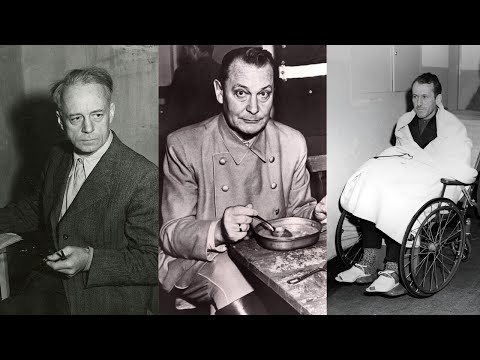
Hermann Göring, the Reichsmarschall and Hitler’s designated successor, sits in his cell, his uniform dirty, his demeanor defiant. “The trial is a farce,” he declares with a wave of his hand. “If they’re looking for someone to hold responsible, I’ll stand as that person. Let the others go.” He speaks of his loyalty to Hitler, his disagreements, and his supposed ignorance of the extermination camps. “I never wished to exterminate anyone,” he insists, “that is not my nature.” Yet his words ring hollow as he admits to authorizing concentration camps as early as 1933—but only for political enemies, he claims.
Göring’s narrative is one of selective memory. He recalls his love of art, his preference for Gothic style over Hitler’s classical tastes, and his childhood in medieval castles. “There’s not much difference between the child I was and the man I became,” he muses, as if his formative years could explain away his role in the horrors to come. He blames Goebbels for the radicalization of anti-Semitism, calling him “a fanatic, the worst kind of opportunist.” But when pressed on his own responsibility, he retreats: “I accept my responsibility for what happened under the regime, but not for crimes I had no knowledge of.”
Ernst Kaltenbrunner, head of the Reich Main Security Office, is equally evasive. “Much of what I know today about these crimes I only learned here in Nuremberg,” he claims, despite having overseen the Gestapo and the SD. He describes the RSHA as a complex, evolving structure, and insists his personal knowledge was limited. “I was completely ignorant of the existence of systematic exterminations,” he says, a statement that strains credulity given the documents bearing his signature. He deflects blame onto Heydrich and Himmler, portraying himself as a mere bureaucrat caught in the machinery of state.
Joachim von Ribbentrop, the former foreign minister, offers a different kind of evasion. He recounts his youth in Canada, his bout with tuberculosis, and his early admiration for Hitler. “He was magnetic,” Ribbentrop recalls. “There was something in his presence that made one unable to stop listening.” He admits to knowing about the persecution of Jews but claims he tried to arrange peace with England in 1940 to prevent further horror. “If we had reached an agreement with England, perhaps those horrors could have been avoided,” he says, as if diplomacy could absolve him of complicity.
Karl Dönitz, the admiral who briefly succeeded Hitler, presents himself as a man of the sea, untouched by politics. “I was a man of the sea. I served my country in wars, followed orders, and never strayed from my naval duties,” he insists. He denies knowledge of the Holocaust, calling the Navy “an island” free of anti-Semitism. He even recounts a story of inviting a Jewish merchant aboard his ship, a gesture he believes proves his lack of prejudice. Yet he also admits to accepting Hitler’s leadership after his suicide, believing it was his duty to prevent Germany from falling to the Soviets.
As the interviews draw to a close, a pattern emerges: each man constructs a narrative of loyalty, ignorance, and victimhood. They speak of honor, duty, and patriotism, but never of guilt. They blame Hitler, Himmler, and Goebbels for the worst crimes, while presenting themselves as soldiers or statesmen who simply followed orders. “I did not know what was happening to the Jews,” Dönitz says. “I did not see it. I did not know.” But the documents, the testimonies, and the sheer scale of the atrocities tell a different story.
The Nuremberg trials would ultimately reject these self-serving accounts. Göring, Ribbentrop, and Kaltenbrunner were sentenced to death; Dönitz received ten years. Yet their words, captured in these interviews, remain as a chilling reminder of how men in power can rationalize the unthinkable—and how easily they can lie, even when faced with the ruins of their own making.
In the corridor outside the interview rooms, a young American psychiatrist named Dr. Leon Goldensohn scribbled notes in a worn leather journal. He had been tasked with evaluating the mental state of the accused, but what he found was something far more unsettling than madness. “These men are not insane,” he wrote. “They are terrifyingly sane.” Each interview had been conducted with the same clinical detachment, the same measured tone, and yet beneath the surface lay a profound moral emptiness that Goldensohn struggled to name.
The transcripts, later smuggled out by a clerk who could no longer stomach the work, would eventually find their way into archives that few would ever read. But for now, in the spring of 1946, the interviews continued. The next name on the list was Albert Speer, the architect of the Reich and Hitler’s personal friend—a man whose polished demeanor and apparent contrition would earn him the nickname “the good Nazi.”
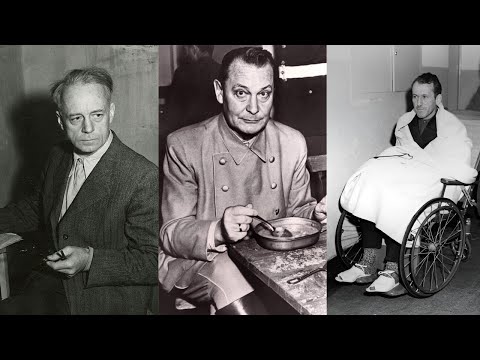
Speer entered the room with the quiet confidence of a man who had rehearsed his lines. His suit was pressed, his hands steady. “I have spent many nights thinking about what I could have done differently,” he began, before the first question was even asked. “I should have listened more carefully. I should have asked more questions.” The words sounded practiced, as if he had been waiting for an audience.
When asked about his role in the use of forced labor, Speer’s expression did not change. “I was responsible for production,” he said. “I needed workers. I did not inquire too deeply into where they came from.” He admitted to seeing conditions at the Dora-Mittelbau camp, where prisoners built V-2 rockets in underground tunnels. “It was harsh,” he conceded, “but I told myself it was necessary for the war effort.” He paused, then added, almost as an afterthought: “I should have done more. I know that now.”
The interviewer pressed him: Did he feel guilt? Speer looked down at his hands. “Guilt is a word that is easy to say,” he replied. “But I am not sure I have the right to use it. I was not there when the worst things happened. I was in Berlin, drawing buildings that would never be built.” He spoke of his love for architecture, of the domes and colonnades he had designed for Hitler’s grand capital, as if the memory of those drawings could somehow offset the smoke of the crematoria.
What Speer did not say—what he would never fully admit—was that he had personally requested workers from the camps, that he had known of the brutal conditions, and that his signature appeared on documents that sealed the fate of thousands. Instead, he offered a carefully constructed narrative of a man who had been seduced by power and then abandoned by it. “I was young,” he said. “I was ambitious. I wanted to build something that would last a thousand years. I did not stop to ask what it would cost.”
Goldensohn, observing from the corner, noted the contradiction. Speer spoke of ignorance, yet his answers were precise. He remembered dates, names, and figures with the clarity of a man who had studied his own case file. “He is not confessing,” Goldensohn wrote. “He is curating.”
The next day, the interviews moved to a less polished figure: Hans Frank, the governor-general of occupied Poland, known as the “Butcher of Kraków.” Frank had converted to Catholicism in prison and now clutched a small crucifix as he spoke. “I have found God,” he announced. “I have repented.” But when asked about the liquidation of the Warsaw Ghetto, his voice hardened. “I was not in charge of the camps,” he said. “Himmler was. I only administered the territory.”
Frank’s diary, however, told a different story. In its pages, he had written of “annihilating the Jews” and of “not being able to eliminate all the lice at once.” When confronted with his own words, he fell silent for a long moment. “I was a different man then,” he whispered. “I did not know what I was saying.” The crucifix trembled in his hand.
As the interviews continued, the pattern repeated itself: denial, deflection, and the careful construction of a self that could survive the judgment of history. But history, unlike the men in the cells, was not so easily persuaded. The transcripts grew thicker, the contradictions more glaring, and the silence between the questions more damning. The truth was not in what they said, but in what they refused to say—and in the documents that spoke for them.
Goldensohn closed his journal that evening and stared at the wall of his quarters. He had come to Nuremberg expecting to find monsters, and instead he had found men who could discuss art, weather, and family with perfect courtesy. “The evil here is not in their faces,” he wrote. “It is in the space where a conscience should be.”
The final interviews were brief. When asked if he had any last words for the German people, Speer offered a thin smile. “Tell them I tried to build something beautiful.” Frank clutched his crucifix and said nothing at all. The guards led them away, and the doors closed with a soft, ordinary click.
In October 1946, the sentences were carried out. Göring cheated the gallows with cyanide; the others were hanged in a gymnasium lit by bare bulbs. Speer watched from his cell window, then returned to his memoirs. He would spend twenty years crafting his legend, and he would almost succeed.
But the transcripts survived. In a dusty archive in Washington, a researcher would one day pull them from a box and feel the cold breath of history on her neck. She would read Göring’s laughter, Ribbentrop’s excuses, Dönitz’s denials, and she would understand something Goldensohn had learned in those cells: the most dangerous lies are the ones men tell themselves.
The interviews ended, but the question they raised did not. When ordinary men are given extraordinary power, and when the world looks away, what stops them from becoming monsters—and what would you have done in their place?
Report this article
Select a reason for reporting:






