In the chaotic skies over Nazi Germany, the fate of the free world hung by a thread. American bombers, flying deep into enemy territory, were being slaughtered in droves. The Luftwaffe, with its seasoned pilots and deadly fighters, seemed unstoppable. But one aircraft would change everything—the P-51 Mustang. This is the story of how a rejected design became the war’s most feared fighter, and how the young pilots who flew it turned the tide of World War II.
The Mustang was born out of desperation. In 1940, Britain stood alone against Hitler’s war machine. The Royal Air Force needed fighters—fast. North American Aviation, a company with no experience building fighters, promised a new plane in 120 days. The result was the NA-73X, a sleek, aerodynamic machine that would become the Mustang. “We sold you on a lark almost,” recalled one engineer. “We knew what we wanted and we got it.” The Mustang was faster than the Spitfire at low altitudes and had twice the range, but its Allison engine faltered at high altitudes, making it unsuitable for dogfights above 20,000 feet.
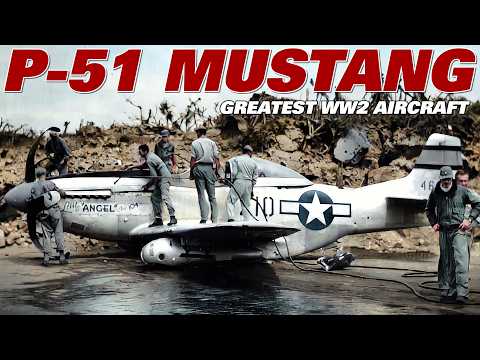
Despite its limitations, the Mustang excelled as a low-level ground-attack aircraft. The RAF ordered 620, but the Americans showed little interest—until Pearl Harbor changed everything. Suddenly, the U.S. was in the war, and the need for a long-range escort fighter became critical. The bombing campaign over Europe was suffering catastrophic losses. “We lost 60 bombers in a single raid,” remembered one pilot. “That’s 600 men. It was unsustainable.” The P-47 Thunderbolt, while powerful, lacked the range to escort bombers all the way to Berlin. The Mustang, with its exceptional range, was the answer—if only it could fight at high altitude.
In 1942, a team of Rolls-Royce engineers made a bold move: they replaced the Mustang’s Allison engine with the Merlin, the same engine that powered the Spitfire. The transformation was miraculous. “The Merlin gave more power at 25,000 feet than the Allison had at takeoff,” said one engineer. The Mustang now had speed, range, and high-altitude performance. The U.S. Army Air Forces quickly placed massive orders. The P-51D, introduced in May 1944, featured a bubble canopy for unmatched visibility and six .50-caliber machine guns. It was the ultimate fighter.
Pilots fell in love with the Mustang. “It was a pilot’s airplane,” said one ace. “You strap it on like a part of you. If you wanted to turn left, you just thought left.” The aircraft was agile, responsive, and deadly. With its long range, it could escort bombers to Berlin and back, engaging enemy fighters along the way. The Mustang’s arrival was a turning point. “We knew we had the best fighter in the theater,” said another pilot. “The Germans respected it. They feared it.”
But the Mustang was more than a machine; it was a symbol of hope for the bomber crews who had watched their comrades fall from the sky. “When we saw those Mustangs, we knew we had a chance,” said a B-17 gunner. “They were our guardian angels.” The P-51 not only saved lives but also helped crush the Luftwaffe, paving the way for Allied victory. As the war raged on, the Mustang would prove to be the decisive weapon in the air war over Europe—a true game-changer.
The pilots who flew the Mustang were young, cocky, and hungry for a fight. “You have to be aggressive,” said one ace. “If you think defensively in a fighter, you’re lost. I wanted to be the tip of the spear.” They arrived in England fresh from training, brimming with confidence, ready to take on the seasoned veterans of the Luftwaffe. “I was a cocky son of a bitch,” admitted another pilot. “But you had to believe you were the best, or you’d never survive.”
The early missions were brutal. The Mustang’s range allowed it to escort bombers deep into Germany, but that also meant flying for six hours or more in a cramped cockpit, enduring bone-chilling cold and the constant threat of enemy attack. “You’d be numb from the cold, deaf from the engine, and then suddenly the radio would crackle with warnings,” recalled one pilot. “The Germans would come at you from out of the sun, and you’d have seconds to react.”
Combat was a blur of G-forces, split-second decisions, and sheer terror. “It’s like playing football at 400 miles an hour,” said one ace. “You lead the target, you squeeze the trigger, and you pray.” The Mustang’s six .50-caliber guns could shred an enemy fighter in seconds, but the Germans were skilled and determined. “I saw a buddy go down in flames,” remembered another pilot. “One minute he was there, the next he was gone. You couldn’t dwell on it. You had to keep fighting.”
The tide began to turn. The Mustang’s long range allowed it to pursue the Luftwaffe relentlessly, even to their own airfields. “We’d catch them on the ground, strafing their bases,” said a pilot. “It was like shooting fish in a barrel, but they were still dangerous.” The Germans, desperate to stop the bombers, threw everything they had at the Mustangs—flak, fighters, even new jet aircraft like the Me 262. But the P-51 pilots adapted, using their speed and agility to outmaneuver the enemy.
One pilot recalled a harrowing dogfight over Berlin. “I had a 109 on my tail, firing everything he had,” he said. “I broke left, dove, and pulled up hard. He overshot, and I got behind him. One burst, and he was smoking.” It was moments like these that defined the Mustang’s legacy—a fighter that could take a beating and still come out on top.
By late 1944, the Luftwaffe was on its knees. The Mustang had shot down thousands of enemy aircraft, and the bomber losses had plummeted. “We knew we were winning,” said one pilot. “You could see it in the faces of the German pilots. They were beaten.” The P-51 had become the undisputed king of the skies over Europe, and its pilots were legends.
The Mustang’s dominance was not just about its performance—it was about the men who flew it and the ground crews who kept them in the air. “Every pilot depended on his crew chief,” said one veteran. “They worked all night to patch bullet holes, swap engines, and load ammunition. Without them, we were nothing.” The bond between pilot and crew chief was sacred. “The plane belonged to the crew chief,” joked another pilot. “He owned it. I just flew it because he let me.” But once the pilot strapped in, the Mustang became his—a trusted friend and weapon.
As the Allies pushed deeper into Germany, the Mustang’s role expanded. It wasn’t just escorting bombers anymore; it was hunting down the remnants of the Luftwaffe wherever they could be found. “We’d hit their airfields at dawn,” recalled a pilot. “Catch them before they could take off. It was ruthless, but it saved lives.” The Germans, desperate to counter the Mustangs, threw everything they had at them—flak, fighters, even the new jet-powered Me 262. But the P-51 pilots adapted, using their speed and agility to outmaneuver the enemy.
One pilot described a tense encounter with a Me 262. “He came at us like a shark, fast and deadly,” he said. “But he couldn’t turn with us. We used our numbers and our wits. I got on his tail and let him have it. He went down in flames.” The Mustang’s ability to absorb punishment and keep fighting became legendary. “I came back with half a wing missing,” laughed another pilot. “The crew chief just shook his head and said, ‘I’ll fix it.’ And he did.”
By early 1945, the Luftwaffe was a shadow of its former self. The Mustang had shot down thousands of enemy aircraft, and the bomber losses had dropped dramatically. “We knew we were winning,” said one pilot. “You could see it in the faces of the German pilots. They were beaten.” The P-51 had become the undisputed king of the skies over Europe, and its pilots were legends. But the war was not over yet. The Mustang would go on to serve in the Pacific, but its days of glory were in Europe, where it had turned the tide of the air war.
As the war in Europe drew to a close, the Mustang’s legacy was already being written. “It was the best fighter of the war,” said one ace. “It had the range, the speed, and the firepower. But more than that, it gave us hope. When we saw those Mustangs, we knew we had a chance.” The P-51 had not only saved lives but had helped crush the Luftwaffe and pave the way for Allied victory. “I’ll never forget the sound of that Merlin engine,” said another pilot. “It was the sound of freedom.”
But the Mustang’s story was far from over. In the Pacific, it would face new challenges and new enemies. And in the decades to come, it would become a symbol of American air power, a testament to what could be achieved when brilliant minds and brave hearts came together. “It was a hell of an airplane,” said one veteran. “I was lucky to fly it. We all were.” The P-51 Mustang had earned its place in history, not just as a machine, but as a legend.
The war in Europe ended, but the Mustang’s story didn’t. In the Pacific, it faced new enemies and new challenges. “We were told the Mustang couldn’t cut it against the Japanese,” said one pilot. “But we proved them wrong.” The P-51 flew escort missions for B-29s over Japan, and even engaged in ground-attack roles. Its long range and durability made it invaluable.
After the war, the Mustang served in Korea and beyond, a testament to its design. “It was a hell of an airplane,” said one veteran. “I was lucky to fly it. We all were.” The P-51 had earned its place in history, not just as a machine, but as a legend.
Today, the Mustang still flies at air shows, its Merlin engine roaring. “When you hear that sound, you remember,” said a former pilot. “You remember the friends you lost, the ones who never came home. And you remember the plane that brought you back.” The P-51 Mustang was more than a fighter—it was a symbol of hope, a guardian angel, and a game-changer.
As the sun sets on another air show, the Mustang’s silhouette against the sky reminds us of the brave young men who flew it. “We were just kids,” said one. “But we did something extraordinary.” The legend lives on.
What does the P-51 Mustang mean to you? Share your thoughts in the comments below.
Report this article
Select a reason for reporting:






