May 8, 1945. The guns fell silent, and the world erupted in joy. In London, Paris, New York, and Moscow, strangers embraced in the streets, tears streaming down their faces. The Nazi beast was dead. The war was over. But as the celebrations echoed through the shattered cities, a chilling truth lurked beneath the cheers: the war was not over. It had merely changed its face.
Europe was a graveyard. Forty million dead. Entire cities reduced to rubble. Millions homeless, hungry, and haunted. The continent had been bled dry, and now it faced a question that would shape the next half-century: how do you rebuild a world from ashes?
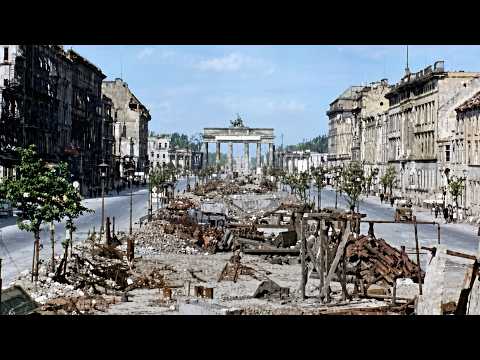
In Berlin, the answer began with women. The Trümmerfrauen—rubble women—dug through the debris with bare hands, clearing millions of tons of stone and twisted steel. They worked for food, for survival, for a future they could barely imagine. Meanwhile, the victorious Allies—America, Britain, France, and the Soviet Union—carved Germany into four zones, each with its own agenda. Behind their smiles, a powder keg of distrust was already smoldering.
And then there were the displaced. Forty million people—former prisoners, forced laborers, refugees—wandered the roads of Europe, all clamoring to go home. But home, for many, no longer existed. In the chaos, vengeance ruled. Women accused of collaborating with the enemy had their heads shaved in public squares. Mobs executed Nazis without trial. The violence of war had not ended; it had simply found new targets.
As summer turned to autumn, the Allies met at Potsdam to decide the fate of Germany and, by extension, the world. Harry Truman, the new American president, arrived with a secret: the atomic bomb. Just days before, the Trinity test had lit up the New Mexico desert, and now Truman held the ultimate trump card. Stalin, the Soviet dictator, listened as Truman mentioned a “new weapon of great destructive power.” He didn’t blink. But behind the scenes, he ordered his scientists to catch up—no matter the cost.
The war in the Pacific ended in a flash of nuclear fire, and with it, a new age began. The atomic age. A weapon that could destroy humanity itself had been born, and the world would never be the same.
But in Europe, the immediate battle was against hunger and chaos. The United Nations Relief and Rehabilitation Administration (UNRRA) rushed food, medicine, and clothing to millions. Trains, planes, and trucks carried hope across the shattered continent. Yet the relief was uneven. In the East, Stalin’s grip tightened. In the West, the Marshall Plan would soon pour billions into reconstruction—but not without a price.
As 1945 drew to a close, the Nazi leaders faced justice at Nuremberg. The world watched as the architects of genocide stood trial. But even as the verdicts were read, a new shadow was falling. Churchill’s “iron curtain” had descended, and the former allies were now rivals. The peace was fragile, and the future uncertain.
The story of Europe’s rebirth had only just begun—and the hardest choices were yet to come.
By early 1946, the rubble was still smoking, but something else was rising from the ruins—a cold, calculated division. In Moscow, Stalin summoned his Eastern European satraps and delivered a simple message: the Marshall Plan was a trap, a dollar bill wrapped around a capitalist bayonet. Czechoslovakia and Poland, desperate for American aid, were ordered to refuse it. They obeyed. The iron curtain was no longer a metaphor; it was a policy.
In Washington, Truman’s advisers watched with alarm. “The Russians are playing chess while we play checkers,” one aide muttered. The response came swiftly: the Truman Doctrine, a pledge to contain Soviet expansion wherever it threatened. Guns and dollars flowed to Greece and Turkey. The Cold War had its first front.
But the most dangerous flashpoint was Berlin. The city lay deep inside the Soviet zone, a Western island in a red sea. In June 1948, the Allies introduced the Deutschmark, a new currency for their zones. Stalin’s reply was brutal: he cut off all road, rail, and canal access to West Berlin. Two million people were suddenly hostages. No food. No coal. No medicine.
Inside the city, panic flickered but did not catch. “We stay,” declared Mayor Ernst Reuter, his voice cracking with defiance. “We will not be starved into submission.” The Americans, under General Lucius Clay, made a decision that seemed impossible: supply the entire city by air. Operation Vittles—the Berlin Airlift—was born.
Every three minutes, a plane touched down at Tempelhof, unloading flour, powdered milk, coal, and medicine. Pilots dropped tiny parachutes filled with chocolate for the children, earning the nickname “Candy Bombers.” Berliners lined the runways, waving and weeping. “Don’t abandon us,” they cried. The planes kept coming—278,000 flights over eleven months, a lifeline in the sky.
Stalin, humiliated, lifted the blockade in May 1949. It was the West’s first great victory of the Cold War. But the cost was permanent division. That same year, two Germanys were born: the Federal Republic in the West, the German Democratic Republic in the East. One nation, two flags, two ideologies—and a wall waiting to be built.
In the East, the communist grip tightened. In Hungary, Cardinal Mindszenty was sentenced to life imprisonment for treason. In Bulgaria, Protestant pastors were executed. Show trials became a grim ritual, confessions extracted through torture, verdicts written in Moscow. The satellite states were being Stalinized, one arrest at a time.
And then, in August 1949, the world shuddered. The Soviet Union tested its first atomic bomb. The American monopoly was over. In Washington, scientists and generals debated the unthinkable: should they build a hydrogen bomb, a weapon a thousand times more powerful? Truman said yes. The arms race had begun, and there was no turning back.
In Europe’s ruined cities, people tried to live normal lives beneath the shadow of annihilation. In London, the last food rationing ended—finally. In Paris, café society bloomed again, existentialists debating freedom over cheap wine. In Rome, Fellini filmed the rubble-strewn streets, finding poetry in despair. But the fear was always there, a low hum beneath the laughter.
Children practiced duck-and-cover drills in school. Families built bomb shelters in their gardens. The peace, it seemed, was just a pause between wars.
In the East, the new People’s Democracies marched in lockstep. By 1950, nearly every government behind the iron curtain was communist-controlled. Opposition was crushed, churches were silenced, and the secret police grew fat on a diet of informants and fear. In Hungary, the dreaded ÁVH moved into a villa once owned by the Arrow Cross; in Romania, the Securitate filled the prisons with peasants who dared to hide grain. Stalin’s shadow stretched from the Baltic to the Black Sea.
Yet the West did not stand idle. In April 1949, twelve nations had signed the North Atlantic Treaty—and now that alliance found its teeth. NATO’s commanders drew up plans for a war they prayed would never come, while American bombers stood on alert from East Anglia to Morocco. The strategy was simple: deterrence. The price was eternal vigilance.
In Washington, a young State Department official named George Kennan had already sketched the doctrine that would define the era. “Containment,” he called it—a patient, unyielding pressure on Soviet power until it either mellowed or collapsed. It was a strategy of decades, not months. Truman read it, nodded, and ordered it implemented.
Then, in June 1950, the fragile peace cracked. North Korean tanks rolled across the 38th parallel, and the Cold War turned hot. Truman, without a declaration of war, sent American troops to fight under the UN flag. The Korean peninsula became a slaughterhouse—and a warning. If communism could strike in Asia, it could strike anywhere.
Europe felt the shockwave. In Paris, the Communist Party’s newspapers cheered the North Korean advance; in Bonn, the new West German chancellor, Konrad Adenauer, demanded rearmament. “We cannot be a buffer without an army,” he insisted. Washington agreed. By 1955, West Germany would join NATO—a move Moscow would answer with its own Warsaw Pact.
And in the shadows, the spies were already at work. In London, the diplomat Donald Maclean and the physicist Klaus Fuchs fed atomic secrets to Moscow. In Washington, Alger Hiss denied everything, then fell. The Cold War had its traitors, its martyrs, and its myths.
Meanwhile, ordinary Europeans kept rebuilding. In Coventry, a new cathedral rose beside the old ruins—a gesture of defiance and faith. In Rotterdam, the port hummed again, cranes swinging over the water. In Warsaw, the Old Town was rebuilt brick by brick from old photographs, a labor of love and memory. “We are not just rebuilding walls,” one Polish mason said. “We are rebuilding ourselves.”
By the early 1950s, the Marshall Plan had pumped thirteen billion dollars into Western Europe. Factories roared, farms flourished, and the first refrigerators and televisions appeared in working-class homes. The boom was real—but it was not shared evenly. In the slums of Naples and the mining towns of northern France, poverty still ruled. And in the East, the five-year plans demanded sacrifice without reward.
In 1953, the contradictions exploded. Stalin died—and with him, the fear that had held the Soviet bloc together. Within weeks, East German workers rose in revolt, demanding bread and freedom. Soviet tanks crushed them. In Hungary, Imre Nagy promised reform, then watched as Russian armor rolled into Budapest. 1956 was a year of blood.
But the West did not intervene. The iron curtain held, and the continent settled into a long, uneasy stalemate. The Cold War had become a way of life.
By the end of the 1950s, the lines were drawn in concrete and barbed wire. The Berlin Wall rose in 1961, sealing the last open wound of the Cold War. Families were split overnight, lovers separated by a strip of no-man’s-land. In the West, the wall became a canvas for graffiti and a symbol of defiance; in the East, it was a prison with a view.
Yet even as the world teetered on the edge of annihilation—during the Cuban Missile Crisis, during the endless proxy wars in Asia and Africa—ordinary life found a rhythm. Europeans married, had children, bought cars, and took holidays by the sea. The rubble was gone, replaced by concrete apartment blocks and neon signs. The past was buried, but not forgotten.
In 1989, the impossible happened. The wall fell. Crowds danced on the rubble, and a continent divided for half a century began to stitch itself back together. The iron curtain rusted into history, and the Cold War ended not with a bang, but with a whimper.
But the scars remain. The wars that followed—in the Balkans, in Ukraine—remind us that peace is never permanent. Europe’s rebirth was a miracle, but miracles require constant tending. The question that haunted the ruins of 1945 still echoes today: how do you build a lasting peace when the world keeps changing?
What do you think—has Europe truly learned the lessons of its darkest century, or is history merely waiting to repeat itself?
Report this article
Select a reason for reporting:






