On the evening of December 6th, 1941, a 14-page message arrived at the Navy Department in Washington. It was written in Japanese, already decoded, and it spelled war. President Franklin Roosevelt read the first 13 pages, set them down, and turned to his advisor Harry Hopkins. “This means war,” he said. He was right. The 14th page would come the next morning, formalizing the rupture. But the attack was already in motion—the Japanese strike force had been at sea for 11 days, now just 200 miles north of Oahu, its aircraft loaded and crews asleep, waiting for dawn.
Three thousand eight hundred miles away, Admiral Husband Edward Kimmel went to bed that night with no knowledge of any of this. He did not know about the 14-page message. He did not know that his president had read it and understood precisely what it foreshadowed. He did not know that American intelligence had been intercepting and decoding secret Japanese diplomatic communications for over a year—a program known internally as Magic, so sensitive that the list of officers authorized to receive it was shorter than the guest list at a private dinner party. Kimmel commanded over 90 warships, including eight battleships, and was responsible for the defense of the most strategically vital American naval installation on the planet. He was not on the Magic distribution list.
That was not a bureaucratic oversight. That was a decision.
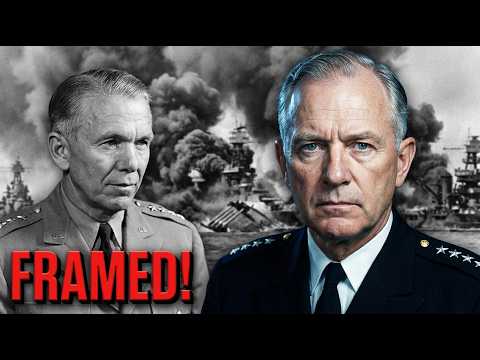
The next morning, at 7:53, the first wave of Japanese aircraft appeared over Pearl Harbor. At 7:55, the first bombs fell. Kimmel was standing at the window of his quarters when a neighbor came running across the lawn, pointing at the sky. He looked up. He saw the anti-aircraft bursts, the smoke rising from Battleship Row. He pulled on his uniform jacket and drove to his headquarters at full speed. When he arrived, he stood at the window and watched his fleet burn. A spent .50 caliber bullet came through the glass and struck him in the chest. It left a bruise but did not penetrate. Kimmel looked at it in his hand and said to the officer next to him that it would have been better if it had gone through him. He was not speaking carelessly. He was speaking as a man who already understood, in those first terrible minutes, that his career and his reputation were finished. He had spent 37 years building both. He would spend the rest of his life defending them against a verdict that had already been written by men who would never be held to the same standard.
To understand what was done to Husband Kimmel, you have to understand who he was before December 7th. Born on February 19th, 1882, in Henderson, Kentucky, he was the son of a career army officer. He entered the United States Naval Academy at Annapolis in 1900 and graduated seventh in his class of 62 in 1904. Seventh. Not in the middle, not near the top—seventh in a year when competition for class rank was ferocious and every position mattered for the assignments that would follow. His career over the next three and a half decades was a model of sustained professional achievement. He commanded destroyers, served on the staff of Chief of Naval Operations, commanded cruiser divisions and battleship divisions. He held every major sea command that an officer of his generation could hold. He was known throughout the Navy as an exceptional administrator and an aggressive, innovative tactical commander. He was blunt, demanding, and occasionally difficult. He was also consistently right about the things that mattered.
When a naval board evaluated the fleet’s readiness exercises in 1940, Kimmel’s forces performed better than any comparable unit in the Pacific. The evaluators noted it explicitly. His record was not good. His record was exceptional. In February of 1941, Chief of Naval Operations Harold Stark recommended Kimmel for promotion over 32 more senior admirals to command the Pacific Fleet. Franklin Roosevelt approved the recommendation. Kimmel raised his four-star flag over Pearl Harbor on February 1st, 1941. He was 58 years old, at the absolute peak of a career that had demanded everything he had. He immediately set about driving his fleet harder than it had ever been driven. He extended training schedules, pushed his captains to complete readiness exercises under conditions as close to actual combat as peacetime regulations permitted. He wrote a series of letters to Admiral Stark in Washington, asking repeatedly and specifically for more resources, more intelligence, and more clarity on the Japanese threat. The letters were polite but insistent. He wanted long-range patrol aircraft to extend his reconnaissance coverage beyond the current range. He wanted more destroyers. He wanted better and more current intelligence on Japanese fleet movements. He was not a passive commander waiting for orders. He was a man who understood the threat and was fighting the bureaucracy to get what he needed to meet it.
The bureaucracy did not give him what he asked for, but far more critically, the bureaucracy did not give him what it already had.
The Magic program had been reading Japanese diplomatic traffic since September of 1940. American cryptanalysts, working in absolute secrecy, had broken the Japanese Purple diplomatic cipher and were producing decrypted intercepts of the highest sensitivity. The intelligence this program generated was considered so valuable and so vulnerable to compromise that the distribution list was kept extraordinarily tight. It included the president, the secretary of state, the army chief of staff, General George Marshall, and the Chief of Naval Operations, Admiral Harold Stark. It included senior officials at the War and Navy Departments in Washington. It did not include the commanders in the field. General Walter Short, the army commander in Hawaii, did not receive Magic intercepts. Kimmel did not receive them. The two officers most directly responsible for the defense of Pearl Harbor were reading a different picture of reality than the men sitting in Washington.
Throughout the autumn of 1941, the Magic intercepts were drawing an increasingly precise and alarming picture of Japanese intentions. By late November, the picture was no longer ambiguous. On November 26th, Secretary of State Cordell Hull delivered an ultimatum to the Japanese government that both sides understood ended any realistic prospect of a negotiated settlement. On November 27th, the War Department and the Navy Department sent war warning messages to their commands in the Pacific. Kimmel received a message from Stark that told him negotiations with Japan appeared to be terminated, that an aggressive move by Japan was expected within the next few days, and that he should execute an appropriate defensive deployment. The message was genuine in its warning, but it was also incomplete in a way that mattered enormously. It did not tell Kimmel that American intelligence had specific indications of where the first Japanese blow would fall. It did not tell him about the series of intercepts that had led analysts in Washington to specific conclusions about Japanese carrier movements. It did not tell him that the Japanese consulate in Honolulu had been asked by Tokyo to divide Pearl Harbor into sections and report on the exact berthing positions of American warships. Kimmel knew none of this. He received a warning that told him to be ready for an attack, but not where the attack would come from. He assessed the most likely threat as a Japanese move against the Philippines or Malaya. Hawaii, he and his staff believed, was not the primary target. He was wrong. But he was wrong because the men in Washington who knew more than he did chose not to tell him what they knew.
On December 6th, the 14-page Japanese message was decoded and read by the men on the Magic distribution list. Roosevelt said it meant war. His military advisers agreed. The question that followed was immediate and obvious: should the commanders in Hawaii be warned that an attack was imminent? General Marshall decided to send a warning the following morning, December 7th. He chose to send it by commercial telegram rather than by the military’s own high-priority radio circuits because, he said later, he did not want to tip off the Japanese that the Americans were reading their communications. The telegram was dispatched at approximately 11:50 in the morning, Washington time. It arrived at the RCA Telegraph Office in Honolulu at 7:33 in the morning, local time. That was 20 minutes before the first Japanese aircraft appeared over Pearl Harbor. The messenger who was supposed to deliver it could not reach Kimmel’s headquarters through the chaos of the attack. He ended up in a ditch during the bombing. The telegram was delivered to a military officer at approximately 2:50 in the afternoon on December 7th, 1941. The attack had been over for hours. The battleships were already on the bottom of the harbor.
Ten days later, Husband Kimmel was relieved of command. He was told to make himself available for the investigation that would follow. He was told that his relief was a matter of operational convenience. He was told that the investigation would determine responsibility fairly and fully. He believed them. He should not have believed them because the investigation that followed was not designed to find the truth. It was designed to find a man to blame. And they had already chosen the man before the investigation began.
The Roberts Commission began its work on December 18th, 1941. Justice Owen J. Roberts, appointed by Roosevelt to chair the inquiry, arrived in Hawaii with a team of four military officers. They had a mandate, a deadline, and an outcome that had already been determined before they boarded the aircraft. The commission spent 17 days gathering testimony, interviewed 266 witnesses, and produced a 40-page report. When that report was released in January of 1942, it concluded that Kimmel and General Walter Short had committed—in the commission’s precise words—dereliction of duty. Not negligence. Not error of judgment. Dereliction of duty. The most damaging phrase in the military vocabulary short of outright treason.
What the Roberts Commission was never shown was the Magic intelligence. The entire body of intercepted and decoded Japanese diplomatic traffic. Justice Roberts himself later acknowledged under oath that he had not been aware of the Magic intercepts during the investigation. He said that had he known about them, the findings would have been different. Different findings. Think about what that means. The commission evaluated Kimmel’s response to a threat picture while being kept ignorant of the full threat picture that existed at the highest levels of American government.
Kimmel was not permitted to present a full defense. He was not represented by counsel. He was not informed of the specific charges against him in advance of his testimony. He sat before Justice Roberts and a panel of generals and admirals, answered their questions as honestly and completely as he could, and left the room without knowing that the evidence that would have supported his position most powerfully was locked in a safe to which neither he nor his accusers on the commission had access.
The Army and Navy both initiated their own investigations in 1944. The Army Pearl Harbor Board found that General George Marshall had failed in his fundamental duty to keep the commanders in Hawaii adequately informed. Specifically, it found that Marshall’s decision to send the December 7th warning via commercial telegram rather than military radio was, in the board’s language, not in keeping with the importance of the message. The Navy Court of Inquiry exonerated Kimmel. It found that he had acted reasonably and professionally on the basis of the information he had been given, and that the information he had been given was critically and inexcusably incomplete through no fault of his own. Both reports were classified. The American public did not see them.
Kimmel requested a court-martial. He wanted a formal military trial where the full record could be examined, where he could confront his accusers under oath, where the classified evidence could be placed before a proper judicial proceeding. He was certain that a court-martial, conducted properly, would produce a different verdict than the Roberts Commission. He was almost certainly right about that, which is precisely why the court-martial was never held. The Judge Advocate General of the Navy reviewed the Navy Court of Inquiry’s findings and recommended that Kimmel be brought before a general court-martial. That recommendation went to the Secretary of the Navy, James Forrestal. Forrestal decided that the proceedings should be deferred until after the conclusion of the war. After the war ended, the political calculation became clear. A court-martial of Kimmel in 1945 or 1946 would have required the government to explain in open proceedings why the commander of the Pacific Fleet had not been given access to Magic intelligence. The court-martial was never ordered. Kimmel was never formally charged. He was never formally acquitted. He existed in a legal and reputational limbo that the American military justice system had created specifically to avoid having to resolve the contradiction between the public record and the classified one.
He retired from the Navy in March of 1942. He was 59 years old. He moved to Groton, Connecticut, where he worked for a private company for several years. He wrote a memoir published in 1955 titled Admiral Kimmel’s Story. He gave speeches. He granted interviews. He corresponded with historians and former officers who shared his conviction that the Roberts Commission findings were unjust. He never stopped. He never stopped because the alternative was acceptance, and acceptance of the Roberts Commission verdict was something he was constitutionally incapable of.
In 1995, the Department of Defense conducted a formal review of the Pearl Harbor investigations. That review, produced by Edwin Dorn, the Under Secretary of Defense for Personnel and Readiness, concluded that Kimmel and Short had been denied crucial intelligence that was available in Washington. That Washington’s failure to share that intelligence contributed directly to the conditions that made the attack possible, and that both officers were entitled to a degree of exoneration that the historical record had not provided. The Dorn report recommended that both men be posthumously advanced to their highest wartime ranks. Kimmel had died in 1968. He was 86 years old. He had spent 26 years as a private citizen fighting a verdict that had been written without the evidence that would have changed it. He died before the Dorn report. He died before the 1995 recommendation. He died before the United States Congress passed legislation in 2000 restoring his rank, legislation that President Bill Clinton declined to implement before leaving office. He died waiting for something that the American government has still, as of this day, never formally delivered.
His family has not stopped, either. His grandsons have testified before Congress. They have submitted petitions and legal briefs. They have given interviews and written articles. They have done everything that a family can do to seek official recognition of what the documented record now shows clearly. And the answer they have received from every administration across more than five decades is a version of the same thing: “Not yet.” “Not yet, Admiral.”
There is a message that the United States Navy says does not exist. Officers who handled it say it does. The officer who received it, transcribed it, and filed it spent the last two decades of his career and years of his retirement trying to prove it was real. Documents that would have confirmed it disappeared from Navy files during the investigations that followed Pearl Harbor. Whether that message existed, whether it was suppressed, and what it would have meant if it had been transmitted to Hawaii is the thread that runs through the deepest and most disturbing part of this story. The message is called “The Winds Execute.” It was part of a Japanese communication system designed to signal war intentions through seemingly routine weather broadcasts. In late November of 1941, American intercept stations decoded a Japanese transmission establishing the system. If Japan intended war with the United States, a future broadcast would contain the phrase “Higashi no kaze ame.” East wind, rain. American signals intelligence officers understood the code and were listening for it.
Captain Lawrence Safford was the head of the Navy’s communications intelligence section. He testified under oath before multiple investigations that on December 4th, 1941, three days before Pearl Harbor, his office received and processed a Winds Execute message. He testified that he personally prepared a summary of it and forwarded it through channels, and that it confirmed Japan’s intent to go to war with the United States. He testified that when he later looked for that message in the Navy’s files, it was gone. The file entry that would have confirmed its receipt was gone. The distribution record was gone. The Navy’s official position, maintained across every subsequent investigation, is that no Winds Execute message was ever received before December 7th. They say the message Safford remembered receiving was either a different transmission misidentified in memory or a fabrication of recalled experience under the stress of investigation. They say the files are complete, and that the absence of the message in the files is proof it was not received. Safford spent 20 years disputing that position. He gathered testimony from other officers who said they had seen the message. He documented inconsistencies in the official record. He wrote detailed technical analyses of the intercept procedures that supported his account. He was never able to prove his case definitively. He was also never convincingly refuted.
The dispute remains open in the scholarly literature to this day, and it matters because if Safford was right, then someone removed a document from official Navy files during an active federal investigation. That is not administrative error. That is obstruction. But the Winds Execute dispute, as significant as it is, was never the central question. The central question was simpler and more damaging. On the evening of December 6th, 1941, the American government possessed intelligence that indicated with extraordinary clarity that Japan was about to launch a surprise offensive. The President read that intelligence. The Secretary of State read it. The Army Chief of Staff and the Chief of Naval Operations had access to it. The Commander of the Pacific Fleet did not. At no point on the evening of December 6th or the morning of December 7th did any senior official in Washington pick up a telephone, encoded or otherwise, and call Hawaii to say, “Be ready. Something is coming tonight or tomorrow.”
Now consider the arithmetic of accountability. The Roberts Commission found that Kimmel committed dereliction of duty. The Roberts Commission was not shown the Magic intelligence. The Army Pearl Harbor Board found that Marshall’s conduct was deficient. The Army Pearl Harbor Board was classified. The Navy Court of Inquiry exonerated Kimmel and found Stark at fault. The Navy Court of Inquiry was classified. The public knew about the Roberts Commission. The public did not know about the boards and courts that contradicted it for years. This disparity was not accidental. The men who made the decisions about what to classify and what to release in 1944 and 1945 understood precisely what they were doing. Marshall was indispensable to the Allied war effort. Stark had been reassigned to London, but remained part of the senior command structure. Placing either man’s conduct before a public court-martial in the middle of the war or even immediately after it would have produced consequences that the War and Navy Departments found intolerable. Kimmel’s reputation was the price of avoiding those consequences. He was already removed from command. He was already the public face of the disaster. The Roberts Commission had already provided a verdict the public had accepted. The cost of using him as the narrative end point of accountability was relatively low compared to what a full public accounting would have required. The men who made this calculation were not acting with malice toward Kimmel personally. They were making a cold institutional judgment about what the nation could absorb in wartime. But they were also making that judgment using another man’s reputation as the currency without his knowledge or consent and without ever giving him the court-martial he had formally requested and that the law entitled him to demand.
Kimmel’s grandsons have testified before the Senate Armed Services Committee. Tom Kimmel, who served in the FBI for over two decades, has spent years assembling and presenting the documentary case for his grandfather’s exoneration. He has appeared before congressional committees. He has submitted detailed legal briefs. He has corresponded with Secretaries of Defense and Secretaries of the Navy. The response has been consistent. Officials express sympathy. They acknowledge the complexity of the historical record. They note that subsequent investigations have offered more nuanced assessments than the Roberts Commission. And then they do nothing. The official position of the United States Navy remains that the Roberts Commission’s findings reflect a considered and appropriate response to the events of December 7th. That position is increasingly difficult to defend as more of the primary record becomes available. Historians who have reviewed the full documentary record—including the Magic intercepts, the Army Pearl Harbor Board findings, the Navy Court of Inquiry transcript, the Clausen investigation records, and the Dorn Report of 1995—have broadly converged on a conclusion that differs substantially from the Roberts Commission. The consensus among serious scholars of the Pearl Harbor attack is that Kimmel was not given the intelligence he needed to make informed decisions about the defense of the fleet. That the failure to provide him with that intelligence was a failure at the Washington level. And that the Roberts Commission produced a verdict that served institutional and political purposes more than it served the historical truth.
The United States government has produced eight formal investigations of the Pearl Harbor attack. The conclusions of those investigations range from Kimmel’s complete condemnation to his substantial exoneration. The one that the American public was allowed to see in real time condemned him. The ones that produced more complex or exculpatory findings were classified, delayed, or ignored.
Husband Kimmel was buried at the United States Naval Academy at Annapolis in the same cemetery where the Navy buries its admirals. He is there among the men who commanded the institution that spent 60 years refusing to fully acknowledge what it did to him. His headstone bears his name, his rank, and the dates of his life. It does not say what he wanted it to say. It does not say what the evidence now shows. It says what the Navy permitted it to say. His grandsons are still asking for more. The government is still saying not yet. And the message that may or may not have disappeared from the Navy’s files in December of 1941 is still missing from the official record. Some things in the keeping of powerful institutions remain classified long after everyone who could be harmed by the truth is gone.
So here is the question that will not go away: if the evidence so clearly supports Kimmel, why has the United States Navy never formally cleared his name? What is it protecting—his legacy, or its own?
Report this article
Select a reason for reporting:






