August 1945. A city of 245,000 souls wakes under a serene sky. Housewives light charcoal braziers. High school students march in columns, demolishing houses to create firebreaks. A young private, newly arrived from Tokyo, stares out a barracks window and thinks he is bored. He wants to go home and make school notebooks. At 8:15 on the morning of August 6th, every clock in Hiroshima stops.
What happened between that quiet dawn and the moment a fireball of 300,000°C melted granite a kilometer away is the arc of an empire that believed it could remake the world in its image. This is the account of how that arc was built, how it shone with devastating force, and how it collapsed upon those who raised it.
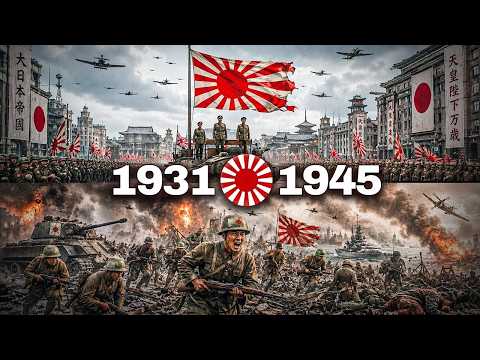
The Japanese perspective of World War II begins long before Pearl Harbor. It begins in the frozen fields of Manchuria, in the alleys of Tokyo brothels, in the classrooms of military academies where young officers learned that dying was more honorable than surrendering. On February 25, 1936, snow was falling on Tokyo. More than 30 centimeters had fallen in three days, breaking a 54-year record. But what 1,400 soldiers were preparing that night had nothing to do with the weather.
They had a name for what they were about to do: Gekokujo—literally, those below dominating those above. A term coined in the 15th century when provincial lords ignored the shogun, and the shogun ignored the emperor. In the Japan of 1936, it had found new life.
The discontent had real roots. The Great Depression had shattered the rural economy. The price of raw silk, the country’s main export, had fallen more than 50 percent. Farmers in northeastern Honshu sent their sons to the cities because they could no longer feed them. Some went as far as selling their daughters to geisha houses for a few yen.
The young army officers—sons of these families of small landowners and merchants—saw the corruption of urban politicians, the scandals of the great zaibatsu conglomerates like Mitsui and Mitsubishi, and felt an indignation that had turned into doctrine. The nation was in the hands of traitors, and only a violent purge could restore the purity of the empire.
Ikki Kita had given them the gospel of that purge. His pamphlet, General Outline of Measures for the Reconstruction of Japan, circulated from hand to hand among the youngest officers. Kita mixed socialism with imperialism. Great fortunes were to be confiscated, political parties dissolved, and Japan liberated from dark powers to fulfill its historical mission of redeeming all of Asia from Western domination.
In the early hours of February 26th, the attack groups set out for their objectives. Lieutenant Kurihara burst into the official residence of Prime Minister Keisuke Okada at 5 a.m. In the darkness and chaos, his men shot dead the premier’s brother-in-law, Denzo Matsuo, mistaking him for Okada. The prime minister survived, hidden in a closet under a pile of dirty laundry.
The finance minister, Korekiyo Takahashi, a man of 74 who had begun his career as a footman and rose to preside over the Bank of Japan, was not so lucky. An officer emptied his pistol into him. Then another cut off his arm with a sword and stabbed him in the belly while shouting, “Tenchu! Divine punishment!”
Grand Chamberlain Canaro Suzuki was shot three times. One pierced his heart. The soldier’s bayonet was already at his throat when the admiral’s wife screamed, “Don’t do it.” And Captain Ando, who in the past had debated with Suzuki about necessary reforms and still secretly admired him, ordered them to withdraw. “Forgive us for this,” he told Mrs. Suzuki before leaving.
Count Nobuaki Makino escaped from a burning mountain thanks to his 20-year-old granddaughter Kazuko, who spread the sleeves of her kimono in front of the soldiers like a wall of silk. A soldier shouted, “Success!” and convinced the others to withdraw.
The rebellion lasted four days. The insurgents occupied the Ministry of War, the barracks neighboring the palace, and the Metropolitan Police Headquarters. But Emperor Hirohito, informed in detail from the first moment, labeled them mere murderers and demanded their immediate suppression. There was no ambiguity in his stance. “Send troops right now and suppress this matter.”
On February 29, the rebels surrendered peacefully. Nineteen were executed. Ikki Kita died by firing squad in August 1937. But the rebellion left something more lasting than blood in the snow of Tokyo. It proved the army was incapable of controlling itself and that the civilian government was too weak to impose itself.
In the following years, the military would consolidate its domination over the cabinet, the press, and Japan’s foreign policy through a simple mechanism. The army and navy had the constitutional right to appoint their own ministers. And if they withdrew those ministers, the cabinet fell. Any government that challenged military ambitions would be dissolved. There was no need for another rebellion. Gekokujo had found its institutional form.
On the night of July 7th, 1937, a Japanese company was conducting night maneuvers less than two kilometers from a large Chinese contingent near the stone bridge that Marco Polo had described in the 13th century as the most beautiful he had ever seen. When a bugle call signaled the end of the exercise, shots arrived from the Chinese lines. The Japanese responded. In minutes, the exchange ended. There was a single Japanese man missing.
Negotiation began, and both sides had already agreed it was a misunderstanding when a second burst fell upon the two Japanese companies from an unidentified direction. Who fired that second burst was never established with certainty. Some Japanese generals believed after the war that they had been agents of the Chinese Communist Party interested in provoking a total war between Chiang Kai-shek and the Imperial Army.
General Mao Zedong had written that autumn to his troops that the Sino-Japanese conflict was an excellent opportunity for the expansion of the Communist Party. The history of cross responsibilities remained unresolved, but the result was unequivocal. The Japanese army in northern China counterattacked, and before the week was out, Tokyo was sending reinforcements: two brigades of the Kwantung Army, one division from Korea, and three from the archipelago onto the ground of what was supposed to be a local solution.
It was not. The Marco Polo Bridge incident began the Second Sino-Japanese War, which the Tokyo government would never formally declare as a war to prevent American neutrality laws from cutting off the supply of raw materials. They called it the China Incident.
Shanghai fell in November 1937 after three months of brutal fighting in which the Chinese army resisted with more tenacity than expected. General Iwane Matsui advanced toward Nanjing, the capital, convinced that its capture would force Chiang Kai-shek to negotiate. On December 13th, 1937, Japanese troops entered Nanjing.
What occurred in the following weeks was recorded in the diaries of Japanese officers, in the letters of Western missionaries who remained in the city, and in the testimonies of Chinese survivors. The estimates most accepted by military historians place the number of Chinese civilians and prisoners of war murdered in what is known as the Nanjing Massacre between 100,000 and 200,000. Prisoners were used as bayonet targets, drowned, burned alive, or buried up to their necks before being decapitated.
General Matsui was convicted by the International Military Tribunal for the Far East in 1948. He was executed. The war in China lasted eight more years without a definitive resolution. The Japanese army controlled the cities and railway lines. The Chinese guerrillas controlled the countryside. Japanese troops needed constant new incorporations.
And to maintain the aggressiveness of the soldiers in the face of a war of attrition, instructors employed methods that an officer of the 14th Division, Tomminaga Sho, described decades later with chilling precision. The new recruits had to execute Chinese prisoners with swords or bayonets as the final step of their training. The instructor who taught him the technique, a second lieutenant named Tanaka, explained that without that experience, soldiers would not be capable of killing in combat.
“Everyone turned into demons in three months,” wrote Tomminaga. “Good sons, good fathers, good older brothers at home, brought to the front to kill each other.”
To finance and supply this endless war, Japan needed something it did not have: oil, rubber, tin, iron—all that was to the south. And toward the south, the Western colonial powers—Great Britain, Holland, France—held empires that the imperial army looked upon both as an obstacle and as an opportunity.
Admiral Isoroku Yamamoto measured exactly 1.60 meters, had broad shoulders and the barreled chest of a wrestler. He was missing two fingers on his left hand, lost in the Battle of Tsushima when he was a young midshipman in 1905. He spoke English fluently, had studied at Harvard, knew the oil fields of Texas and the automobile factories of Detroit. He had said publicly more than once that it was madness to go to war with the United States.
And yet, it was he who designed the plan to attack Pearl Harbor. His reasoning was that of a poker player, and Yamamoto was an obsessive player, capable of remembering the distribution of cards with the same precision with which he remembered Japanese idols. If war was inevitable, as the army seemed determined to make it, then the only viable strategy was to deal such a devastating blow at the beginning that the Americans, confronted with months of reconstruction before being able to counterattack, would accept a negotiated peace while Japan consolidated its dominion over Southeast Asia.
“If we fail,” Yamamoto told his operations chief, the eccentric Captain Kameto Kuroshima, “it is better that we abandon the war.” Kuroshima, known in the fleet as the foggy officer, worked out the details of the plan in his cabin for days, emerging wrapped in clouds of garlic, incense, and cigarette smoke.
The most precise details about Pearl Harbor were provided by Ensign Takeo Yoshikawa, a 29-year-old intelligence agent who lived in Honolulu under the alias Tadashi Morimura with the official rank of consular official. For months, Yoshikawa drove his car twice a week around the island of Oahu, visited the surroundings of the port every day, took mental notes on the movements of the fleet from a hill, and drew diagrams of the anchored ships while drinking sake with geishas at the Shunchuro restaurant, which offered a perfect view of the basin.
In the submarines near Mitsuku Bay on the island of Shikoku, dozens of young officers practiced torpedo attacks with two-man midget submarines. In Kagoshima, torpedo pilots flew at 7.5 meters of altitude between chimneys and telephone poles, rehearsing the topography of Pearl Harbor in the streets of a civilian city. Housewives complained to the barracks because the planes almost tore off the roof of the Hirano restaurant trying to impress the geishas.
On November 26th, 1941, the carrier strike force—Kido Butai in Japanese—put to sea from Hitokappu Bay in the Kuril Islands. Six aircraft carriers, two battleships, two heavy cruisers, one light cruiser, eight destroyers, and several support ships. A total of 360 planes. Local fishermen had been preemptively picked up by patrol boats so they could not see the fleet depart. Outgoing mail was confiscated. Captains received instructions to sink any neutral ship that crossed their path.
The fleet sailed in total radio silence toward the northeast, taking the northern route at 42 degrees north latitude, where no commercial ship sailed in November due to the heavy seas. Sailors held the fuel loads with their teeth through the stormy nights. Pilots played cards in the dark cabins, painted watercolors, wrote books. Fighter pilot Yoshio painted eight watercolors of a temple and organized a private exhibition for the officers of the Kaga. Feeling ashamed to do something so lacking in seriousness at such a serious moment, he was convinced he would not live to exhibit them elsewhere.
On November 26th, Secretary of State Cordell Hull delivered to the Japanese ambassadors in Washington a memorandum that demanded the withdrawal of all Japanese forces from China and Indochina as a condition for any agreement. Ambassadors Kichisaburo Nomura and Saburo Kurusu—the latter sent especially as reinforcement—knew that was impossible.
Admiral Nagano, chief of the naval general staff, summarized the situation before Prime Minister Tojo with one figure. The Navy consumed 400 tons of oil per hour. Reserves would last two years of war. If Japan did not act now, it could never act.
On December 1, 1941, at the imperial palace, Emperor Hirohito heard the presentation of the decision for war. Seated on the dais facing the long tables where the cabinet and high commands kept silence with heads bowed, he did not say a word. Then he withdrew. The declaration of war documents were presented to him for his seal. He signed them.
Historians have debated for decades the emperor’s role in this decision. Available evidence indicates he knew the plan to attack Pearl Harbor and approved it. In January 1946, he confessed to his grand chamberlain, Hisanori Fujita: “The emperor of a constitutional state cannot express himself freely in speech or action. When a decision is presented to me by legal procedure, I have no choice but to approve it, even if I consider it highly undesirable.”
The combined fleet received the coded signal on December 2: Niitakayama Nobore 1208. Climb Mount Niitaka on December 8. Mount Niitaka in Formosa was the highest peak of the Japanese Empire at 4,145 meters. It was code for attack as planned on December 8. In Honolulu, it was still December 7.
Before dawn on December 7, 1941, 353 Japanese aircraft—97 horizontal bombers, 135 dive bombers, 40 torpedo planes, and 81 fighters—came off the decks of six aircraft carriers in a sea with four-meter-high waves. The carriers listed between 12 and 15 degrees. Maneuvers were normally canceled when waves exceeded five degrees. There was no option to postpone.
Commander Mitsuo Fuchida, a veteran pilot of 3,000 flight hours in China, led the first wave. When he spotted the shores of Oahu at dawn, he saw the sun rise to his left, bright and red. The planes ahead of him were silhouetted in black against the red. Young torpedo pilot Jui, son of a farmer, had never seen a sunrise from the air. The scene seemed so romantic to him, so incongruent with what he knew was coming next, that he could not believe he was heading into Japan’s most important battle.
US Army radars on the northern tip of Oahu detected the formation at 7:06 in the morning. Privates George Elliot and Joseph Lockard, who operated the equipment at Opana Point, reported the largest signal they had ever seen to the only duty officer available, a training pilot named Kermit Tyler. Tyler assessed that it must be the 12 B-17 Flying Fortresses arriving from California that morning. “Don’t worry about it,” he said.
At 7:53, Fuchida transmitted the signal Tora, Tora, Tora—the signal that total surprise had been achieved. At 7:55, the first torpedoes penetrated the shallow waters of the basin and struck the battleship row. The destroyer Ward had already sunk a Japanese midget submarine at 6:51 in the morning, and the report had taken 40 minutes to reach general staff. By the time Admiral Kimmel was notified, the first bomb was already falling.
In 90 minutes, two attack waves sank or severely damaged eight battleships, three cruisers, three destroyers, and 188 aircraft. 2,403 Americans died. The Imperial Japanese Navy lost 29 aircraft, five midget submarines, and 65 men. But the three aircraft carriers of the Pacific Fleet were at sea that morning, and the oil refineries, fuel depots, and shipyards of Pearl Harbor remained intact. Admiral Nagumo, concerned about the possibility of counterattacks, ordered the carriers to withdraw without launching a third wave that could have destroyed those facilities.
Yamamoto aboard the Nagato in the Inland Sea learned of the attack by radio. He had spent the afternoon playing Japanese chess with his favorite officer, Commander Yasuji Watanabe. He won three out of five games. When the news of the success arrived, there was no celebration in his cabin. Yamamoto composed a poem of 31 syllables: “It is my only desire to serve the emperor as his shield. I will not spare my honor nor my life.”
He also wrote to a friend: “I find myself in a strange position, having to make a decision diametrically opposed to my personal opinion, with no choice but to move full speed ahead in its execution. Is that also fate?”
In Washington, President Roosevelt announced the infamy before Congress. The next day, the United States declared war on Japan. Hitler, honoring the Tripartite Pact, declared war on the United States on December 11th. What had begun as a regional conflict in Asia had become a world war.
On the same December 8th that marked Pearl Harbor, Lieutenant General Tomoyuki Yamashita landed three divisions on the northeast coast of the Malay Peninsula, promising to take Singapore in 70 days. Colonel Masanobu Tsuji—the god of operations—had personally flown over the Malayan jungle to photograph British airfields, concluding that a law star and Kota Bharu had to be taken in the first hours at any sacrifice.
Yamashita had 70,000 men. The British, commanded by General Arthur Percival, had a garrison of 85,000 in Singapore, but most were poorly trained auxiliaries. The immense 15-inch guns pointing to the sea could not turn toward land. Singapore was impregnable by sea, but practically defenseless from the north.
His troops advanced by bicycle. When a tire was punctured, they continued on the rims. The screeching of thousands of airless tires on the tropical asphalt sounded to the British like approaching tanks. On February 15th, 1942, exactly within the promised time frame, Percival sat across from Yamashita in the Ford factory near Bukit Timah.
Yamashita asked if there was unconditional surrender. Percival hesitated. Yamashita grew impatient and interrupted him with a bang on the table. “Yes or no?” The British general looked down. “Yes.” More than 130,000 British, Australian, and Indian soldiers surrendered—the largest military capitulation in the history of Great Britain.
Churchill, informed by telephone at dawn, replied, “They have been beaten.”
Report this article
Select a reason for reporting:






