By the end of January 1945, Berlin was a city on the brink of collapse. The air raid sirens wailed twice a night, their shrill cries a grim lullaby for a population already numb with fear. Refugees from the east poured in, their eyes hollow, their voices trembling as they whispered of unspeakable atrocities at the hands of the advancing Red Army. The Eastern Front was collapsing, and panic spread like wildfire through the rubble-strewn streets.
Among the ruins, rumors swirled. Common soldiers clung to the desperate hope that the Soviets would only execute officers and SS men. Civil servants and workers tried to convince themselves they would be spared. But the most reliable information didn’t come from official channels—it came from railway workers, who often knew more about enemy movements than the high command itself. As the war progressed, more and more Germans risked listening to BBC broadcasts, knowing that a single report to the Gestapo could send them to a concentration camp.
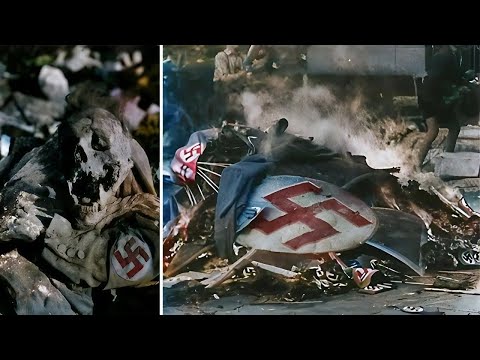
Urban transportation was paralyzed, forcing workers to navigate mountains of debris daily. Some improvised shelters near their workplaces, while others relied on sleeping bags as essential as coats. Portable beds multiplied in the homes of those hosting relatives fleeing from the east or who had lost everything in the bombings. Escape plans circulated among those with contacts or resources, fueled by horrifying stories of property owners summarily executed by Soviet troops in East Prussia. “Don’t come back. Stay where you’re going,” colleagues quietly advised those with legitimate reasons to leave.
Most people fantasized about finding refuge in some remote village where farms still had food reserves. Some, in desperation, considered obtaining false documents, making foreign diplomats unexpectedly popular. Ministerial workers were relocated to the south, benefiting from their positions. But the most feared threat was the wave of executions ordered by Himmler and carried out by the SS. On January 23rd, as Soviet forces crossed the eastern borders of the Reich, several opponents involved in the July 20th plot were executed at Plötzensee. Among them were Count Helmuth James von Moltke, Eugen Bolz, and Erwin Planck, son of the famous physicist Max Planck.
In that climate of repression, Goebbels launched a new slogan: “We will win because we must win.” For those who did not follow the Nazi ideology, this slogan only provoked despair and rejection, though most citizens didn’t dare question it. Even when defeat seemed inevitable, many clung to the idea of a final victory, more out of fear and resignation than conviction. Goebbels’s propaganda machine, designed to eliminate all notion of an alternative, had managed to impose the illusion that there was no other possible destiny for Germany than to fight to the last breath.
Goebbels, in his dual role as Minister of Propaganda and Reich Commissioner for the Defense of Berlin, moved about with ease and enthusiasm as the leading spokesperson for total war. He kept appearing at public events, inspecting Volkssturm ranks, giving fiery speeches, and making propagandistic visits to the troops, reinforcing his image as an active leader. Meanwhile, Hitler’s figure became increasingly distant to the population. His absence in the newsreels was evident, and the last time many had heard him was in his radio message on January 30th, commemorating the 12th anniversary of the Nazi regime. However, his voice no longer inspired fear or determination. It sounded muted, unrecognizable. This fueled a wave of rumors claiming he was dead or had been captured.
The regime never clarified whether the Führer was at his Berchtesgaden retreat or still hiding in Berlin. Meanwhile, Goebbels, present in the city and among the civilians suffering the effects of the bombings, was reinforcing his popularity. Hitler, in contrast, seemed to be avoiding his devastated capital, refusing even to contemplate the disaster it had become. The brutal fate awaiting German civilians was just beginning, and in places like Breslau, the tragedy reached unbearable levels.
With the unstoppable advance of the Red Army and the tanks of General Lelyushenko, the city was plunged into panic. Although it’s not known for certain whether some refugees died aboard sunken ships during the escape, what is documented is the suffering of thousands of women and children who tried to flee on foot in the middle of winter. Men who had not yet been enlisted into the Wehrmacht were mobilized by the Volkssturm to defend the city, leaving their families behind. Thus, mothers were left alone, driven by desperation, while loudspeakers patrolled the streets, urging people to evacuate immediately.
Those who failed to board the overcrowded trains had to set off on foot with their children in their arms, relying on promises of aid from the NSV, the Nazi party’s welfare organization. They carried backpacks with powdered milk, blankets, and thermoses filled with hot milk, trying to protect their babies from the extreme cold. But upon reaching the city’s outskirts, the reality was devastating. They were alone. Hardly any vehicles were running, and most had to walk along snow-covered roads. Exhausted, mothers ended up abandoning their baby carriages and carrying their children directly in their arms. The freezing wind turned the contents of the thermoses into icy liquid, and feeding the infants became a desperate task.
Many tried to breastfeed in sheds or behind walls, any shelter from the wind. But the cold was relentless. Milk would no longer flow, and mothers’ bodies began to lose heat at an alarming rate. Some suffered frostbite on their breasts. In a letter sent by a young mother to her own mother, she anguishedly described how her child died of hypothermia and how other women wept while holding the lifeless bodies of their babies. Along the roads were silent figures, mothers sitting in the snow with small children around them, trembling, not knowing whether their mother was still alive or had died from exhaustion and cold. In such extreme conditions, the difference between fainting and dying became imperceptible. This was no evacuation. It was the beginning of a calvary.
The punishment against the Germans at the hands of those who had suffered years of occupation and repression reached levels of unleashed violence. Such was the thirst for revenge among Polish ranks that it had even provoked concern within the Soviet apparatus. General Ivan Serov, head of the NKVD assigned to the First Belorussian Front, sent a report to Lavrentiy Beria warning that the behavior of Polish troops was seriously hindering military intelligence work. According to his report, soldiers of the First Polish Army treated German prisoners with uncontrolled brutality. In many cases, those captured never reached the designated holding areas. One of the most extreme examples occurred in the sector of the Second Infantry Regiment of the First Division. There, 80 Germans were captured alive, but only two reached the facilities intended for prisoners. The rest were summarily executed along the way.
The massacre wasn’t limited to impulsive acts in the heat of battle. Even after preliminary interrogations, when the prisoners were being taken to the intelligence officer for formal questioning, they were shot before arriving. This pattern was not an isolated case, but part of a relentless cycle of collective punishment. For the Poles, who had seen their cities destroyed and their population massacred by the Germans, there was no room for forgiveness, only violence as a response to years of horror.
On the Eastern Front, the fury of the Red Army swept away everything in its path. From Königsberg to Vienna, the Soviet troops advanced, intoxicated by a mixture of victory, revenge, and hatred. For millions of Soviet soldiers, this was a campaign of personal justice, a retaliation for the razed villages, murdered brothers, and cities burned by the Wehrmacht. But that justice soon turned into indiscriminate cruelty.
The mass rapes were not limited to Berlin. They occurred in nearly every German city and village occupied by the Soviets. In Silesia, Pomerania, and East Prussia, atrocities were recorded that today are barely mentioned in school textbooks. In many villages, not a single woman remained unviolated. Several renowned historians have claimed that collective rape became a symbolic and systematic punishment. It was such a widespread phenomenon that even high-ranking Soviet commanders privately acknowledged the severity of the situation. Nevertheless, the political leadership in Moscow allowed it. Stalin’s conquest over the Third Reich had to be imprinted on the bodies of its citizens.
But it wasn’t only women who suffered. In many cases, German civilian men, elderly, and teenagers alike were summarily executed without trial. Other times they were deported eastward to forced labor camps in the Soviet Union. Many of them would never return. Children also did not escape the brutality. Some were killed alongside their parents, and others who had been orphaned during the war or after the occupation were abandoned in orphanages without identity or homeland. Families were dissolved between columns of smoke and columns of soldiers.
In East Prussia, hell took the form of an exodus. Coastal cities like Pillau and Danzig filled with refugees trying to board ships heading west, fleeing from the Red Army. But many did not succeed. Trains were bombed, ships were sunk, roads were blocked by ice or corpses. Some froze to death. Others were shot by Soviet soldiers. Those who survived did so with mutilated souls.
In the West, the Allied occupation was different. And although it is often portrayed as a more civilized process, it was not free from violence. The American, British, and French forces found a country in ruins, although the treatment was less brutal than in the east. Revenge was not absent. Internment camps were established for Germans accused of collaboration or mere Nazi sympathy. In many cases, without trial or evidence, they were denied food, medical assistance, and human dignity. One of the darkest episodes was that of the Rheinwiesenlager camps, which we will discuss later.
In France, the situation was even more humiliating for some Germans. Colonial troops from subsaharan Africa integrated into the French army were deliberately deployed in German areas to punish the population. Numerous testimonies collected by the Red Cross and war correspondents describe rapes, looting, and abuse. In Stuttgart and other cities, hundreds of women were attacked. The French authorities rarely intervened. The Allied doctrine assumed that the German people had to be re-educated from scratch. This included press censorship, school indoctrination, and the removal of symbols. But it also meant collective humiliation.
German children were forced to watch films about the concentration camps. Entire populations were forced to bury the corpses of Holocaust victims. All of this was aimed at instilling a perpetual sense of guilt. But the line between justice and revenge is fragile. In many towns in southern Germany, American soldiers organized forced parades of civilians past mass graves. In others, they placed signs that read, “Here died the true Germans.” The psychology of the defeated was not rebuilt. It was demolished.
Women who had been raped found no understanding. They were stigmatized, called collaborators, or simply ignored by their neighbors. Many fell into silence, unable to verbalize the trauma. Men who returned from the front or from the camps found neither home nor honor. They were ghosts in a country in ruins. And yet the machinery of revenge did not stop because beyond the decisions of governments, rage was embedded in the hearts of the peoples. The postwar violence was the dark echo of Nazi violence, a repetition without redemption.
Across the continent, Germans were now the universal enemy. Even those who had been persecuted by the Nazis, even the children born in 1945. The notion of justice became confused with that of collective punishment. What began as liberation ended for many as a perpetual condemnation.
Along the Rhine, between April and September 1945, the Western Allies established the Rheinwiesenlager—open fields of barbed wire where over a million disarmed German soldiers were held without Geneva protections. “They were our brothers, our fathers, our sons,” recalled a village woman who watched guards stomp on bread thrown over the fences. Estimates of the dead range from 3,000 to 90,000.
Then came the expulsions: 12 to 14 million Germans driven from lands their families had held for centuries. The Wilhelm Gustloff sank with over 9,000 aboard; the Benes decrees stripped citizenship and property; the death march from Brno left thousands in roadside graves. In Dresden, Hamburg, and Pforzheim, Allied bombs killed tens of thousands more.
When the rubble settled, it was the Trümmerfrauen—the women of the ruins—who rebuilt Germany stone by stone, unpaid and unremembered. Their monument is the country itself.
And so the pendulum of cruelty swung until it stopped, leaving behind a question that still haunts our textbooks: if memory must include all victims, why do we still choose which suffering to remember?
Report this article
Select a reason for reporting:






