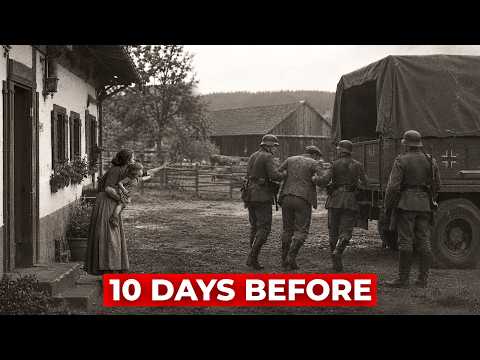
Wilm Hosenfeld was 44 in the summer of 1939, a village schoolteacher with a wife, five children, and a wound from the last war. On August 26, six days before Germany invaded Poland, he was mobilized as a sergeant of the reserve. He was one of thousands of men taken from their families in the last ten days before the war—men who would leave behind jobs, wives, and children, and step into a conflict that would consume the world.
By the time Hosenfeld reported for duty, the question of war had already been settled. On August 22, 1939, exactly ten days before the invasion, Adolf Hitler gathered his senior commanders at his mountain home in Bavaria. “The favorable circumstances Germany enjoyed would not last another two or three years,” he told them. “Better a conflict now.” He spoke twice that day, and notes of both speeches were later found in the headquarters of the German armed forces high command. Hitler had made up his mind.
The next day, his foreign minister, Joachim von Ribbentrop, was in Moscow. The pact he made with the Soviet Union carried that date, although it was actually signed on the 24th. It was a non-aggression pact, and it came with a secret protocol that divided Poland between the two dictatorships. Everything east of the rivers Pisa, Narew, Vistula, and San would go to the Soviet Union, and Germany would take the west. The attack itself was set for 4:00 in the morning on August 26—the same day Hosenfeld was mobilized.
Then on the 25th, Britain signed a military alliance with Poland, and Hitler hesitated. He pushed the invasion back to September 1. Not everyone got the message. Late on the evening of the 25th, a small German Abwehr unit led by Lieutenant Hans-Albrecht Herzner set off from Slovakia to seize a vital railway tunnel on the Polish side of the border. Nobody had told them the attack was off. At around 4:00 in the morning on the 26th, they reached the station at Mosty and opened fire on the building. In its basement, a female telephonist raised the alarm. Polish troops drove the Germans back with machine gun fire, and by around midday, they had withdrawn. Shots were being fired a week before the war officially began by men who didn’t know it had been postponed, and the tunnel they had come for never fell into German hands. On September 1, the Polish Colonel Władysław Peszell had it blown up.
Behind all of this sat a plan that had been in place since the previous winter. The German army’s mobilization plan of December 8, 1938, raised its divisions in waves, and three of those waves were raised in the run-up to the invasion of Poland. The second wave was 16 divisions. The fourth, 14 more, was formed from training units. And the third wave alone was 22 divisions, taking in men born between 1901 and 1913 who needed refresher training before they could be sent to fight. In the summer of 1939, those men were between about 26 and 38 years old. These were grown men. At that age, many of them had jobs, wives, and children. And in the last days of August, they left all of it behind.
Hosenfeld was older than most of them. He was born on May 2, 1895, the son of a Catholic schoolmaster, and he followed his father into teaching. In the First World War, he fought as an infantryman from 1914 to 1917 in Flanders, in the Baltic, and in Romania until he was badly wounded. He came home with the Iron Cross Second Class. He married Annemarie Krummacher, a woman who is said to have pulled him towards pacifism, and together they had five children. He taught in Rosbach, in Kassel, and finally in Thalau, and by 1939 he was the head teacher there. He was not a man who stood outside the system. As a young man, he had been part of the Wandervogel Youth Movement, and through it he went into the SA, the Nazi party’s brown-shirt militia. In 1935, he joined the Nazi party itself, and he attended the party rallies at Nuremberg in 1936 and 1938. But by 1938, he was already expressing unease at the regime’s attacks on religion. Over the years that followed, those doubts would grow into something much stronger.
Then came August 26, 1939. Hosenfeld was mobilized as a sergeant of the reserve at 44, a veteran of one world war being sent to another. His unit was held at first in the town of Fulda. From there it went east, and he arrived in occupied Poland with a territorial defense battalion. He would spend the rest of the war in Poland. He would also write—through all those years he kept a diary, and he wrote letter after letter to Annemarie. Six decades later, in 2004, the German military’s own history research office published them in full under the title I Try to Save Everyone.
In Cologne, a much younger man was getting ready to leave home, too. Hinrich Böll came from a Catholic family with pacifist leanings that opposed the Nazis. In the 1930s, he refused to join the Hitler Youth. He had trained as an apprentice to a bookseller, and in November 1938, he was sent into the compulsory labor service. Then in April 1939, he finally enrolled at the University of Cologne to study German and classics. He got four months. On August 5, 1939, a call-up order arrived telling him to report for military service on September 4. He never reached that date as a civilian. On August 28, four days before the invasion, the 21-year-old walked into the Winkelhausen barracks in Osnabrück. On September 3, he was sworn in as a private soldier of the Wehrmacht, and he would stay in that training camp until May 1940. Over the next six years, he would serve in Poland, France, Romania, Hungary, and the Soviet Union.
Böll never forgot the moment that piece of mail arrived. In 1951, he turned it into a short story called Die Postkarte—The Postcard—built around a call-up notice delivered with an official registered mail stamp. And like Hosenfeld, he wrote home almost every day for the rest of the war. Most of his letters went to Annemarie Cech, the young woman he would marry in 1942. They were later published as Letters from the War 1939–1945. So two of the men who left home in that last week of August ended up pouring their war into letters to a woman named Annemarie. They were part of a flood of mail. During the Second World War, the German field post carried up to 40 billion letters and parcels between the front and home, against roughly 28 billion in the First World War. For the families, what a letter said often mattered less than the fact that it had come at all. One soldier opened a letter to his wife by telling her he had to send her another sign of life that day.
From March 1940, the army ran censorship offices, but they could read less than 1% of the mail, and most soldiers simply censored themselves. For the families they left behind, the war arrived in the kitchen before it arrived on the radio. In the last week of August 1939, days before the invasion, the government introduced ration cards by decree. The cards were printed on pink watermarked paper with a main section and 72 smaller coupons for the rationed goods. Each card was valid for four weeks. When people bought their food, shopkeepers tore off the matching coupons, collected them, and sent them to the food authorities in order to be allowed to order new stock. In a house where the husband had just left for the barracks, a pink card now decided how much of the basics the family could buy.
On the night of August 31, the regime gave itself its excuse. As part of a wider SS scheme known as Operation Himmler, SS men in Polish uniforms led by Alfred Naujocks, on orders from Reinhard Heydrich and the Gestapo chief Heinrich Müller, seized the German radio station at Gleiwitz and broadcast a short anti-German message in Polish to make it look like the work of Polish saboteurs. The Gestapo left a body at the scene. It was Franciszek Honiok, a 43-year-old farmer who had been arrested the day before, drugged, and shot. Prisoners from the Dachau concentration camp were also drugged and shot at the site, their faces disfigured so they could not be identified. The SS had a code word for these victims. They called them “canned goods.”
On the morning of September 1, the American journalist William Shirer drove through Berlin to make his first radio broadcast of the day, and he found the people in the street apathetic. Later that day, Hitler went before the Reichstag. He told the deputies, “We have been returning the fire.” It was not even the right time. The first shots had been fired about an hour earlier, at around 12 minutes to 5, by the German battleship Schleswig-Holstein. Hitler also announced that from now on he was simply the first soldier of the German Reich and that he would not take off his uniform coat again until victory or death. Shirer noticed there was much less cheering in the Reichstag than on earlier, less important occasions, and his colleague Jordan whispered that it sounded like Hitler’s swan song. By evening the whole city was blacked out, and at 7:00 Berlin had its first air raid alarm.
Here’s a question for you: If you had been one of the families left behind in August 1939, with a husband or a son suddenly gone and a pink ration card on the kitchen table, what would you have feared most? Let me know in the comments below. Because for more than 16,000 of those families, the answer came within five weeks. The invasion of Poland began on September 1, 1939, and lasted 35 days until October 6. Germany sent in 66 divisions. By the end, 16,343 German soldiers had been killed, 30,300 had been wounded, and around 3,000 were missing. Within five weeks, more than 16,000 German families had lost a son, a husband, or a father. And the letters those families had sent to the front could come back to them, marked with words like fallen for the fatherland.
Poland paid far more. Around 66,000 Polish soldiers were killed in the campaign. More than 133,000 were wounded, and roughly 690,000 were taken prisoner. On September 17, 16 days after the German attack, the Soviet Union invaded Poland from the east, just as the secret protocol had arranged. This was a war of conquest, and Germany had started it. In Warsaw, a pianist named Władysław Szpilman was still playing on Polish radio. He had joined the station in April 1935, and by 1939, he was one of its best-known soloists. On September 23, the station was bombed. Shortly after, it broadcast his last Chopin recital. It would be years before he played there again.
Hosenfeld saw what the occupation meant almost at once. In November 1939, after witnessing the execution of Polish leaders and the expulsion of Polish and Jewish citizens, he wrote to his wife that he was sometimes ashamed to be a German soldier. For a time he was put in charge of a camp for prisoners of war at Pabianice. There he recorded his outrage at the rough treatment of Jewish prisoners. And against the camp’s own rules, he let the families of the prisoners come and visit them. It was a small thing. It was also the first sign of what he would do later.
Later in the war, Hosenfeld was based in Warsaw. Promoted to captain of the reserve in 1942, he ran the Wehrmacht Sports School and served as an intelligence officer. In Warsaw, he could see what was being done to Poland’s Jews. “We have lost the war with this appalling mass murder of the Jews,” he wrote in June 1943. He did more than write. He employed people the regime was hunting under false names, saved a priest from the SS, and hid two Jewish survivors on the school grounds.
Then on November 17, 1944, Hosenfeld found a man hiding in the attic of an abandoned building at number 223 on Podleji Avenue. It was Władysław Szpilman, the pianist from Polish radio. Hosenfeld asked him to prove it, and Szpilman played Chopin’s Nocturne in C minor. Hosenfeld did not report him. He gave him a coat and for several weeks brought him bread and jam. Szpilman never learned his name.
Two months later, Hosenfeld was taken prisoner by the Soviet army. Sentenced to 25 years in a labor camp, he died on August 13, 1952, half paralyzed, too ill even to write his own postcard home. In 1957, Szpilman visited Hosenfeld’s widow in Thalau. In 2008, Yad Vashem recognized Hosenfeld as Righteous Among the Nations. The man who left Thalau in the last days before the war never came home from it. In the end, the visitor who came to his family’s door was the man he had saved.
What do you think made Hosenfeld act when so many others looked away?
Report this article
Select a reason for reporting:






