Afghanistan, 2006. In the middle of a firefight, the most elite soldiers in the Australian military made a decision that could end their careers. They abandoned their American allies—not out of cowardice or panic, but because staying with them was a death sentence.
This is the story that has been buried in classified after-action reports for nearly two decades. A story so explosive that both governments tried to keep it out of the history books. Because this isn’t just about tactics—it’s about a rift so deep inside the coalition that it nearly cost lives on both sides.
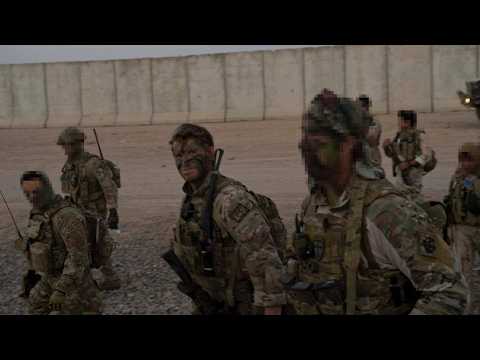
The Australian SAS—ghosts, silent killers trained to disappear into thin air and watch the enemy for weeks without being detected—versus the American war machine. Overwhelming firepower, helicopters, gunships, radios crackling across every frequency. Two philosophies of war, two brothers in arms, and one valley in Afghanistan where it all came crashing down.
Why did an Australian commander break protocol and split his patrol in the middle of enemy territory? What did Taliban intercepts reveal about how easily they could track coalition movements? And what dark secret would surface 20 years later that changes everything we thought we knew about Australia’s most decorated unit?
The scorching July sun of 2006 beat down relentlessly on the unforgiving rocks of the Kora Valley in Uruzgan province. An Australian Special Air Service patrol lay completely motionless in the dust, their camouflage blending seamlessly with the rugged terrain, watching through high-powered optics as their American allies crashed through the ridge line above them.
The contrast was agonizing. While the Australians had moved like ghosts—silent and invisible for days—the approaching American unit announced its presence with the subtlety of a sledgehammer. The sound of heavy boots pounding on rock echoed across the valley floor, carrying for kilometers in the thin mountain air. Radios crackled loudly with constant chatter, broadcasting their position to anyone with a cheap scanner.
Every instinct in the Australian commander’s body screamed danger. He knew the Taliban were watching from the shadows, listening to the cacophony and preparing their ambush with terrifying precision. The mission was supposed to be a joint operation, a symbol of coalition unity. But the reality on the ground was a disaster waiting to happen.
The Australian commander keyed his radio, his voice low but filled with absolute conviction: they were pulling out because the Americans were going to get them all eliminated. This was just the first crack in an alliance that would threaten to tear the entire war effort apart.
The Australian SAS Regiment has operated alongside American forces since the jungles of Vietnam, forging a bond in blood and fire. Created in 1957 and modeled on the legendary British SAS, the regiment built its reputation on three unshakable pillars: patience, silence, and long-range reconnaissance deep behind enemy lines. Their motto, Who Dares Wins, is not just a slogan—it is a way of life earned through sweat and sacrifice.
They were the phantoms of the jungle, the quiet professionals who could vanish into thin air and reappear only when it was too late for the enemy. Their origins date back to the Malayan Emergency, where they learned that a single snapped twig or a whisper could mean the difference between life and tragedy. In the dense humidity of Borneo during the confrontation with Indonesia in 1965, they perfected the art of the ambush and the silent kill.
During the Vietnam War, they solidified their terrifying reputation. While American forces relied on massive firepower, napalm, and helicopter assaults, Australian SAS patrols operated in the shadows of Phuoc Tuy province. They were so effective, so silent, and so deadly that the Viet Cong feared them more than entire battalions of regular infantry. They were known as the phantoms of the jungle—a moniker earned because they seemed to strike from nowhere and vanish before the enemy could even raise their rifles.
This legacy of absolute stealth became the DNA of the regiment, a sacred doctrine passed down from veteran to rookie. But the true test of any elite unit lies in its selection process—a crucible designed to break all but the strongest. Their selection course remains one of the most brutal and unforgiving military trials on the planet. For 21 agonizing days, candidates are pushed beyond the limits of human endurance. They must navigate hundreds of kilometers alone through the harsh Australian outback, carrying heavy packs with minimal food and water, stripped of all comfort and support.
The instructors, known as the cadre, are relentless in their scrutiny, looking for any sign of mental weakness or physical failure. Candidates are sleep-deprived, starved, and marched until their feet bleed and hallucinations begin. They are tested on their ability to make critical decisions while completely exhausted, to navigate complex terrain without technology, and to maintain the highest standards of discipline when no one is watching. The failure rate exceeds 90%—a staggering number that ensures only the absolute elite earn the sandy beret.
These men are not just soldiers. They are masters of survival, capable of operating in complete isolation for weeks on end. They are trained to be self-reliant, to solve problems with their minds first and their weapons second, and to endure conditions that would break an ordinary person in hours. However, the deserts of the Middle East would present a challenge that no amount of jungle training could predict.
By the time Operation Slipper began in 2001, the world had changed forever. The terror attacks of September 11th had triggered a global response, and Australia was among the first to answer the call. Australian SAS squadrons were mobilized and embedded with United States Special Operations Command across Afghanistan. They deployed on rigorous rotations, integrating with American, British, and Canadian special forces under the International Security Assistance Force.
Coalition planners in air-conditioned offices expected seamless integration between these elite units, assuming that professionalism would bridge any gap. They looked at the spreadsheets and saw two highly trained forces, both speaking English, both fighting the Taliban, and assumed they were interchangeable parts in a grand military machine. Both forces were battle-hardened and dedicated to the mission. Both shared identical strategic objectives and faced the same elusive enemy. But nobody expected the invisible wall that would rise between them on the battlefield.
The first tragic warning sign came on February 16th, 2002. Sergeant Andrew Russell became the first Australian soldier to fall in Afghanistan, losing his life when his vehicle struck a landmine during a patrol. His loss was a devastating blow—a stark reminder of the lethal environment they were operating in. It was a moment that hardened the resolve of the regiment, proving that this was not a peacekeeping mission, but a brutal kinetic war.
But as the war dragged on, a different kind of danger emerged—one that came not from enemy mines or ambushes, but from within the coalition itself. It wasn’t a lack of courage or competence on either side. It was a fundamental, irreconcilable difference in how they approached the very concept of warfare. Military records and veteran accounts reveal a doctrinal clash so severe it threatened coalition effectiveness across multiple provinces.
The Australian SAS operated on 72-hour insertion protocols, maintaining absolute radio silence and zero visible movement during daylight hours. Their philosophy was to become one with the environment—to see without being seen, to be a shadow in the mountains. They believed that information was the most powerful weapon on the battlefield, and that gathering it required absolute stealth.
American doctrine, forged in the fires of the Cold War and honed in different conflicts, emphasized something entirely different. They relied on speed, overwhelming firepower, and continuous coordination with air support. They believed in dominance through force, maintaining constant communication with command elements and supporting units. They operated under the assumption that they owned the air and the ground—and that any enemy contact could be resolved with superior firepower.
The difference in practice was stark and dangerous. Australian patrols could remain undetected 200 meters from enemy positions for days at a time, watching and waiting. They would dig in, camouflage so perfectly that an enemy fighter could walk within meters and never know they were there. They managed their waste, their noise, and their thermal signatures with obsessive attention to detail.
In contrast, American units, according to SAS field observers, announced their presence from kilometers away through sound, movement patterns, and electronic emissions. They moved in large convoys, their engines roaring, their radios broadcasting a constant stream of encrypted but detectable data. To the Australians who had spent decades perfecting the art of invisibility, this approach seemed almost suicidal in a guerrilla war.
And as the dust settled on the early years of the war, this tactical divide was about to turn into a full-blown crisis. The tension emerged almost immediately during joint planning sessions at Kandahar Airfield in late 2001. Australian SAS teams arrived expecting mission briefings conducted in secure, sound-dampened facilities with strict information control. They were used to compartmentalization—where only those who absolutely needed to know the details were briefed.
Instead, they found American planning rooms filled with chaos. Multiple radio frequencies broadcast simultaneously. Personnel moved constantly between workstations, and tactical coordination happened across open channels that anyone with appropriate clearance could monitor. It was a culture shock that rattled the Australians to their core. To them, operational security was a religion. To their allies, it seemed like a suggestion.
One SAS sergeant later described the disbelief in a detailed interview. He explained how his team would spend three weeks preparing a single insertion, studying every rock formation, every goat path, every village routine down to the minute details of daily life. They would memorize the terrain until they could navigate it blindfolded. Then they would brief with the Americans—who wanted to insert by helicopter at dawn with Apache gunship support standing by for immediate fire support.
It was a clash of precision against power, of the scalpel against the sledgehammer. But the doctrinal divide went far deeper than just noise discipline and tactical patience.
Australian SAS selection and training emphasized land navigation without GPS technology, survival on minimal rations for extended periods, and the physical and mental ability to remain static in observation positions for 18 hours without any movement whatsoever. Candidates learned to control their breathing, to lower their heart rate. They learned to manage pain from cramping muscles without shifting their weight. They learned to maintain focus despite extreme discomfort and fatigue, knowing that a single lapse in concentration could compromise the entire patrol.
American special forces training prioritized rapid assault techniques, close air support coordination, aggressive patrol methods, and quick reaction capabilities. Their expertise lay in direct action missions, hostage rescue, and unconventional warfare campaigns where speed and violence of action were paramount. Their philosophy extended to equipment selection and loadout configuration.
Australian SAS patrols carried sound-suppressed weapons as standard issue, used minimal electronic devices to reduce electromagnetic signatures, and wrapped every piece of kit in tape or cloth to eliminate noise from movement. Each patrol member carried exactly what they needed for the mission duration with no excess weight. They were light, fast, and silent.
American loadouts included standard-issue rifles, multiple radio systems for different communication nets, infrared markers for air support and identification, and equipment optimized for firepower and communications capability over stealth and silence. They carried the weight of a superpower on their backs, ready to call down thunder at a moment’s notice.
How do you fight a shadow war when your ally’s tactics fundamentally contradict everything you have trained for? This was the question that haunted every Australian commander in the field. They respected their American counterparts’ bravery and firepower, but they feared their noise. They knew that in the mountains of Afghanistan, noise was death. This fundamental disconnect would soon lead to a series of confrontations that would force commanders to rewrite the rule book on joint operations.
The silent professionals were about to clash with the masters of firepower, and the results would change the course of the war in Uruzgan province forever. March of 2002 would become the month that changed everything. The Shahi-Kot Valley, a jagged scar in the Paktia province, was about to become the stage for Operation Anaconda—the largest combat operation in Afghanistan since the Battle of Tora Bora.
Intelligence reports estimated that more than 500 hardened al-Qaeda and Taliban fighters had dug into the mountains, turning the valley into a fortress of caves and fortified positions. It was a target-rich environment that coalition commanders had been dreaming of—a chance to strike a decisive blow against the insurgency. But behind the scenes, another battle was already raging—not with bullets, but with words and maps in the planning rooms.
For the Australian SAS commanders, the approach was obvious. They proposed a methodical slow-burn infiltration. Their plan involved small teams moving on foot under the cover of darkness, advancing approximately 800 meters per night. They would establish covert observation posts high in the mountains, invisible to the enemy below. From these perches, they would build a complete pattern-of-life analysis, documenting movement schedules, supply routes, and leadership meetings for two weeks before a single shot was fired. It was a classic special reconnaissance strategy: see everything, know everything, and then strike when the enemy is most vulnerable.
But the American operational plan was a sledgehammer to the Australian scalpel. US commanders called for an immediate high-impact insertion via Chinook helicopters with AC-130 gunships providing suppressive fire during the approach. They wanted to flood the valley with troops, seize the high ground by force, and overwhelm the enemy with superior numbers and firepower. To the Australians, this was madness.
Inserting noisy helicopters into a valley known to be crawling with heavy weapons was, in their view, a recipe for disaster. They argued that it would alert every fighter in the province before boots even touched the ground. The planning sessions revealed such a fundamental disconnect that it threatened to derail the entire operation.
According to veteran accounts from both sides, the Australian commanders made a request that was practically unheard of in coalition warfare. They asked for separate operational zones and insertion timelines. They effectively said: “We cannot work with your plan. Let us do it our way in our own sector, or we cannot guarantee the safety of our men.” It was a diplomatic way of saying that the American tactics would get them killed.
This request marked the first major official crack in the facade of seamless integration. However, the battlefield was not the only place where cultures collided with jarring force. The tension had been building long before the first helicopter lifted off for Anaconda. It began in the planning rooms of Kandahar Airfield in late 2001, where the culture shock was almost physical.
Australian SAS teams arrived expecting the kind of operational security they were used to at home—mission briefings conducted in secure, sound-dampened facilities with restricted access and strict information compartmentalization. They expected whispers, locked doors, and a need-to-know basis for everything. Instead, they walked into American planning centers that looked more like stock exchange floors than military briefing rooms.
The air was filled with the cacophony of multiple radio frequencies broadcasting simultaneously. Personnel moved constantly between workstations, shouting updates and sharing data. Tactical coordination for sensitive missions was happening across open channels that, to the horrified Australians, felt dangerously exposed—anyone with the appropriate clearance could walk in and monitor operations that the SAS considered top secret.
By 2008, the war had forced a pragmatic solution. Special Operations Command effectively created parallel structures—Australian elements ran weeks-long reconnaissance in remote provinces, feeding intelligence to American direct-action raids. “The Australians see what we cannot,” one US colonel wrote. “We destroy what they find. It works precisely because we stopped trying to do it the same way.”
But separation bred its own dangers. In 2010, a surrounded SAS patrol deep in Kandahar was pulled out by an American quick reaction force—a rescue that forced both nations to reconsider the risks of fighting alone.
And in 2020, the Brereton Report exposed a darker truth: within the isolated, autonomous SAS, a warrior culture had curdled into something toxic, with credible evidence of 39 unlawful killings.
The scalpel had cut both ways. So tell us—was the Australian commander right to walk away from his allies?
Report this article
Select a reason for reporting:






