March 1945. A young American pilot climbs down from the back of a truck at a muddy airfield in eastern France, close enough to the German border that on quiet nights he can hear artillery working beyond the tree line. They show him where he’ll sleep. The blankets are still folded the way the previous man left them. No one tells him what happened to that man, because no one needs to.
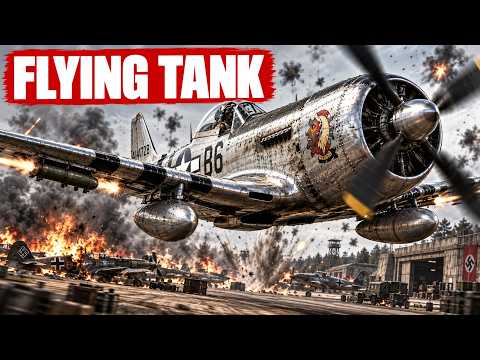
Then they walk him to the machine he’ll fly. It’s taller than he is. The engine cowling in front of the cockpit is so wide he can’t see over it or around it. Eight .50-caliber machine guns buried in the wings, more than 2,000 horsepower, and 17,500 pounds when loaded for war—nearly 8 tons—making it the largest and heaviest single-engine fighter any nation had ever put in the air.
Two years earlier, the men who flew it had called it the “Jug,” and American generals had been weeks away from canceling the entire program. There’s something else mounted in the wing, small enough to be missed. A gun camera wired directly to the trigger, set to run automatically every time he fires. It will record everything he does over Germany for the next ten weeks—including the part he will never talk about afterward.
The airfield was called Rover, flat and wet, close enough to Germany that the war was a sound rather than a rumor. Mud caked the men’s boots. The runway wasn’t really a runway but a long strip of perforated steel planking laid over straw and dirt, because the ground beneath couldn’t hold eight tons of fighter without help.
Arthur Davis arrived the way replacements always did—on a truck with a duffel bag and orders in his pocket. He was in his early twenties. Most of them were. There were two or three men in the group approaching thirty, and those men were called “the old man,” and the joke wasn’t entirely a joke.
He was assigned to the 362nd Fighter Group—three squadrons of Republic P-47 Thunderbolts, the 377th, 378th, and 379th, about 50 aircraft depending on the week and how the last few days had gone. They gave him a bed. It had belonged to someone else until very recently. That was the replacement pilot—not an addition but a substitution.
What surprised him was the morale. He’d expected something else—silent men, maybe, or bitter ones who didn’t look up when a stranger walked into the tent. He knew this group had been losing people steadily for months, and he knew exactly whose seat he was taking and why it was empty. But the mood in that camp was high. It stayed high, and it took him time to understand that what he was seeing wasn’t courage the way civilians imagined it. It was more like an agreement. No one discussed the arithmetic out loud.
The arithmetic went like this. A veteran said the new pilot joining a Thunderbolt outfit in the spring of 1945 could expect to last about two missions. No general signed that number. It never appeared in a report. It was a number that spread through the squadrons like weather, passed along in chow lines, and men believed it, and their belief in it was part of how they flew.
Then they walked him to the flight line and showed him his airplane. His training had never prepared him for the size of the thing. It stood nearly 15 feet tall on long, wide landing gear, and a man standing at the wingtip couldn’t see past the engine cowling. The front was a wall of solid metal. Behind that wall sat 18 cylinders arranged in two rows, a Pratt & Whitney radial engine generating more than 2,000 horsepower, and behind the engine, ducting and a turbosupercharger ran through the fuselage like pipes buried in a building’s wall.
Eight .50-caliber guns, four in each wing, plus bomb racks, rocket rails, and one extra thing, mounted in the leading edge of the wing—a box no bigger than a lunchbox that a man could walk past a hundred times without noticing. It was the gun camera. It was wired to the trigger. Everything he would shoot at, it would see, and it would keep a record long after he was gone.
To understand why the U.S. Army handed an 8-ton machine to a kid barely out of his teens and told him to fly it 50 feet over Germany, you have to go back six years to a drafting board on Long Island and an engineer almost no one in America had heard of.
His name was Alexander Kartveli. He was born in Tbilisi, Georgia, at the far southern edge of the Russian Empire. He fought in World War I and was badly wounded. When the revolution swallowed his country, he got out—first to France, where he studied engineering and where an accident nearly finished what the war had started, then to the United States, where he went to work for another exile, a legless Russian pilot and showman named Alexander de Seversky. Seversky founded the company. Kartveli drew the airplanes.
In 1939, the board pushed Seversky out of his own company while he was abroad, and the company was renamed Republic Aviation, and Kartveli stayed on as chief engineer with a problem on his desk and a failure behind him. The failure was the P-43 Lancer. It could fly high, but it wasn’t good at anything else. The Army used it for training and shipped the rest to China. For an aviation company in 1940, with a world war burning in Europe, that wasn’t just a disappointment. It was closer to a death sentence.
Then came the requirement that made everything else possible. The Army wanted a high-altitude fighter, and it wanted it built around a turbosupercharger—the same device being developed to push heavy bombers into the thin air above 25,000 feet. It was a reasonable request on paper. In practice, it was nearly impossible. The turbine, the ducting, the intercoolers—all of it was enormous. No fighter airframe in the world could fit those components inside it.
So Kartveli didn’t design an airplane and then look for room for the machinery. He designed the machinery first. He arranged the engine, then the ducts that carried exhaust gas along the belly to the turbine, then the return path that carried compressed air forward again, and only when all of that was settled did he design the airframe around it. That’s why the Thunderbolt’s fuselage looks so deep. That’s why the whole machine looks more like a truck than a fighter.
He knew exactly what he had done. When he compared the numbers the Army asked for with the numbers his design produced, he said it would be “a dinosaur,” but a dinosaur with good proportions. He wasn’t being modest. He was being accurate. Nothing that size had ever been asked to fight other fighters and win.
And here’s the part that’s easy to miss 80 years later. Before the first prototype ever left the ground, before a single test pilot flew it, the Army ordered 773 of them. They didn’t place that order because they were confident. They placed it because the United States in 1940 had almost nothing else. American fighter design was years behind its European counterparts. The country had months, not years, to fix that, and there was no time to wait. It was a gamble built on blueprints and funded by public money in uncertain circumstances.
On May 6, 1941, the prototype took off for the first time from Farmingdale Field on Long Island with a civilian test pilot named Lowery Brabham at the controls. The flight nearly ended in disaster. Oil leaked into the exhaust system and smoke began filling the cockpit. Brabham, flying the most expensive gamble in American aviation history, had to cut the flight short and land at another field. The very thing that made the airplane possible—that long, hot duct buried in its belly—almost killed the first man to fly it.
They fixed it. They fixed a hundred other things too. And in the winter of 1943, the first Thunderbolts crossed the Atlantic to England, where the men who were supposed to be impressed by them were not. Some of those pilots came from Spitfire squadrons. They had been flying a machine that weighed half as much, turned on a dime, and wrapped around the pilot like a comfortable coat. Now they were handed something that sat on the runway like a parked bus. They called it the “Jug,” and the polite explanation is that the word was short for “Juggernaut,” while the other explanation is that it looked like a milk jug on wheels.
It climbed slowly. At low altitude, its performance reflected its nature exactly. It couldn’t outmaneuver a Focke-Wulf, and every pilot who tried discovered that fact in less than 30 seconds. Worst of all, it didn’t have the fuel to go anywhere. It could escort bombers part of the way to Germany, then it had to turn back, leaving the bombers to finish the trip alone, which in the spring of 1943 meant the bombers went to their deaths.
On April 15, 1943, Thunderbolts fought their first real battle over the coast of France. They claimed three German fighters. They lost three of their own. That was the pattern of the first weeks. Thunderbolt groups flew and bled. And for every German plane shot down, there was an empty hardstand in England waiting for a return that didn’t come. Mechanical failures killed men. Compressibility killed men. In a steep dive, the controls froze like poured concrete, and the nose went down on its own. A pilot who didn’t slow down in time flew a perfectly good airplane straight into the ground.
At Eighth Air Force headquarters, senior officers began discussing, in the dry and careful language such men use, whether the whole program had been a colossal mistake. It wasn’t victory that saved it. There was no single air battle that turned the tide. What saved it was a change in the nature of the mission. Someone finally realized that the airplane’s real advantages weren’t the ones anyone had asked for. It could dive faster than anything the Germans had in the air. It could carry a massive load of ordnance and absorb a level of battle damage no other fighter in the world could take and still bring the pilot home.
Those aren’t the qualities of a high-altitude interceptor. Those are the qualities of a machine that belongs down low, where the flak is, and where the war is actually decided on the ground. So they took Kartveli’s dinosaur, designed from the inside out around a turbosupercharger meant for thin air at 30,000 feet, and sent it to fly at 50 feet.
At Rover, in the mud, in March 1945, the crew chief walked Arthur Davis around the Thunderbolt that was now his and told him the only thing that mattered about it. “She’ll bring you home.”
The briefing was at 3:30 a.m. Three-thirty in the morning is a particular kind of time. It’s not night, not yet dawn. The air is cold, and the body doesn’t want to wake. A man dresses in the dark by touch, because light would wake the others who aren’t flying the first mission. They walked to the briefing tent. Someone had made coffee. The map at the front of the tent was covered with a cloth, and when it was pulled back, the men looked at the route marked by string. Beyond the Rhine.
It’s worth pausing here to understand what it took to put 50 airplanes over Germany in the morning, because the pilots are the part everyone remembers, but they were a small part of the picture. A Thunderbolt fighter group of about 48 aircraft ran on roughly 75 pilots and about 1,200 ground personnel. Crew chiefs and their assistants, armament men who hung the bombs and belted the ammunition, engine mechanics, radio and radar operators, weather experts, operations officers, anti-aircraft gunners for the airfield, fuel handlers, and engineers who built runways from nothing and repaired them after every raid. Every airplane needed about 25 people to keep it flying. The work never stopped. It went on at night under tarps and dim lights while the pilots slept. And when an airplane came back torn up, men who hadn’t slept in 20 hours went out into the cold to fix it so it could fly again by morning.
There were rules against officers fraternizing with enlisted men. Ken Pollock, 23 years old, who flew with the 377th, put it simply. Those rules evaporated the moment he joined the outfit. It didn’t matter whether you were a private or a colonel. The respect was there, but the barriers weren’t. You were all in the same thing, and you all understood what would happen if one man took a wrong step. An honest mistake didn’t cost you a reprimand. It cost a life, and everyone in that camp knew whose.
Before engines started, something strange happened, designed by a flight surgeon somewhere far away. Five minutes of silence. The pilots were already strapped in, belts tight, parachutes beneath them, gloves on, canopy still open. And for five minutes, no one started an engine, and no one spoke. The first time a man went through it, he thought it was foolish. Let’s get going. That was the attitude. Then, after doing it once or twice, he understood why. In those five minutes, a man could take everything churning inside him and set it aside. He could review his instructions, steady his hands, focus on the mission. Pilots said their entire attitude changed during those five minutes. Something like peace settled over the field, spreading from the cockpits to the mechanics and armament men standing nearby. All of them silent together in the dark.
Then the silence ended, and 18 cylinders coughed to life, one airplane after another, until the ground itself shook.
Taxiing was its own problem. The crew chief and his assistant helped you up. You started it right there on the maintenance platform. Then the crew chief had to climb onto the wing and walk alongside you, because that huge nose meant the pilot in the cockpit saw nothing directly ahead. The taxiways were steel matting and straw with soft mud waiting on the sides. You couldn’t rock the plane left and right to see around the cowling the way you would in a smaller fighter. So another man sat out in the prop wash in the dark and told you where the edge was. Because a Thunderbolt with one wheel off the taxiway was a Thunderbolt that wasn’t flying that day.
At the end of the runway, the crew chief climbed down and the pilot took his place in the formation. Then O’Dell said: “Some things cross your mind.” His own feeling was that he felt almost invincible. He didn’t expect anything to happen to him, so he didn’t carry it the way people assume. Then he opened the fuel valve. No pilot who flew a Thunderbolt doesn’t talk about that moment. Next to the fuel valve was a second lever for the turbosupercharger, and you opened that too, because you needed every ounce of power the machine had, especially loaded heavy with bombs. Then the fuel valve was pushed to the max, what they called running it up to the firewall, and more than two thousand horsepower came alive at the end of the cowling and pushed the man hard back into the armored plate behind his seat. They said it was a wonderful experience. You had all the power you would ever need, and you knew you were going to fly.
And that armored plate behind the seat, which the pilot was pressed against at every takeoff, would become very important later.
By March 1945, the mission had changed completely. The Thunderbolt spent 1943 escorting bombers and failing at it. It spent most of 1944 as an escort and ground-attack plane, carrying bombs to bridges and assembly yards and truck parks, while longer-range Mustangs took the deep escort missions to Berlin. Now, in the last spring of the war, the P-47s of the Ninth Air Force were tactical aircraft and nothing more. Their job was to fly just ahead of the American army and destroy anything that stood in its way.
That meant flying low. Very low. Attacks were made from as low as 50 feet. Not 5,000 feet—50. Low enough to see faces. Low enough that the airplane passed the target in the time it took to say a short sentence. And low enough that if something went wrong, there was no altitude to trade for time, and no room at all to use a parachute.
Usually a formation of 16 planes went out in four groups of four. Three groups carried bombs and went in low toward the target. The fourth group stayed high and carried nothing. They were called the cover group. Their only job was to watch for enemy fighters that the men below would never see coming. And yet, as one of them said, you’re alone up there. Even inside a formation of 16, you’re alone. You are the master of your own fate. He said it was an exhilarating feeling.
Some groups flew three combat missions a day. What killed them wasn’t what anyone expected. The German air force was still there in the spring of 1945, and it was still dangerous when it dropped out of the sun onto formations busy looking at the ground. Fights began and ended in seconds. The two planes closed to 100 yards or less, and at that range eight .50-caliber guns fired more than 100 rounds a second, and the men discovered things about combat that no training film had told them.
One pilot said he saw tracer rounds passing over his cockpit from behind and understood in that moment that a German fighter was lurking behind his tail, and his only thought was that this would not happen. Not today, not to him. Another described the sharp turn to the right with his wingman because you always turn toward them, and realized as they turned that he could hear the German guns firing through the walls of his cockpit. That’s how close it was. Another looked in his rearview mirror and saw a Messerschmitt behind him, and only then realized his plane had already taken about a hundred hits. He pulled the stick back hard and nearly stalled the plane, and said that tells you how fast everything happens and how little time you have to think. You’re not trying to be brave in those seconds. You’re just trying to get away from the guns.
But German fighters weren’t what emptied the bunks. What emptied the bunks was the ground. German heavy flak by 1945 was radar-directed, and a pilot diving on a fortified target could hear what was happening to him. There was a sound in the headset—a hum, a buzz, something unnatural—and every man in that group knew what it meant. There was radar down there somewhere, and it had found him, and the guns were being aimed at his airplane at that moment. One of them said that was what they feared most, because there was not much you could do about it. You can’t dogfight a radar.
Then, at a lower level, there was the other kind, and that other kind is what actually killed them. Light automatic cannon, 20 and 37 millimeter, set in trenches around every bridge and train station and airfield in Germany. Fired by men who didn’t need radar because they saw the plane coming with their own eyes. At 50 feet, the Thunderbolt was inside their range for two or three seconds. There was no room to maneuver out of it. You flew through it and found out later what it had done to you.
On every raid they made, the little camera in the wing ran alongside the guns to record the event. While the Thunderbolts destroyed everything that would slow the army’s advance. There was an army coming. And ahead of them stretched the Rhine.
It’s hard now to describe what that river meant. It had been Germany’s natural line of defense since the Romans reached it and decided to stop. Throughout the modern age, no foreign army had crossed it by force. Not since Napoleon. The Germans destroyed or fortified almost every crossing, and in the last week of March 1945, the U.S. Ninth Army had been waiting on the west bank for three weeks, trying and failing to secure a bridgehead on the other side.
Everyone knew how it would be done. The British and Canadian armies in the north were preparing the largest organized river assault of the war—thousands of guns, an airborne drop, smoke screens miles long, and a timetable precise to the minute. Everyone was wrong about who would get there first.
On the night of March 22, 1945, south of Mainz, in a town called Oppenheim, George Patton’s Third Army put its boats in the water. There was no artillery preparation, not one shell. The guns stayed silent because the bombardment would have revealed exactly where the crossing was, and Patton decided surprise was worth more than firepower. The infantry crossed in the dark, silently, expecting to be slaughtered in the water. Almost no one fired at them. By the next morning, six battalions were on the east bank, and engineers were stringing pontoon bridges behind them. The whole operation cost 28 American soldiers killed and wounded. 28 men for the river that had stopped everyone since Rome.
It worked because of what had been done in the weeks before. The fighter-bombers spent those weeks systematically destroying everything that could reinforce that sector of the bank. Rail lines, locomotives, bridges, radio stations, and truck convoys. Whole towns that refused to surrender were first told through loudspeakers from tanks, given five minutes, and then, when the five minutes were up, hit by 50 or 60 planes with rockets and .50-caliber guns until, as one pilot said, there wasn’t a rat left in them.
The men who flew those missions were never told they were paving the way for the river crossing. They were just told to hit whatever the forward observers asked for. Twice, sometimes three times a day, and they did it. And the result was German defenses unable to move, unable to see, and unable to receive supplies.
Two days after Patton crossed, the big planned attack began in the north, and more than 16,000 paratroopers and glider troops landed on the far bank of the Rhine in about three hours—the largest single-day airborne operation ever mounted. It was enormous and costly, and it made headlines in every newspaper in the world. Patton had already crossed two days earlier with 28 casualties in the dark and without firing a shot.
For the Thunderbolt pilots, the crossing didn’t mean rest. It meant the front line started moving east faster than anyone had planned, and the missions became shorter, lower, and more frequent. Without air cover of their own, and with nowhere to hide in daylight, German armor became nearly helpless. Tanks that had dominated ground war for five years were now hunted from above by planes diving at more than 300 miles an hour at 50 feet.
The tanks were tough. The Tiger tank was genuinely hard to destroy from the air, and the pilots knew it. So they stopped trying to punch through the armor and started thinking. Many German tanks towed fuel in a trailer behind them. So the squadrons ignored the tank entirely and set the trailer on fire. Or they aimed deliberately low so the .50-caliber rounds would ricochet off the road and penetrate up into the belly of the machine, the one place no one had bothered to armor. They used napalm too. Dropping a load on a tank with an open hatch produced one result. Dropping it on a tank with a closed hatch produced another. It spread and burned over the whole hull and cooked the men inside. And the pilots who did it knew exactly what they were doing, and described it later in exactly those words.
Then there was another kind of target, the kind no one puts in a recruitment film. At 50 feet, the pilot sees everything. He sees whether the truck is carrying ammunition or potatoes. He sees faces. And in the last months of the war, the German army was so short of fuel that much of its ammunition was moved by horses and wagons. Many of those wagons were driven by women, because the men were either dead or at the front or already sixteen years old and in uniform. Those wagons were full of shells. They were a legitimate military target under any reading of the rules. And the squadrons swooped down on them, again and again, reforming and coming back until 20 or 30 wagons were scattered on the road and the horses were thrown into the air by the impact of the bullets. One pilot, describing it more than 50 years later, said the roads were literally painted red. Then he said the only honest thing that could be said about it: you did your duty. But you didn’t feel good about it.
That is the war the wing cameras recorded, not the version with the music.
The trip home was an ordeal of its own. Flak damage doesn’t always bring a plane down immediately. It often makes it impossible to land. Planes came back with severed hydraulic lines and landing gear that wouldn’t come down. With fuel almost gone. With bombs or rockets still hanging under the wings. Fire trucks and ambulances waited at the end of the runway every time, because there was always someone who needed them.
Even a normal landing was done fast. Squadrons circled the field below the tower, the tower flashed a green or red light, and the planes peeled off one by one in a sharp turn, banking so steeply it was almost inverted, dropping their landing gear while still in a hard turn downward. They tried to get it done in less than a minute per plane. There was a good reason. If every pilot took a minute, 50 planes would all land within 50 minutes, and 50 planes circling an airfield in Germany with their fuel gauges pointing at empty were not a formation. They were a disaster waiting for a spark.
Some mornings, the disaster happened anyway. There was one morning when eight planes went out and only one came back. The pilot who returned taxied his plane to the runway, shut down the engine, and sat in his cockpit. Then he took out his .45 pistol and emptied the magazine into his own cockpit. They took him to the hospital. He never flew again. No one who was there described that man as having broken down. They described it as something that happened, the way weather happens. You felt terrible when a man in the squadron went down, especially if you were sure he was dead, but you couldn’t think about it because dwelling on it meant not surviving, so you had to keep going, because there was a mission at 3:30 in the morning.
Men lost three or four pounds a week without trying, and it didn’t look like sudden weight loss, which was worse in a way. It happened steadily, one man at a time.
So here’s the question that surrounds all of it. Under those conditions, at that altitude, against radar-directed guns, with the average combat life of a fighter pilot measured in a handful of flying hours, how did anyone come back at all?
The answer was in front of the pilot the whole time. Every other front-line fighter in that war—the Mustang, the Lightning, the Spitfire, the Messerschmitt—used liquid-cooled inline engines. It was a wonderful arrangement. It was streamlined and precisely built, and it made those planes fast and graceful. But it depended entirely on a radiator and a network of cooling pipes, and a single rifle bullet through any of them meant the engine would run for a few minutes and then stop, and the pilot’s day would end in a field or a prison camp.
The Thunderbolt had no cooling system at all. 18 cylinders in two rows, air-cooled, standing in front of the pilot like a wall of iron. There was nothing to puncture because nothing needed to circulate. And so Thunderbolts came home in conditions that should not have been possible. They came back to their bases with cylinders completely shot away from the engine. One pilot landed after a mission, taxied to the hardstand, and found ground crew running alongside his wing pointing at his plane. He stuck his head out. The entire side of the fuselage was black with oil. When he got out, he found a hole in the engine a foot wide and two cylinders completely gone. The engine had run fine the whole way home.
Another plane came back with a piston visibly flapping up and down in the open air. Another lost one entirely, and yet the machine made its approach, landed, rolled off the runway, and the pilot shut it down and walked away.
A group commander was flying very low and forgot how low he was, and flew straight into a large tree. The tree lost the fight. The wings stayed on. The leading edges were battered and the airframe badly damaged, and yet he brought it home. The men who flew other types said plainly that a Mustang wouldn’t have done it, nor a Lightning, nor a Warhawk.
They came back with holes in the wings from light flak big enough for a ground crewman to put his head through, and men took pictures of them doing exactly that. They came back with cannon shells having torn away control cables, with huge gaps in the cowling, with the aluminum skin split and hydraulic fluid running down the side. And they came back with a sound every pilot among them remembered afterward—the sound of bullets striking the armored plate behind their seats. The same plates they pressed their backs against at every takeoff.
Alexander Kartveli didn’t design any of that on purpose. He never set out to build the most survivable fighter of the war. He was asked to build a plane around a turbosupercharger to fight in thin air at 30,000 feet. And in solving that problem, he put a ton and a half of air-cooled iron, a heavy airframe, and a plate of armor between the young American and everything trying to kill him. The dinosaur turned out to be a shield. The men who flew it didn’t care why. They cared that it worked.
And in mid-April 1945, they needed every ounce of that performance, because someone in command decided the time had come to eliminate the German air force once and for all. And the way to do it wasn’t in the air.
On April 8, 1945, the 362nd packed up and moved into Germany, to a captured airfield outside Frankfurt. It was their fifth field since the summer of the invasion. The front was moving east so fast that fighter groups had become wanderers, and Air Force engineers went ahead of them to see if a site was usable. What the engineers found at Frankfurt told them the war was almost over. Everything the Thunderbolts hadn’t destroyed in earlier raids, the Germans had destroyed themselves. Hitler had ordered it. If the Allies were going to sweep into the fatherland, they would inherit scorched earth. And so the retreating German air force had gone down its flight lines and smashed its own planes. German fighters lay wrecked and burned by the dozens. Hangars were still smoking. Barracks and supply buildings were gutted. The air force that had terrified Europe for six years was now this. Broken machines on a broken field, with no fuel and no spare parts. The elite German pilots were dead or captured or forced to take off in their jets from autobahn roads because there were no usable runways left. And the high command decided that wasn’t enough to finish the job.
There was one target in the war that silenced a briefing tent, and every man in that tent knew it before the map was uncovered. An airfield. When the order came down, some pilots got sick. Not many of them, not the same men every time, but it happened. And no one in that group ever dared to despise those men afterward, because everyone understood why. It wasn’t fear of the unknown. It was the exact opposite. On any other mission, you might get hit. On an airfield mission, you were going to get hit. That wasn’t a guess, and it wasn’t pessimism. It was a fact you put in your mind while you were still buckling your seat belt. The only question left hanging was how bad it would be.
German airfields were ringed with radar-directed flak, operated by men who had spent years studying exactly how attacking fighters would come at them.
On April 16, 1945, Allied air forces attacked those airfields across what was left of Germany, in numbers never assembled for that purpose before. Thousands of planes, dozens of airfields in a single day. The stated goal of the operation wasn’t just to hurt the Luftwaffe or neutralize it. The goal was to wipe it out completely. The method was simple and brutal, and it had to be carried out from an altitude that nearly touched the ground. The pilot dives, puts the airfield in his sights, and fires a short burst first to test his guns and make sure they work. Then he closes further. Regulations specified a certain distance to open fire, but pilots consistently ignored it and closed further, because 1,800 rounds of .50-caliber sounds like a huge amount until you start using it. And the pilot wanted to be sure that what he was spending his ammunition on would produce a concrete result. Then he squeezed the trigger for two or three seconds. That was all it took. Then he pulled away, skimming low across the airfield, through the flak that was waiting for him. Attacks were made from as low as 20 feet. The wing cameras recorded all of those moments.
By the end of that day, more than 700 German aircraft had been destroyed on the ground. It was the largest number of aircraft destroyed in a single day in the entire war, and that number has never been surpassed.
And here the truth must be stated clearly, because the men who did it deserve better than myths. Most of those planes were parked and empty. Many had no fuel in their tanks, no pilot assigned, and no realistic hope of ever flying again. The Luftwaffe wasn’t beaten on April 16 in a huge air battle among the clouds. It was burned where it sat by fighter-bombers flying at treetop height, after weeks of having lost the ability to contest control of the air. The Thunderbolt didn’t defeat the Luftwaffe in single combat. It helped strangle it over two years by destroying its fuel, its trains, its airfields, and its supplies. That’s a less romantic story. But it’s also the story that actually ended the war.
The cost was paid the way it always was. Dozens of fighters fell to flak that day, and at 20 feet above the runway, a parachute becomes just a piece of equipment a man carries uselessly. Some pilots went into those attacks with a motive stronger than duty. One of them said afterward, without hedging, that he had been conditioned to hate the German army. That part of it had been done to him deliberately during training, and that when they were hitting an airfield it felt like revenge, because these were the men who had tried to kill him, and now he had a chance to finish them. He said it made him feel good. He was telling the truth about what he felt at twenty-three years old, inside an airplane, in 1945. What he felt three weeks later was something entirely different.
For another 18 days, the Thunderbolts roamed the skies over Germany with nothing left to oppose them in the air. Everything that moved was a target. As they flew over fields and rooftops, squadrons spotted a column or a convoy or a train and dove on it. There was a rule about trains that everyone followed. The first one to dive got the locomotive. You knew you’d hit it when the steam rose in a white column and the whole train stopped moving. Then the rest of the squadron took the cars, one after another, in turn, until the train burned from end to end.
On May 1, 1945, the group flew its last combat mission of the war. Seven days later, Germany surrendered. One pilot described the prayer he said every night. He never asked to survive the war. He only asked to be given tomorrow so that in the evening he could thank God for that day. It was a one-day-at-a-time arrangement, and it was the only kind that worked.
When the surrender came, the first feeling was relief that a man now had a real chance to go home. The second feeling arrived immediately on its heels, and it was a question. Would he be transferred to the Pacific? Some were. Some weren’t. While Paris and London and New York filled with people cheering in the streets, a silence settled over the pilots sitting on captured German airfields. They were alive, and they were astonished to be alive. And what lay before them wasn’t a victory. It was the country they had been flying over for a year. They saw it for the first time from the ground. Orphaned children begging in the streets of every ruined city. Freed prisoners and forced laborers from every corner of Europe waiting by the thousands for transport to homes that in many cases no longer existed. And columns of German soldiers, miles long, beginning to walk back to Germany. Along the same roads and through the same towns they had marched through as invaders five years before. The columns kept passing the airfields for days. One American watched them come. What stuck in his memory was the slumped shoulders, the lowered heads, and the fact that they no longer had any power at all. There were amputees everywhere. Men who had lost an arm, or a leg, or whose heads were wrapped in bandages. The fighter pilot never saw his enemy’s face. He saw the face of the country from 50 feet at 300 miles an hour. The end of the war introduced them to each other.
The 362nd Fighter Group’s tally looked like this. More than 3,000 combat missions, two Distinguished Unit Citations—one for continuing the attack on the fortress at Brest through weather and flak in August 1944, the other for operations in the Moselle and Rhine triangle in March 1945 for the work that helped Patton cross the river. And half of their pilots killed, captured, or wounded. 48 Thunderbolts destroyed.
Let’s return to those gun cameras for a moment. On every mission that spring, the film was running. The men in front of those lenses and the men behind them were filmed continuously in March and April of 1945 on the flight line, in cockpits, walking toward their planes in the dark. Nearly half the men in those frames, veterans and replacements alike, would become casualties within 10 weeks. For most of them, this film is the only motion picture that exists of them. It’s the only way anyone will ever see how they walked.
More than 15,600 Thunderbolts were built, more than any other American fighter in history. Most were cut up for scrap a few years after the surrender, tons of aluminum sold by the pound. A handful may still be flyable today, and when one starts up at an air show, people fall silent from the noise three fields away. And in the public memory, the Jug lost. The Mustang surpassed it—faster, more elegant, reached Berlin, and got the pictures and the films and the books. One man who knew both planes described it best. He said comparing them was like comparing a racehorse to a plow horse. The Thunderbolt was the boxer who fights without gloves. It was never a thoroughbred.
Alexander Kartveli kept working. He designed the Thunderjet, then the Thunderscreech. And the company he built his dinosaur for eventually put that name on another plane, the A-10 Thunderbolt II—a second machine with that name. An ugly, heavy aircraft with straight wings, built around its gun and its armor, designed from the inside out to fly low, take damage, and bring the pilot home.
Eighty years later, ask anyone who flew the original what mattered about it, and none of them will talk about its speed or its guns. They talk about the men who came out alive from planes missing two cylinders and a tree through the wing. They talk about the sound of bullets hitting the armor behind the seat and stopping there. The racehorse got the glory. But the plow horse brought the boys home.
So here’s the question: if you had to climb into that cockpit at 3:30 in the morning, knowing the arithmetic, knowing what waited at 50 feet—would you still have opened the fuel valve to the firewall?
Report this article
Select a reason for reporting:






