The mud was waist-deep. The air stank of cordite and rot. And 200 yards away, a line of enemy infantry was advancing with bayonets fixed. He had ten seconds to decide. He raised his rifle, fired, worked the bolt, fired again, fired again, fired again. Fifteen aimed shots in sixty seconds—and the advance stopped. Not by machine gun. Not by artillery. By one man, one bolt-action rifle, and a mechanism so perfectly engineered that soldiers were still pulling its trigger sixty years later. That rifle was the Lee-Enfield.
But the story of how it came to exist—the arguments, the failures, the obsessive refinements, the desperate compromises—is one of the most consequential engineering sagas in the history of warfare. It took decades, two very different geniuses, and a catastrophic war to expose every flaw before the world finally got the weapon it needed.
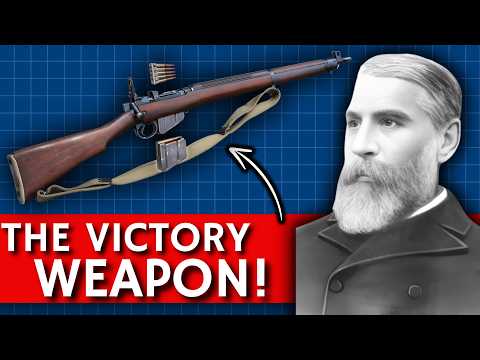
James Paris Lee was not a man who fit neatly into any category. Born in 1831 in Hawick, Scotland, his family emigrated to Canada when he was a child, and he grew up in Ontario—a frontier environment where a firearm was not a military curiosity but a daily tool. He watched gunsmiths work. He disassembled rifles the way other boys disassembled clocks. By the time he was a young man, he had internalized something that the established armaments designers of Europe had not yet grasped: the magazine was the future of warfare.
In every major army of the mid-19th century, the soldier’s rifle was a single-shot weapon. You fired, you reloaded from a cartridge pouch, you fired again. The entire architecture of infantry tactics was built around this limitation. Officers drilled their men in coordinated volley fire precisely because individual soldiers could only shoot once every several seconds. A single soldier’s sustained firepower was a contradiction in terms. It simply did not exist.
Lee wanted to destroy that assumption entirely. His solution was elegant in its mechanical logic. Instead of storing ammunition on the soldier’s body, where it required manual insertion into the breech one round at a time, Lee designed a detachable box magazine that sat beneath the action of the rifle. Inside that box, cartridges were stacked and spring-loaded. Each time the bolt was cycled, the spring pushed the next round up into position, ready to be stripped into the chamber. The soldier did not load between shots. He loaded before engagement, and the rifle fed itself. When the magazine was empty, he did not fumble with loose cartridges. He detached the empty box, snapped in a full one, and kept fighting.
On paper, this sounds simple. In practice, it was a revolution. The British Army did not immediately see it that way. Lee had been working on magazine rifles since the 1860s, refining his designs through several patents and failed military trials. He moved back and forth between America and Britain, presenting his ideas to skeptical procurement committees who were conservative by instinct and slow by bureaucratic design. They worried about soldiers wasting ammunition. A bolt-action magazine rifle, the critics argued, would encourage profligate shooting. A soldier who knew he had eight or ten rounds ready to fire would not aim carefully. He would blaze away and empty his magazine in thirty seconds, leaving himself helpless. This was not an unreasonable concern, but it was also, as events would prove, entirely wrong.
By the early 1880s, the British Army had adopted a single-shot rifle called the Martini-Henry, a falling-block design that was mechanically reliable and accurate. But it fired a heavy black powder cartridge that produced enormous clouds of smoke, revealing a soldier’s position the moment he fired. European armies were already experimenting with smokeless powders and magazine systems. Britain was falling behind, and the men in charge of procurement knew it.
The solution arrived through an unlikely marriage of two separate engineering traditions. William Ellis Metford was a civilian engineer and shooter born in 1824 who had spent decades obsessing over the mathematics of rifling. Rifling is the spiral groove cut into the interior of a gun barrel that imparts spin to the bullet, stabilizing it in flight and dramatically improving accuracy over long distances. Metford had experimented with shallow segmented rifling patterns designed specifically for the new smokeless propellants that were beginning to emerge. His rifling was not the traditional deep groove military design. It was a system of seven shallow grooves and lands carefully calculated to reduce fouling and work with the lower pressure propellants that generated less residue inside the barrel.
In 1888, the British Army combined Lee’s bolt action and detachable box magazine with Metford’s rifling system, and chambered the whole assembly for a new .303 caliber cartridge. The result was designated the Lee-Metford. It had an eight-round magazine, a smooth rear locking bolt that was faster to cycle than competing front locking designs, and accuracy that was a generation ahead of the Martini-Henry. But the Lee-Metford had a problem. Nobody fully anticipated how aggressively the new smokeless powder would erode Metford’s shallow rifling. The early cordite propellant burned hotter than black powder. Over sustained firing, the heat and gas pressure wore down Metford’s carefully calculated grooves in a fraction of the rounds they should have survived. Rifles that should have lasted years were showing worn barrels after relatively modest use. The military was shooting itself in the foot with its own improvement.
The solution required another engineer and another set of grooves. The Royal Small Arms Factory at Enfield Lock in Middlesex had been producing British military firearms for over a century. Its engineers began working on a new rifling pattern specifically designed to withstand cordite’s brutal operating conditions. The Enfield rifling used five deeper grooves with a sharper twist rate, designed to handle the higher pressures and temperatures of smokeless propellant without sacrificing accuracy. It was a harder, more robust system than Metford’s, and tests confirmed that it dramatically extended barrel life. In 1895, the British Army adopted the Lee-Enfield. The action was Lee’s, the rifling was Enfield’s. The name said exactly what it was. And for the first time, the British infantryman carried a magazine-fed bolt-action rifle with a detachable ten-round magazine, an increase from the Lee-Metford’s eight, chambered for the .303 British cartridge.
On paper, it was the finest military rifle in the world. But the British Army still had not fully understood what it had built. Because the rifle was just the beginning of the story. What happened next would change everything.
The Second South African War broke out in 1899. Britain went to war against the Boer Republics expecting a conventional conflict. What they found instead was an enemy that refused to fight conventionally. The Boers were farmers, hunters, and horsemen who had grown up with firearms the way James Lee had. They were natural riflemen. They used cover. They shot from concealment. They picked targets with patience.
And they exposed a brutal truth about the British Army’s tactical thinking. Having a superior rifle meant nothing if your soldiers were drilled to fire in massed volleys from exposed positions. The British soldier of the 1890s was trained to conserve ammunition, to fire on command, to stand in formation. The Boer was trained to shoot accurately at long range from a prone position and to hit what he aimed at.
The disparity in casualties was shocking. British regiments suffered grievous losses from accurate long-range fire they could barely see, let alone effectively return. The individual British soldier, despite carrying the Lee-Enfield, was being outshot by farmers.
The army learned painfully and slowly, but it learned. The importance of individual marksmanship training became undeniable. Officers who had dismissed accurate rifle fire as something for sportsmen reconsidered their position when their men were being killed by an enemy they could barely see. New training doctrine emerged. The individual soldier would be trained not just to fire on command, but to aim, to read range, to control his breath, and to cycle the bolt as fast as the action would allow.
This shift in thinking led directly to one of the most important decisions in the history of the Lee-Enfield: the creation of the Short Magazine Lee-Enfield. Before 1907, the British Army used two separate rifles. The long Lee-Enfield was issued to infantry. A shorter carbine version was carried by cavalry and artillery crews. The logistical complexity of maintaining two different weapons, each with slightly different parts and handling characteristics, was a constant irritation. Engineers and procurement officials began arguing for a single universal rifle that could serve all branches. The argument was not new, but after the South African War, it gained genuine urgency.
The Short Magazine Lee-Enfield, designated the Mark III, was adopted in 1907. It was shorter than the long Lee-Enfield by nearly five inches, but longer than the carbine. It was a compromise in physical dimensions, but an improvement in almost every other measurable quality. The Mark III retained the ten-round detachable box magazine, but added a new aperture rear sight—a small circle of metal with a hole drilled through it—that aligned naturally with the human eye, improving instinctive accuracy. The bolt action was smooth and fast. The trigger pull was clean. The rifle balanced well in the hand.
And then the army discovered something unexpected. The bolt on the Short Magazine Lee-Enfield was not just fast by the standards of bolt-action rifles. It was genuinely, remarkably, almost impossibly fast. The secret was the rear locking bolt. Most contemporary military rifles used front locking bolt systems, where the locking lugs engaged at the front of the action, close to the chamber. This was mechanically stronger under pressure, but it required the bolt to travel a longer distance and engage with more mechanical resistance during the rotation. Lee’s design locked at the rear of the action. It was slightly less rigid at peak chamber pressure, but the bolt travel was shorter and the rotation to lock and unlock was smoother and faster. A trained soldier could cycle the Lee-Enfield bolt almost without conscious thought, his hand sweeping back and forward in a single fluid motion, chambering a fresh round in a fraction of a second.
The army had a rifle that a skilled marksman could fire at extraordinary rates without losing sight picture or accuracy. What happened next turned that rifle into a legend. British Army musketry instructors began developing what they called the Mad Minute. It was not a battle technique. It was a training exercise, a test of individual marksmanship and rifle handling that pushed both soldier and weapon to their absolute limits. The standard was fifteen aimed shots at a target two hundred yards away, delivered within sixty seconds, with the majority of rounds striking a circle the size of a man’s torso.
Fifteen rounds, sixty seconds, with a bolt-action rifle. This was not spraying bullets downrange. Each shot required the soldier to acquire the target through the aperture sight, confirm his aim, squeeze the trigger, sweep the bolt handle back, drive it forward, return to the target, reacquire, and fire again. Again. Again. Without losing accuracy, without losing composure. The rifle had to be fast enough to allow it. The action had to be smooth enough to sustain it. And the Lee-Enfield was both.
The top performers did not stop at fifteen. Sergeant Instructor Alfred Snoxall set a record in 1914 that still stands in the history of bolt-action marksmanship: thirty-eight hits on a twelve-inch target at three hundred yards in sixty seconds. Not fifteen. Thirty-eight. The performance was so extraordinary that for years people refused to believe it had been done without a machine gun.
When the First World War began in August 1914, the British Expeditionary Force crossed the Channel with the Short Magazine Lee-Enfield Mark III. They were the most extensively trained riflemen in the world at that moment, and they carried a weapon precisely suited to their training. What happened at the Battle of Mons in August 1914 became one of the most debated engagements in military history.
The German First Army, advancing through Belgium, encountered the British Expeditionary Force along a canal line. German commanders later reported that their infantry had been cut down by what they believed was massed machine-gun fire. The volume of accurate fire from the British positions was so intense, so sustained, and so precisely targeted that the attacking formations could not identify how many weapons were engaging them. They assumed the British had far more machine guns than any infantry unit was supposed to carry. They were wrong. What they had encountered was the Mad Minute, delivered by thousands of trained British riflemen, each cycling the Lee-Enfield at the absolute limit of its mechanical capability.
The retreat from Mons followed almost immediately. The British were heavily outnumbered and could not hold the canal line. But the legend of the Mad Minute was born. German intelligence reports noted with bewilderment the rate of fire that a small British force had sustained. Officers who had watched their men fall in waves could not reconcile the casualty rates with the number of rifles the British carried. It was one of those rare moments in military history where a weapon and the training around it created an effect that exceeded all expectations.
Then the trenches swallowed the war. The fluid battles of August 1914 gave way to four years of attrition, mud, wire, and artillery. And in this new environment, the Lee-Enfield proved its second great virtue: durability. The Western Front was a machine for destroying equipment. Rifles were dropped in mud, submerged in water, packed with dirt, frozen overnight, overheated in summer, and generally subjected to conditions that would have destroyed lesser weapons. The Short Magazine Lee-Enfield endured. Its action was tolerant of contamination in ways that more precisely machined rifles were not. The bolt could be cycled even when fouled with mud that would have jammed a tighter-fitting design.
Soldiers learned to care for their rifles in the trenches, but they also learned that the Lee-Enfield would function even when care was impossible. It was a weapon that understood the reality of war. The trench also created a new demand: the sniper. Adapted with a telescopic sight, the Mark III became the first generation of British military sniper rifles, its inherent accuracy and the .303’s effective range making it lethal in skilled hands.
By November 1918, millions had been produced across Britain, Canada, India, and the United States. The interwar years brought the Number 4 Mark I in 1941—not a radical redesign but a refinement, with a heavier receiver, a superior aperture sight, and standardized tolerances allowing true parts interchangeability between factories and countries. Any part from any production run would fit any rifle. For an army fighting across multiple continents, this was fundamental.
The Number 4 served in North Africa, Burma, Italy, and Northwest Europe. Snipers received selected receivers fitted with the No. 32 scope, achieving kills at ranges that would have seemed impossible to earlier generations. Savage Arms in Massachusetts produced hundreds of thousands under Lend-Lease, indistinguishable in performance from their British counterparts.
By 1945, the Lee-Enfield had seen fifty years of continuous service across the Sudan, Mesopotamia, Gallipoli, East Africa, and the Northwest Frontier. The jet age made the bolt action tactically obsolete for front-line infantry—but the rifle refused to disappear. In the Malayan Emergency, jungle fighters requested Lee-Enfields by preference over the heavier, humidity-sensitive L1A1. India produced its own Ishapore 2A1 chambered for 7.62 NATO. And the Canadian Rangers carried the Number 4 across the Arctic for decades, where lubricants in modern self-loaders froze and the bolt action never failed. The Rangers only retired it in 2019—rifles over seventy years old, still shooting.
James Paris Lee could not have known his magazine would still feed cartridges on the edge of the Arctic Circle a century later. William Metford could not have known his rifling would set the accuracy standard for generations. But that is what happens when engineering solves a real problem well. The detachable box magazine is now so fundamental that it is invisible—nobody calls it Lee’s magazine. It is simply how rifles work. That invisibility is the truest measure of an engineering revolution.
For a century and more, through mud and sand and Arctic cold and jungle heat, the answer from the Lee-Enfield was always the same. When the range was closing and the magazine was emptying, the next round was in the chamber.
So here is the question for you: in an age of drones, smart optics, and self-guiding munitions, is there still a place for a rifle that asks nothing of technology but everything of the soldier holding it—or has that era finally, truly ended? Tell us in the comments.
Report this article
Select a reason for reporting:






