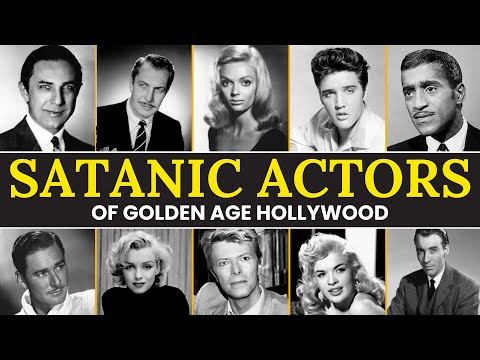
Hollywood has always been a place where dreams are made—and sometimes, those dreams come at a terrible price. Behind the glittering premieres and dazzling smiles, whispers of dark bargains and sinister rituals have haunted the Golden Age for decades. From Jayne Mansfield’s alleged involvement with the Church of Satan to James Dean’s cursed Porsche, the line between fame and damnation has never been more blurred.
In the mid-1960s, Jayne Mansfield was more than just a blonde bombshell—she was a woman drawn to the extremes of fame, indulgence, and, some claim, black magic. Her association with Anton LaVey, the enigmatic founder of the Church of Satan, sparked rumors that went far beyond friendship. Some whispered she was a priestess in LaVey’s inner circle, participating in rituals with animal blood and incantations. The most chilling claim? That LaVey cursed her lawyer and lover, Sam Brody, after Brody mocked his beliefs. Shortly after, Mansfield and Brody died in a horrific car crash in 1967. Was it coincidence, or the fulfillment of a dark pact?
Elvis Presley, the King of Rock and Roll, grew up in a deeply religious household, singing gospel in church. Yet rumors persist that he was secretly fascinated by the occult. He allegedly amassed a personal library filled with esoteric books on numerology, Hermetic philosophy, and even the works of Aleister Crowley—often called “the wickedest man in the world.” Some claimed Elvis believed he was guided by the spirit of his stillborn twin, Jesse Garon, and that he performed ritual prayers to protect his voice. When he died in 1977, conspiracy theories emerged suggesting his death was the price of a deal with dark forces. Was the King’s talent a satanic bargain?
James Dean embodied the rebellious spirit of the 1950s, but his love for speed and danger fueled speculation that something darker lurked beneath his cool exterior. The most famous element of this legend is his Porsche 550 Spyder, nicknamed “Little Bastard,” which was said to be cursed. After Dean’s fatal crash in 1955, the car’s parts were sold, but accidents and injuries plagued everyone who handled them. Some believe Dean’s dabbling in séances or Ouija boards opened a portal to malevolent forces, sealing his tragic fate. Did the Devil ride with him?
Errol Flynn, the swashbuckling hero of the silver screen, was a notorious off-screen rogue. His private yacht parties were legendary, mixing starlets with eccentric artists and alleged occultists. Black candles, strange symbols, and mysterious rituals were sometimes part of midnight celebrations, though few dared to speak openly. Flynn’s rebellion against social norms fueled beliefs that he dabbled in dark forces as part of his defiance. Even his death in 1959 at age fifty was shrouded in mystery, with some speculating he paid the ultimate price for his indulgence in sinister energies.
Sammy Davis Jr., the multi-talented Rat Pack member, was rumored to have been briefly involved with the Church of Satan in the late 1960s. Some accounts claim he attended rituals where participants chanted incantations by black candlelight. Friends dismissed it as a phase, but others whispered of a deeper, darker experience. Davis suddenly distanced himself from LaVey, as if he had seen something that forced him to retreat. Did he toy with dark forces, or was it just a daring amusement in an era of experimentation?
Marilyn Monroe embodied Hollywood’s glamour, but the mysterious circumstances of her life—and especially her death—have always fed rumors of hidden forces manipulating her destiny. One thread of the legend suggests Monroe was chosen, some say groomed for stardom, by an elite group practicing dark rituals that granted her fame in exchange for compliance. Her connections to powerful figures, including President John F. Kennedy, only deepened suspicions of covert manipulation. When she was found dead in 1962 from a barbiturate overdose, the official ruling was a probable suicide—yet the suddenness of her death and the secrecy surrounding the investigation fueled theories of a sinister cover-up.
Vincent Price’s name is synonymous with horror, but some fans and conspiracy theorists alike have wondered whether his passion for the macabre was purely theatrical. Rumors suggest he collected books on Satanism and the occult, and his erudite nature lent credibility to claims that he was exceptionally well-versed in the history of magic. Some stories from film crews hint that Price’s dressing room was filled with esoteric artifacts and symbols. Did he conduct private experiments in séances or darker energies? He consistently denied practicing any form of sorcery, yet his embodiment of menacing characters kept the rumors alive long after his death in 1993.
Barbara Steele’s wide-eyed, haunting gaze made her a staple of gothic horror throughout the 1960s, often playing tormented spirits, witches, or vengeful ghosts. Some claim Steele was deeply interested in real-world witchcraft, frequenting gatherings where practitioners explored séances and ceremonial magic. On set, she was said to possess an eerie ability to channel her characters, entering trance-like states that unsettled even veteran directors. Crew members whispered about unusual objects in her personal belongings—candles inscribed with strange symbols and black-bound notebooks filled with incantations. Did she simply gravitate toward gothic tales, or did she possess genuine knowledge of the arcane?
Christopher Lee was more than an actor—he was a physically imposing figure whose portrayal of Count Dracula in Hammer’s horror series remains legendary. What is certain is that he owned a massive personal library on demonology, magical practices, and the supernatural. He often warned fans and interviewers about the dangers of delving into black magic, sparking rumors that his knowledge went beyond academic curiosity. Some tales suggest he once encountered real practitioners of the dark arts and allegedly witnessed ceremonies summoning malevolent entities. Whether he was a genuine expert or a scholarly connoisseur of the hidden, Lee’s aura of immense knowledge continues to captivate believers in Hollywood’s dark side.
Bela Lugosi rose to fame as the quintessential Count Dracula in 1931, mesmerizing audiences with his magnetic gaze and exotic accent. Yet some believe this iconic role was more than brilliant acting—that Lugosi himself harbored a genuine interest in magic. Accounts from within Hollywood claim he occasionally attended séances and expressed curiosity about communicating with the other world. As his career declined and he faced addiction and financial troubles, speculation grew that he had summoned forces he did not fully understand. Even after his death in 1956, the legend persisted that Lugosi was buried wearing one of his Dracula capes—a symbol of how deeply the dark character, and perhaps the mystery behind it, had merged with his personal identity.
David Bowie is often remembered as a rock icon whose personas—Ziggy Stardust, Aladdin Sane, the Thin White Duke—drew on alien and futuristic themes. But beneath his fascination with extraterrestrials and androgyny lay another interest: the occult. According to various accounts, including memoirs by his then-wife Angie, Bowie developed a deep fear of black magic during the 1970s, believing witches were conspiring against him. This paranoia allegedly drove him to perform protective rituals, and at one point he enlisted a white witch to cleanse his home. Angie Bowie recounted an incident in Los Angeles where David became convinced that evil forces had taken over their swimming pool. The white witch reportedly performed an exorcism involving chanting, scattering salt, and symbolic gestures to banish dark spirits. Bowie watched in horror and fascination, convinced he saw strange, disturbing shapes in the water. His fears were partly fueled by heavy drug use and erratic behavior that blurred the lines between reality and hallucination—yet his willingness to explore forbidden themes found its way into his music, lyrics, and interviews, adding another layer of mystery to an artist who repeatedly reinvented himself and the cultural landscape.
Yet the most unsettling chapter of this hidden history may belong to a star whose public image was built on wholesome charm and family values. Bing Crosby, the crooner whose velvet voice defined Christmas for generations, was said to have harbored a private obsession with the occult that few dared discuss. According to whispers from within his household, Crosby kept a locked study filled with texts on spiritualism and mediumship, and he reportedly hosted private séances at his Holmby Hills estate during the 1940s. Guests described tables that moved, raps on the walls, and a chill that settled over the room whenever the candles were dimmed.
Some accounts suggest Crosby’s interest deepened after the death of his first wife, Dixie Lee, in 1952. Grief-stricken and restless, he allegedly sought out mediums who claimed they could reach her spirit—and one, a mysterious woman known only as Madame Zara, was said to have warned him that a curse had followed him from a long-forgotten bargain. Whether that bargain involved his early career or a darker exchange, no one could say for certain. But those close to him noticed a change: the easy smile grew tighter, the famous blue eyes more guarded.
Then there is the strange case of Rudolph Valentino, the silent film lover whose sudden death in 1926 at age thirty-one unleashed a frenzy of morbid fascination. A woman in black, known as the Lady in Black, appeared at his grave every year on the anniversary of his death—a ritual that some claim was not mourning but a magical working to bind his spirit. Valentino himself was rumored to have consulted fortune tellers and carried a protective amulet given to him by a mysterious adviser. His crypt in Hollywood Forever Cemetery has since become a pilgrimage site for those who believe his ghost still walks among the palm trees, forever searching for the stardom that slipped away.
And no chronicle of Hollywood’s dark side would be complete without the curious tale of Thelma Todd, the blonde comedienne found dead in her garage in 1935. Her death was ruled accidental, but rumors of a gambling den, a secret lover, and a mob-connected ex-husband painted a far more sinister picture. Some claimed she had stumbled upon a ritual in the hills above Pacific Palisades, a gathering of powerful men and mysterious figures who did not appreciate an uninvited witness. The official story said carbon monoxide poisoning; the whispers said something far older and far less forgiving.
Each of these stories shares a common thread—the sense that beneath the glamour, something ancient and hungry waits. Whether these stars were true devotees of the dark arts or merely victims of rumor and coincidence, their legends have become inseparable from the mythology of Hollywood itself. The line between performance and pact, between ambition and invocation, has never been clearly drawn—and perhaps that is exactly how the darkness prefers it.
And then there is the story that ties them all together—the rumor that these stars were not isolated cases but threads in a single, sprawling tapestry of ambition and shadow. Some claim a hidden network of powerful figures in the entertainment industry has long traded influence for obedience, offering fame in exchange for silence and service. Whether that network was real or a phantom born of paranoia, its shadow touched the careers and deaths of too many icons to be dismissed entirely.
What remains is a legacy of unanswered questions. The studios kept their secrets, the witnesses faded away, and the graves kept their silence. Hollywood moved on, as it always does, trading one set of golden idols for the next—but the old stories never truly died. They simply waited in the dark, ready to be whispered again.
Perhaps that is the true nature of the bargain: not a single pact signed in blood, but a slow, collective surrender to the allure of the spotlight, whatever the cost. The darkness does not demand worship—only attention. And Hollywood, more than any other place on earth, has always been willing to give it.
So the next time you watch an old film and see a star’s smile flicker just a little too brightly, ask yourself: was it talent that lit that fire, or something older watching from behind the screen? What do you believe—coincidence, or a contract signed in shadow? Share your thoughts below.
Report this article
Select a reason for reporting:






