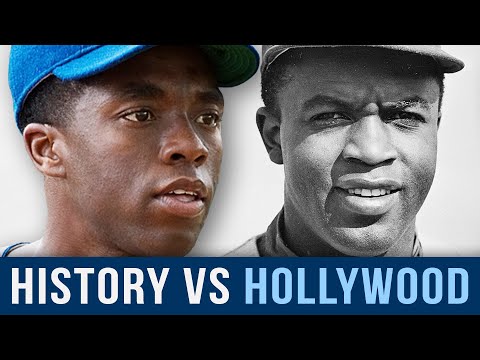
On April 15, 1947, Jackie Robinson stepped onto Ebbets Field and shattered baseball’s color barrier. His courage and resilience in the face of relentless racism became the stuff of legend. But how much of what we see in the 2013 biopic 42 actually happened? The film, starring Chadwick Boseman in a breakout role, brought Robinson’s story to a new generation. Yet, like any Hollywood adaptation, it took creative liberties. In this exploration, we separate fact from fiction and uncover the true story of Jackie Robinson.
The movie opens with Brooklyn Dodgers general manager Branch Rickey (Harrison Ford) discussing his plan to integrate baseball. He learns of Robinson’s court-martial for refusing to move to the back of a segregated bus during his army days. That much is true: Robinson was indeed arrested and tried. But the film leaves out a crucial detail—he was acquitted and honorably discharged. This omission paints a slightly different picture of the military’s stance on Robinson’s defiance.
Rickey’s right-hand man in the film is Wendell Smith, a sportswriter for the Pittsburgh Courier, who helps Robinson navigate the hostility of spring training. Smith is based on a real journalist who played a pivotal role in integrating baseball. In reality, it was Smith who recommended Robinson to Rickey, along with other Negro League stars like Larry Doby, Monte Irvin, and Roy Campanella. Smith’s motivation ran deep: as a teenager, he had been a talented pitcher, but a white scout told him he couldn’t sign him because of his race. That moment fueled his lifelong mission to break baseball’s color line.
The film also introduces a young fan, Ed Charles, who receives a baseball from Robinson as the team train departs. While that specific gesture never happened, the scene captures a larger truth. Charles, who grew up to play in the majors, later recalled the thrill of watching Robinson play and chasing after his train, pressing his ear to the tracks to feel the vibration. “We wanted to be part of him as long as we could,” Charles remembered. It’s a poignant reminder of how Robinson’s journey inspired countless others.
During spring training, the movie shows players circulating a petition to keep Robinson off the team, led by Dixie Walker. That petition was real, and while some players supported it, others like Pee Wee Reese refused to sign. “It didn’t matter to me whether he was black or green,” Reese later said. “He had a right to be there too.” This early display of solidarity foreshadows the powerful bond that would develop between the two men.
The film doesn’t shy away from the racism Robinson faced on the field. In one scene, Pirates pitcher Fritz Ostermueller throws at Robinson’s head, forcing him to duck. In reality, Ostermueller hit Robinson in the elbow, but only because Robinson raised his arm to protect his face. Former Pirate Jim Russell later claimed Ostermueller had been ordered to “take Robinson down.” The movie also depicts Phillies manager Ben Chapman hurling racial slurs from the dugout, pushing Robinson to smash his bat in frustration. That bat-smashing moment is fictional, but it symbolizes the immense pressure Robinson endured. As Boseman noted, “At some point he had to break.” The real Chapman was indeed vicious, and the photo op where he posed with Robinson was one of the hardest things Robinson ever had to do.
Another controversial moment is Cardinals player Enos Slaughter spiking Robinson at first base. Whether it was intentional remains debated, but Slaughter’s aggressive style was well-known. The film also recreates the iconic moment when Pee Wee Reese put his arm around Robinson on the field in Cincinnati. No photo or footage exists, but Rachel Robinson recalled how much it meant to Jackie: “It came as such a relief to him that a teammate and the captain of the team would go out of his way in such a public fashion to express friendship.” A statue now commemorates that gesture.
Overall, 42 captures the essence of Robinson’s struggle and triumph. But there’s more to the story—more details, more nuance, and more moments that define his legacy. As we continue, we’ll delve deeper into the true history behind the film and the man who changed baseball forever.
Beyond the moments depicted on screen, 42 compresses and rearranges timelines for dramatic effect. For instance, the film suggests that Rickey’s decision to sign Robinson was swift and decisive, driven largely by a single conversation. In reality, Rickey had been scouting Negro League talent for years, and his plan was meticulously calculated—he needed a player who could withstand the abuse, not just play well. “I needed a man who could carry the burden without fighting back,” Rickey later explained, and Robinson fit that profile precisely.
The movie also simplifies the role of the Dodgers’ front office and the league’s owners. In the film, the integration of baseball seems like Rickey’s solo crusade against a backdrop of vague opposition. But the real story involved a formal vote among National League owners, with several teams—most notably the Cardinals—reportedly threatening to strike rather than play against Robinson. That strike was narrowly averted, but the tension was far more organized and widespread than the film conveys.
Another key difference lies in Robinson’s early performance. The movie shows him struggling initially before a dramatic breakthrough. In truth, Robinson hit .297 in his rookie season, stole 29 bases, and won the inaugural Rookie of the Year award. His adjustment to the majors was remarkably smooth given the circumstances, though the psychological toll was immense. “I had to fight for every inch,” Robinson wrote in his autobiography, I Never Had It Made, “and I couldn’t fight back with my fists.”
One of the film’s most emotional scenes—Robinson breaking down in the tunnel—never happened, but the isolation he felt was real. Teammates like Reese and Ralph Branca gradually warmed to him, but many others kept their distance, and opposing players targeted him relentlessly. The film hints at this but doesn’t fully capture the relentless, daily grind of hostility Robinson faced from fans, players, and even umpires.
Perhaps the most significant omission is the broader context of the Negro Leagues. The movie mentions Robinson’s time with the Kansas City Monarchs but doesn’t explore the vibrant, competitive world he left behind—or the resentment some felt when he was chosen as the first. “Why Jackie?” was a question whispered by other Black players who felt equally deserving. Robinson’s selection wasn’t just about talent; it was about marketability, temperament, and Rickey’s strategic vision.
These nuances don’t diminish the film’s power. 42 is a tribute, not a documentary, and it succeeds in capturing the spirit of a man who endured the unendurable. But as we continue, we’ll see how the real Jackie Robinson—complex, proud, and fiercely intelligent—left a legacy far richer than any two-hour movie could contain.
The film’s portrayal of Robinson’s relationship with Wendell Smith, while heartfelt, also glosses over the journalist’s ongoing role after that first spring training. Smith didn’t simply fade into the background once Robinson made the roster. He continued to travel with the team throughout the 1947 season, filing stories that chronicled not just Robinson’s stats but the daily indignities he faced—segregated hotels, restaurants that refused service, and the constant threat of violence. “Wendell was Jackie’s shadow and his shield,” one contemporary later observed, and the film’s decision to minimize his presence after the opening act shortchanges a partnership that lasted years.
The movie also tidies up the messy, often ugly reality of Robinson’s relationship with some teammates. In 42, Dixie Walker’s petition fades quickly, and the team largely comes around after a few key moments of solidarity. In truth, the clubhouse remained fractured for much of the season. Walker, a popular veteran, continued to harbor resentment and was eventually traded—but not before his presence created a persistent chill. “There were guys who never spoke to Jackie off the field,” recalled Dodgers pitcher Rex Barney. “Not once. Not all year.”
One of the more subtle liberties the film takes involves Branch Rickey’s motivations. Harrison Ford plays him as a crusader with a moral compass, and there’s truth to that—Rickey was a devout Methodist who genuinely believed in equality. But he was also a businessman who saw an untapped market. The film touches on this when Rickey mentions the “great experiment” could fill seats, but it downplays the cold calculation behind his choice. “Rickey was a genius, but he wasn’t a saint,” historian Jules Tygiel noted. “He wanted to win, and he wanted to make money. Integration was his path to both.”
Perhaps the most glaring omission from 42 is the fate of the Negro Leagues themselves. The movie ends on a note of triumph—Robinson’s success opening the door for others. But that door swung shut on the very institutions that had nurtured him. Within a few years of Robinson’s debut, the Negro Leagues collapsed as their best players were siphoned off to the majors. Owners like Effa Manley of the Newark Eagles lost their livelihoods. “Integration was right, but it came at a cost,” Manley later said. “They took our players and gave us nothing in return.” The film never addresses this collateral damage, leaving audiences with a cleaner, more triumphant narrative.
The movie also skips Robinson’s later career, when the initial novelty wore off and the abuse didn’t stop—it just changed form. By 1949, he was an MVP, but he was also feuding with teammates, battling umpires, and speaking out more forcefully about racism, which made some in the Dodgers’ front office uncomfortable. “Jackie was never going to be a quiet hero,” Rachel Robinson said. “He refused to be.” That defiance, that refusal to soften his edges, is only hinted at in the film’s final act.
As we move deeper into the real history, it becomes clear that 42 is less a portrait than a sketch—a loving one, but incomplete. The man who emerges from the historical record is more complicated, more contradictory, and ultimately more compelling than the saintly figure the movie sometimes presents. And the story doesn’t end with a pennant or a statue. It continues in every player who followed, every fan who believed, and every battle that still needed fighting.
That complexity extends beyond the field. After baseball, Robinson became a fierce advocate for civil rights, marching alongside Dr. King and publicly challenging presidents. “A life is not important except in the impact it has on other lives,” he once said—words that defined his post-baseball years as much as his playing days.
He co-founded a bank to serve Black communities, fought for housing desegregation, and never stopped pushing. When asked why he risked his hard-won acceptance, he answered simply: “I cannot stand and sing the anthem. I cannot salute the flag; I know that I am a black man in a white world.”
Rachel Robinson, now 98, has carried that torch for over fifty years. The Jackie Robinson Foundation has sent thousands of students to college. His number 42 hangs in every ballpark, retired across the sport—a permanent reminder that one man’s courage reshaped a nation.
Jackie passed away on October 24, 1972, at just 53. But the barrier he broke still stands open. 42 may soften the edges, but the truth is more powerful than any screenplay: he didn’t just play the game—he changed it forever.
So what do you think—does 42 do justice to Jackie Robinson’s legacy, or should Hollywood have shown the harder truths? Let us know in the comments below.
Report this article
Select a reason for reporting:






