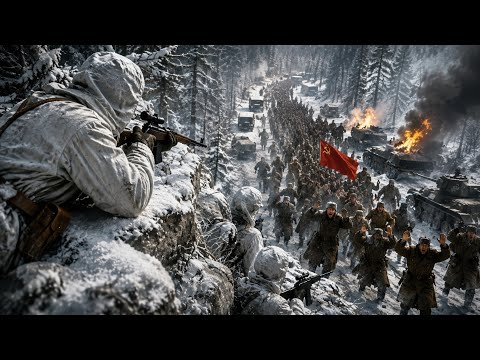
The temperature had plummeted to forty below zero. In that kind of cold, a truck engine, once shut off, would never start again. The oil thickened into grease, the battery died within an hour, and the fuel line froze solid from the inside. So on the night of January 5, 1940, along a logging road in the forests of eastern Finland, hundreds of Soviet trucks sat bumper to bumper, engines running, going nowhere. They burned fuel they could not replace, filling the darkness with a low mechanical hum that carried for miles through the frozen trees.
The men listening to that sound were lying in the snow about eighty yards inside the tree line. They had been listening for days. They counted the engines, because each engine meant a truck, and each truck meant a hundred men sleeping in the open beside it—there was no room inside the vehicles and no shelter anywhere else. That column was the Soviet 44th Rifle Division. Between fifteen and eighteen thousand men, depending on which records you trust. Tanks, artillery, transport vehicles, a full modern combat formation, and a military band with its instruments packed in crates, brought along for the victory parade that headquarters assumed was at most two weeks away.
The division stretched along nearly twelve miles of road barely wide enough for two vehicles. It had not moved in six days. The men in the trees were Finnish reservists—loggers, farm workers, men who repaired boats and hauled timber sleds for a living. They were far fewer in number. They had almost no artillery. Their commander had spent most of the past twenty years behind a desk, some of it arguing municipal affairs in a town council hall 400 kilometers away. In seventy-two hours, the 44th Rifle Division would effectively cease to exist.
I want to be careful with that sentence because it is the kind of claim that gets thrown around loosely. I do not mean the division was mauled or that it retreated in disarray. I mean a formation of the Red Army entered a stretch of Finnish forest and was annihilated so completely that the Finns would later count thousands of captured horses and find among the wreckage the sheet music for a band preparing for a performance in a city those men never came within a hundred miles of. And the thing that did it was not a secret weapon. It was a word. A word Finnish loggers had used for centuries to describe a pile of firewood.
To understand how any of this happened, you have to start with how absurd the matchup looked on paper. Because on paper, it was not a contest. It was a timetable. The Soviet Union in 1939 had a population of over 170 million and an army that had been expanding for a decade. Finland had about 3.7 million people and a reserve army in the most literal sense. When the call-up came, the men who showed up had been milking cows and running sawmills the previous week, and some arrived in their own clothes with a badge pinned on because there were not enough uniforms to go around. The soldiers had a dark joke about it. They called the outfit “Model Cajander” after the prime minister, as if a belt and jacket from home were official kit.
That was the army Joseph Stalin decided to crush. The demands had come earlier that autumn, framed as a security matter. Leningrad sat uncomfortably close to the border. So Moscow wanted the border pushed back. It wanted islands in the gulf. It wanted a naval base at Hanko. Finland was offered land in the north in exchange—thousands of square kilometers of forest that nobody in Helsinki really needed. The Finns refused anyway, for a reason that had nothing to do with square footage. They had watched the Baltic states sign agreements that autumn that began with base rights and ended with occupation. Handing over the fortified Karelian Isthmus in front of Viipuri meant standing in an open doorway and trusting the man on the other side.
So on November 30, 1939, the Red Army crossed the border. About half a million men in the first wave. Soviet aircraft bombed Helsinki the same day. The plan was not complicated because nobody in Moscow believed it needed to be. Smash the Finnish defenses on the Karelian Isthmus in the south, take the capital, install a friendly government, and be done before Christmas. A puppet administration was formed in advance and given a name and a leader, which tells you exactly how much doubt anyone had about the outcome.
The southern attack was the main event. The Finns had built a line of fortifications across the isthmus, the Mannerheim Line, and everyone expected the war to be decided there. But there was a second offensive, one that nobody at the time thought would matter. Look at a map of Finland and find the narrow part. Not the far north where the country widens again into Lapland, but the area roughly at the latitude of the town of Suomussalmi. From the Soviet border there to the Gulf of Bothnia on the western coast is a distance of just over 150 miles. Reach the coast at Oulu, and Finland is split in two. Everything above that line is cut off from the government, the ports, the rail network, and the war itself. It ends the state as a functioning entity without a single shot fired at Helsinki.
That was the mission given to the Soviet Ninth Army. Advance west from the border through Suomussalmi. Keep walking. Once you reach the sea, the war collapses on its own. The men who planned it were reading only the map. They were not reading the ground. The province of Kainuu they were about to enter is not empty the way it looks on a schematic. It is full, and everything in it stands in your way. It is forest—mile after mile of crowded pine and spruce—ground covered with rock and root, and in winter, snow deep enough to swallow a man to his chest. It is laced with lakes and frozen marshes that look perfectly solid until they prove otherwise.
In 1939, the population of Suomussalmi was about 4,000 people, and the region’s infrastructure amounted to a handful of dirt logging roads, single-lane, carved between the trees to haul timber in winter. That last detail is the heart of the entire battle, so sit with it for a moment. A Red Army infantry division in 1939 was a mechanized formation. Tanks, tractors, field guns, ammunition and fuel trucks, field kitchens, ambulances, and thousands of tons of equipment on wheels and tracks. And every piece of it could only move where there was a road. Off the road, in that terrain, in that snow, a truck becomes a stationary object. A tank sinks into a marsh and stays there. Even a horse-drawn sled struggles once it leaves the packed track.
Which means that the moment a Soviet division committed to one of those logging roads, it stopped being a division in any meaningful sense and became a column. A long, single-file line stretching for miles, unable to spread out, unable to leave the road, and in many places unable even to turn around, with its head and its tail so far apart they might as well have been in different countries. Militarily, that shape has a name. It is called a target.
The Finns understood this because they had lived there. The Soviets did not because the men writing the orders were hundreds of miles away, and the men executing them were handed a map with a line drawn on it and told to follow the line.
Now, the officer Finland sent to deal with all of this. Field Marshal Mannerheim needed someone to take command in the north, and the man he chose was a colonel named Hjalmar Siilasvuo. If you were building the ideal commander for a desperate winter campaign from scratch, his profile would not be on the shortlist. Born Hjalmar Strömberg in 1892 in the Swedish-speaking part of Finnish society, he later took a Finnish surname as many nationally minded Finns of his generation did. Siilasvuo’s parents died when he was young, and he was raised by relatives. He went to Helsinki and trained as a lawyer, which is not usually the first line in a soldier’s biography. Then he did something that tells you more about him than the law degree does.
Finland at the time was not an independent state. It was the Grand Duchy of Finland, a possession of the Russian Empire, and had been for over a century. In 1915, young Finns began secretly slipping into Germany to receive military training with the clear, unambiguous intention of one day returning to fight for independence. They became the 27th Royal Prussian Jäger Battalion. Siilasvuo was one of them. He went and trained as light infantry, and he fought against Russian forces on the Eastern Front in World War I. Light infantry—not heavy formations, not set-piece assaults, but small, fast, self-reliant units operating in terrain the enemy knew less well than you did.
Remember that those Jägers returned home in 1918 and were thrown straight into the Finnish Civil War, which was short and brutal as civil wars usually are. Siilasvuo fought in it, and then spent the next twenty-one years doing work that does not qualify anyone for the winter of 1939. He served in the Ministry of Defense. He commanded a home-front brigade and a military district. He held a seat on the Oulu town council. By 1939, he was a forty-seven-year-old officer with a legal background, known as a meticulous staff man, and he had no experience leading troops in a real battle since Woodrow Wilson was in the White House.
I keep returning to this point because it runs against the stories we usually like to tell about military genius. There was no legendary tactical expert waiting in the wings. There was a competent, unassuming, somewhat bureaucratic man who was handed an impossible task and did one thing exceptionally well: he looked honestly at what he actually had instead of what he wished he had.
What he had was the following. An improvised force built around the 27th Infantry Regiment, pushed north by rail and road, which grew over the following weeks into what was reorganized as the Finnish 9th Division. At full strength, about 11,000 men facing, across those two roads, two Soviet divisions with a combined strength of 30,000 to 45,000 soldiers, plus armor and artillery on a scale the Finns could not match. Siilasvuo’s entire force had a very limited number of serviceable field guns at the start. Some accounts put it at just 11 pieces for the whole division at the height of the fighting. There were no anti-tank weapons to speak of. There were not enough tents. There was not enough of anything.
But the men were from Kainuu or from places very much like it, and that mattered more than any equipment list. These were people who grew up on skis the way others grow up on bicycles. Not skiing as a sport, but as working movement—covering twenty kilometers of forest in the dark to check a trap or reach a neighbor’s farm without thinking twice about it. They knew how snow behaved on different terrain, which parts of a frozen lake would hold and which would not, how to build a fire that did not give away their position, and how to sleep in weather that kills people. They knew, individually and without being told, where the roads led and what lay between them.
Siilasvuo never tried to turn them into something else. He never tried to build a traditional defensive line and trade fire with tanks in the open, which would have finished his division in a day. He did not wait for equipment that was never coming. He built the entire campaign around the two things his men genuinely possessed: movement off the roads and the ability to endure the cold. And he aimed those two things at the only structural weakness the Red Army could not fix. The Soviets had to stay on the road. The Finns did not. Everything that follows flows from that single sentence.
The Finnish word is “motti.” In ordinary usage, it has nothing to do with war at all. If you walk into a Finnish forest in the autumn, you will see felled tree trunks stacked in neat blocks beside the road, measured and squared off, ready to be split and hauled. That pile is a motti. Roughly a cubic meter of wood cut into manageable pieces. You take a tree too big to handle whole. You cut it into sections and then you handle the sections one at a time. As a description of what the Finnish 9th Division did to two Soviet divisions over five weeks in the forest around Suomussalmi, this is not a metaphor. It is a work instruction.
Here is how it works in practice. A Soviet column on a road it cannot leave. Finnish ski troops moving parallel to it through the trees. Invisible because they are wearing white camouflage capes in the snow, while the Soviet vehicles are painted dark olive and their infantry wear khaki that stands out against the white from a mile away. The Finns pick a point. Usually at night, usually where the road is at its narrowest and the trees crowd closest. They drop timber across the road. They mine the approaches. They put a machine gun and an anti-tank gun there and dig in. Then they pick another point half a mile away and do the same thing. And another after that. What was one Soviet division is now six or eight separate groups of Soviet soldiers. Each one sealed off between two checkpoints. Each one unable to reach the others. Each one cut off from the fuel in a truck three blocks behind them, the ammunition in a truck four blocks ahead, and the food in a field kitchen somewhere no one can reach.
Each of those pockets is a small siege in itself. Each one has now become a motti. And then the Finns do not attack. Not immediately, and not head-on. This is the part that gets underrated because it required the most discipline. You see, the men of the 9th Division were not trying to win a decisive battle. There was no battle available to them, and looking for one would have gotten them wiped out. They waited and raided and kept chopping. They hid at night and vanished. They shelled the pockets with the few mortars they had—not to destroy them, but to keep the men inside awake and in the open and afraid. Meanwhile, they let the temperature do the work.
I do not think you can understand this campaign properly without understanding what the cold was actually doing to people, because the cold was not just a background condition. It was the primary weapon, and the Finns aimed it deliberately. The winter of 1939 to 1940 was the coldest northern Europe had seen in decades. In the Suomussalmi area, temperatures sometimes reached about forty below zero—the point where Celsius and Fahrenheit meet and where the specific number stops mattering because everything simply breaks. At that temperature, exposed metal strips skin from a bare hand. Weapons freeze and jam. Lubricating oil in a machine gun thickens to paste and the weapon stops working. Batteries die and radios fail, which is critical in the moment. Bread freezes so hard it has to be cut with a saw. The vodka issued for consolation accelerates hypothermia rather than slowing it. And a man who is severely cold for long enough stops making decisions.
This is the part that people who have not really been cold cannot quite grasp intuitively. Extreme cold degrades cognition. You lose judgment first, then fine motor control, so feeding a weapon becomes fumbling and then impossible, and the desire to move at all fades entirely. Soldiers were later found sitting upright in the fog wherever they had stopped.
Now put the two armies side by side in that weather. The Finns had white capes, felt boots, multiple layers of wool, skis, and, most importantly, the ability to leave. A Finnish ski patrol could hit a column, withdraw three miles into the forest, disappear into a dugout or a tent with a stove, dry their socks, eat hot food, sleep, and come back the next night refreshed. The phrase “dry their socks” contains an entire war.
Soviet soldiers could not leave. They were tied to a road they no longer controlled. In a country where the sun barely clears the treetops in December and total darkness lasts eighteen hours. Many units sent to Kainuu came from Ukraine and regions farther south. Winter camouflage was not issued in sufficient numbers. Skis were scarce, and where they existed, there were no men who knew how to use them. Often there was nowhere to sleep but beside the vehicle, and lighting a fire in the open meant revealing your position to men who watched for fires specifically. Frostbite casualties in Soviet formations in the north reached the thousands. That means thousands of men out of the fight without a Finn firing a shot at them.
Siilasvuo built his entire plan around this. He was not trying to defeat the Red Army. He was trying to keep it in place, in the open, in January, and let winter decide the battle.
The first division to fall into this trap was the 163rd. It came from the northeast along the Juntus road, commanded by Andrei Zelentsov. On December 7, it reached the village of Suomussalmi and took it, which was not difficult because there was nothing there to stop it. Finnish presence at that point amounted to one understrength battalion of border guards and reservists, holding a front that normally required a full division. What the 163rd found when it arrived was a burning village. The Finns had done it themselves. The civilians of Suomussalmi had been evacuated and the buildings set on fire with a simple logic: a Soviet division arriving in a Finnish winter should not be given roofs, stoves, and firewood sufficient for 4,000 people. It is a brutal thing to do to your own town, but it was exactly right.
For the next three weeks, Zelentsov’s men lived in a place where every structure that might have protected them from the cold had been reduced to chimneys standing in the snow. But for a few days, the Soviet plan seemed to be going as designed. The village was secured on schedule. The western road toward Oulu lay open. The signals sent to headquarters were positive. Then Siilasvuo arrived with the 27th Infantry Regiment and did the thing that decided the campaign. He did not attack the village. Realize how counterintuitive that is. The objective had already been lost. Every instinct, every conventional answer in the military academies, tells you to retake the objective. And launching a direct assault on Suomussalmi against a fortified Soviet division with artillery and armor would have been suicide for a Finnish regiment with almost no guns of its own.
Siilasvuo looked at the village, decided it was not important, and went for the roads instead. On December 11, his men cut the road east of the village. That was the 163rd’s lifeline back to the Soviet border, the road along which everything they ate, fired, and burned had to arrive. Finnish troops overran a Soviet artillery battery near the Halila farm in the dark, set up roadblocks on both sides, sited anti-tank guns, and dug in. Two days later, they cut the northern road as well, and that was enough.
That was the whole trick. Executed in 48 hours by men on skis. A full Soviet infantry division, deep in a foreign country in December, was now trapped in the ruins of a town it had captured. With both its roads back in Finnish hands, and its supplies dependent on an improvised route across the ice of a frozen lake.
Over two weeks, the siege tightened. Finnish reinforcements began to trickle in. A few artillery pieces arrived, and the arrival of even that small number of guns changed the calculations inside the pocket. Ski patrols went out night after night. They shot sentries. They hit supply parties on the ice. They planted mines on the tracks. They found the field kitchens. That last point deserves a pause because it became a signature of the entire campaign. It is a cold-blooded piece of logic. Finnish patrols were instructed to prioritize field kitchens as targets—not command posts, not artillery positions. The reasoning runs as follows. A soldier who cannot shoot is still a soldier. But a soldier who has not had a hot meal in a week at thirty below zero will not be a soldier at all within three days. Destroy the kitchens, and you will destroy the division slowly without ever having to assault it.
Zelentsov knew what was happening to him long before Moscow did. Around December 20, he requested permission to withdraw. It was not granted. Instead, headquarters decided the solution was to send another division to break through and rescue him. On Christmas Eve, a relief attempt pushed south. It failed. On Christmas Day, another pushed west. That failed too. On December 27, Siilasvuo attacked from several directions at once, and the Soviet force did not retreat or lose ground gradually. It came apart.
What followed was not an organized withdrawal in any sense. It was a rout across the ice of Lake Kiianjärvi in the dark and bitter cold, men abandoning their equipment to move faster while Finnish ski troops harried the edges. Some went through the ice. Others simply stopped somewhere in the white and did not get up again. The survivors who reached the border came in fragments—single men, pairs, small groups—over the course of days. Within four weeks, a Soviet infantry division that had crossed the border with tanks, cavalry, and support no longer existed as a combat formation.
And while that was happening, about twenty miles to the east, the relief force was already on the road.
The 44th Rifle Division, an elite Ukrainian formation with full artillery and armor, marched west along the Raate road to save the 163rd. Its commander, Aleksei Vinogradov, a rapid beneficiary of Stalin’s purges, ordered his men on December 28 to halt and fortify along the road. He had just built a twelve-mile motti without realizing it. Siilasvuo turned his entire division east and began chopping on New Year’s Day.
Ski patrols cut the road into isolated pockets. They prioritized field kitchens, knowing a soldier without a hot meal at forty below is no soldier for long. Tanks were disabled with logs, satchel charges, and Molotov cocktails. By January 5, the 44th was a string of freezing men beside immobile vehicles, radios dead, no contact with Moscow.
On January 6, the Finns squeezed. Vinogradov finally ordered withdrawal, but there was no division left to withdraw. Men fled across the ice of Lake Kiantajärvi in the dark, abandoning tanks, guns, and wounded. Finnish ski troops harried the edges. When the Finns counted the wreckage, they found 43 tanks, 71 field guns, 260 trucks, and the band’s sheet music for a parade in a city those men never reached.
Moscow sent an investigator. Vinogradov was court-martialed and shot before the survivors of his own division. Among the charges: the loss of 55 field kitchens. Someone counted the kitchens. No one counted the men.
The road is a memorial now—17,000 stones for the dead of both sides, and 105 bells, one for each day of the Winter War, rung only by the wind. Standing there in the fading winter light, it is hard to believe this quiet place was, for five weeks, the most efficient killing ground in Europe.
So here is my question for you: if a system punishes officers for retreating more harshly than it punishes them for dying, can any army ever truly adapt—or does the next Vinogradov simply wait to be shot?
Report this article
Select a reason for reporting:






