What if the past could stare back at you? Not through the faded pages of a textbook, but with eyes that once witnessed the rise and fall of empires. In a quiet room, a screen flickers to life, and suddenly, the veil of centuries dissolves. History is no longer a distant echo—it is here, breathing, watching, waiting.
This is the promise of Relax History AI: to resurrect the icons who shaped our world with such startling clarity that you feel you could reach out and touch them. From the cunning gaze of Julius Caesar to the brooding intensity of Beethoven, each face emerges from the annals of time, stripped of myth and marble, revealing the human beneath the legend.
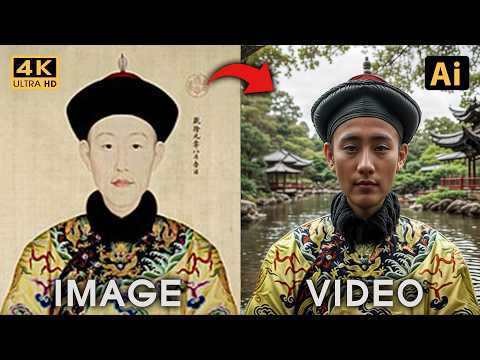
Imagine standing before Cleopatra, the last queen of Egypt, her legendary beauty now a tangible presence. Or locking eyes with Napoleon Bonaparte, his ambition still burning in a gaze that once commanded armies. These are not mere portraits; they are windows into souls who altered the course of history.
But what secrets lie hidden behind these reconstructed faces? The AI doesn’t just recreate appearances—it hints at the stories etched into every line and shadow. The weight of the crown on Emperor Kangxi’s brow, the quiet determination in Isaac Newton’s eyes as he unravels the universe, the fierce resolve of Saladin before the Battle of Hattin.
As the journey unfolds, you’ll encounter the poet Dante, his mind still wandering through hell and paradise; the brilliant mind of Plato, whose ideas echo through millennia; and the tortured genius of Mozart, his music lingering like a ghost in the air. Each figure steps out of the past, not as a relic, but as a living testament to human potential.
This is more than a history lesson—it’s an experience that blurs the line between then and now. Are you ready to meet them? The icons are waiting, their stories ready to be told once more. But be warned: once you’ve seen them like this, the past will never look the same again.
The screen shimmers, and the first figure steps forward from the haze of centuries. It is Dante Alighieri, his face gaunt and weathered, the sharp line of his jaw framed by the crimson hood of his Florentine exile. His eyes—those famous, sorrowful eyes—hold a fire that seems to burn straight through the glass. “You wish to know the weight of a soul,” he murmurs, and his voice carries the echo of a thousand recited cantos. “Then you must first learn to walk through darkness without losing your way.”
He turns, and the scene dissolves into a spiraling descent. The air grows cold, thick with whispers. We are no longer watching Dante—we are following him, down through the nine circles of his Inferno, each terrace revealing faces twisted by their own sins. The AI paints it all with terrifying intimacy: the frozen lake of Cocytus, the burning tombs of the heretics, the river of boiling blood.
Then, a sudden shift. The gloom breaks, and we stand on the shores of Mount Purgatory, where the air tastes of salt and hope. Dante climbs, his steps heavy with repentance, until at last a woman appears in a veil of light. “Beatrice,” he breathes, and the name alone seems to mend something broken in the world.
But the journey does not end there. A new figure emerges from the light—a man with a powdered wig and the sharp, restless eyes of a mind that cannot rest. Isaac Newton stands beneath an apple tree, though the tree is not the point. “Gravity,” he says, almost impatiently, as if the word itself were a tool he has just invented. “It is not magic. It is law. And laws can be understood.”
He gestures, and the orchard dissolves into a dizzying scroll of equations. The three laws of motion spin around him like planets. He lifts a prism to the light, and a rainbow fractures across his face—the discovery of the spectrum, the secret colors hidden in white. “I have stood on the shoulders of giants,” he whispers, “but I have also learned to see what they could not.”
The scene ripples, and Newton fades into the marble halls of Athens. Plato sits beneath a colonnade, his hands folded, his expression serene. He does not speak at first. He simply watches, as though the entire conversation has already happened in his mind. “You are wondering about the world of forms,” he finally says, a faint smile playing at his lips. “Everything you see here is only a shadow. The real world exists beyond the cave.”
He rises and walks toward a wall where shadows dance—men, beasts, and objects projected by a fire we cannot see. “Most people never leave the cave,” he explains. “They mistake the shadows for truth. But the philosopher—the one who dares to turn around—he sees the fire, and then the sun.”
As Plato speaks, the shadows on the wall begin to shift. One of them grows larger, more defined, until it steps out of the cave entirely. It is Aristotle, his student, his critic, his equal in brilliance. “The forms are not enough,” Aristotle says, his voice firm. “We must study the particulars—the animals, the plants, the politics of real men. Knowledge begins with observation, not with abstraction.”
The two philosophers face each other, and for a moment, the air crackles with the tension of a debate that has lasted two thousand years. Then, a new sound cuts through the silence—a piano, distant but unmistakable. The scene dissolves, and we are standing in a dimly lit room in Vienna, where a small man with wild hair and trembling hands hammers at the keys.
Ludwig van Beethoven does not look up. His hearing is gone, but his fingers move with a precision that defies the silence. “I cannot hear the music anymore,” he says, his voice rough with frustration and defiance. “But I can feel it. In my bones. In my soul. And that is enough.”
The music swells—the Ninth Symphony, its final movement rising like a tidal wave. Beethoven closes his eyes, and for a moment, the room fills with a choir we cannot see. “Joy,” he whispers, “beautiful spark of the gods.” The notes hang in the air, and then the scene flickers, pulling us away.
The music fades into the clatter of hooves and the ring of steel. We are standing on a dusty plain beneath a merciless sun, and before us rides a figure in a simple linen shroud—no gold, no jewels, only the quiet authority of a man who has already won. Saladin reins in his horse and studies us with calm, unreadable eyes. “You have come to see the victor of Hattin,” he says. “But victory is not what you think. It is not the blood. It is what you do after the sword is lowered.”
He gestures, and the battlefield dissolves into the streets of Jerusalem. The Crusaders have surrendered, and the city waits in terror for the slaughter that custom demands. But Saladin walks among the defeated, and his voice is gentle. “Rise,” he tells an old woman kneeling in the dust. “No one will harm you. Go home.” The scene is so quiet, so ordinary, that it feels more powerful than any charge of cavalry.
Then the dust of the Holy Land gives way to the green hills of England, and a man with a high, sloping forehead and eyes that miss nothing bends over a tray of beetles and finches. Charles Darwin holds a magnifying glass to a specimen, his brow furrowed with a question that has haunted him for decades. “Look closely,” he murmurs, almost to himself. “Every beak, every wing, every seed—they are all letters in a language older than any scripture.”
He straightens and looks at us, and there is a weariness in his face, the weariness of a man who knows his discovery will break the world in two. “I have seen things on the Beagle that would make angels weep,” he says. “And I have spent twenty years afraid to write them down. But truth does not wait for our comfort.”
The study fades, and we are standing in a crowded Elizabethan playhouse, the air thick with the smell of ale and sweat. William Shakespeare is on the stage, not as a playwright but as an actor, his face half-hidden by a mask. He removes it, and his eyes are quick, amused, endlessly curious. “All the world’s a stage,” he says, and the familiar words suddenly sound like a confession. “And I have spent my life trying to write every part—the king, the fool, the lover, the traitor. Because they are all in here.” He taps his chest.
The playhouse dissolves into the deck of a ship pitching on a black Atlantic. Christopher Columbus grips the rail, his face weathered by salt and obsession. “They said the world was flat,” he shouts over the wind. “They said I was mad. But madness and vision are brothers, and I have sailed with both.” He points west, and the horizon glows with a light that is not the sun—it is the edge of a world no European has ever seen.
But the ship vanishes, and we are in a sunlit garden in Athens, where Aristotle walks among caged animals and pressed plants, cataloguing the living world with the same ferocity his teacher Plato reserved for the world of forms. “Plato looked up,” Aristotle says, “I look down. And what I find is not a shadow—it is a miracle.” He holds up a sea urchin, its spines still moving. “The real world is not a prison. It is a library, and every creature is a book.”
A rustle of silk interrupts him. Cleopatra enters the garden, her dark eyes taking in the philosophers, the animals, the strange assembly of history. She does not bow. “You men spend so much time arguing about the truth,” she says. “I have spent my life using it. Truth is a tool, and a queen must know which edge to hold.” She turns to us, and her smile is both dazzling and dangerous. “Shall I show you how to keep a kingdom?”
Before we can answer, the garden dissolves into the marble floor of the Roman Senate. Julius Caesar stands at its center, toga draped, eyes fixed on something beyond the room. “You want to know how a republic dies,” he says quietly. “It dies when men forget that power is a loan, not a gift.” The senators close in around him, and the scene cuts to black.
From the dark, a chisel rings. Michelangelo appears, dust on his hands, gazing up at the half-finished David. “I do not create,” he says. “I release what is already there. Every soul hides a masterpiece, waiting for the courage to be uncovered.”
A new voice interrupts—a young man at a harpsichord, fingers flying. Mozart laughs, bright and reckless. “Life is short, so make it sing!” The melody swells, and the room fills with light.
Then silence. A man in a simple grey coat stands at the edge of a battlefield, watching the sun set over a frozen island. Napoleon looks back at us, and for once, his ambition seems tired. “I conquered Europe,” he says, “but I could not conquer time. Perhaps that is the only honest lesson.”
The figures gather now, one by one, in a circle of faces that span centuries—Jefferson, Goethe, Shakespeare, Darwin, Saladin, all watching us. “You have seen us,” Dante says softly, “but the question was never whether you could see the past. It is whether you will let it change you.”
The screen flickers, and they begin to fade, each returning to the fog of history. But just before the light dies, Cleopatra turns one last time. “History is not a mirror,” she whispers. “It is a door. Will you walk through it?”
The screen goes dark. And the question lingers, waiting for you.
Report this article
Select a reason for reporting:






