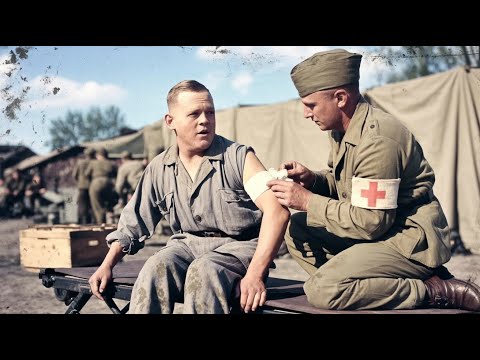
November 1943, the Western Front. When this wounded German soldier was captured by American forces, he prepared to die. Nazi propaganda had taught him that the enemy would abandon wounded prisoners as useless burdens—just as his own army often did. But what happened next in that American field hospital would shatter everything he believed about war, about enemy nations, and about the true meaning of strength.
The question that will haunt you after hearing his story is: if your worst enemy treated you better than your own people, what would that do to everything you thought you knew about right and wrong?
The cold November air pierced the torn fabric of Hans Müller’s uniform as he lay weakly against a stone wall of what had once been a farmhouse outside Monte Battaglia, Italy. It was 1943, and the war that Adolf Hitler promised would bring glory to the German people was slowly grinding his country into dust.
Hans could hear the distant rumble of American Sherman tanks moving through the valley below. Their steel tracks crushing everything in their path. His left leg was gone from below the knee, amputated by an American artillery shell three hours ago. The crude tourniquet his squad leader had tied around his thigh was soaked through with blood.
Hans pressed his back harder against the cold stone, feeling the sharp edges of each rock dig into his spine. The pain helped him stay awake. Sleep meant death, and he wasn’t ready to die yet.
For months, German High Command had told soldiers like Hans exactly what to expect if captured by the Americans. “The enemy are savage beasts,” they said. “They torture prisoners for information, then leave them to rot in filthy camps. The disabled are treated even worse.”
Hans had heard these stories whispered around campfires during the long retreat through Sicily. “American soldiers will shoot wounded Germans rather than waste medical supplies on them. It’s more merciful that way,” the officers explained. The Americans viewed injured enemy soldiers as nothing more than excess baggage.
Hans touched the small photograph in his breast pocket, feeling its worn edges through the fabric. His wife Maria and their two-year-old son Klaus looked back at him from that black-and-white image. He hadn’t seen them in eight months.
Maria’s last letter, now lost somewhere in the wreckage of a destroyed supply truck, told him that food had become scarcer in their small Bavarian village. Bread rations had been cut again. Little Klaus was growing thinner.
The sound of boots crunching on broken glass made Hans freeze. American voices drifted through the smoke-filled air, speaking in their strange, flat language. Hans couldn’t understand the words, but he recognized the tone. They were searching the rubble, looking for survivors.
His hand moved instinctively toward his empty holster. He had thrown his Luger into a ditch two kilometers back when shrapnel tore through his leg.
Hans had been raised in a Germany where weakness was shameful. His father had served in the Great War and taught him that a soldier’s duty was strength, to endure pain without complaint, and never become a burden to his comrades. The Nazi Party reinforced these ideas further. They spoke of creating a master race, building a nation where only the healthy and strong thrived.
Hans had seen what happened to disabled veterans in his hometown. They were pushed to the edges of society, given meager pensions, and then forgotten. Some simply disappeared. And now, Hans had become one of them.
A broken soldier with half a leg, lying in enemy territory with no weapon and no hope of escape. According to everything he had been taught, he was now worthless. His army would have no use for a man who couldn’t walk, couldn’t fight, couldn’t contribute to the war effort. And if his own people would abandon him, what mercy could he expect from the enemy?
The American voices were getting closer. Hans could hear them moving through the ruins of the next room, their heavy boots scraping against chunks of concrete and twisted metal. He tried to make himself smaller, pressing his body further into the shadows behind a fallen beam.
His leg throbbed with every heartbeat, sending waves of searing pain up his spine. Black spots began dancing at the edges of his vision. Through a gap in the wall, Hans caught his first glimpse of the American soldiers.
They were larger than he expected, their uniforms clean and well-fitted despite days of combat. Their helmets gleamed with a metallic sheen that German equipment had lost months ago. Most shocking of all, they moved with purpose, but without cruelty. Hans had expected murderous, wild-eyed killers, but these men looked supremely professional as they searched the debris.
One of the Americans knelt near a pile of rubble and called out something in broken German. Hans could barely make out the words, but the tone wasn’t threatening. The soldier was asking if anyone was hurt, if anyone needed help.
Hans almost laughed at the absurdity. Help from the enemy? It had to be a trick, a way to lure hiding German soldiers into the open for easy shooting. But as Hans watched, something happened that made no sense according to everything he had been told about American brutality.
They found a wounded Italian civilian, an old man with a gash across his forehead. Instead of ignoring him or pushing him aside, they immediately began treating his wounds. One American pulled a white bandage from his pack and began wrapping the man’s head with precise, gentle movements. Another offered the Italian man water from his own canteen.
Hans blinked hard, wondering if blood loss was making him see things. But the scene continued to unfold before his eyes. The Americans were actually helping an enemy civilian, using their own medical supplies, taking time away from their military objectives to care for someone who meant nothing to them.
It didn’t make sense. It contradicted everything Hans had been taught about how war was supposed to work. The sound of his own ragged breathing seemed incredibly loud in the sudden quiet. Hans tried to control it, but his damaged body wouldn’t respond. The black spots were growing larger, and he felt consciousness slipping away despite his efforts to stay awake.
His last thought before darkness claimed him was a question that would haunt him for the rest of his life. If these Americans were willing to help a stranger, what would they do to him?
Hans woke to the strangest feeling he had known in months: clean sheets, white and soft against his skin. He stared at a spotless white ceiling, lit by warm electric bulbs. The smell was soap and something sharp he would later learn was disinfectant.
An American soldier in a white coat stood beside his bed, speaking broken German. “You are safe now. Your leg—we cleaned the wound. No infection. You will live.” Hans looked down at the stump wrapped in layer upon layer of clean white bandages. More medical supplies than he had seen used on a single patient in the entire war.
Over the next three days, the impossible became ordinary. Meals arrived three times daily—real meat, fresh green vegetables, soft white bread. On his fourth morning, he watched a bright red truck unload wooden crates marked with curving letters: Coca-Cola. A nurse brought him a green bottle of the dark, fizzing liquid. It was sweet and sharp at once, bubbles stinging his nose.
Captain Morrison visited every morning, speaking of Hans’s recovery as though it mattered to him personally. They were requesting a custom artificial leg from a factory in Ohio. Two weeks to arrive. Hans could not understand why these people would spend so much on a man who had been trying to kill them days before.
On his sixth day, African-American nurses arrived in crisp white uniforms, working side by side with white doctors, treating German prisoners with the same gentle care. One woman, barely older than his Maria, spent extra time teaching him to balance on crutches. When he fell, she helped him up without a trace of impatience. She treated him more kindly than some German officers had treated their own men.
Hans began lying awake at night, staring at the clean white ceiling. Everything his government had told him about Americans was proving false. They were not savage killers. They were not wasteful. They believed every human life had value—even an enemy soldier who could no longer fight. The abundance was almost frightening. The medical supplies used on him alone could have treated fifty German soldiers. The food he ate in a day was more than many German civilians saw in a week.
And yet the Americans acted as though this level of care was normal, as though treating enemies with dignity was simply the right thing to do. As Hans watched American doctors work to save German prisoners’ lives, he began to wonder about something that would change his understanding of everything. If these people treated their enemies this way, how did they treat their own citizens? What kind of society could produce such wealth, such organization, such fundamental respect for human life? And what did that mean for the society that had sent him to fight against them?
The moment that would change Hans Müller forever came on a cold Thursday morning in late November, exactly three weeks after his capture. His new artificial leg had been fitted the day before—a marvel of American engineering weighing only four pounds, yet feeling as solid as steel beneath him. It had been made in an Ohio factory to his exact measurements, shipped across an ocean in wartime, and fitted by specialists who treated him like a brother returned from battle.
Hans was still learning to walk on it when Captain Morrison appeared beside his bed with an unusual request. The Americans were celebrating something called Thanksgiving, their doctor explained in his careful German. A day to give thanks for their blessings and share a feast with everyone around them. Hans would be welcome to join the celebration in the main dining hall—not as a prisoner forced to watch, but as an invited guest at their table.
The idea seemed impossible. Hans had spent two years fighting these people, trying to kill them, following orders to destroy everything they valued. And now they wanted him to sit at their table and share their most important meal of the year. He tried to refuse, certain it must be some kind of test or trap, but Captain Morrison’s smile was so genuine that Hans found himself nodding before he fully realized what he was agreeing to.
That evening, Hans made his way slowly down the hospital corridor, his new leg making soft clicking sounds on the polished floor with each step. The main dining hall had been transformed into something that looked more like a palace than a military facility. Long tables covered with white cloths stretched across the room, arranged with real plates and silverware that reflected the light from dozens of electric lamps hanging overhead.
The smell that filled the air was rich and warm, nothing like the thin soup and dry bread that had become Hans’s normal fare over the past year. American soldiers sat alongside German prisoners at the same tables, sharing the same food from the same serving dishes. Hans watched in amazement as enemy soldiers passed platters to the men who had been shooting at them just weeks before. There was no separation, no special section for prisoners, no guards standing over them with weapons. Just men eating together as though the war had never happened.
The food itself was beyond anything Hans could have imagined. Turkey so tender it fell apart at the touch of a fork. Sweet potatoes covered in butter that melted on his tongue, cranberry sauce both tart and sweet at once, green beans that were actually green instead of the gray mush he had eaten for months, and fresh bread rolls still warm from the oven. Hans ate slowly, trying to make each bite last, knowing that this level of abundance couldn’t possibly be real.
But it was the pies that broke something inside Hans’s understanding of the world. Apple pie, pumpkin pie, and something called pecan pie were sweeter than any dessert he had ever tasted. The American cook, a cheerful man still covered in flour, explained through a translator that he had made thirty-seven pies for the celebration. Thirty-seven pies, Hans repeated to himself. In Germany, sugar was so scarce that his mother hadn’t baked a cake in over a year. Here, the Americans were making dozens of desserts for a single meal and serving them to enemy prisoners as though it were the most natural thing in the world.
Hans found himself seated next to a young American soldier named Tommy from a place called Iowa. Tommy had been wounded in the same battle where Hans lost his leg, and now they sat side by side trading stories in a mixture of broken German and simple English. Tommy wanted Hans to see pictures of his family’s farm, with fields of corn stretching to the horizon and cattle that looked fat and healthy.
Hans shared his own photograph of Maria and Klaus, and watched Tommy’s face light up with the same proud smile that Hans wore when he talked about his son. The conversation around the table grew louder and more friendly as the evening progressed. Hans listened to the American soldiers talk about their homes, their dreams for after the war, their worries about family members serving in other parts of the world. They weren’t the savage killers that German propaganda had described. They were farmers and factory workers, students and store clerks, men who missed their mothers and worried about their sweethearts, just as German soldiers did.
As the meal continued, Hans noticed something that made his chest tighten with confusion and shame. An American corporal named Jackson, a man with dark skin whom Hans had been taught to view as inferior, was teaching a group of German prisoners a card game called poker. Jackson’s hands moved with confidence and speed as he dealt the cards, explaining the rules in simple, patient German that he had clearly learned specifically for this purpose. When one of the German prisoners made a mistake, Jackson laughed good-naturedly and helped him understand the correct way to play.
Hans watched this scene with growing bewilderment. In Germany, he had been told that American Negroes were treated like animals, that they were stupid and dangerous, that they lived in fear and misery. But here was a black soldier speaking multiple languages, having learned German specifically to communicate with enemy prisoners, and treating German soldiers with more kindness than some German officers showed their own men. Jackson’s uniform was as clean and sharp as any white soldier’s. His equipment was identical, and the other American soldiers clearly respected him as one of their own.
The moment of complete ideological collapse came when Hans excused himself to use the restroom and got lost in the hospital corridors. His new artificial leg was still unfamiliar, so he moved slowly down the wrong hallway, looking for someone to ask for directions. Through an open door, he saw something that made him stop and stare in disbelief.
A German prisoner. A man Hans recognized as Sergeant Weber from his own unit, lay unconscious on an operating table. Weber had been captured three days ago with serious internal injuries. Wounds that would have meant certain death in any German field hospital. But here, a full team of American doctors and nurses was working to save his life.
Hans could see expensive equipment humming and blinking around Weber’s body. Machines that cost more than most German soldiers earned in a year. What shattered Hans’s understanding completely was the sight of the chief surgeon, an older American doctor with gray hair and tired eyes, carefully stitching Weber’s torn intestines. The operation had been going on for hours, and this doctor was devoting his skills and America’s precious medical supplies to saving the life of an enemy soldier who would never be able to fight again.
Weber would survive, but he would be permanently disabled, unable to work or contribute to the war effort. According to everything Hans had been taught about military logic and racial superiority, this operation made no sense. Weber was now useless as a soldier and a burden on whoever would care for him. The rational action would have been to let him die and save the medical supplies for someone still capable of fighting.
That was what German military doctrine dictated, what Nazi ideology demanded, what Hans had accepted as natural his entire adult life. But these Americans were spending thousands of dollars and countless hours of skilled labor to save a man who could never repay them, a man who had been their enemy just days before, and who would need care and support for the rest of his life. They weren’t doing it because Weber was valuable to them, or because he would help them win the war, but simply because they believed his life had value.
Hans slid down the wall, suddenly feeling his artificial legs heavy and uncomfortable beneath him. The tears came again, more violently this time. Great, heaving sobs that he couldn’t control. He wasn’t crying for Weber, though he was grateful that his fellow soldier would live. He was crying for himself, for the man he had been, for the beliefs that had shaped his entire understanding of right and wrong.
Captain Morrison found Hans there twenty minutes later, still leaning against the wall with tears streaming down his face. The American doctor didn’t ask what was wrong or demand an explanation. He simply helped Hans back to his room, walking slowly to match the pace of the artificial leg, offering his arm for support whenever Hans stumbled.
That night, Hans lay in his clean hospital bed and tried to write a letter to Maria. He wanted to tell her about the Thanksgiving dinner, about the American soldiers who had become his friends, about the society he had discovered that treated its enemies better than Germany treated its own wounded veterans. But every time he tried to find the words, he realized how impossible it would be for her to believe him.
How could he explain that the Americans had spent more money on his artificial leg than his family had seen in five years? How could he describe a country so wealthy that they threw away more food in a single day than most German families ate in a month? How could he make her understand that the enemy they were fighting wasn’t a nation of savage beasts, but a people who believed that every human life, even German lives, deserved dignity and care?
Hans finally put down his pen and stared out the window at the American flag flying over the hospital compound. The stars and stripes moved gently in the night breeze, illuminated by electric lights that stayed on all night because these people had so much power they didn’t need to worry about conservation. He thought about the German flag with its swastika and its promises of racial superiority, and wondered how he had ever believed that hatred and cruelty could build a better world.
The question that had been growing in his mind for weeks was impossible to ignore now. If America treated its enemies this way, what did that say about everything he had been fighting for? And more terrifyingly, what would he find when he returned to the Germany that had taught him to see compassion as weakness and mercy as foolishness?
Hans closed his eyes and tried to imagine explaining this to his son Klaus, that the Americans he had been sent to kill were actually the most honorable people he had ever met. The thought terrified him more than any artillery barrage he had faced in his life.
The train that carried Hans Müller back to Germany in March 1946 was nothing like the clean, efficient transport he had expected after his American experience. The wooden seats were cracked and uncomfortable. The windows were clouded with dirt, and the carriage smelled of unwashed bodies and old cigarettes.
Hans shifted his weight carefully, adjusting his American-made artificial leg in the cramped space between seats. The limb was still functioning perfectly after more than a year of use, its metal joints moving smoothly and silently with each step he took.
In his worn canvas bag, Hans carried the physical reminders of his time as an American prisoner. A small bottle of aspirin that Captain Morrison had given him for the phantom pain in his missing leg. A folded paper with Tommy’s address in Iowa, along with a promise to exchange letters about life after the war. Three photographs that American soldiers had taken of the Thanksgiving dinner, showing Hans seated at the same table with his former enemies, all of them smiling like old friends.
Most precious of all was the letter of recommendation that Captain Morrison had written in precise German script. The letter explained Hans’s medical condition and praised his character, suggesting that any employer would be fortunate to have such a dedicated worker. Hans had read the letter so many times that he knew every word by heart. But he still took it out occasionally to make sure it was real. No German officer had ever written such a letter about a disabled soldier.
Hidden deep in his bag was something even more valuable. A small notebook filled with his own handwriting, documenting everything he had witnessed during his captivity. Hans had recorded details of every meal, every medical treatment, every conversation with American soldiers. He had drawn diagrams of the hospital equipment, noted the names of medications, described the industrial kitchen that fed thousands of men each day. The notebook was his proof that what he had experienced was real, not just a fever dream brought on by blood loss and shock.
The train stopped with a screech at the bombed-out ruins of Munich’s main station. Hans gathered his few belongings and stepped onto the platform. The contrast was shocking, like a physical blow to his chest. While American train stations had bustled with people in smart clothes carrying leather bags and discussing business trips, this platform was filled with pale-eyed refugees clutching cardboard boxes and cloth bundles. Children with thin faces and patched clothes clung to their mothers, and old men leaned heavily on wooden crutches that looked like they had been carved from tree branches.
Hans limped through the crowd, his American artificial leg making soft sounds on the broken concrete. People stared at his limb with a mixture of envy and suspicion. Artificial limbs were rare in Germany, available only to the very wealthy or well-connected. Most disabled veterans made do with simple wooden legs or crutches, if they were lucky enough to get anything at all.
An old woman with missing teeth pointed at Hans’s leg and asked loudly how he had obtained such an expensive device. When Hans mumbled something about military medical care, she laughed bitterly and showed him her husband’s crude wooden leg. “My Johann lost his leg at Stalingrad,” she said. “The army gave him a piece of firewood and told him to be grateful he was still alive. Where did you serve to get such a wonderful leg?”
Hans couldn’t answer without revealing the truth about his capture by the Americans. So he simply nodded and moved on. But the encounter revealed something he hadn’t expected. His artificial leg marked him as different, as someone who had received special treatment that other German veterans had been denied. The very thing that proved American generosity seemed to other Germans like evidence of unfair privilege.
The bus ride to his village took three hours instead of one, stopping constantly for engine trouble or to navigate around bomb craters in the road. Hans watched the German countryside pass by the dirty windows and felt his heart clench with each mile. The fields that should have been green with spring crops were brown and empty. Farmhouses still had collapsed roofs and walls riddled with bullet holes. Entire villages had been reduced to piles of rubble, with only a few chimneys pointing at the gray sky like broken fingers.
At one stop, Hans watched a group of German children digging through a garbage pile behind a small store, searching for food scraps or anything useful they could trade. The oldest couldn’t have been more than ten, but he moved with the precise efficiency of someone who had been hungry for a very long time. Hans thought of the American children he had seen in photographs the soldiers shared, healthy and smiling, playing with toys and eating ice cream. The contrast made him feel sick.
Maria was hanging laundry on a line strung between two trees when Hans finally arrived at their small house on the dirt road. She looked older than her twenty-six years. Gray streaks had appeared in her hair, and her dress hung loosely on her thin frame. Little Klaus, now nearly four years old, peered out from behind his mother’s skirt with eyes that seemed too large for his pale face.
The reunion was not the joyful homecoming Hans had imagined during his long months in the American hospital. Maria’s embrace was hesitant, almost formal, as though she wasn’t sure this man with his strange artificial leg and his foreign stories was really her husband. Klaus wouldn’t come near him at first. He was frightened by the clicking sound of the prosthetic and confused by his father’s tales of enemy soldiers who had treated him like family.
Hans tried to share his American medicines and the small gifts he had brought, but Maria’s reaction was not what he expected. When he offered her the aspirin, she asked suspiciously where he had gotten such an expensive drug. When he showed her the photographs of the Thanksgiving dinner, she stared at them for a long moment before asking why he was smiling while sitting with men who had been trying to kill Germans.
The most difficult moment came when Hans tried to explain what he had learned about American society and how it had changed his understanding of the war. Maria listened silently as he described the abundance of food, the quality of medical care, the dignity with which prisoners were treated. When he finished, she remained quiet for several minutes before speaking.
“Hans, you must not tell these stories to others in the village,” she said carefully. “They will think the Americans did something to your mind while you were captured. People here have lost sons and fathers fighting against these Americans. They won’t want to hear that our enemies were kind to you.”
Hans realized his wife was right, but the knowledge felt like another wound in his chest. He had returned home carrying the truth about what he had experienced, but it was a truth his people couldn’t accept. The contrast between American abundance and German scarcity was too great. The difference in how the two societies treated their weakest members was too stark. The gap between propaganda and reality was too wide for most Germans to bridge.
During his first week back, Hans made a serious mistake. In the village tavern, weakened by beer and desperate to share his experiences with someone, he began telling another veteran about the American hospital. He described the clean sheets, the plentiful food, the careful medical care he had received. The other man, who had lost an arm in Normandy and received no prosthetic, listened with growing anger.
“It sounds like you enjoyed being a prisoner,” the man said finally, loud enough for everyone in the tavern to hear. “Maybe you should have stayed with your American friends if they treated you so well.”
Silence fell over the room, and Hans felt every eye in the tavern staring at him with suspicion and disgust. He left without finishing his drink and never spoke publicly about his captivity again.
In the months that followed, Hans found work as a clerk in the village government office, using Captain Morrison’s letter of recommendation to convince local officials that his disability wouldn’t prevent him from performing his duties efficiently. He was one of the few disabled veterans in the area with a steady job, and he knew he owed it to the American doctor’s faith in his abilities.
The job brought Hans face to face with the devastating reality of post-war Germany. Every day, widows came to his office asking about pension payments that never arrived. Disabled veterans filled out medical assistance forms that the government couldn’t afford to provide. Families applied for housing assistance after their homes were bombed, but there were no resources to help them rebuild.
Hans processed these requests with growing shame, knowing that America had the resources to solve these problems while his own country had squandered its strength on a war that brought only misery. He began quietly helping other disabled veterans in his community, sharing his American medicines and teaching them exercises that the hospital physical therapists had taught him. He never told them where he learned these techniques, claiming only that he had picked them up during his recovery.
He used his small salary to buy extra food for families with injured fathers, remembering the abundance he had witnessed and feeling ashamed that his country couldn’t provide similar care for its own warriors.
The hardest case was Sergeant Weber, the man whose life American doctors had saved during that long operation Hans had witnessed. Weber had indeed survived, but he had returned to Germany with severe intestinal damage that required ongoing medical care. The German medical system had no resources to help him. Weber was slowly dying from complications that could have been easily treated in an American hospital.
Hans visited Weber regularly, bringing him small portions of his American medicines and sitting with him during his worst pain. Weber never knew that Hans had watched American doctors save his life, or that those doctors would have continued his care if he had remained in captivity. Hans kept this knowledge to himself, but it ate at him like acid. Here was a man whose life had been saved by enemy generosity, now dying because his own country couldn’t provide the same level of care.
At night, Hans sat at his kitchen table and wrote letters to Tommy in Iowa, carefully phrasing every sentence to avoid mentioning military details that might raise censorship suspicions. Tommy replied with stories about corn farming and fixing farm equipment, casual mentions of buying new clothes and taking his girlfriend to the movies. The letters painted a picture of normalcy and prosperity that seemed like fairy tales compared to post-war Germany.
One of Tommy’s letters included a small photograph of his family’s Thanksgiving dinner in 1947. Hans stared at the picture for hours, comparing it to the meal he had shared with American soldiers two years earlier. The abundance was identical—tables groaning under the weight of food, people with full, healthy faces, children playing with their toys while adults talked and laughed. Tommy’s family was celebrating in peacetime what Hans had experienced as a prisoner of war. And both meals showed the same astonishing level of wealth and generosity.
Hans tried to imagine a similar photograph taken in his village. German families were still gathering around tables with empty plates, telling their children that food would come someday, making meals from scraps and hoping things would improve. The contrast was so sharp that Hans sometimes wondered if he had imagined his entire American experience.
Klaus gradually grew accustomed to his father’s artificial leg and began asking questions about the clicking sound it made when Hans walked. Hans would lift his son onto his lap and explain how the American doctors had made this leg specially for him. How they had measured every part of his remaining limb to ensure a perfect fit. How they had spent more money on this single prosthetic than most German families earned in a year.
“Why did the Americans help you, Papa?” Klaus asked one evening as they sat together watching the sunset. “Were you friends?”
Hans was silent for a long moment, thinking about how to answer a question that still puzzled him.
“No, Klaus,” he said finally. “We were enemies when they found me. They helped me because they believed all humans deserve help, even their enemies. They proved to me that strength doesn’t mean hurting those weaker than you. Being truly strong means using your power to lift up everyone around you.”
As Klaus grew older, Hans began teaching him the lessons he had learned during his American captivity, without revealing their source. He taught his son to share his food with less fortunate children, to help elderly people who struggled with heavy loads, and to treat everyone with respect regardless of their background or beliefs. When Klaus asked why these things mattered, Hans would simply answer that caring for others is what separates good people from bad.
The most profound change in Hans’s life came during the winter of 1948, when a severe cold wave killed dozens of elderly people in neighboring villages. Hans organized relief efforts, using his government position to coordinate donations of food and fuel. He worked eighteen-hour days, limping from house to house on his artificial leg, checking on families and distributing supplies. When people asked why he worked so hard to help others, Hans remembered Captain Morrison spending his own money to buy extra medicine for him, and Tommy sharing pictures of his family with a man who had been trying to kill Americans just weeks before.
Years later, when Klaus was old enough to understand, Hans told him the full story of his American captivity. He explained how that Thanksgiving feast had taught him that a nation’s true strength isn’t measured by its ability to destroy enemies, but by the dignity it grants to those who cannot defend themselves.
Hans never returned to America, but he carried its lessons with him for the rest of his life. He became known in his village as a man who helped anyone in need, regardless of their political affiliations or past. When people asked why he was so generous with his time and resources, Hans would simply answer that he had learned during the war that showing kindness to others isn’t a sign of weakness—it is the truest measure of strength.
The artificial leg that American doctors had made for him lasted more than twenty years, making a soft clicking sound with each step, a constant reminder of the day his understanding of human nature changed forever. When the prosthetic finally wore out, Hans kept it in his closet, unable to throw away the physical proof that his enemies had treated him better than his own country treated its disabled veterans.
When Hans finally told his grandchildren about his experience as a prisoner of war, he ended the story with the same words every time. “I went to fight America and came home knowing that the real enemy was always the hatred in my heart. The Americans showed me that the strongest people are those who use their power to lift others up, even those who have wronged them. This is the lesson I want you to remember long after I am gone.”
In his final years, Hans often sat in his garden and thought about the two paths nations could choose. They could follow the German model he had witnessed in his youth, using their power to crush the weak and glorify the strong, building a society where only the perfect were valued and the disabled were cast aside. Or they could follow the American model he had seen, using their abundance to care for everyone, even their enemies, building a society where every person’s life had value regardless of their ability to contribute.
Hans chose to spend the rest of his life proving that the second path wasn’t just possible—it was necessary for any society that wanted to call itself truly civilized. And every click of his American-made artificial leg reminded him that our greatest teachers are sometimes the people we once considered our enemies.
So now I ask you: if you discovered that your enemy treated your wounded better than your own country did, would you have the courage to question everything you were taught—or would you cling to the hatred that feels safer?
Report this article
Select a reason for reporting:






