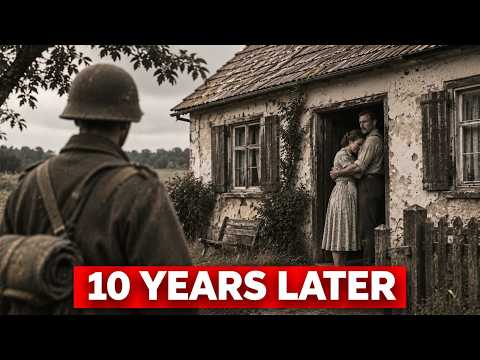
On a cold February night in 1947, radios across northern Germany crackled with the voice of a man coming home from the war. His name was Beckmann. He had spent three years in a Siberian prison camp, and he returned to Hamburg to find his wife in the arms of another man. She no longer called him by his first name. She called him Beckmann—as if he were a stranger, a ghost, a relic of a past she had buried.
But Beckmann was not real. He was a character in a radio play, a fiction conjured by a dying young writer named Wolfgang Borchert. What almost no one listening knew was that the law had already planned for real men like him—men who would come home years, even a decade, after the war ended. And that law gave the returning husband no say at all.
Borchert knew exactly what he was writing about. He had served on the Eastern Front, been imprisoned twice for undermining military morale, and come home with a liver disease that would kill him at twenty-six. He wrote the play in eight days, and when it aired, the response was explosive. Half the letters were adoring; half were furious. The press called it the voice of a generation. Borchert never heard it—a power cut silenced his radio that night—and he died before it ever reached the stage.
But the play was only a mirror. The men Beckmann stood for were millions. In 1948, three years after the war, hundreds of thousands of German prisoners remained in Allied and Soviet camps. The Soviet Union had taken over three million men; only about two million ever came home. For families, there was no news, no grave, no closure—only a void that the state had learned to manage with paperwork.
Germany had done this before. A 1916 decree had made it easier to declare soldiers dead on the battlefield. The law used after World War II was the Missing Persons Act of 1939, revised in 1951. It allowed a court to declare a missing person dead, and from that moment, the state took over. Normally, a person had to be missing for ten years. But for the war, a special rule applied: anyone missing in connection with the war could be declared dead, with the date of death typically set at the end of 1945. For prisoners, the waiting period was five years after the last year they were known to be alive.
A declaration of death changed everything on paper. It settled estates, freed widows’ pensions, and—most crucially—allowed a wife to marry again. Courts took these declarations seriously. In 1949, Austria’s Supreme Court ruled that a declaration of death created a presumption of death that applied to everything, including marriage. On paper, a declared man was dead. The question was what happened if he walked through the door.
For the women at home, the arithmetic was brutal. In 1950, West Germany counted nearly three million more women than men. Around one million war widows lived in the Western zones alone. They had raised children through bombing and hunger, not knowing whether their husbands were prisoners, graves, or names on a list. Some waited ten years. Some stopped waiting. And some marriages that survived the homecoming broke apart soon after—divorces tripled compared to pre-war years.
Behind each number was a decision made alone at a kitchen table. If your husband had been missing for eight years with no letter and no grave, would you have waited—or started a new life?
For the women who chose not to marry again, the state had its own problem. A war widow could receive a pension, but if she remarried, that pension stopped. So many women made a different choice: they lived with a new partner without marrying him, keeping the pension. These relationships had a name in post-war Germany—Onkelehen, uncle marriages.
The state saw them as a problem. A 1961 ruling of West Germany’s Federal Social Court described what lawmakers had intended: by allowing a widow’s pension to be revived if a new marriage ended, and by paying a larger lump sum on remarriage, they wanted to make marriage more attractive and push back against what the court called pension concubinage. The same incentives were written into the law for war victims. A later ruling clarified that the lump sum was paid only once, for a widow’s first remarriage.
The writer Heinrich Böll put these households into a novel. In The Unguarded House (1954), two boys grow up without fathers in a city on the Rhine. One mother refuses to marry again; another lives with a series of uncles, mostly out of financial need. Some scholars have since read the novel as a moral judgment on how war widows lived.
For the women who did remarry—and for the husbands who came back—the law had already worked out who would win. In February 1946, the Allied Control Council issued a new marriage law. Two short paragraphs dealt with exactly this situation. The rule itself was older than the occupation; its wording was essentially the same as in Nazi Germany’s marriage law of 1938.
Paragraph 38 said this: if a wife married again after her husband had been declared dead, her new marriage was valid even if the first husband turned out to be alive. The only exception was if both she and her new husband had known at the time of the wedding that he had survived. With the new marriage, the old one was dissolved—and it stayed dissolved, the law said, even if the declaration of death was later overturned.
Paragraph 39 dealt with the return. If the husband who had been declared dead was still alive, his former wife could ask a court to annul her new marriage. The right was hers alone. And if she used it, she could not then marry whoever she liked. While her first husband was alive, the only man she could marry again was him.
An East German legal journal explained the reasoning in 1954: the law gave the remarried wife the right to undo her second marriage, but it did not want her simply to free herself from the second man and then choose freely. Read from the side of the man at the door, the law was stark. He had been dead on paper; his marriage was gone. He had no claim to undo his wife’s new marriage and no right to demand that she come back. Whether he had a wife at all now depended entirely on her.
The rule never went away. It is still part of German law today. Paragraph 1320 of the German Civil Code says almost the same thing the Allied law said in 1946. If a spouse who has been declared dead is still alive, the other spouse may ask for the new marriage to be annulled—unless they knew at the wedding that the first spouse was alive. Today’s version adds a deadline: the request must be made within one year of learning that the person declared dead is alive.
Most German prisoners in the Soviet Union came home by 1950, but some did not return until the war had been over for ten years. By then, West Germany had started to pay them under a law of January 1954: former prisoners received 30 Deutschmark for every month spent in captivity from the start of 1947, and more for men released after the start of 1949. The largest group entitled to it was the roughly two million men who had come back from Soviet captivity.
In September 1955, Chancellor Konrad Adenauer traveled to Moscow and secured the release of the last German prisoners of war. The release covered not only soldiers but also Germans convicted by Soviet military tribunals and German civilians held in the gulag. On the 7th of October 1955, the first of these late returnees reached the transit camp at Friedland in Lower Saxony. A temporary branch camp was opened in the town of Dassel to help receive them.
Friedland had been opened by the British in September 1945 on the grounds of a university agricultural research station near Göttingen. By the end of that first year, more than half a million people had already passed through it. Now it received the last of them. Returnees were greeted with a hymn that became known as the Friedland Choral. The last of the late returnees arrived in January 1956. Years later, in 1967 and 1968, a memorial to the returnees was built on a hill above the camp.
Among the late returnees were around 10,000 soldiers. Most had spent a decade in Soviet camps, and most had been sentenced to 25 years of forced labor in Soviet trials. Some were convicted war criminals; some were later put on trial again in West Germany. Beckmann in the play had come home after three years. These men came home after ten.
The West German press reported, somewhat optimistically, on how well they had survived. But under the 1951 law, a man held since 1945 could have been declared dead years before he ever reached Friedland. The photographs showed mothers searching the crowds for their sons, and one mother kissing Adenauer’s hand. They did not show what happened later, behind the doors of houses where a wife had waited—or had not.
For a man who found that his wife had remarried, Paragraph 38 had already decided the outcome. The new marriage stood; his did not.
On the other side of the inner German border, East Germany wrote its own rules. Returnees from Soviet captivity came through the reception camp at Gronenfelde near Frankfurt an der Oder. East Germany’s family code of 1965, in force from 1966, made a declaration of death end the marriage outright from the moment it became final. But it dealt with the man who came back in a different way: if the spouse declared dead turned out to be alive and the other had remarried, the law allowed a divorce to be sought within one year.
Two German states, built on two opposing systems, both had to write rules for the same situation. A woman who had been told her husband was dead had married again—and then the dead man had come home.
Germany kept telling this story long after the last prisoners returned. In 1979, Rainer Werner Fassbinder made The Marriage of Maria Braun. Maria marries a soldier named Hermann in 1943. During an air raid he goes back to the front, and she is told he has been killed. She starts a new relationship with an American soldier. Then Hermann comes back from captivity and walks in on them. In the heat of the moment, Maria kills the other man; Hermann takes the blame and goes to prison for her. When he is released, he leaves for Canada. The film ends in July 1954 with the World Cup final playing on the radio. It was a box-office success, and Hanna Schygulla won the Silver Bear at the Berlin Film Festival for playing Maria.
Decades later, German television was still returning to the same story, in films such as Die Ehefrau des Heimkehrers—The Returnee’s Wife—broadcast in 2006. In 1947, Böll told this story through the husband who came home to a closed door. In 1979, Fassbinder told it through the wife who had to decide whether to open it. Between those two stories stood the law, which had already settled that the decision was hers.
And so the question Borchert’s Beckmann never got to ask still hangs in the air, decades after the last train pulled into Friedland: if the door finally opens, who among us would truly know which side of it we belong to?
Report this article
Select a reason for reporting:






