He was the military genius Hitler couldn’t control, the strategist Churchill and Montgomery fought to free, and the man the SS secretly investigated for Jewish ancestry. Erich von Manstein—perhaps the greatest general of World War II—lived a life shrouded in paradoxes. But how much do you really know about the man behind the legend?
Born into Prussian aristocracy, he was adopted before his first breath, carried a surname not his own, and rose to become the architect of Germany’s most stunning victories. Yet his story is far darker and more fascinating than the history books admit.
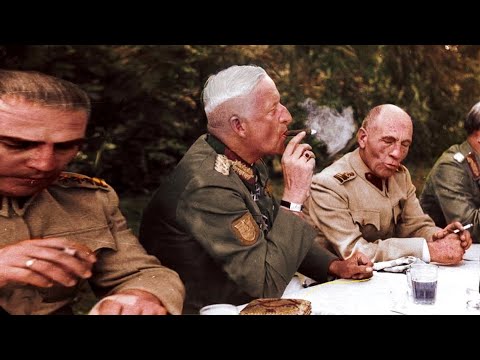
In 1948, three years after the war, Manstein stood trial as a war criminal. The verdict: eighteen years in prison. The world expected silence. Instead, two of his most unlikely defenders emerged—British Field Marshal Bernard Montgomery and Prime Minister Winston Churchill—both of whom campaigned tirelessly for his release. By 1953, Manstein walked free. Why would the men who defeated him fight so hard to save him?
But that’s just one curiosity. Consider this: Manstein was never supposed to be a Manstein at all. He was born Erich von Lewinski, the tenth child of General Eduard von Lewinski. Before his birth, a pact was struck—he would be adopted by his mother’s sister, Hedwig, and her husband, Lieutenant General Georg von Manstein, who could not have children. At his baptism, the infant was renamed Erich von Manstein. Both his biological and adoptive families traced their lineage to the Teutonic Knights, and one of his aunts would later marry Paul von Hindenburg, the future president of Germany.
As Manstein’s star rose after the fall of France, his brilliance threatened the old guard. General Franz Halder, the army’s chief of staff, saw him as a rival—a younger, more decisive, and more intuitive tactician. Halder, a methodical Bavarian who deliberated endlessly, clashed with the Prussian Manstein, a man of rapid, instinctive decisions. To neutralize the threat, Halder tried to banish him to a secondary theater: first Norway, then North Africa. In February 1941, Manstein was tapped to lead the newly formed Afrika Korps. But fate intervened. Hitler personally overruled the decision, handing the command to Erwin Rommel instead. Manstein never set foot in the Mediterranean.
What if he had? The desert war might have unfolded very differently.
And then there was the money. As a field marshal, Manstein earned a base salary of 26,550 Reichsmarks a year—plus a secret bonus of 48,000 Reichsmarks, typically delivered by Hitler on his birthday. This was no gift; it was a bribe, a down payment on unconditional loyalty. Total annual income: roughly 75,000 Reichsmarks, about fifty times what a skilled tank factory worker earned. In today’s terms, that’s nearly half a million dollars. When Manstein was dismissed in March 1944, the bonus shrank to 4,000 Reichsmarks—a clear signal of falling favor.
But the most explosive secret? Manstein knew about the plot to kill Hitler. In fact, he was one of the best-informed men who refused to join it.
The first whispers reached him in late 1942, when a circle of officers hinted at a coup and offered him the role of commander-in-chief if he backed them. Manstein refused. Months later, in July 1943, he dined with Field Marshals Kluge and Rommel, both of whom insisted that removing Hitler was the only way to save Germany from ruin. Manstein’s reply was cold and pragmatic: the war was not yet lost, and if catastrophe came, Hitler would voluntarily surrender command of the armies.
Through 1944 the requests kept coming—especially after his dismissal—but his answer never changed. A field marshal, he said, never mutinies. Then came the final warning: his aide informed him that an attack on the Führer was days away. Manstein’s response was to leave for a holiday on Germany’s North Sea coast, conveniently near the Benemünd base. When the bomb detonated on July 20, he had been on leave for a week—a perfect alibi.
Practically no senior general escaped being approached about the plot, including figures like Walter Model. But Manstein was among the best-informed men who chose to stay silent.
And then there was the question of blood. His aide, Lieutenant Alexander Stahlberg, later remarked: “Manstein always suspected that some of his ancestors were Jewish.” Specifically, he believed a great-great-grandfather named Lewi may have been a prominent rabbi in Warsaw—though he was never certain.
The matter lay dormant until his dismissal in March 1944. Given his recent arguments with Hitler and his lack of ideological commitment to the Third Reich, the SS opened an investigation in April 1944 to determine whether Manstein had Jewish ancestry. In the end, they could not prove it either way, and his file was left incomplete.
After the war, his son Rüdiger confirmed that he, like his father, believed the family might carry Jewish blood—but could never prove it.
So there it is: the adopted son of Prussian generals, the rival Halder tried to exile, the field marshal bribed with birthday Reichsmarks, the man who knew of the plot against Hitler and chose the beach instead, and the aristocrat the SS suspected of being a Jew.
Yet one episode remains almost entirely forgotten—the visit Manstein made to Hitler in Berlin in January 1945, when the war was already lost. What was said in that room would follow him into the courtroom three years later.
By January 1945, the Reich was collapsing on every front. Soviet armies had reached the Oder, barely fifty miles from Berlin. Manstein, sidelined since his dismissal the previous March, had spent months in Silesia watching the catastrophe unfold from a distance. Then came the summons: report to the Führer.
He arrived at the Chancellery on a cold evening, expecting a strategic briefing. What he found instead was a bunker of illusions. Hitler, visibly deteriorating—trembling hands, sunken eyes—greeted him with the same manic energy that had once conquered France. Maps were spread across the table, showing divisions that existed only on paper.
“You see, Field Marshal,” Hitler said, tapping a phantom army near the Vistula, “the enemy will break here. We need only one decisive counterstroke.”
Manstein studied the map in silence. He knew these units were hollow—skeleton crews, boys, and invalids. The counterstroke Hitler envisioned was fantasy. But he had not come to argue about tactics.
What he had come for was the fate of German prisoners and the eastern territories. He raised the question of evacuating civilians from East Prussia, of negotiating—however vaguely—with the Western Allies. Hitler’s face hardened. “Negotiation is defeat,” he snapped. “I will not be another 1918.”
The meeting ended without resolution, but not without consequence. Manstein had been seen entering the Chancellery in the Reich’s final months—a detail prosecutors would later use to argue he remained loyal to the regime until the bitter end.
Yet the truth was more complicated. During that same visit, Manstein privately urged several officers to spare what remained of Germany’s infrastructure—bridges, factories, rail lines—against Hitler’s scorched-earth orders. Some listened. Most did not.
Back in Silesia, he received one final request from the resistance remnants: a plea to take command of a last-ditch military government in the east, should Hitler fall. Manstein declined. “The time for mutiny,” he wrote, “has passed. Now only ruin remains.”
When the war ended in May, British troops arrested him at his home in Lüneburg. He offered no resistance, reportedly telling the officer: “I have been waiting for you.”
In the courtroom three years later, the January visit became a centerpiece of the prosecution’s case—proof, they argued, that Manstein remained Hitler’s man to the last. But his defense countered with something unexpected: the testimony of officers who recalled his quiet sabotage of the scorched-earth policy, his refusal to join the SS in the war’s final days, and his insistence that soldiers, not politicians, bear the blame for defeat.
The judges listened. The world listened. And in that strange theater of postwar justice, the man who had never mutinied found himself defended by his enemies and condemned by his former comrades.
The verdict—eighteen years—fell like a hammer. Yet even as the gavel echoed, the courtroom knew the sentence was as much political as judicial. Manstein’s real crime, many whispered, was having served Hitler too brilliantly, not too loyally.
Then came the unlikely rescue. Montgomery, the victor of El Alamein, and Churchill, the man who had vowed to destroy Hitler, now argued that Manstein was a soldier, not a war criminal. Churchill told Parliament the sentence was “a grave injustice.” Montgomery wrote letters, pulled strings, and lobbied behind closed doors. Why? Some said it was respect for a fellow professional. Others suspected a darker motive—the Cold War was dawning, and a rearmed Germany might need men like him.
By 1953, Manstein was free. He retired to Bavaria, wrote his memoirs, and lived quietly until 1973. He never apologized, never recanted, never explained. “A field marshal does not mutiny,” he had said—and he never did.
But the questions linger. The adopted son, the suspected Jew, the bribed loyalist, the silent conspirator who chose the beach over the bomb—who was Erich von Manstein, really? A genius trapped by oath? A pragmatist who served evil without believing in it? Or simply a soldier who mistook loyalty for virtue?
History has never quite decided. Perhaps that is the point.
So now we ask you: If you had been in Manstein’s boots—knowing the plot, holding the power—would you have mutinied? Or would you, too, have packed for the coast?
Report this article
Select a reason for reporting:






