Georgy Zhukov’s chest was not a chest. It was a mountain range of gold, silver, and enamel—a glittering terrain so dense that foreign observers swore the marshal could barely breathe beneath it. At the 1945 Victory Parade, as he rode a black stallion across Red Square, the morning sun struck his uniform and shattered into a thousand points of light. Every medal told a story. Every ribbon carried blood.
But behind the spectacle lay a question that haunted the Kremlin’s corridors: was this avalanche of decorations a tribute to valor, or a calculated theater of power?
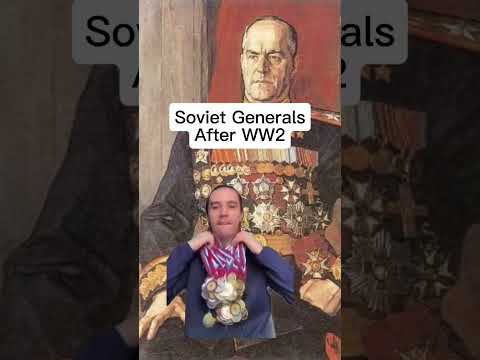
The tradition began long before Zhukov. Soviet military culture had always treated medals as both reward and leash—a way to bind soldiers to the state with ribbons of honor. Yet under Stalin, the practice spiraled into something surreal. Generals competed not for victory, but for the sheer volume of metal on their tunics.
“A general without medals,” one Red Army officer reportedly joked, “is like a soldier without a rifle—naked before the enemy.” The quip masked a darker truth. Each decoration was a public declaration of loyalty, and loyalty, in Stalin’s Soviet Union, was never truly guaranteed.
Zhukov himself was no mere collector. He had earned his stars in the fire of Khalkhin Gol, the frozen hell of Moscow, and the ruins of Berlin. His medals were not bought—they were bled for. Yet even he understood the game. When the war ended, his uniform became a walking monument, and monuments, as every Soviet general knew, could be toppled overnight.
In the spring of 1946, the unthinkable happened. Stalin summoned Zhukov to Moscow and accused him of plotting against the state. The marshal who had saved Leningrad and Stalingrad now stood in the shadow of the Lubyanka, his medals suddenly weighing more than any enemy bullet.
“Comrade Stalin,” Zhukov said, his voice steady, “I have only ever served the Motherland.” The words hung in the air like smoke. What followed would determine whether the most decorated soldier in Soviet history would become a hero or a ghost.
Stalin did not answer at once. He paced behind his desk, pipe in hand, the map of Europe still pinned to the wall with Berlin circled in red grease pencil. “The Motherland,” he said at last, “is not a thing a man serves alone. It is a thing a man shares.” The implication was unmistakable: Zhukov’s glory had grown too large for one man to hold.
What Stalin feared was not treachery but popularity. In the streets, soldiers spoke Zhukov’s name before the Generalissimo’s. In the officers’ clubs, toasts were raised to the Marshal of Victory—and only then, with a nervous glance, to the Supreme Commander. Such ordering of names could get a man shot.
Zhukov was stripped of his command of the Ground Forces and dispatched to Odessa, a provincial backwater far from the parades and the cameras. His medals traveled with him, packed in wooden crates like so much scrap brass.
But the exile did not last. When Stalin died in 1953, the pendulum swung again. Zhukov returned to Moscow, and in 1957 he was made Minister of Defense—the highest military post in the land. Once more the medals came out of the crates, and once more the sun shattered against his chest.
Yet the same lesson repeated itself. Zhukov backed Khrushchev against the Presidium, and Khrushchev, grateful and wary in equal measure, soon found reasons to retire him. “He wears too many medals,” the new premier muttered, “for a man who no longer commands troops.”
The marshal understood the arithmetic of power by then. Medals were not protection; they were an invitation. Every ribbon was a debt the state could call in at any moment, and the more a man wore, the more he owed.
He spent his final years in a dacha outside Moscow, writing his memoirs, tending his roses, and watching younger generals parade through Red Square in uniforms that grew heavier with each passing decade.
By the 1970s, the disease had metastasized. Leonid Brezhnev, a man who had never led a battalion across a river or held a trench through a winter, had become the most decorated figure in Soviet history. His chest was a museum of self-congratulation—medals for anniversaries, medals for peace conferences, medals for simply surviving another year in the Politburo.
“Leonid Ilyich,” his aide once whispered, “the tailor says the tunic can hold no more weight. The fabric is tearing at the shoulder.” Brezhnev reportedly smiled and replied, “Then we shall order a stronger tunic.”
The joke spread through Moscow’s kitchens and factory floors. The Marshal of Victory had earned his gold in fire; the General Secretary had earned his in ink. Veterans who had stormed the Reichstag now watched the May Day parades with a sour taste, counting the rows of ribbons on men who had never heard a shot fired in anger.
Zhukov saw it all from his dacha. He said little. But when a young officer once asked him what made a soldier truly decorated, the old marshal looked at his own reflection in the window glass—the mountain range of gold now dulled by time—and answered slowly.
“A medal is a promise the state makes to a man,” he said. “And a promise, like a bullet, can be fired in either direction.” The officer did not understand. Zhukov did not explain.
When Brezhnev died in 1982, his uniform was displayed in a glass case at the Central Armed Forces Museum. Visitors filed past in silence, staring at the sheer impossibility of it—a chest so laden that the tunic seemed to sag under its own history. Someone had counted the decorations once: over two hundred. More than Zhukov. More than any marshal, any admiral, any soldier who had ever bled for the Motherland.
And yet no one wept at the sight. No old women crossed themselves. No veterans stood a little straighter. The glass case held metal, and metal alone.
Zhukov’s own medals, by contrast, were scattered. Some went to museums. Some were sold. Some simply vanished into the long gray winter of the Soviet collapse, carried off by collectors and cousins and men who knew a piece of history when they saw one.
The mountain range had been dismantled, peak by peak. But the question it raised still hung in the air, waiting for someone to answer it.
The answer came, as answers often do, from someone who had never worn a single medal. In 1995, a young archivist named Irina Volkov was cataloguing the Central Armed Forces Museum’s storage vaults when she found a cardboard box marked simply: Zhukov, G.K. — personal effects, unverified.
Inside were no medals. There was a tunic, plain and gray, with the shoulder seams worn thin. There was a pair of boots, resoled three times. And there was a single sheet of paper, folded into quarters, in a hand she recognized from the memoirs.
“To whoever finds this: I have given my medals to the state. They were never mine. They belonged to the men who did not come home. If you wish to know what I earned, count the empty chairs at my table.”
Irina sat on the vault floor for a long time. She thought of Brezhnev’s glass case upstairs, sagging under two hundred decorations, and of this box, which held nothing but cloth and paper and the weight of an old man’s grief.
She wrote the quote down. She did not publish it. But she copied it onto a card and pinned it above her desk, where it stayed for thirty years, through the fall of one world and the rise of another.
Visitors still file past the Brezhnev tunic. They still stare and count and shake their heads. But the ones who know—the ones who ask—are told a different story. They are told about the empty chairs. They are told about the boots resoled three times. They are told that the greatest decoration a soldier can wear is the silence of the men who trusted him.
And somewhere, in a vault no one visits, a cardboard box waits with its plain gray tunic and its single folded page, asking each new generation the same question Zhukov asked himself in the long Moscow winters.
What, truly, is the weight of a medal—and who among us has the courage to weigh it honestly?
Report this article
Select a reason for reporting:






