In the fall of 1943, the German fighter pilots defending the Reich believed they were winning. They watched American bombers fall from the sky over Schweinfurt—sixty Flying Fortresses in a single afternoon. They counted parachutes drifting down over the fields. They saw the American escort fighters turn back at the border, their fuel tanks nearly empty, leaving the bombers alone over Germany. The sky above their homeland belonged to them.
Then, in the heart of winter, something new appeared over the gray waters near Kiel. A slender fighter with a long nose and a strange scoop beneath its belly. It did not turn back at the border. It did not turn back at all. Within six months, more than 2,000 German fighter pilots would lose their lives—veterans who had fought over Poland, France, and England; commanders whose faces filled newsreels; boys who had barely learned to fly. One young pilot kept a diary through it all. He recorded victories. He recorded the weather. He recorded the names of men who did not return.
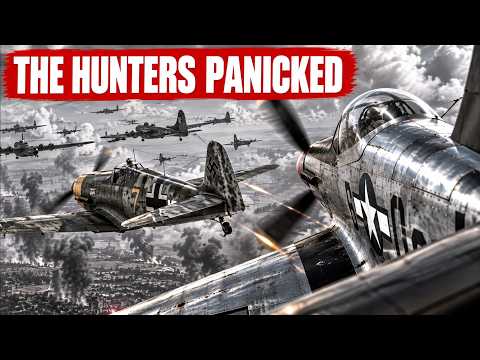
Months earlier, one of the most powerful men in Nazi Germany had issued a direct order. He said the American fighters were not there. The young pilot’s diary survived the war. Most of the names written inside it did not.
On March 22, 1943, a young German pilot sat in the cockpit of his Messerschmitt at an airfield near the cold, gray North Sea coast, waiting for the Americans to come. His name was Heinz Knoke. In two days, he would turn twenty-two. He had grown up in Hameln, the old river town famous for the Pied Piper legend, and had wanted to fly for as long as he could remember. Now he was a fighter pilot in the Luftwaffe, one of the young men tasked with defending the skies of northern Germany against American bombers that had begun crossing the sea in daylight.
Beneath his fighter that morning hung something that was never supposed to be on a fighter at all: a 250-kilogram bomb packed with high explosives and fitted with a time fuse. The idea was simple and a little insane. The American Flying Fortresses flew in tight formations, dozens of them packed together. Every bomber bristled with heavy machine guns. To attack them meant flying through a storm of .50-caliber bullets from every direction at once. Why not climb above them, drop a bomb into the heart of the formation, and let the explosion do the work?
The bombers came toward Wilhelmshaven that day. Knoke climbed above the formation, estimated his altitude, timed his drop, and released the bomb. It fell and vanished into the silver block below. For a long moment, nothing happened. Then the sky beneath him erupted. One of the giant four-engine bombers lost a wing. It rolled slowly at first, then fell, tumbling toward the water with its engines still running. When Knoke landed, ground crews swarmed around his fighter. It was the kind of day any young pilot dreamed of. He wrote about it in his diary that night. He kept that diary faithfully, the way some people keep a family Bible. Victories, losses, the weather over the coast, the names of friends.
In the spring of 1943, the pages were full of confidence. And the Germans had reason to feel confident. The American bombers were brave, and they were heavily armed. But at the deepest part of every mission, they were alone. Put simply, the Allied fighters did not have enough fuel to follow them deep into Germany. The escort turned back near the border, waggled their wings, and headed for home. From that moment on, the bombers were at the mercy of the Luftwaffe.
German pilots learned to wait for that moment. They learned to attack from the front, where the Flying Fortress had fewer forward-firing guns. They learned to hit the formation at its edges, pick off the stragglers, and come back again and again until a damaged bomber fell out of formation and died alone. Each Messerschmitt carried a 20mm cannon firing through the propeller hub and a pair of machine guns above the engine. A few well-aimed cannon shells could tear the heart out of a bomber.
By summer, Knoke’s group was led by a man named Günther Specht. Specht was a stern, serious officer who had been badly wounded in combat over the North Sea in the first winter of the war, in December 1939. Those wounds cost him one of his eyes. Most men would have been grounded for good. But Specht kept flying. He led his pilots into the bomber streams with one eye and a will that terrified the young men who served under him. Around men like Specht, a young pilot like Knoke could believe that the Luftwaffe would hold, that the bombers would keep coming and dying, and that the Americans would decide sooner or later that the price was too high.
But far from the airfields, in command posts and private trains of senior commanders, a different conversation was taking place. Adolf Galland was thirty-one years old and already a legend. He had flown in Spain before the war. He had fought over France and England in the summer of 1940. He was one of Germany’s most famous fighter pilots, and now he held the title of General of Fighters. His job was to understand the war in the air, and he did not like what he saw.
The American Thunderbolts were beginning to carry drop tanks beneath their bellies. Every month they flew a little farther. Every month the boundary where escort fighters turned back crept closer to the heart of Germany. In the summer of 1943, American fighters were shot down near Aachen. Aachen was inside Germany itself. Galland reported it. According to Galland’s own account, written after the war, he found himself in a sharp conversation with the commander of the entire Luftwaffe, Marshal Hermann Göring.
Göring was fifty years old, massive, proud, and fiercely committed to the promises he had made to Hitler. He had once boasted that no enemy aircraft would ever fly over the Ruhr. Now his General of Fighters was telling him that American escorts were reaching German soil. Göring refused to believe it. He insisted the Americans could not fly that far. It was impossible. Galland held his ground. The wreckage was there. The facts were there. Galland warned that the Americans would soon fly farther still. Galland later recalled Göring’s response. “I hereby give you an official order that they were not there. The fighters were not there.”
That was now the official position of the Luftwaffe. Galland could only reply with the words of a soldier. Orders were orders. It was a small moment, a conversation between two men, but it revealed something that would cost Germany dearly. At the top of the Luftwaffe, the truth had become an insult, and the men who brought bad news were treated as enemies.
And it got worse. As the bombers kept coming and German cities kept burning, Göring needed someone to blame. He found his scapegoat in the very men who were dying to stop the raids. In the fall of 1943, he accused his fighter pilots of cowardice. They were not pressing home their attacks, he said. They lacked fighting spirit. They were letting the bombers through. In his memoirs, Galland described how deeply this insult cut. He wrote that after one of these outbursts, he tore the Iron Cross from his collar and placed it on the table in front of the Marshal. For months afterward, he refused to wear his decorations.
At the airfields, the young pilots heard nothing of these quarrels. They only felt the pressure. More sorties, more attacks. Get closer. Fight harder. And whatever happens, do not come back without engaging the enemy.
Then came the day that seemed to prove Göring right about everything. On October 14, 1943, the Americans sent 291 Flying Fortresses against the ball-bearing factories at Schweinfurt, deep in central Germany. Ball bearings were in every German tank engine, every aircraft, every submarine. The Americans believed that destroying them would bring the German war machine to a complete halt. Thunderbolt fighters escorted the bombers as far as they could. Then, near the border, they turned back.
What followed became known to American aircrews as “Black Thursday.” Wave after wave of German fighters rose to meet the formations. Single-engine fighters attacked from the front. Twin-engine fighters stayed at a distance and fired heavy rockets into the packed bomber boxes, breaking them apart. The Fortresses fought their way to the target and fought their way back, and the Luftwaffe chased them the entire way. Sixty bombers did not return. Around 600 American airmen were lost, killed, or captured in a single day. Many of the bombers that did return were so badly damaged they would never fly again.
For the German pilots, the news felt like a victory and a vindication. They had done it. They had stopped the Americans cold, and the Americans seemed to agree. After Schweinfurt, the Eighth Air Force stopped sending unescorted bombers deep into Germany. The great daylight offensive paused. Across the fighter bases of the Reich, a feeling spread among the young pilots. The Americans had learned their lesson. The sky over Germany was German again.
Galland was not so sure. He studied the intelligence reports. He knew how many aircraft the American factories were producing. He knew the United States could lose sixty bombers and replace them within days. And he knew that somewhere across the Atlantic, the Americans were working on the one thing that might change everything: a fighter that could go the whole distance.
In fact, that fighter already existed. It had been designed in California by North American Aviation, originally built for the British. Its first engine lost power at high altitude, and for a while nobody knew quite what to do with it. Then someone had the idea to fit it with a Rolls-Royce Merlin engine, the same engine that powered the Spitfire. In America, the Merlin was built under license by Packard in Detroit. The combination transformed the aircraft. It became fast at high altitude, sleek, and—most importantly—capable of carrying an enormous amount of fuel for its size. It was called the P-51 Mustang.
On December 13, 1943, Mustangs of the 354th Fighter Group escorted American bombers all the way to Kiel and back. It was one of the longest escort missions of the war to that point. And something strange happened in those first weeks. The Mustang was so new over Europe, its slender silhouette so unfamiliar, that some American bomber gunners thought it was a German Messerschmitt. Nervous gunners opened fire on their own escorts. Soon the Americans painted broad white stripes on the wings and tails of the Mustangs so the men in the bombers would know who was protecting them.
The Luftwaffe noticed the new fighters too. Slowly, reports began to reach command. A new American type, long-range, seen deep inside German airspace. Heinz Knoke, stationed in northern Germany, recorded the war as he always did. The weather, the sorties, the friends. His diary pages were still full of confidence, but winter was coming, and with it a question no one in the Luftwaffe wanted to ask out loud.
Months earlier, Hermann Göring had issued an official order. The American fighters were not there. Now they were flying over Kiel. And they were coming farther.
Winter 1943 and early 1944 settled over northern Germany as a wet gray blanket. At the coastal airfields, ground crews worked with frozen fingers to warm engines in the dark and scrape frost from canopies before dawn. Low clouds hung over the flat land for days on end. When the weather was too bad, the pilots sat in their huts, played cards, wrote letters home, and listened to the wind rattling the windows. And when the sky cleared, the Americans came.
Heinz Knoke had been fighting bombers for nearly a year now. He had learned the rhythm of these battles. The alarm, the scramble, the long climb through layers of cloud, the oxygen mask freezing against his face. The moment the formation appeared—hundreds of silver aircraft spread across the sky, their contrails stretching behind them like chalk lines on a blackboard.
He knew the smells too. The sharp stink of aviation fuel on the flight line, the hot oil and leather inside the cockpit, the rubber of the oxygen mask, the cordite that seeped into the cockpit after his guns fired. He knew the sounds. The cough and roar of the engine catching in the bitter cold, the hiss and crackle of the radio, and the strange quiet at 30,000 feet, where the world below was just a white carpet of cloud and the sky above was a dark blue that verged on black.
At that altitude, the cold was savage. It crept through heavy flying boots and fur-lined gloves. It fogged the cockpit glass. It made the fingers slow and clumsy on the controls. A pilot could spend an hour up there, fight for his life for three minutes, and come down so exhausted he could barely climb out of the cockpit.
The bombers were terrifying, but they were predictable. They flew straight. They held formation. They did not chase you. That was about to change.
On January 6, 1944, a new commander took over the American Eighth Air Force in England. His name was Jimmy Doolittle. He was forty-seven years old, a former racing pilot, a man with a doctorate from MIT, and the leader of the famous raid on Tokyo in the spring of 1942. The Americans knew him as a hero. The Germans would soon know him by his methods.
Shortly after taking command, Doolittle walked into the office of General William Kepner, head of Eighth Air Force Fighter Command. On the wall hung a sign. It read: “The first mission of the Eighth Air Force Fighters is to bring the bombers back alive.” For more than a year, that sentence had defined how American fighters fought. Stay close to the bombers. Weave above the formation. If a German fighter attacked, drive it off, then return to your position. Never stray. Never chase.
Doolittle looked at the sign and ordered it taken down. The new sign read: “The first mission of the Eighth Air Force Fighters is to destroy German fighters.” It was a change of only a few words, but it changed everything. From now on, American fighters would not merely guard the bombers. Some groups would range ahead of the formations to sweep the sky clean. They would hunt German fighters wherever they found them—while they were forming up, while they were climbing, while they were landing, and eventually while they sat on their airfields.
The bomber crews had been bait for more than a year. Now they would become bait in a trap.
Five days after Doolittle took command, the trap wrote its first famous story. On January 11, 1944, American bombers struck aircraft factories deep in Germany, including a plant at Oschersleben that built Focke-Wulfs. The weather was bad. Some formations were recalled; others pressed on. The Luftwaffe rose to meet them with everything it had. Among the escorting fighters that day were Mustangs of the 354th Fighter Group. One of their flight leaders was a quiet thirty-year-old major named James Howard.
Howard was no ordinary American fighter pilot. Born in China to American parents, he had flown with the American Volunteer Group in Burma and China—the men the newspapers called the Flying Tigers—before America entered the war. He had seen more air combat than most of the young men around him. He did not talk about it much.
Over Oschersleben, in the chaos of battle, Howard lost contact with the rest of his group. He looked around and found himself alone. Below him, a formation of Flying Fortresses was under furious attack. German fighters, dozens of them, were tearing into the bombers in wave after wave. Howard had every reason to leave. One Mustang against that many enemy fighters was not a fair fight. It was an invitation to die.
But he dove in. For roughly half an hour, a single American fighter repeatedly charged the German attackers. He disrupted their runs. He forced them to turn away from the bombers to deal with him. He shot several of them down. As the fight went on, his guns began to fail one by one, until—by the accounts of the time—only a single machine gun was still working. He kept attacking anyway, maneuvering and diving, forcing the Germans back.
The bomber crews watched all of it. When they returned, they could not stop talking about the lone Mustang that refused to leave them. James Howard was awarded the Medal of Honor. He was the only American fighter pilot in the European Theater to receive it during the war.
For the Germans, it was hard to grasp what that day meant. It was just one fighter. Just one battle. The Luftwaffe had inflicted heavy losses on the American bombers that day. On paper, it looked like another German success. But something had happened over Oschersleben that the numbers did not show. An American fighter had reached the heart of Germany and fought as if it had all the fuel in the world. It had not turned back. It had not been forced to leave, and it was not the only one of its kind. There were more coming every week.
As January turned to February, German pilots began to feel the difference in their bones. In the past, the danger had always been in front of them—the bombers and their guns. You could see the danger. You could plan your attack around it. Now the danger came from everywhere. German fighter formations needed time to climb and assemble. A formation of German fighters might spend long minutes circling above its home airfield, gathering into position, climbing slowly toward bomber-stream altitude. That was the moment the Mustangs and Thunderbolts had learned to strike. They came out of the sun, from above and fast, tearing into German formations before those formations even reached the bombers.
And when a German pilot survived a fight, out of ammunition and fuel and heading home with shaking hands, there was no safety in the final approach. American fighters chased them. They caught German fighters low and slow on landing approach, gear down, flaps open, with nowhere to run. For men like Heinz Knoke, the airfield was the one place in the war where you could catch your breath. Now even the airfield was part of the battlefield.
Think about what that does to a man. A pilot takes off away from his base and cannot relax because the enemy might already be waiting above him in the disc of the sun. He reaches the bombers and cannot focus on them because he must keep turning his head, searching the sky behind him for the glint of a silver wing. He fights and survives and turns for home, and still he cannot relax because the enemy might follow him down. He sees his airfield, the huts, the fuel trucks, the familiar rows of trees—and even then he must look over his shoulder one last time before lowering his gear. There was no longer a single moment in the entire mission when a German pilot was safe. From the first turn of the propeller to the last, he was hunted.
Young pilots began to call warnings over the radio more often. Their voices grew sharper, more tense, faster. Men who had once flown with calm, easy confidence now flew with necks aching from constantly looking behind them.
The German fighters themselves were good aircraft. The Messerschmitt and the Focke-Wulf could still match the American fighters in the hands of an experienced pilot. The problem was not the machine. The problem was the arithmetic. The Luftwaffe now had to do two things at once. It had to attack the bombers because they were destroying German cities and factories, and it had to fight the American escorts because they were destroying the Luftwaffe. It could not do both. Every German fighter that went after a bomber became vulnerable to the escorts. Every German fighter that turned to fight the escorts left the bombers free to reach their target.
Günther Specht understood this better than most. He had been fighting since the first winter of the war. He had lost an eye in combat, and he watched week after week as his experienced pilots disappeared.
Then, in the third week of February, the weather over Germany improved. The Americans had been waiting for it. They had a plan called Operation Argument, aimed directly at the German aircraft industry. The factories that built the fighters, the plants that made the parts. Destroy the Luftwaffe’s ability to replace its aircraft, and destroy it in the air when it rose to defend those factories.
On February 20, 1944, the Eighth Air Force sent more than a thousand heavy bombers in a single day for the first time in its history. Thunderbolts, Lightnings, and Mustangs escorted them. The targets included aircraft plants around Leipzig and Braunschweig. It was the beginning of what history would call “Big Week.”
For six days, the bomber stream kept coming. From England came the Eighth Air Force. From Italy came the Fifteenth. At night, the Royal Air Force pounded German cities: Leipzig, Braunschweig, Gotha, Regensburg, Schweinfurt, Augsburg, Stuttgart. The names rolled across the German radio net one after another. And every day, the Luftwaffe rose to fight.
For the pilots, those six days blurred into one long, exhausting nightmare. Waking in the dark. Eating, or trying to. Sitting by the telephone waiting for the alarm. Running to the aircraft. Takeoff. Combat. Landing, if you were lucky. Refueling. Rearming. Sometimes going up again the same afternoon. Then lying awake at night listening to the distant thunder of the British raids, knowing it would all begin again in a few hours.
The mechanics worked through the night, patching bullet holes, changing engines, stripping parts from wrecks to keep other aircraft flying. Ground crews learned not to ask too many questions when pilots climbed out of the cockpit. They could read the answer on the men’s faces. At some bases, the empty places at the mess table were not cleared quickly enough. A plate, a chair, a cap hanging on a hook by the door. Small things. They said more than any casualty report could.
The Germans shot down many bombers during Big Week. The Americans lost more than 200 heavy bombers and thousands of airmen. By the standards of 1943, it should have been another German victory, another Schweinfurt. But it was not. Because the American fighters were everywhere this time. They flew above the targets. They flew above the German assembly points. They flew above the routes home. And they were not just trying to protect the bombers. They were hunting.
The German factories turned out to be repairable. Under the direction of the Armaments Ministry, fighter production was dispersed into small workshops, forests, tunnels, and underground plants. Within months, the output of new German fighters would actually rise. But you cannot disperse a pilot into a forest. You cannot rebuild a pilot in a tunnel. In February, the Luftwaffe lost nearly a fifth of its daytime fighter pilots. The men who died were not only beginners. Many were experienced leaders. Men who knew how to lead formations into the bomber stream. Men who knew when to attack and when to wait. Men who had endured since 1939. Each one had taken years to make. Each one was gone in an instant.
The Americans could replace their bombers. They could replace their fighters. They could replace their pilots, too. Training schools in Texas, Alabama, and Arizona were graduating thousands of new pilots—young men with hundreds of hours of flying time behind them, trained on fuel no one had rationed. The Luftwaffe could replace its aircraft. But it could not replace its men.
On March 4, 1944, a small force of American bombers dropped its bombs on Berlin in daylight for the first time. Two days later, on March 6, the Americans returned in full strength. Hundreds of heavy bombers crossed Germany toward the capital, escorted by hundreds of fighters. The Luftwaffe threw everything it had against them. This was Berlin. This was the heart of the Reich. If there was one sky the German fighters could not surrender, it was this one.
The battle that day was one of the most savage air battles of the entire war. Sixty-nine American heavy bombers were lost. It was the greatest loss the Eighth Air Force would suffer in a single day. Hundreds of American airmen fell from the sky. But the German fighter force was bleeding too. And when the people of Berlin looked up, they saw something no radio broadcast had prepared them for: American fighters flying over their city, over the Reich Chancellery, over the capital of an empire that had been promised no enemy aircraft would ever reach them.
The Mustangs were flying over Berlin.
Imagine standing in a Berlin street on that cold March day: the air-raid sirens wailing; the heavy flak towers firing until the ground shook beneath your feet; and high above, weaving between the long streams of bombers, thin white lines of fighters that were not German but American, hundreds of miles from their bases in England, circling over the capital of the Reich as if they owned it.
For years, the German people had been told that the Luftwaffe was the finest in the world, that enemy bombers would be driven from the sky. Now they saw with their own eyes that the enemy had not only arrived—he had brought his fighters with him, and they were coming back again and again.
On March 23, 1944, the war killed one of the most respected fighter leaders in the Luftwaffe. Wolf-Dietrich Wilcke was thirty-one years old. He commanded an entire fighter wing, one of the most famous in Germany. He had fought in Poland, in France, over England, and on the Eastern Front. He had more than 160 aerial victories. He wore the Knight’s Cross with Oak Leaves and Swords, one of the highest decorations a German soldier could receive.
That day, Wilcke led his fighters against an American raid over northern Germany. Near Braunschweig, Mustangs ambushed his formation. Wilcke’s aircraft was shot down and he was killed. It was one death among thousands. But for the Luftwaffe, it was a sign of something terrible. The Mustangs were not just killing beginners who could not fly. They were killing the best that Germany had.
Across the fighter bases of the Reich, the ready rooms grew quieter. When a young pilot dies, it is a tragedy. When a man like Wilcke dies, it shakes something deeper. Men like Wilcke were supposed to be invincible. They had survived everything the war had thrown at them for four and a half years. The young pilots had looked at them the way a son looks at a father. If a man like that could fall into a Mustang trap, what chance did anyone else have? No one said it out loud. No one had to.
Galland watched all of it from his headquarters. He had warned them. He had warned them for a full year. He had been told the American fighters were not there. Now they were over Berlin, and the best pilots in Germany were dying beneath them. Galland wrote the truth down. In a report to his superiors, he described the cost in plain language. He wrote: “Between January and April 1944, the German day-fighter force lost more than 1,000 pilots.” Among them were many of the best squadron, group, and wing leaders in the Luftwaffe. He warned that the fighter arm was on the verge of collapse.
It was an extraordinary thing for a general to write. It was an admission that the defense of Germany was failing. The historian Williamson Murray later calculated that from January through May 1944, the Luftwaffe lost more than 2,200 fighter pilots. In some months that spring, the German fighter force lost more than a fifth of its pilots in a single month. No air force in the world could survive that rate.
To fill the gaps, the Luftwaffe sent replacements. They were younger. They were eager. Many of them had been told the same stories Knoke had grown up with. German pilots are the best in the world. The Luftwaffe has conquered the skies of Europe. Courage and skill will overcome anything. But they arrived with a fraction of the training their American opponents had received. Fuel was rationed. Instructors were pulled into combat. Flight schools cut hours to rush pilots to the front. Many of the new men had barely learned to fly their fighters in clear skies. Now they were thrown into the most dangerous air battles in history against American pilots who had spent hundreds of hours in the air before they ever saw combat.
Many of the new men did not live long enough to learn. The veterans could see it in the way the new pilots moved on the runway, in the way they formed up—too tight or too loose—in the way they fixed their eyes on the bombers and forgot to look behind them. In combat, one mistake was enough. A moment of hesitation, a turn in the wrong direction, a glance at the gauges at the wrong second. The Mustang pilots, many of whom had trained specifically to spot those mistakes, did not need a second chance.
Some new pilots reached the squadron, flew one or two missions, and were gone before the older men had even learned their first names. Their belongings were packed into small boxes and sent to families who had been proud to see them in uniform just weeks before. Heinz Knoke watched them come. He watched them go. He wrote down their names.
The diary that had once been full of confident notes about the weather and victories began to change. The entries grew shorter. They began to record the same thing over and over. A friend did not return. A young pilot on his first mission, gone before anyone really knew him. A familiar face missing from the dinner table.
Knoke himself did not escape. That year his aircraft was shot down. He was wounded more than once. And each time he returned to the cockpit. Each time he found more strangers in the ready room, and fewer of the men he had started with. He thought about his wife, Lilo. He thought about his homeland. He thought about the confident young man who had dropped a bomb on a formation of Flying Fortresses a year before. And he wondered what had happened to that sky. The sky that had once belonged to them.
A year earlier, the young men of his unit had laughed in the evenings. They had argued about tactics, told stories about girls back home, and compared the damage to their aircraft like schoolboys comparing scraped knees. Now the evenings were quiet. Men sat alone with their cigarettes. Some wrote letters they might never finish. Some wrote nothing at all.
Knoke kept writing in his diary. It was perhaps the only thing he still felt belonged to him alone. The war decided where he flew, when he flew, and whether he would come home. But the diary was his. In it, the dead were still remembered. In it, they still had names.
It was not lost in one great battle. There was no single day on which the Luftwaffe was defeated. That was what made it so hard to understand. The Germans shot down bombers. They won battles. They inflicted terrible losses. On paper, they had many victories to point to. And yet, week after week, the sky was slipping away from them.
The Mustang was not invincible. Experienced German pilots shot them down. The Mustang had weaknesses. Its liquid-cooled engine could be disabled by a single hit to the cooling system. Its early versions suffered from guns that jammed in hard turns, as James Howard had discovered over Oschersleben. On any given day, in any given fight, a German pilot could beat one.
But the Mustang did not need to win every fight. It only had to be there—over Kiel, over Braunschweig, over Berlin, over the airfield when the Germans took off, and over the airfield when they came back. Every day it was there, the Luftwaffe lost more men than it could replace.
By late spring of 1944, the German fighter pilots understood a truth Hermann Göring still refused to accept. The American fighters were there. They were everywhere, and they were never going to leave.
In the ready rooms along the coast, the few remaining veterans looked at the young faces around them and did the arithmetic in silence. Heinz Knoke opened his diary and wrote down another name.
By the spring of 1944, the Americans had achieved something they had been fighting for through two long years. They could go wherever they wanted, whenever they wanted. And so they chose a new target. On May 12, 1944, American bombers struck the synthetic oil plants in central Germany. These were vast industrial complexes that turned coal into gasoline—the fuel that powered tanks and trucks and, above all, the aircraft of the Luftwaffe. Germany had very little natural oil of its own. Without these plants, its war machine would starve.
The Luftwaffe rose to defend them. And the Mustangs were waiting. Albert Speer, Hitler’s armaments minister, understood immediately what that day meant. Years later, he wrote a single sentence about it. He said: “That day, the technological war was decided.”
The attacks continued without pause. Week after week, the oil plants were struck, repaired, and struck again. Aviation fuel stocks began to fall. Training flights were cut further. New pilots reached the front with fewer flying hours than ever. And the veterans who survived now faced a new kind of enemy—not just the Mustangs in the sky, but the empty fuel tanks on the ground. The circle was closing. The Mustangs protected the bombers. The bombers destroyed the fuel. Without fuel, the Luftwaffe could not train pilots. Without trained pilots, they could not stop the Mustangs.
Then came the morning the whole world had been waiting for. On June 6, 1944, the Allied armies landed on the beaches of Normandy. Above them was the greatest concentration of air power the world had ever seen. On that single day, Allied aircraft flew more than 14,000 sorties. Fighters swept the beaches in layers. Bombers struck the roads and railways leading to the coast. Fighter-bombers hunted anything that moved. And the Luftwaffe—the air force that had once swept through Poland and France—was barely seen at all.
Josef Priller was one of the few German fighter pilots who appeared over the beaches that morning. He was twenty-eight years old and led one of the most famous fighter squadrons in the Luftwaffe. He had more than 90 aerial victories. On the morning of the invasion, he took off with only one wingman, Sergeant Heinz Wodarczyk. The two Focke-Wulfs raced low over the coast, strafed the beach, and returned through a sky full of Allied aircraft. It was one of the very few German fighter attacks over the landing beaches that morning. Two fighters against an entire armada.
Imagine the view from the cockpit. The sea below swarming with ships from horizon to horizon. Landing craft churning toward the sand. Smoke rising from the dunes. Barrage balloons swaying above the beach on their cables. And everywhere in the sky, aircraft bearing the white and black invasion stripes painted on their wings.
A few years earlier, the Luftwaffe had dreamed of sending its fighters over the English coast in hundreds. Now two German aircraft raced over the coast of France, and behind them there was nothing.
The young soldiers waiting on the beach below may never have understood what it meant. But the reason they were able to land, the reason the sky above them was full of their aircraft and almost empty of the enemy’s, had been decided months earlier: over Oschersleben, over Braunschweig, over Berlin, in the winter and spring of 1944, when the Mustangs followed the bombers into Germany and bled the German fighter force to death.
In the weeks after the invasion, the fighter groups that had been defending Germany were rushed west to France. They took off from primitive airfields hidden in orchards and forests. They were hunted from the moment they arrived. Allied fighters roamed every road and every airfield. The losses were catastrophic. Pilots slept in tents and farmhouses. Their aircraft were pushed under trees and covered with branches. Fuel arrived by truck—if it arrived at all—and the trucks were hunted on the roads just as the fighters were hunted in the sky. A German pilot in France that summer could not take off, fly, or land without wondering whether the enemy had already found him.
Heinz Knoke’s war went on. His aircraft was shot down. He was wounded again. He kept flying. He kept writing. The diary that had begun with a bomb dropped on a formation of Flying Fortresses had become something entirely different. It had become the record of a generation passing away.
Günther Specht kept flying too. By the end of 1944, he commanded Fighter Wing 11. He was still that hard, one-eyed officer who had flown since the first winter of the war. He was one of the few who remained alive.
On January 1, 1945, the Luftwaffe launched one last great blow in the West. It was called Operation Bodenplatte. Hundreds of German fighters took off at dawn to attack Allied airfields in Belgium, Holland, and France, hoping to destroy the enemy air forces on the ground in a single morning. Specht led his wing toward an American airfield near the Belgian town of Asch. Among the American units stationed there were Mustangs. Some of them had already begun to climb into the air when the Germans arrived.
It was a cold, clear New Year’s morning. Many of the young German pilots who flew that day had never taken part in a large formation before. Some had never fired their guns at an enemy. They flew low over the frozen countryside to avoid radar, their engines roaring over sleeping villages, and reached the airfield just as the sky above it began to fill with American fighters.
Günther Specht did not return. He was listed as missing. Operation Bodenplatte destroyed many Allied aircraft, but the Allies could replace them within days. The Luftwaffe lost more than 200 pilots killed, missing, or captured. Among them were experienced leaders who could never be replaced. It was one of the worst days in the history of the German fighter arm, and it came at a time when that arm had almost nothing left to lose.
That same month, Adolf Galland was relieved of his command. He had spent years telling the truth to men who did not want to hear it. He had warned about the American fighters. He had fought for more fighters to defend Germany, for better training, for the Me 262 jet to be used as a fighter instead of wasted as a bomber. He had lost those arguments, one after another. And in the end, his honesty cost him his post.
Galland did not retire quietly. In the last months of the war, he formed a small unit of jet fighters and flew in combat again as a squadron commander. Some of the most famous surviving German aces joined him. They flew the fastest fighters in the world, but there were too few of them, the fuel was scarce, and time was very short. The jets had to take off and land somewhere, and the Mustangs had learned to wait for them there.
In April 1945, Galland was wounded in combat. Within weeks, the war in Europe was over.
After the war, Hermann Göring was asked about the air war. He is said to have admitted that he knew the end had come when he saw the Mustangs over Berlin. The words attributed to him have been repeated for decades. “When I saw the Mustangs over Berlin, I knew the game was up.” Whether he said those exact words, historians cannot say with certainty. But the meaning behind them is beyond dispute. The man who had issued an official order that the American fighters were not there lived to see those fighters over his capital.
Heinz Knoke survived the war. He had flown through most of it. He had seen the Luftwaffe at the height of its confidence, and he had watched it bleed to death over his homeland. In the final weeks of the war, he was awarded the Iron Cross. By then, it must have felt like a decoration from another world.
After the war, his diary was published. In English, it became known as I Flew for the Führer. It is one of the most vivid records ever written of what it was like to fight the American air offensive from the German side. Not from headquarters, but from the cockpit—from the cold at 30,000 feet, from the silence at the dinner table after another friend failed to return.
Knoke lived until 1993. James Howard, the quiet major who fought alone over Oschersleben, survived the war too. He returned to America and lived until 1995. Adolf Galland lived until 1996. In the decades after the war, he met many of the Allied pilots he had once fought. Some of them became his friends. Old men sitting together, talking about a sky they had once tried to tear from each other.
The story of the Mustang is often told as the story of a great aircraft. It was a great aircraft. But the German pilots who faced it learned something more painful than that. They were not beaten by a single fighter. They were beaten by a fighter that was there every day, by a nation that could build thousands of them, fuel them without limit, and train young men to fly them for hundreds of hours before they ever saw the enemy. They were beaten by commanders who changed one sign on an office wall and turned their escort fighters into hunters. And by their own leaders, who refused to believe what was plain to see until it was too late.
The Luftwaffe did not lose the sky in one great battle. It lost it one pilot at a time, one name at a time. Somewhere between the pages of Heinz Knoke’s diary, those names are still waiting. Young men who flew into the cold blue sky over Germany and never came back. In the summer of 1943, they were told the American fighters were not there. They discovered the truth the only way a fighter pilot can. They looked over their shoulders—and the Mustangs were already there.
If you were a German fighter pilot in that winter of 1943, would you have believed the war could still be won—or would you have started counting the empty chairs?
Report this article
Select a reason for reporting:






