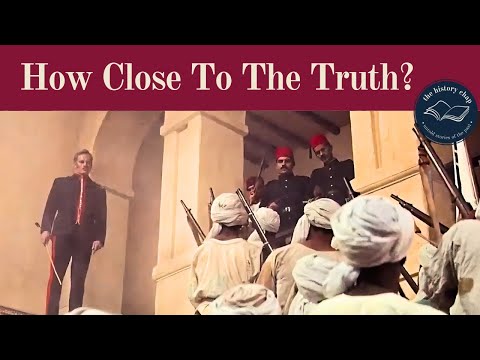
The desert sun beat down on Khartoum as the Mahdi’s warriors surged forward, their cries echoing off the city walls. Inside the governor’s palace, General Charles Gordon stood alone, his cane in hand, facing the inevitable. This was the moment that would define his legend—but was it the truth? The 1966 film Khartoum gave us Charlton Heston’s heroic last stand, but the reality was far more complex and far more brutal.
Gordon was no stranger to danger. From the Crimean War to the Taiping Rebellion, he had earned a reputation as a fearless and eccentric commander. His exploits in China had earned him the nickname “Chinese Gordon” and the prestigious Yellow Jacket from the Emperor himself. But it was in Sudan that he would face his greatest challenge—and his final one.
In 1884, as the Mahdist revolt threatened to engulf Sudan, the British government faced a dilemma. Prime Minister Gladstone, wary of costly imperial entanglements, reluctantly sent Gordon to evacuate Egyptian troops and civilians from Khartoum. “I trust no man who consults God before he consults me,” Gladstone reportedly said, capturing his unease with Gordon’s evangelical fervor. Yet Gordon was the people’s hero, and the press clamored for action.
Gordon arrived in Khartoum to a hero’s welcome. Many remembered his efforts to abolish the slave trade during his previous tenure as governor-general. But the situation was dire. The Mahdi’s forces had crushed Egyptian armies and were closing in. Gordon, ever the engineer, fortified the city, digging a massive ditch to connect the Blue and White Niles and turning Khartoum into an island fortress.
But Gordon was also a man of contradictions. He believed he could negotiate with the Mahdi, even as he prepared for siege. In the film, the two men meet face-to-face in a dramatic desert parley. In reality, they never met. They exchanged letters, each trying to outmaneuver the other, but the closest they came was across the Nile, each a distant figure to the other.
As the siege tightened, Gordon’s messages grew more desperate. He sent Lieutenant Colonel Stewart downriver on a steamer, hoping to reach the relief force, but the boat struck rocks and all aboard were killed. The Mahdi, in a chilling display of psychological warfare, sent Gordon a letter detailing every document found on the boat—proof that Stewart was dead and that Gordon’s pleas for help had never reached the outside world.
Meanwhile, the relief expedition under General Wolseley was bogged down. Wolseley, cautious and methodical, chose the longer Nile route over the faster desert crossing. His delay would prove fatal. As Gordon’s supplies dwindled and starvation set in, he opened the city gates and allowed thousands of civilians to leave, many choosing to throw themselves on the mercy of the Mahdi rather than starve.
The end came in the early hours of January 26, 1885. The Mahdi’s warriors, guided by a traitor through the dry mud flats that Gordon had believed impassable, stormed the city. The defenders, weakened by hunger, were overwhelmed. Gordon died in the chaos—but how? The film shows him facing his enemies with dignity, spear in chest. In reality, accounts vary: he may have been shot, speared, or even beheaded. His head was taken to the Mahdi, who ordered it displayed on a pole.
The relief force arrived two days too late. Khartoum had fallen, and Gordon was dead. The British public was outraged, and Gladstone’s government nearly fell. But the legend of Gordon had already taken hold—a Christian martyr who died for his country, a symbol of Victorian heroism.
Yet the real Gordon was more complex. He was brilliant and eccentric, deeply religious and often reckless. He ignored orders, trusted his own judgment, and believed he could single-handedly shape the fate of nations. In the end, his defiance cost him his life—and created a myth that would endure for generations.
But was the film right? Did it capture the essence of the man and his last stand? The answer is both yes and no. Khartoum may have taken liberties with history, but it also captured something true: the courage and tragedy of a man who refused to abandon his post, even when all hope was lost.
What the film could not show—what no film truly can—is the strange, haunted quality of Gordon’s final months. His letters from Khartoum swing wildly between defiance and despair, between grand strategy and petty grievance. One day he was planning to march out and crush the Mahdi himself; the next he was contemplating how many days his garrison could survive on camel meat and biscuit.
He wrote to his sister in England, describing the siege as though it were a minor inconvenience. To others, he confessed darker thoughts. “I am a victim of my own vanity,” he reportedly told one confidant, a startling admission from a man the British press had crowned a saint.
The Victorian public, of course, never saw those letters. They saw only the headlines: GORDON SURROUNDED, GORDON HOLDS FIRM, GORDON AWAITS RESCUE. The press had built him into something larger than a man—a symbol of British pluck and Christian virtue standing alone against the heathen horde. And once a symbol is created, it cannot be allowed to die quietly.
Meanwhile, in London, the debate raged. Gladstone, who had spent his career railing against imperial adventurism, found himself trapped by his own rhetoric. He had sent Gordon to evacuate, not to conquer. Yet the public demanded a rescue mission, and the cabinet, fearing political annihilation, overruled him.
“We are dragged into this business by the shoulders,” Gladstone lamented to a colleague. History would judge him harshly for the delay, but the truth was messier: no one in London had anticipated that Gordon would refuse to leave. He had been given an exit strategy, and he had chosen to ignore it.
General Wolseley, for his part, moved with the ponderous caution of a man who had never quite trusted the mission. His Nile expedition was a logistical marvel—thousands of boats, camels, and men strung out along a river that seemed to shrink by the day. But marvels take time, and time was the one commodity Khartoum did not have.
By mid-January, Wolseley’s advance guard was still hundreds of miles away. The flying column across the desert had been a gamble, and it had cost him two of his best officers. The men were exhausted, the camels dying, and the Mahdi’s scouts shadowed every movement.
When the news finally reached Wolseley that Khartoum had fallen, he is said to have sat in silence for a long moment. Then he rose, straightened his uniform, and gave the order to withdraw. “Too late,” he wrote in his dispatch—two words that would haunt him for the rest of his career.
But the story did not end with Gordon’s death. The Mahdi himself would not live to enjoy his triumph. Barely five months later, in June 1885, Muhammad Ahmed died of typhus—some said of a broken heart, others of the sheer exhaustion of ruling a country he had won but could not govern. His successors would squabble over his legacy, and the British would wait thirteen years for their revenge.
That revenge, when it came, would be delivered by a young officer who had been present at the relief expedition’s failure: Herbert Kitchener. He had watched the disaster unfold, had seen the consequences of delay and indecision. When his turn came, he would not make the same mistakes.
But that is another story—the story of Omdurman, of the Anglo-Egyptian reconquest, and of an empire that had learned, in the blood of Khartoum, exactly what it was willing to sacrifice for its heroes.
Kitchener had learned the lesson of Khartoum well. Where Wolseley had crept up the Nile with agonizing caution, the new commander would advance with methodical, overwhelming force. He rebuilt the railway across the desert, pushed it mile by mile toward the river, and assembled an army of over twenty thousand men—British regulars and Egyptian conscripts alike. Nothing would be left to chance.
But the Mahdi’s legacy did not crumble easily. His successor, the Khalifa, ruled from Omdurman with an iron hand, commanding a dervish army that still numbered in the tens of thousands. They believed, with the same fierce certainty that had carried them through the siege of Khartoum, that Allah would deliver the British into their hands.
The showdown came on the plains of Omdurman on September 2, 1898. The dervishes charged with incredible courage, hurling themselves against the British lines in wave after wave. And the Maxim guns cut them down. Ten thousand fell in a single morning—a slaughter so complete that even Kitchener’s own officers were shaken. The Khalifa fled, and the Mahdist state was finished.
Yet the victory at Omdurman carried a bitter irony. Among the British dead was a young lieutenant named Hector MacDonald’s subordinate—no, more tellingly, among the wounded was a young Winston Churchill, who had ridden with the 21st Lancers in one of the last great cavalry charges in British history. Churchill would later write that the battle was “the most signal triumph ever gained by the arms of science over barbarians.” But he also admitted, in quieter moments, that the dervishes had fought with a bravery that deserved a better cause.
And what of Gordon’s head, that grisly trophy the Mahdi had ordered displayed on a pole? Some said it was thrown into the Nile. Others claimed it was buried secretly by a faithful servant. The truth was never established. Like so much of Gordon’s life, his death dissolved into myth and contradiction.
The British public, however, had no patience for ambiguity. Gordon was enshrined as a martyr, his statue erected in Trafalgar Square, his name given to schools and churches across the empire. Gladstone, meanwhile, was pilloried in the press and in verse—one popular rhyme ran: “He murdered Gordon in the Sudan / And left his body to the Mahdi’s hand.” The truth, as always, was more complicated, but the public wanted a villain, and Gladstone fit the bill.
Yet the prime minister had his defenders. Some historians would later argue that Gordon had been the author of his own destruction—that he had disobeyed orders, overestimated his influence, and refused every opportunity to leave. “He was a hero who did not know how to retreat,” one biographer wrote, “and so he made a religion of standing still.”
Whatever the verdict, the siege of Khartoum left a mark on the British imagination that would not fade. It became a cautionary tale about the limits of imperial power, and a founding myth about the cost of heroism. Every officer who served in the Sudan after 1885 carried Gordon’s ghost with them—the man who stayed too long, who trusted too much in his own destiny, who died with his cane in his hand and his head on a pole.
And in the end, perhaps that is why Khartoum endures as a film, despite its historical liberties. It captures something that the dry dispatches and the political debates cannot: the sheer, terrible loneliness of a man who believes he is doing God’s work, and who discovers too late that God has other plans.
The film ends with the Mahdi’s cry of “I forbade it!”—a moment of dramatic irony that the real Muhammad Ahmed never had the luxury of expressing. He died of typhus just months after his triumph, his state already fracturing under the weight of his own prophecy.
Gordon’s head, meanwhile, vanished into legend. Some said the Nile swallowed it; others whispered of a secret burial. The British public never learned the truth, and perhaps they never wanted to.
What remains is the statue in Trafalgar Square, the myth of the martyr, and the uncomfortable question the film never asks: was Gordon a hero, or simply a man who refused to be rescued?
What do you think—hero, fanatic, or both?
Report this article
Select a reason for reporting:






